







Perps vs Spot Trading in Crypto Overview
Spot trading means buying or selling crypto directly at the current market price. If a trader buys BTC on spot, they own the asset and can hold, transfer, or sell it later. This makes spot trading simpler, ownership-based, and usually easier for beginners to understand.
Perpetual futures, or perps, are derivative contracts that track an asset’s price without requiring traders to own the underlying crypto. Unlike traditional futures, they do not expire, so positions can remain open as long as margin requirements are met. Traders use perps to speculate, hedge, or gain leveraged exposure.
The key difference is exposure. Spot traders exchange one asset for another, while perp traders open contracts based on expected price movement. Perps also use funding payments between longs and shorts to keep contract prices close to spot prices, creating an extra cost or income layer.
In practice, perps dominate crypto trading activity. CoinGlass reported that in Q1 2026, crypto spot volume was about $1.94 trillion, while derivatives volume reached about $18.63 trillion, making derivatives roughly 9.6 times larger than spot. That shows how strongly active traders favor leveraged contract markets.
Pricing Mechanisms in Perps vs Spot Trading
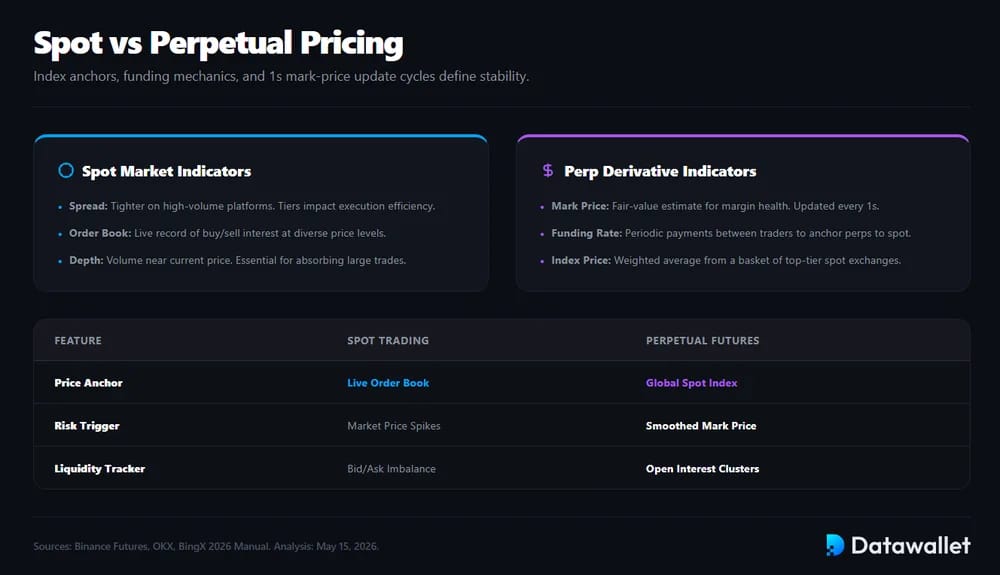
Pricing works differently in spot and perpetual markets because spot reflects direct exchange activity, while perps rely on exchange-managed indexes, mark prices, and funding systems.
Spot Trading Pricing
On spot exchanges like Binance, Coinbase, OKX, and Kraken, prices come from live order books where buyers and sellers place bids, asks, market orders, and limit orders. Binance describes an order book as a real-time list of buy and sell orders for a trading pair.
Key pricing indicators in spot markets include:
- Bid Price: The highest price buyers currently offer on an exchange, showing immediate demand and helping traders estimate where a sell order may execute.
- Ask Price: The lowest price sellers currently accept, showing available supply and indicating what buyers may pay for fast execution.
- Spread: The gap between bid and ask prices, often tighter on high-volume exchanges and wider when liquidity is fragmented or thin.
- Order Book: A live exchange record of open buy and sell orders, organized by price level, available size, and market depth.
- Market Orders: Orders that execute immediately against available exchange liquidity, sometimes causing slippage when order book depth is too shallow.
- Limit Orders: Orders placed at a chosen price, adding liquidity to the exchange order book until matched, canceled, or left unfilled.
- Liquidity Depth: The available volume near current prices, helping determine how easily larger spot trades can execute without moving the market.
Perpetual Futures Pricing
On derivatives exchanges like Binance Futures, OKX, Bybit, Coinbase Advanced, and dYdX, perp prices track spot markets through index prices, mark prices, and recurring funding payments. Coinbase explains that funding helps keep perpetual futures close to the underlying spot index price.
Key pricing indicators in perpetual markets include:
- Index Price: A reference price built from spot exchange data, reducing reliance on one platform and helping perps track the broader market.
- Mark Price: A fair-value estimate used by exchanges for margin and liquidation calculations, helping reduce unfair liquidations during short-term volatility.
- Last Price: The most recent perp trade price on the exchange, useful for execution tracking but less reliable for liquidation risk assessment.
- Funding Rate: A recurring payment between long and short traders, designed to pull perp prices closer to the underlying spot market.
- Premium Index: The difference between contract and index pricing, often used by exchanges such as OKX and Bybit when calculating funding.
- Open Interest: The total value of active perp contracts on an exchange, showing market participation and potential leverage-driven pressure.
- Liquidity Zones: Perp prices often move toward areas with dense leveraged liquidity or stop clusters, which traders can visualize using tools like a Bitcoin liquidation heatmap.
Perps vs Spot Trading Fees
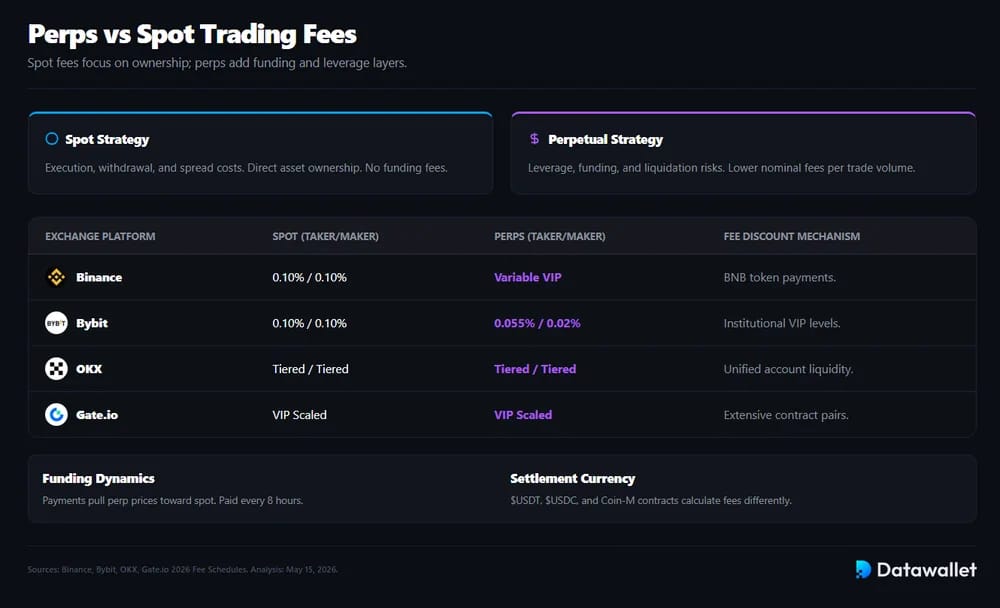
Crypto trading fees differ because spot traders pay mainly exchange and transfer costs, while perp traders also face contract costs, funding payments, and leverage-related charges.
Spot Trading Fees
Spot trading fees are usually simpler because traders buy or sell the actual asset, with costs tied to execution, spreads, withdrawals, and exchange tiers.
Common spot trading fee types include:
- Maker Fees: Limit orders that add liquidity usually pay maker fees; Binance’s regular spot tier lists 0.100% maker fees, reduced to 0.075% with BNB discount.
- Taker Fees: Market orders or immediately filled orders remove liquidity; Binance lists 0.100% regular spot taker fees, while Bybit lists 0.1% for non-VIP spot takers.
- Spread Costs: Some exchanges and quick-buy interfaces include a spread between quoted buy and sell prices, making the effective cost higher than the visible fee.
- Volume Tiers: Exchanges often reduce spot fees for higher-volume traders; Coinbase Advanced bases fee tiers on total USD trading volume over the past 30 days.
- Token Discounts: Some platforms offer fee reductions for holding exchange tokens; Binance shows discounted spot maker and taker fees when users pay with BNB.
- Withdrawal Fees: Moving crypto from an exchange wallet to an external wallet may trigger network or platform withdrawal fees, separate from the trading fee itself.
- Fiat Fees: Bank card purchases, instant buys, or fiat conversions can carry different pricing from exchange order books, especially on retail interfaces.
Perpetual Futures Fees
Perp trading fees are more complex because every position may involve execution fees, funding payments, leverage costs, and possible liquidation-related expenses.
Common perpetual futures fee types include:
- Maker Fees: Resting limit orders that add liquidity usually pay lower fees; Bybit lists 0.02% maker fees for non-VIP perpetual and futures trading.
- Taker Fees: Market orders remove liquidity and often cost more; Coinbase advertises perpetual futures with 0% maker and 0.03% taker fees.
- Funding Fees: Perps use funding payments between longs and shorts to keep contracts aligned with spot prices, so holding costs can change by market direction.
- Position Fees: Exchanges may charge when opening and closing a contract; Binance explains futures trading fees as position value multiplied by the applicable fee rate.
- VIP Discounts: High-volume derivatives traders often receive lower maker and taker fees, making fee tier status more important for active perp strategies.
- Liquidation Costs: When margin becomes insufficient, the exchange may close the position automatically, creating realized losses and possible extra liquidation-related charges.
- Settlement Currency: USDT-margined, USDC-margined, and coin-margined contracts can calculate fees differently, depending on whether notional value is quoted in stablecoins or crypto.
- DeFi Fees: Decentralized perp protocols may charge maker-taker fees plus blockchain gas or protocol costs; Hyperliquid uses a maker-taker model for trading fees.
Leverage Use in Perps vs Spot Trading
Spot trading is usually non-leveraged, but some exchanges offer spot margin for qualified users. Kraken says margin trading uses existing crypto as collateral and supports up to 10x leverage on selected assets, though traders are still dealing with underlying assets and borrowed funds.
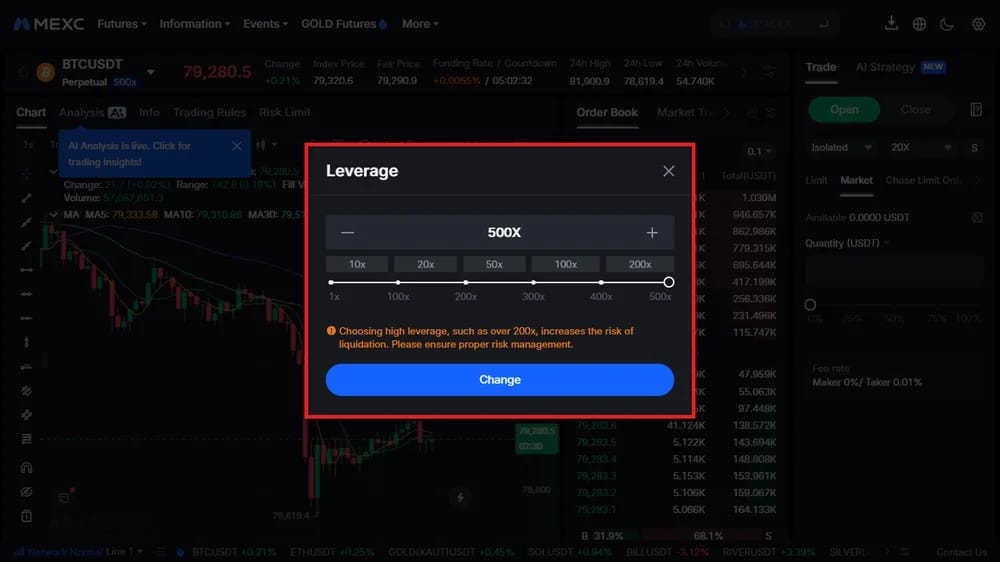
Perpetual futures are designed around leverage, so limits are often much higher and vary by exchange, pair, and risk tier. MEXC advertises up to 500x futures leverage, while Bitget notes up to 125x or 150x on certain pairs, making liquidation risk central.
Perpetual Futures vs Spot Trading Regulations
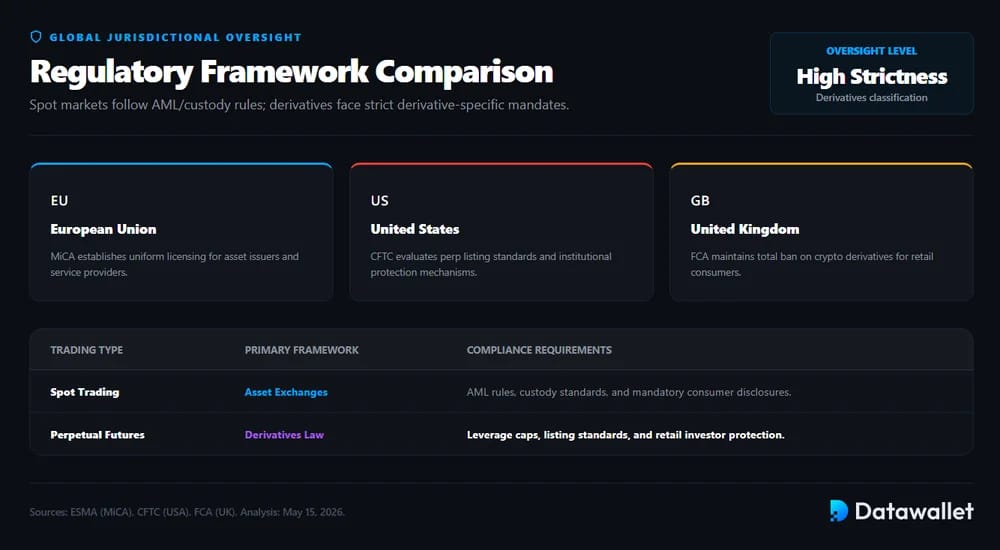
Spot crypto trading is increasingly regulated through exchange licensing, AML rules, custody standards, and consumer disclosures. In the EU, the European Securities and Markets Authority oversees MiCA, which creates uniform rules for crypto-asset issuers and service providers not already covered by financial law.
Perpetual futures usually face stricter treatment because they are derivatives, not simple asset purchases. In the US, the Commodity Futures Trading Commission requested public comment on perpetual contracts in 2025, reflecting growing institutional interest but also unresolved questions around listing standards, leverage, and investor protection.
The UK takes a more restrictive approach for retail users. The Financial Conduct Authority banned the sale of crypto derivatives and exchange-traded notes referencing certain cryptoassets to retail consumers from January 2021, arguing retail clients cannot reliably assess their value and risks.
In Asia, rules vary widely. The Monetary Authority of Singapore proposed regulating payment-token derivatives traded on approved exchanges, while also tightening digital-token service expectations. Overall, spot markets are often handled under crypto-service frameworks, while perps may fall under securities, futures, or derivatives regimes.
Risks in Perpetual Futures vs Spot Trading
Spot and perp trading both expose users to crypto volatility, but the risk profile changes sharply when ownership, leverage, funding, regulation, and liquidation mechanics are added.
Spot Trading Risks
Spot trading avoids liquidation from leverage, but it still carries severe downside risk because traders directly hold assets whose prices can collapse from market stress, regulation, or project failure.
Key spot trading risks include:
- Market Crashes: Major assets like BTC and ETH can fall sharply during panic events, while smaller altcoins may collapse faster when liquidity disappears or sentiment turns negative.
- Altcoin Collapse: MANTRA’s OM token reportedly lost over 90% in April 2025, falling from above $6 to below $0.50 within hours, showing how quickly spot holdings can lose value.
- Protocol Failure: Terra’s LUNA and UST collapse in 2022 wiped out an estimated $40 billion in investor value, despite many holders using no leverage at all.
- Regulatory Access: Spot traders can suddenly lose access to assets if exchanges delist tokens for compliance reasons, as seen when Coinbase restricted non-compliant stablecoins in the EEA under MiCA.
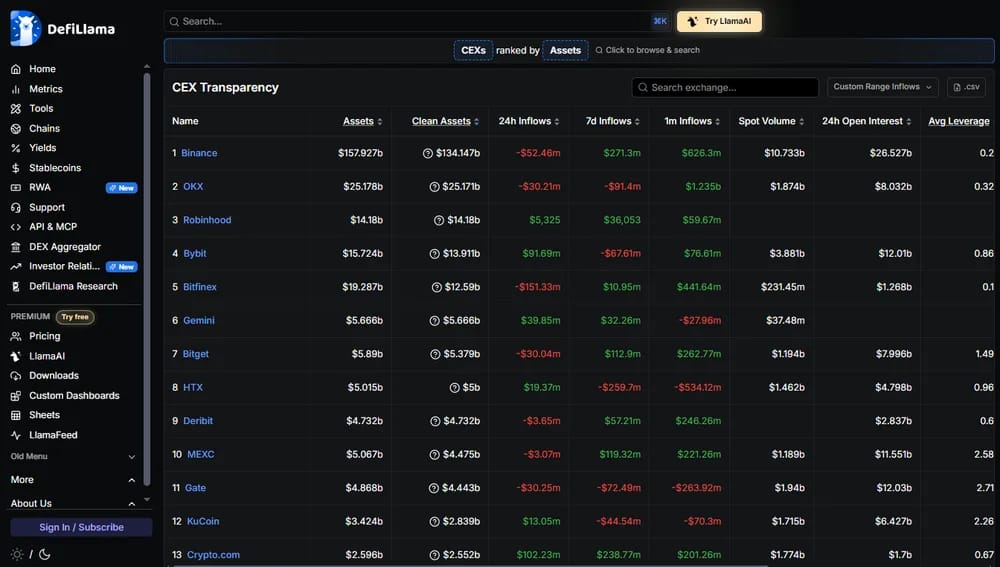
- Exchange Risk: Holding spot assets on centralized exchanges introduces custody risk, where withdrawals, listings, or trading access may be affected by platform failures, legal actions, or operational freezes. Always check for proof-of-reserves.
- Liquidity Gaps: Thinly traded tokens can show misleading prices during calm markets, then drop aggressively when sellers overwhelm available bids and buyers disappear.
Perpetual Futures Risks
Perpetual futures add leverage, margin requirements, funding payments, and forced liquidation, so even small market moves can create outsized losses compared with unleveraged spot exposure.
Key perpetual futures risks include:
- Liquidation Risk: With 50x leverage, traders post about 2% of position value as margin, meaning a small adverse move can wipe out the position before manual exit.
- Margin Calls: Bybit explains that liquidation is triggered when unrealized losses push position margin below the required maintenance margin, making collateral management critical.
- Mark Price Risk: Exchanges often liquidate based on mark price rather than last traded price, so sudden index movement can close a position even when the visible chart looks survivable.
- Funding Costs: Funding payments can reduce position margin over time; Bybit notes that unpaid funding fees may move liquidation prices closer to the mark price.
- Cascade Events: In crowded trades, forced liquidations can accelerate price moves as exchanges close positions automatically, turning a normal correction into a faster liquidation cascade.
- Leverage Illusion: A $1,000 margin deposit can control a far larger position, but losses are calculated on the full notional size, not the small margin amount.
- Platform Rules: Maximum leverage, maintenance margin, auto-deleveraging, and insurance-fund rules vary by exchange, so the same trade may carry different liquidation risk across platforms.
Perps vs Spot Trading in Decentralized Markets
Decentralized trading is gaining ground in both spot and derivatives markets as liquidity routing, faster chains, and better execution tools make onchain trading more competitive.
CoinGecko reported that DEX spot market share doubled from 6.9% in January 2024 to 13.6% in January 2026, while DEX spot volume rose from $95.86 billion to $231.29 billion.
Decentralized Spot Trading
Decentralized spot trading happens through smart contracts instead of centralized order books. Traders connect a wallet, swap assets directly, and keep custody of their funds throughout the transaction. This model is especially useful for long-tail tokens, newly launched assets, and stablecoin pairs that may appear on DEXs before major centralized exchanges.
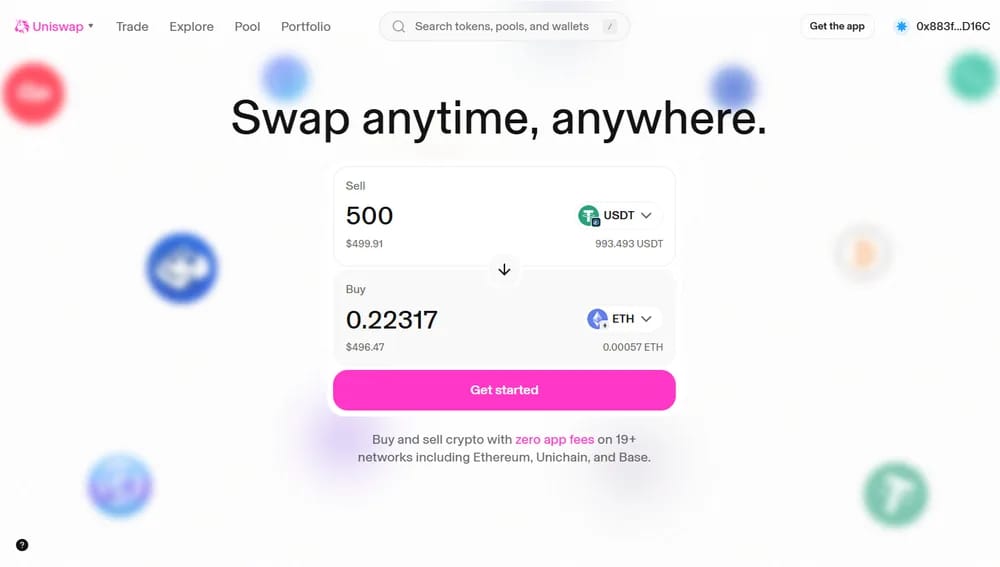
On Ethereum, Uniswap remains one of the most important DEXs for onchain spot liquidity, using automated market maker pools rather than a traditional exchange matching engine. On Solana, Jupiter acts as a DEX aggregator, routing trades across protocols such as Raydium, Orca, Lifinity, and other liquidity sources to improve execution and reduce slippage.
Raydium is also central to Solana’s spot trading stack because it provides AMM-based liquidity for many routed trades. CoinGecko reported that Raydium’s monthly spot volume reached $88.56 billion in January 2025, nearly matching Uniswap’s $88.92 billion during the same month, driven largely by Solana-based trading activity.
Decentralized Perpetuals
Decentralized perpetuals bring leveraged futures-style trading onchain, but their designs vary widely. Some protocols use liquidity pools and oracle pricing, while newer ones use order books, matching engines, and onchain settlement to offer faster execution, tighter spreads, and a trading experience closer to centralized futures exchanges.
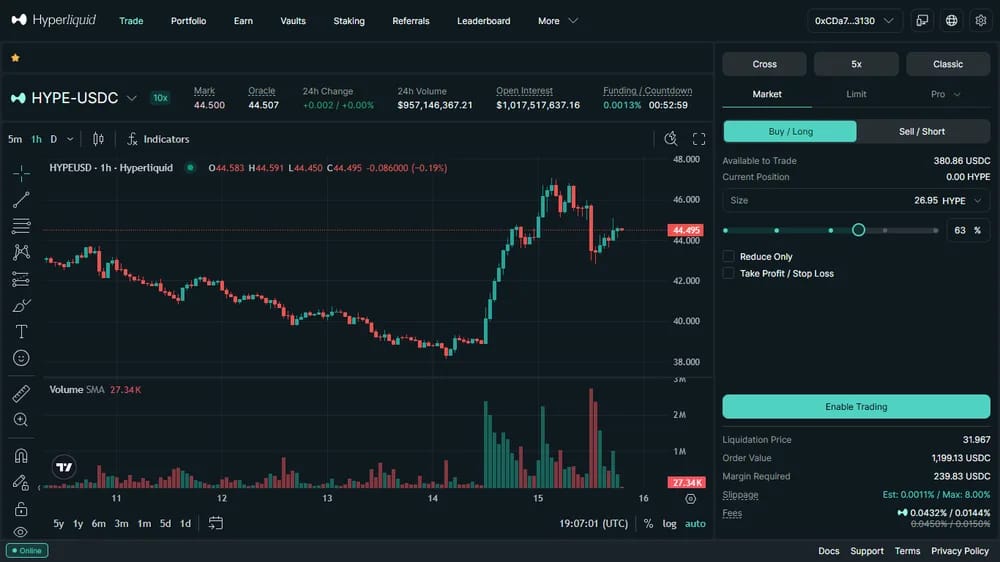
Hyperliquid has become one of the most important decentralized perps, using an order book model rather than the older AMM-style structure. Oak Research reported that Hyperliquid’s weekly volume rose from about $13 billion in Q4 2024 to an average of $47 billion in H1 2025, with one week exceeding $78 billion.
This differs from earlier perp DEX models such as dYdX and GMX, where liquidity pools, oracle pricing, or hybrid infrastructure played a larger role. Those models can still offer transparency and self-custody, but they may face trade-offs around price impact, execution speed, and liquidity depth during volatile periods.
Decentralized perps are also claiming more share from centralized derivatives. A 2026 market report cited on Binance Square said the DEX-to-CEX perpetual volume ratio reached 11.7%, up from 2.5% one year earlier, showing how quickly perp DEXs are growing.
When to Choose Spot vs Perps
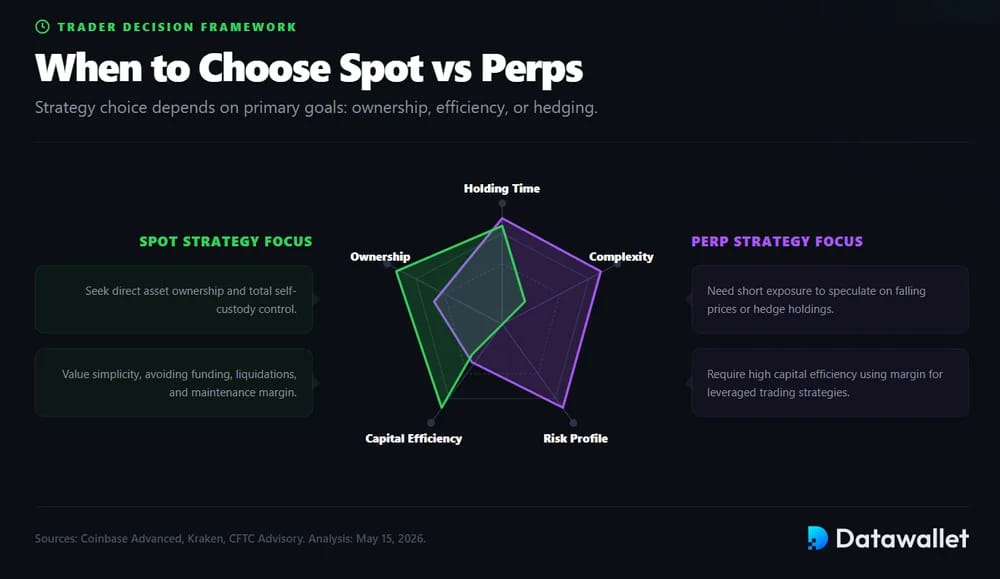
Choosing between spot and perps depends on the trader’s goal: asset ownership, lower complexity, self-custody, hedging, short exposure, or leveraged capital efficiency.
Use this decision framework before choosing a market:
- Choose Spot For Ownership: Spot is better when traders want to own BTC, ETH, stablecoins, or altcoins directly, because the position represents the actual asset rather than a derivative contract.
- Choose Spot For Self-Custody: Spot assets can be withdrawn to a personal wallet, making them more suitable for users who want direct control instead of exchange-held margin balances.
- Choose Spot For Simplicity: Spot trading avoids funding rates, liquidation prices, and maintenance margin, which makes it easier for beginners and long-term holders to manage.
- Choose Spot For Long-Term Holding: Investors using dollar-cost averaging or multi-year accumulation usually prefer spot because the position does not expire and cannot be liquidated by leverage.
- Choose Perps For Short Exposure: Perpetual futures allow traders to speculate on falling prices without borrowing the underlying asset or selling spot holdings first. Coinbase explains that perps let traders speculate on crypto prices without owning the underlying asset.
- Choose Perps For Hedging: A trader holding spot ETH can open a short ETH perp to reduce downside exposure while still keeping the original tokens in the portfolio.
- Choose Perps For Capital Efficiency: Perps use margin, so traders can control larger positions with less upfront capital; Kraken notes that spot margin can reach up to 10x on selected assets, while perp platforms often offer higher leverage.
- Choose Perps For Active Trading: Perps are better suited to experienced traders who monitor funding rates, open interest, liquidation levels, and margin requirements closely during fast-moving markets. The CFTC warns users not to invest in virtual currency futures or strategies they do not understand.
Tax and Accounting Differences Between Spot and Perps
Tax treatment depends heavily on jurisdiction, but spot crypto is commonly treated as a taxable asset when sold, swapped, or spent. In the US, the IRS treats digital assets as property and says taxpayers may need to report gains, losses, and income from digital asset transactions.
For spot traders, accounting usually centers on cost basis, acquisition date, disposal value, and transaction fees. Selling BTC for fiat, swapping ETH for another token, or using crypto to pay for goods can all create reportable gains or losses, depending on local rules and the trader’s records.
Perps can be more complex because traders may need to track realized profit and loss, funding payments, trading fees, collateral movements, and contract settlement records. In the UK, HMRC notes that company derivatives over cryptoassets may fall under derivative contract rules, showing how treatment can differ from direct token ownership.
Reporting standards are also becoming more formal. The OECD Crypto-Asset Reporting Framework is designed to help tax authorities receive information on crypto-asset transactions across borders, which means both spot and derivatives traders should expect more exchange reporting, better audit trails, and stricter recordkeeping expectations.
Final Thoughts
Spot trading and perpetual futures serve different goals. Spot offers direct ownership, simpler mechanics, and self-custody potential, while perps provide leveraged exposure, shorting, hedging, and capital efficiency without owning the underlying crypto.
The trade-off is risk. Spot traders mainly face market, custody, and project-specific risks, while perp traders must also manage liquidation, margin requirements, and funding payments that keep contracts aligned with spot prices.
For most beginners, spot is the cleaner starting point. Perps are better suited to experienced traders who understand leverage, funding, position sizing, and exchange rules before using derivatives in volatile crypto markets.
%20vs%20Spot%20Trading%20in%20Crypto%20Explained.webp)