





 Binance
 BTCC
BTCC Coinbase International Exchange
 Coinbase Exchange
 WEEX
WEEX OKX
OKX Biconomy.com
 KuCoin
 Tapbit
 Ourbit
 Binance
 Gate
Gate MEXC
MEXC Bybit
Bybit Bitget
 Hyperliquid
 KuCoin
 OKX
OKX WhiteBIT
 BingX
BingXWhat Moves the Sui Price
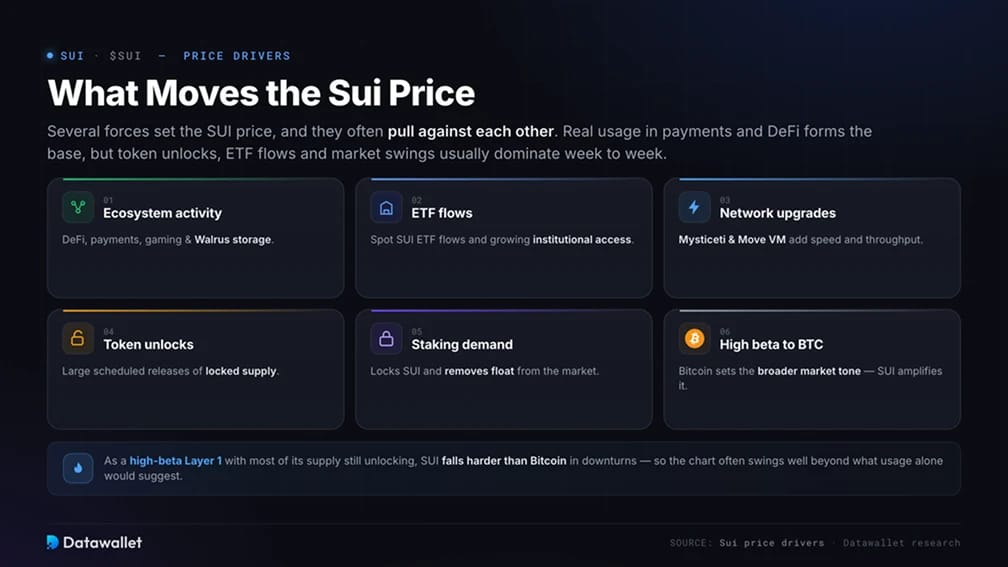
SUI's price in 2026 is a standoff between scheduled unlocks and a set of demand sinks that barely existed a year ago. Vesting lands on a fixed calendar and keeps capping rallies even when usage climbs, which is why strong ecosystem news has often failed to lift the token.
The main drivers we track:
- Token unlocks, the heaviest weight, though the early-investor and team cliffs are winding down and the mix is tilting toward Community Reserve.
- The USDsui buyback loop, which recycles stablecoin reserve yield into open-market SUI buybacks, a structural counter to dilution.
- Staking and treasury lockups that pull SUI off the market, including a Nasdaq firm staking ~2.7% of supply that sparked a 37% weekly jump.
- Spot ETF and CME futures flows, still modest next to Bitcoin and Solana and quick to reverse in a weak market.
- Ecosystem usage and stablecoin settlement, now past $1 trillion in transfers, though gasless transfers remove a gas-demand sink for SUI.
- Network reliability, after repeated mainnet outages that cap institutional trust and trigger liquidations.
- High beta to Bitcoin, so a broad drawdown hits SUI harder than BTC.
The supply side won through 2025, leaving SUI around 85% below its peak. Whether it re-rates from here turns on the buyback loop and staking demand outpacing the supply still due to unlock.
SUI Supply, Token Unlocks and Staking
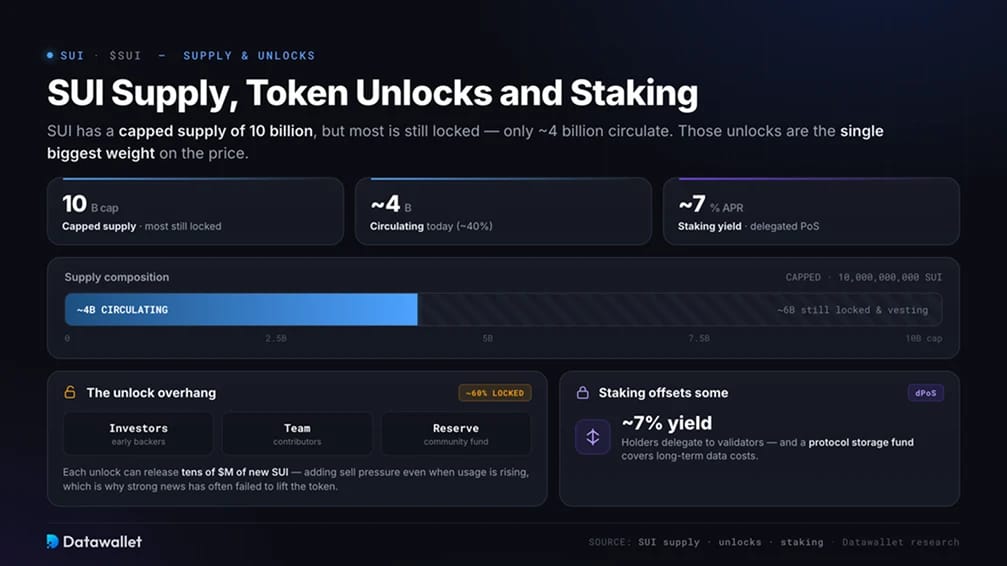
SUI has a capped supply of 10 billion tokens, but most is still locked. Only around 4 billion circulate, with roughly 60% held by investors, the team and a community reserve that vests over several years. Those unlocks are the single biggest weight on the price.
Each unlock can release tens of millions of dollars of new SUI, adding sell pressure even when usage is rising. This overhang is why strong ecosystem news has often failed to lift the token.
Staking offsets some of that. SUI uses delegated proof of stake, holders delegate to validators for a yield around 7%, and a protocol storage fund covers long-term data costs. Model staking returns with our crypto staking calculator.
Spot Sui ETFs and Institutional Demand
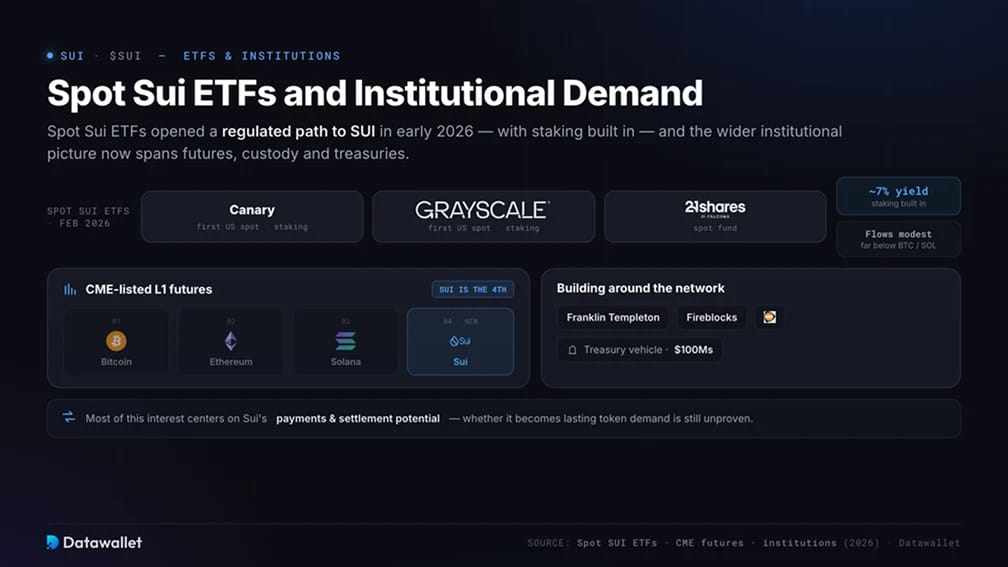
Spot Sui ETFs opened a regulated path to SUI in early 2026. The first US spot SUI funds from Canary and Grayscale launched in February with staking built in, paying holders around 7% yield, followed by a spot fund from 21Shares. Flows stay modest, far smaller than Bitcoin or Solana ETF demand.
The institutional picture is wider. CME listed SUI futures, making Sui the fourth Layer 1 on its regulated derivatives market after Bitcoin, Ethereum and Solana. Franklin Templeton, Fireblocks and Galaxy have built around the network, and a treasury vehicle has committed hundreds of millions to SUI.
Most of this interest centers on Sui's payments and settlement potential, and whether it becomes lasting token demand is unproven.
Sui, the Move Language and Sub-Second Finality
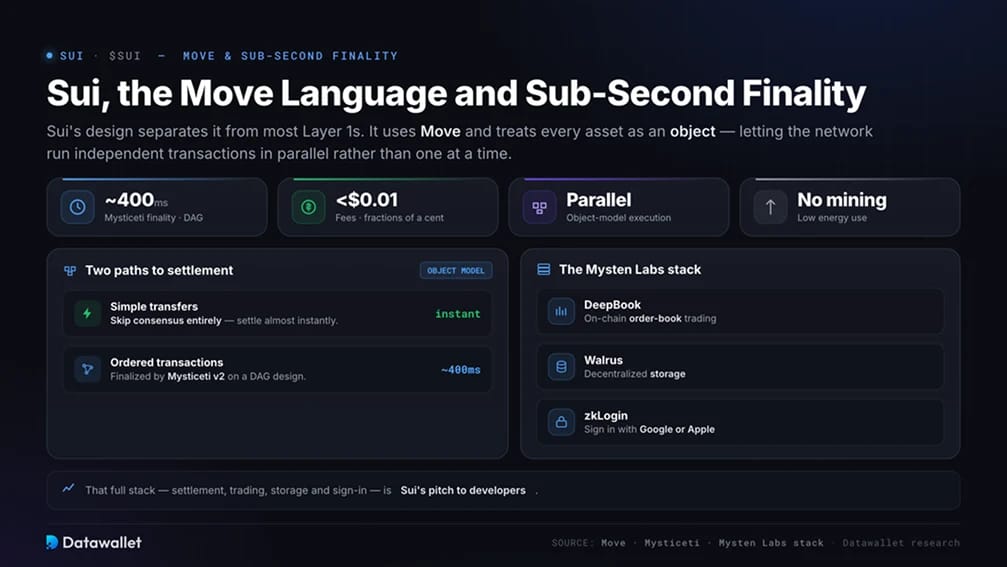
Sui's design separates it from most Layer 1s. It uses Move and treats every asset as an object, which lets the network run independent transactions in parallel rather than one at a time. Simple transfers skip consensus entirely and settle almost instantly.
For transactions that need ordering, the Mysticeti consensus finalizes them in roughly 400 milliseconds on a DAG-based design, upgraded to Mysticeti v2 in late 2025. Fees cost fractions of a cent, with no mining.
Mysten Labs has built a full stack around this core: DeepBook for on-chain order-book trading, Walrus for decentralized storage, and zkLogin for sign-in with a Google or Apple account. That breadth is Sui's pitch to developers.
Sui as a Payments and DeFi Hub
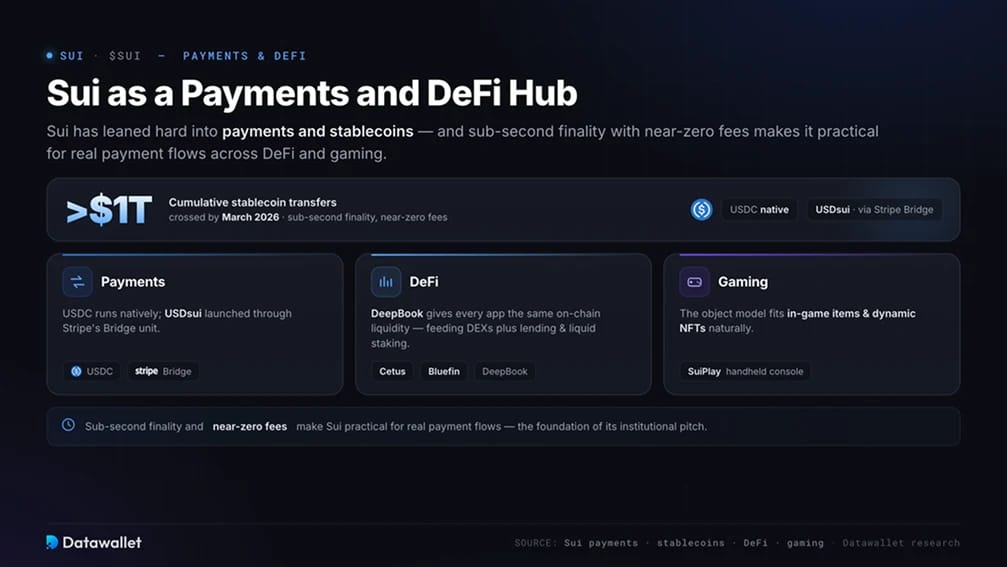
Sui has leaned hard into payments and stablecoins. USDC runs natively, the USDsui stablecoin launched in early 2026 through Stripe's Bridge unit, and cumulative stablecoin transfers crossed $1 trillion by March 2026. Sub-second finality and near-zero fees make it practical for real payment flows.
DeFi runs on shared infrastructure. DeepBook gives every app the same on-chain liquidity, feeding DEXs like Cetus and Bluefin, while lending markets and liquid staking round out the ecosystem.
Gaming is the third pillar. The object model fits in-game items and dynamic NFTs naturally, and Mysten Labs has shipped a handheld console, SuiPlay, to reach mainstream players.
The Sui Decentralization Debate
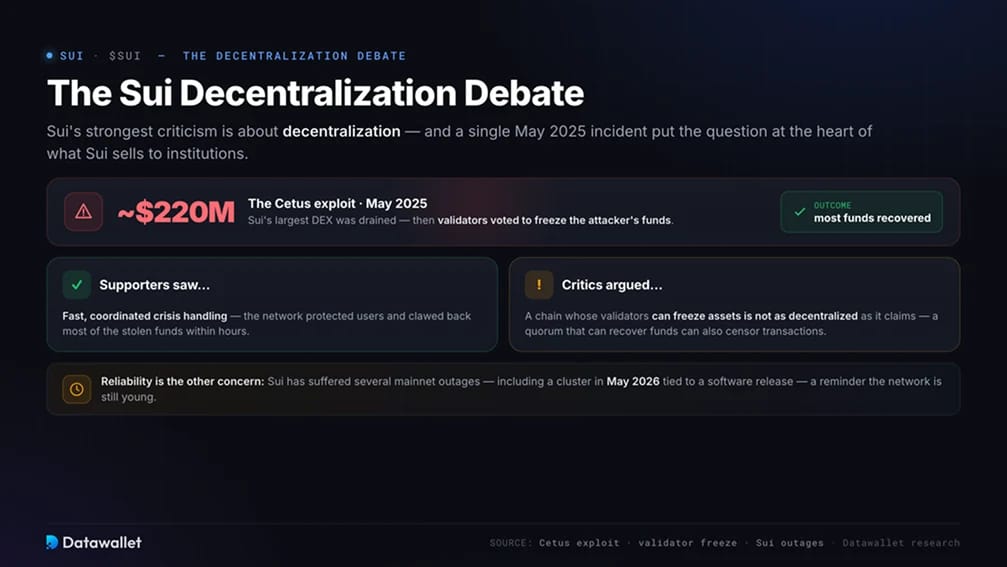
Sui's strongest criticism is about decentralization. In May 2025, the network's largest DEX, Cetus, lost roughly $220 million to an exploit, and validators voted to freeze the attacker's funds and recover most of it. That protected users but showed a validator quorum can censor transactions.
The response cut both ways. Supporters saw fast, coordinated crisis handling, while critics argued a chain whose validators can freeze assets is not as decentralized as it claims. This goes to the heart of what Sui sells to institutions.
Reliability is the other concern. Sui has suffered several mainnet outages, including a cluster in May 2026 tied to a software release, a reminder that the network is still young. Both issues shape how far institutions trust it as core infrastructure.
Risks That Shape the SUI Price
Several risks weigh on the SUI price, and holders should size positions with them in mind:
- Token unlocks, since most supply is still vesting and releases monthly
- Validator control and concentration, raised by the Cetus freeze response
- Network reliability, after repeated mainnet outages
- Heavy competition from Solana, Ethereum and other fast Layer 1s
- DeFi exploits and bridge risk in a young, fast-growing ecosystem
- Modest ETF flows that can reverse quickly in a weak market
- High beta to Bitcoin, so a broad drawdown hits SUI harder than BTC
None of these are unique to Sui, but together they explain why SUI has fallen far below its peak even as the ecosystem grew.
A Short History of the Sui Price
Sui launched its mainnet in May 2023, and SUI changed hands near a dollar before sliding to an all-time low around $0.36 that October. A strong 2024 run, driven by fast DeFi and developer growth, carried it to an all-time high of $5.35 in January 2025.
The decline since has been steep. A weak altcoin market, the Cetus exploit and constant token unlocks pulled SUI down through 2025 and into 2026, with on-chain value falling sharply even as the protocol shipped upgrades.
SUI trades near $0.72 in mid-2026, about 87% below its peak even as ETFs launch and stablecoin volume scales. Whether it recovers hinges on real usage outpacing the supply still due to unlock.