





.png)
.png)


What Is the Zcash Liquidation Heatmap?
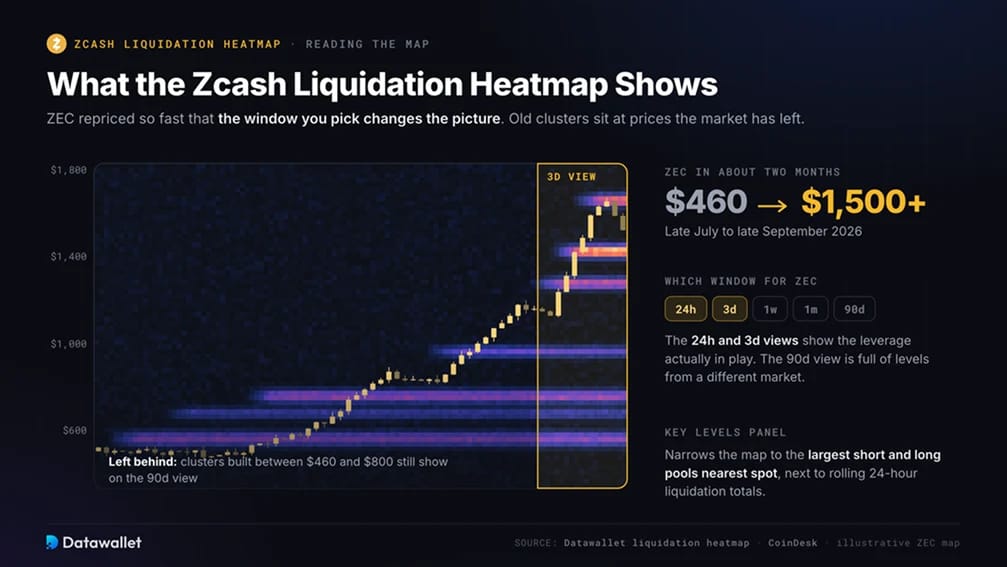
The Zcash liquidation heatmap estimates where leveraged ZEC/USDT perpetual futures positions on Binance and Bybit would be forcibly closed. Clusters above the ZEC price are mostly short liquidations, which turn into forced buying if price rises into them. Clusters below are mostly long liquidations, which turn into forced selling on the way down.
ZEC repriced from around $460 in late July 2026 to above $1,500 by late September, so the window you choose changes the picture more than it does for most assets. The 90-day view is full of clusters built at prices the market has already left. The 24h and 3d views show the leverage that is actually in play. The key levels panel narrows this to the largest short and long pools nearest spot, next to rolling 24-hour liquidation totals.
ZEC is one of the most leverage-driven large-cap markets in crypto. So this heatmap often explains more of ZEC's short-term price action than a heatmap does for Bitcoin or Ethereum.
Why Is ZEC So Sensitive to Leverage?
Zcash is a privacy-focused cryptocurrency. It lets users move ZEC into shielded pools, where zero-knowledge proofs hide the sender, the receiver and the amount. Its market has swung repeatedly between very large rallies and sharp drops, and derivatives traders sit at the center of both.
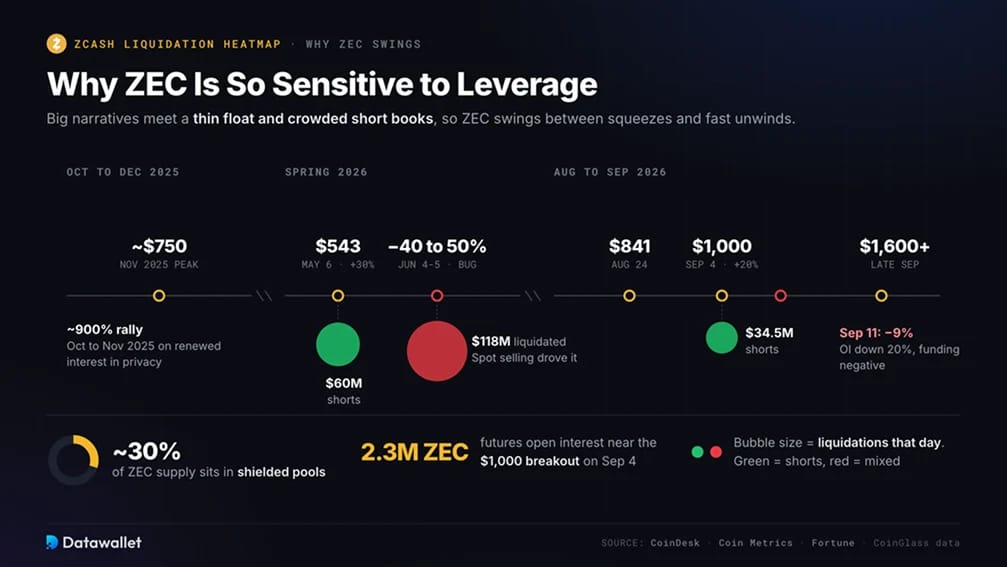
- A thin float and big narratives: ZEC rallied about 900% from October to November 2025 on renewed interest in privacy. By then around 30% of the supply sat in shielded pools, and analysts linked the move partly to a supply squeeze.
- Crowded short books: Record short positioning after each drop has repeatedly turned into squeeze fuel. On May 6, 2026, ZEC jumped about 30% to $543, and about $60 million of ZEC shorts were liquidated. That was the second-largest liquidation total of any asset that day, behind only Bitcoin.
- The $1,000 breakout: ZEC hit an eight-year high of $841 on August 24, 2026. On September 4 it rose about 20% through $1,000, liquidating $34.5 million of shorts, while open interest stood near 2.3 million ZEC. By late September it had traded above $1,600.
- Fast unwinds: Leverage leaves as quickly as it arrives. On September 11, ZEC fell 9%, open interest dropped 20% to about $1.4 billion, and funding turned negative within hours.
What Did the Orchard Bug Teach ZEC Traders?
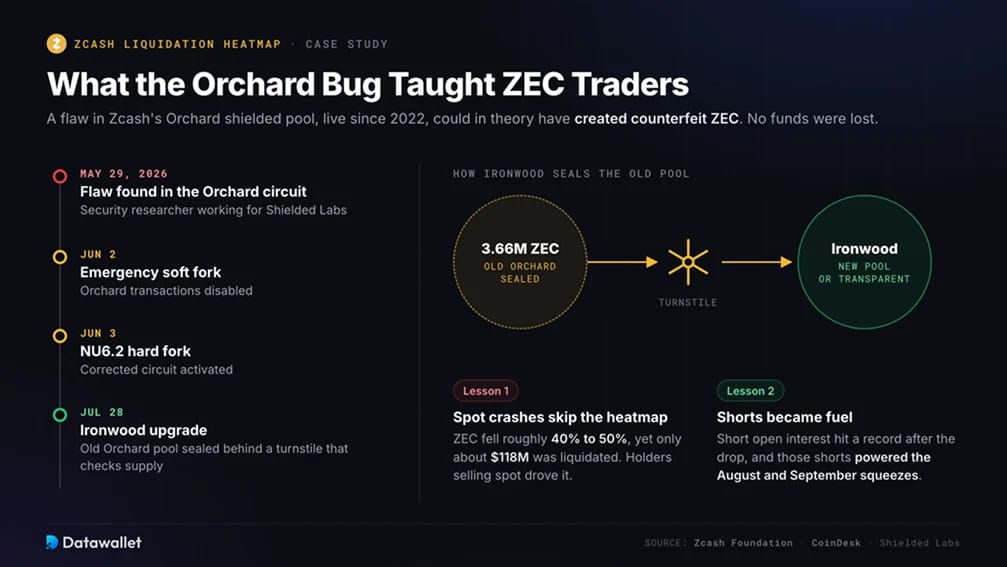
On May 29, 2026, a security researcher working for Shielded Labs found a soundness flaw in the Orchard shielded pool's zero-knowledge circuit. The flaw had been live since 2022, and in theory it allowed counterfeit ZEC to be created.
Developers disabled Orchard with an emergency soft fork on June 2 and activated a corrected circuit through the NU6.2 hard fork on June 3. The Zcash Foundation reported no evidence that the bug had been exploited.
The market reaction is a useful case study for heatmap readers:
- Spot-driven crashes skip the heatmap: ZEC fell roughly 40% to 50% within days, yet only about $118 million was liquidated. Holders selling spot ZEC drove the decline. Liquidation cascades played a smaller part.
- Shorts piled in after the drop: Open interest in ZEC terms hit a record as traders bet on further losses. That short book became the fuel for the August and September squeezes.
- Recovery rebuilt confidence in supply: On July 28, the Ironwood upgrade sealed the old Orchard pool, which held about 3.66 million ZEC. Funds can only leave through a turnstile that checks supply. Datawallet's Zcash explainer covers the exploit and Ironwood in detail.
Which Catalysts Are on the ZEC Calendar?
- ETF access: Grayscale's Zcash ETF (ZCSH) began trading on NYSE Arca on August 25, 2026, and 21Shares listed a physically backed Zcash product on Euronext in September. ETF flows add unleveraged demand that can absorb forced selling.
- The NU7 upgrade: In a private vote in September 2026, ZEC holders backed 25-second block times and kept Bitcoin-style halvings. The upgrade targets mainnet activation on November 5, 2026, and network upgrades have historically attracted leverage in the weeks before activation.
- EU privacy rules: The EU's Anti-Money Laundering Regulation bars crypto service providers from maintaining accounts that allow the use of anonymity-enhancing coins from July 10, 2027. Any exchange delisting announcements tied to that deadline could quickly change where ZEC leverage sits. Datawallet's privacy coins guide covers where privacy coins are legal and where they're restricted.
- Security research: The Orchard flaw was found with AI-assisted auditing, and formal verification work is ongoing. Further disclosures, good or bad, can reprice ZEC within hours.
How Should You Read ZEC Clusters Responsibly?
- Think in percentages: ZEC can move 20% in a day. Clusters within 5% to 10% of spot are active targets, and clusters left behind by recent repricing may no longer matter.
- Favor recent windows: The 24h, 3d and 1w views reflect the current market better than 90-day clusters that formed when ZEC traded at half its current price.
- Check the short book: Heavy short clusters above price combined with negative funding came before almost every major ZEC squeeze in 2026. Check live ZEC funding rates before treating a short cluster as fuel for a squeeze.
- Know what's missing: Hyperliquid's ZEC perpetuals, where large onchain shorts have taken eight-figure losses, aren't in the model. Neither are spot-driven selloffs like the one in June.
- It maps pressure, not direction: The heatmap shows where forced orders would land. News, protocol developments and regulation decide which side breaks first.