





 Binance
 KuCoin
 BTCC
BTCC Azbit
Azbit Biconomy.com
 XT.COM
 Bybit
Bybit Coinbase Exchange
 Coinbase International Exchange
 Toobit
 Binance
 Bybit
Bybit MEXC
MEXC Hyperliquid
 Bitget
 Gate
Gate WhiteBIT
 OKX
OKX BingX
BingX KuCoin
What Moves the Avalanche Price
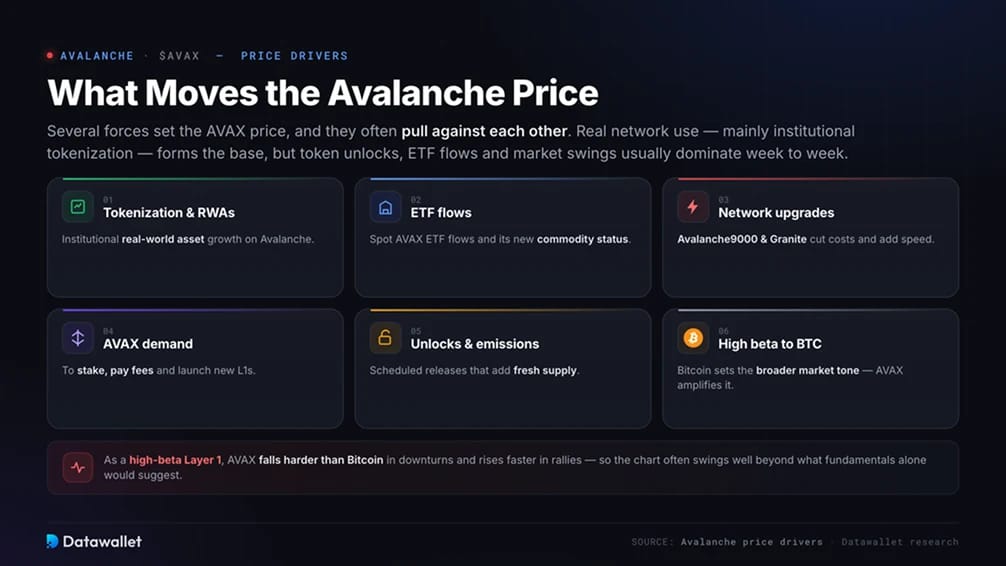
For two years Avalanche has landed the institutional partnerships every Layer 1 chases, from BlackRock to FIFA, and AVAX has fallen anyway. Most of that adoption settles in stablecoins and tokenized assets rather than the token, which is why the price tracks Bitcoin's tape more than its own network.
The main drivers we track:
- Institutional tokenization, the demand base, with BlackRock, FIS, Securitize and Japan's Progmat pushing on-chain real-world assets toward $2 billion.
- The value-capture gap, the question of whether that growth reaches AVAX, since Avalanche9000 replaced the old 2,000 AVAX stake per chain with a small monthly fee.
- Treasury company demand, a new 2026 buyer, with Nasdaq-listed AVAT and AVAX One holding AVAX directly and AVAT alone near 3.5% of circulating supply.
- Spot ETFs and commodity status, from VanEck's VAVX and staking funds by Grayscale and Bitwise to a 2026 digital-commodity classification that cleared custodians to hold AVAX.
- Token unlocks and emissions, still adding tens of millions of dollars of AVAX a month against a fee burn that stays small at current usage.
- Network upgrades like Avalanche9000, Octane and Granite that keep the chain cheaper and faster than rivals, the core pitch to enterprises.
- High beta to Bitcoin, so a broad drawdown hits AVAX harder than BTC.
The bull case rests on Avalanche's capped supply and fee burn, where heavy enough usage could eventually outpace new issuance and tighten the float. That has not happened yet, because the activity arriving on the network still isn't converting into token demand, and 2026's ETFs and treasury vehicles are the first real test of whether it will.
AVAX Supply, the Fee Burn and Staking
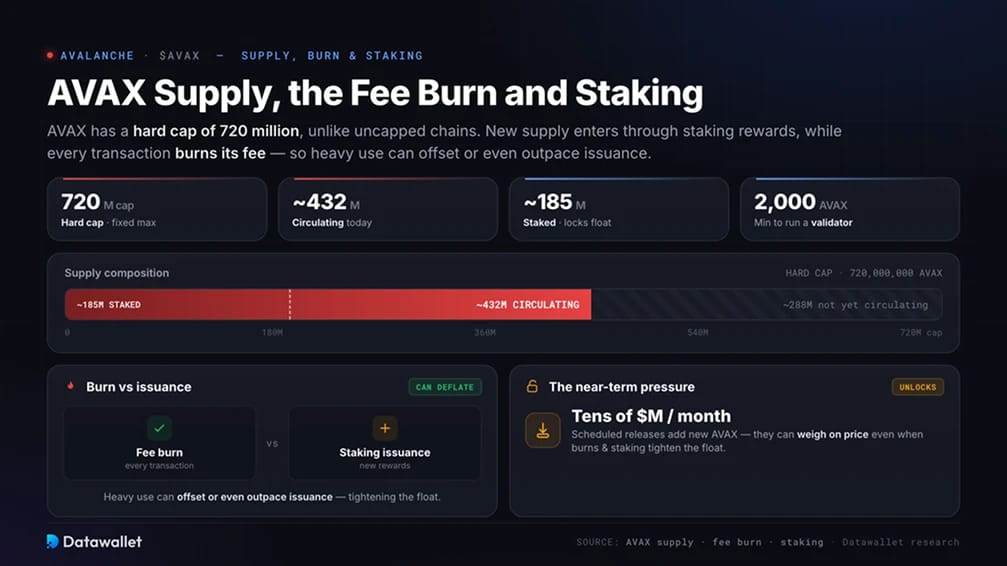
AVAX has a hard cap of 720 million tokens, unlike uncapped chains. New supply enters through staking rewards, while every transaction burns its fee, so heavy use can offset or even outpace issuance. Circulating supply sits near 432 million.
Staking secures the network and locks up float. Around 185 million AVAX is staked, running a validator node needs at least 2,000 AVAX, and yields sit in the mid-to-high single digits. Model staking returns with our crypto staking calculator.
The near-term pressure is unlocks. Scheduled releases still add tens of millions of dollars of new AVAX each month, which can weigh on price even when burns and staking tighten the float.
Spot Avalanche ETFs and Institutional Demand
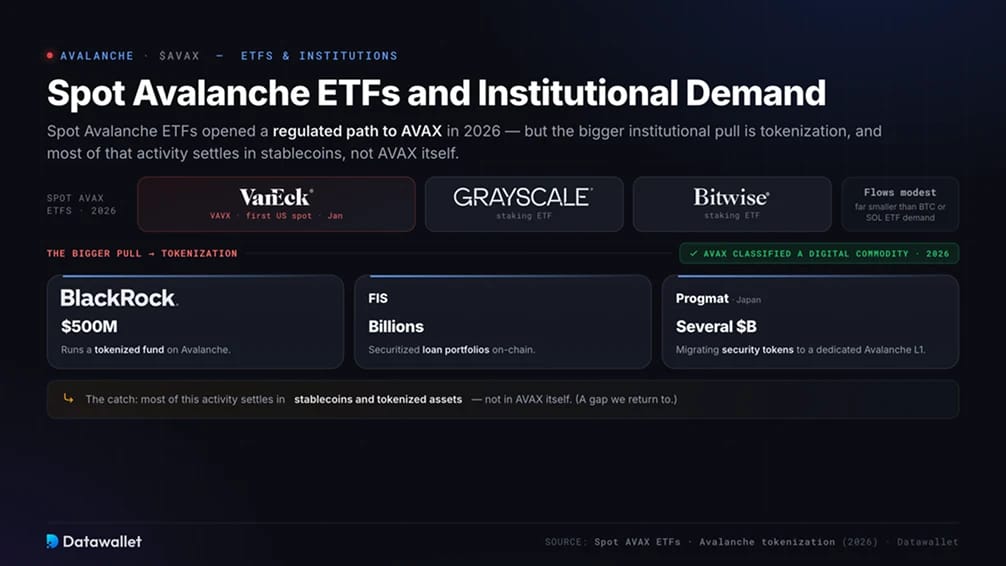
Spot Avalanche ETFs opened a regulated path to AVAX in 2026. VanEck launched the first US spot AVAX fund (VAVX) in January, followed by staking ETFs from Grayscale and Bitwise that pass network yield to holders. Flows stay modest so far, far smaller than Bitcoin or Solana ETF demand.
The bigger pull is tokenization. BlackRock runs a $500 million tokenized fund on Avalanche, FIS securitized billions of dollars of loans on it, and Japan's Progmat is migrating several billion dollars of security tokens to a dedicated Avalanche L1. US regulators also classified AVAX as a digital commodity in 2026, clearing custodians to hold it.
Most of this activity, though, settles in stablecoins and tokenized assets rather than in AVAX itself, a gap we return to below.
Avalanche L1s, Subnets and Sub-Second Finality
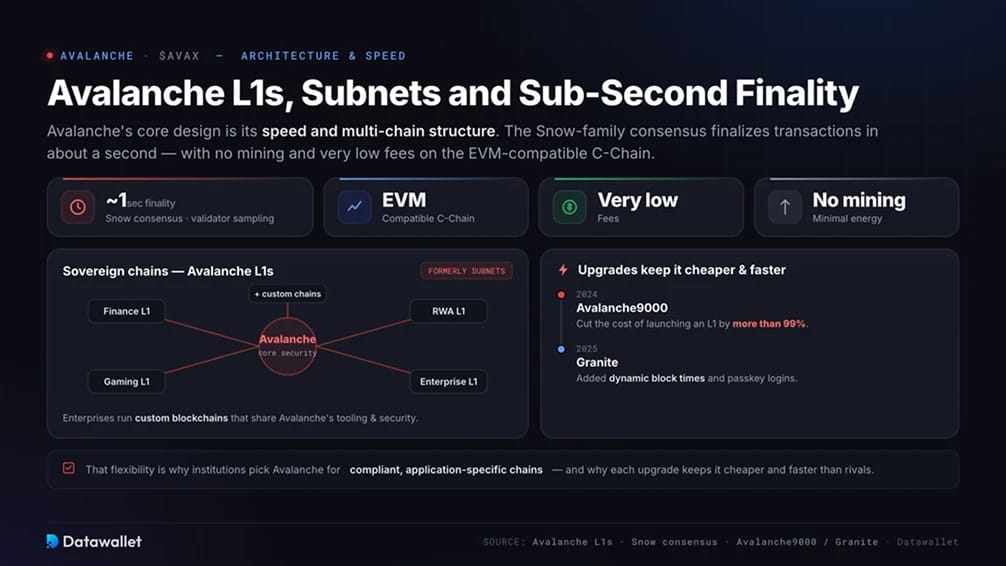
Avalanche's core design is its speed and multi-chain structure. The Snow-family consensus finalizes transactions in about a second through repeated validator sampling, with no mining and very low fees on the EVM-compatible C-Chain.
The standout feature is sovereign chains. Avalanche L1s, formerly subnets, let enterprises and apps run custom blockchains that share Avalanche's tooling and security. The 2024 Avalanche9000 upgrade cut the cost of launching one by more than 99%, and 2025's Granite upgrade added dynamic block times and passkey logins.
That flexibility is why institutions pick Avalanche for compliant, application-specific chains, and why each upgrade keeps the network cheaper and faster than rivals.
Avalanche as an Institutional Tokenization Hub
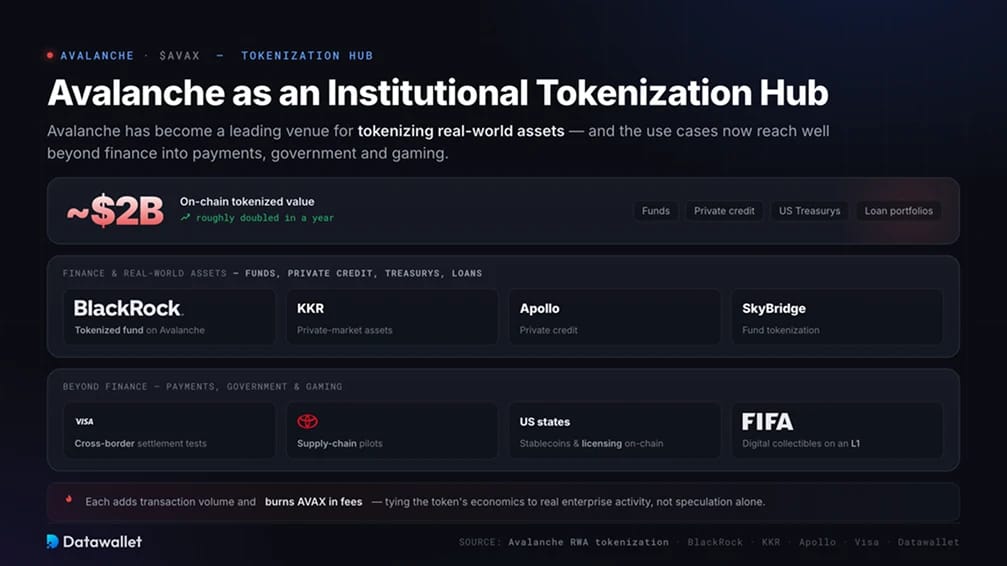
Avalanche has become a leading venue for tokenizing real-world assets. On-chain tokenized value has roughly doubled over the past year to around $2 billion, spanning funds, private credit, US Treasurys and loan portfolios from names like BlackRock, KKR, Apollo and SkyBridge.
The use cases reach beyond finance. Visa has tested Avalanche for cross-border settlement, US states have issued stablecoins and moved business licensing on-chain, and Toyota has run supply-chain pilots. Gaming is a second front, with game titles and FIFA's digital collectibles on dedicated L1s.
Each adds transaction volume and burns AVAX in fees, tying the token's economics to real enterprise activity, not speculation alone.
The Avalanche Value-Capture Debate
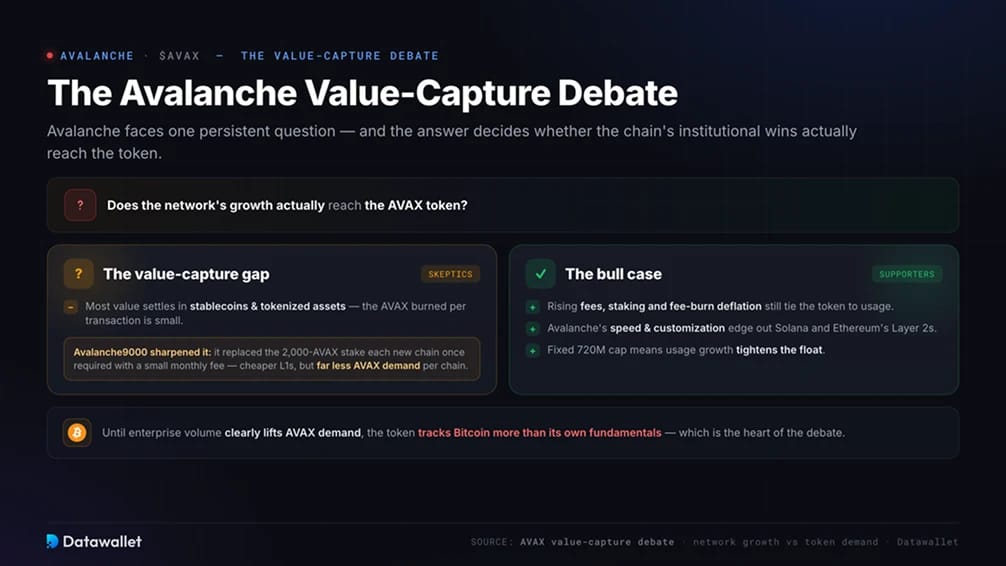
Avalanche faces one persistent question: does the network's growth reach the AVAX token? The chain is winning real institutional tokenization, but most of that value settles in stablecoins and tokenized assets, and the AVAX burned per transaction is small.
Avalanche9000 sharpened this. By replacing the 2,000 AVAX stake each new chain once required with a small monthly fee, it made L1s far cheaper to launch but cut the AVAX demand each one creates. More chains no longer lock up AVAX the way they once did.
Bulls counter that rising fees, staking and fee-burn deflation still tie the token to usage, and that Avalanche's speed and customization edge out Solana and Ethereum's Layer 2s. Until enterprise volume clearly lifts AVAX demand, the token tracks Bitcoin more than its own fundamentals.
Risks That Shape the AVAX Price
Several risks weigh on the AVAX price, and holders should size positions with them in mind:
- Token unlocks and staking emissions that keep adding supply
- The value-capture gap, if ecosystem and tokenization growth fail to drive proportional AVAX demand
- Falling validator and staking participation, which dropped sharply through 2025
- Heavy competition from Solana, Ethereum Layer 2s and other tokenization chains
- Modest ETF flows that can reverse quickly in a weak market
- Execution risk on upgrades, where a security flaw would hit a chain selling itself on technical superiority
- High beta to Bitcoin, so a broad drawdown hits AVAX harder than BTC
None of these are unique to Avalanche, but together they explain why AVAX has lagged even as its ecosystem grew.
A Short History of the Avalanche Price
Avalanche launched its mainnet in September 2020 with AVAX worth a few dollars. A 2021 boom in DeFi and NFTs drove it to an all-time high around $147 that November, briefly putting AVAX among the largest cryptocurrencies.
The bear market that followed was brutal. AVAX fell through 2022 and traded in the tens of dollars for two years, then slid from about $35 in early 2025 to roughly $12 by year-end despite record on-chain activity and growing institutional adoption.
AVAX kept falling into 2026, trading near $6 in mid-year, more than 95% below its peak even as ETFs launch and tokenization scales. Whether it recovers hinges on the network's enterprise growth finally translating into token demand.