





 FameEX
 Binance
 Deepcoin
 BVOX
BVOX CoinUp.io
 BTCC
BTCC Toobit
 Gate
Gate XT.COM
 WEEX
WEEX Binance
 Gate
Gate Hyperliquid
 Bybit
Bybit Bitget
 MEXC
MEXC OKX
OKX BingX
BingX WhiteBIT
 HTX
HTXWhat Moves the Solana Price
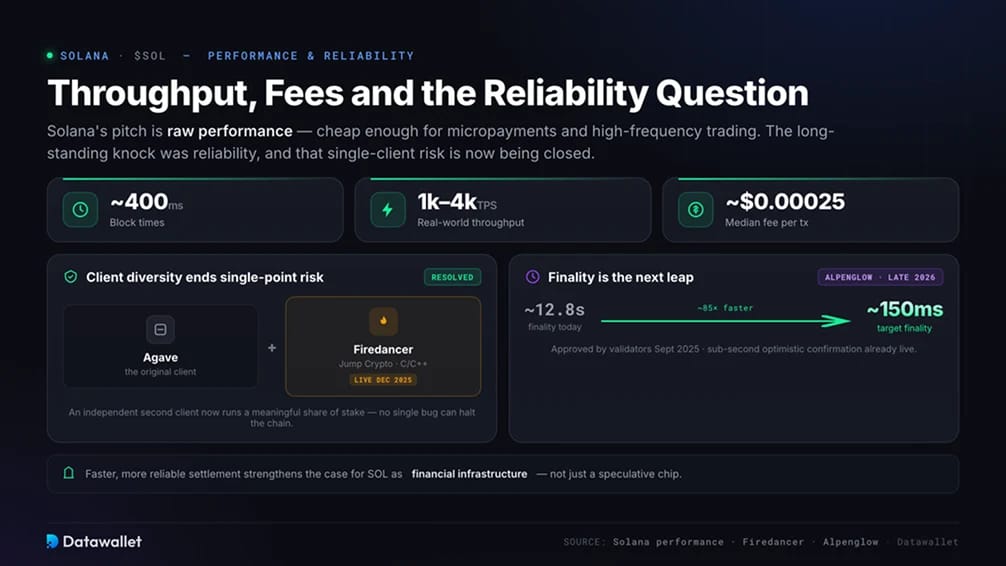
Solana runs two economies at once. One is the busiest stablecoin rail in crypto; the other is the largest altcoin trading market, where ETF, treasury and perps leverage set the price week to week.
The main drivers we track:
- Real network revenue, the fundamental anchor, now well down from its 2025 peak and increasingly captured by apps rather than the base layer.
- Staking, with about 68% of supply locked near 7% yield against 4 to 4.5% issuance and no supply cap.
- Spot ETF demand, led by Bitwise's BSOL, with over $1.1 billion in cumulative inflows rotating out of Bitcoin and Ethereum.
- Treasury holdings, over 15 million SOL, a bid that cooled in 2026 as discounts to asset value raised forced-selling risk.
- Firedancer and Alpenglow, ending the single-client outage risk and targeting finality near 150 milliseconds.
- Stablecoin and memecoin activity, a steadier payments base alongside swingy, Pump.fun-driven fees.
- Leverage and high beta to Bitcoin, the deepest altcoin perps book, so drawdowns hit SOL harder than BTC.
Among Ethereum's rivals, Solana has the most usage to point to and the least stable price to show for it. Until fee revenue stops riding the memecoin cycle and the FTX estate's remaining SOL clears, leverage and sentiment will keep moving the price more than the network does.
SOL Supply, Inflation and Staking Yield
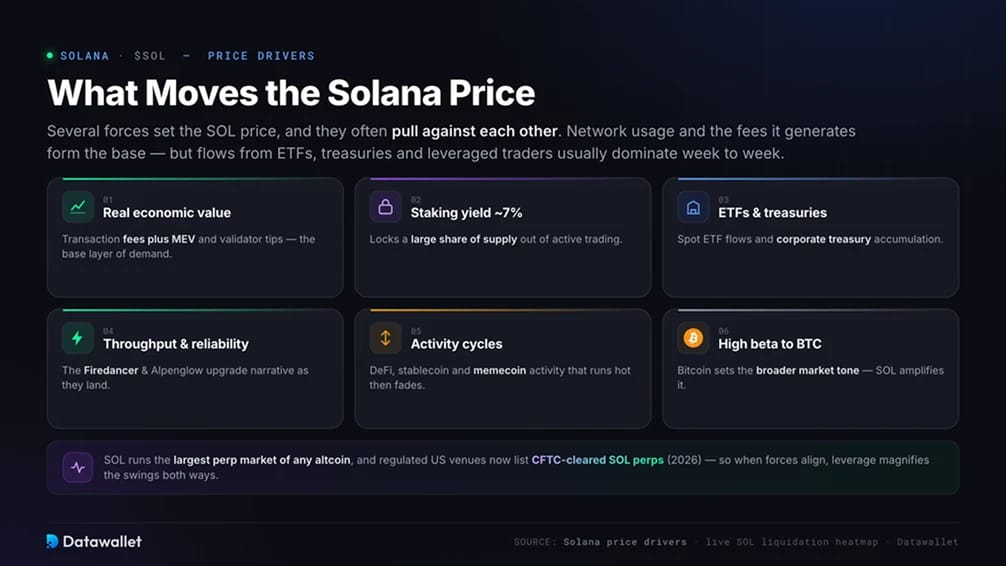
Solana has no maximum supply. New SOL enters on a disinflationary schedule that began near 8% and falls about 15% each year toward a 1.5% terminal rate. Issuance now sits around 4 to 4.5%, with circulating supply near 580 million SOL.
Staking offsets much of that dilution. About 68% of supply is staked for a nominal yield near 7%, securing the network and pulling a large float out of active trading. Holders who stay unstaked lose ground against that staked base every epoch.
Liquid staking keeps that capital usable. Tokens like JitoSOL add MEV tips on top of base rewards and work as DeFi collateral, which keeps participation high even in drawdowns. Model net returns with our crypto staking calculator and compare venues in our best Solana staking platforms guide.
Spot Solana ETFs and Institutional Demand
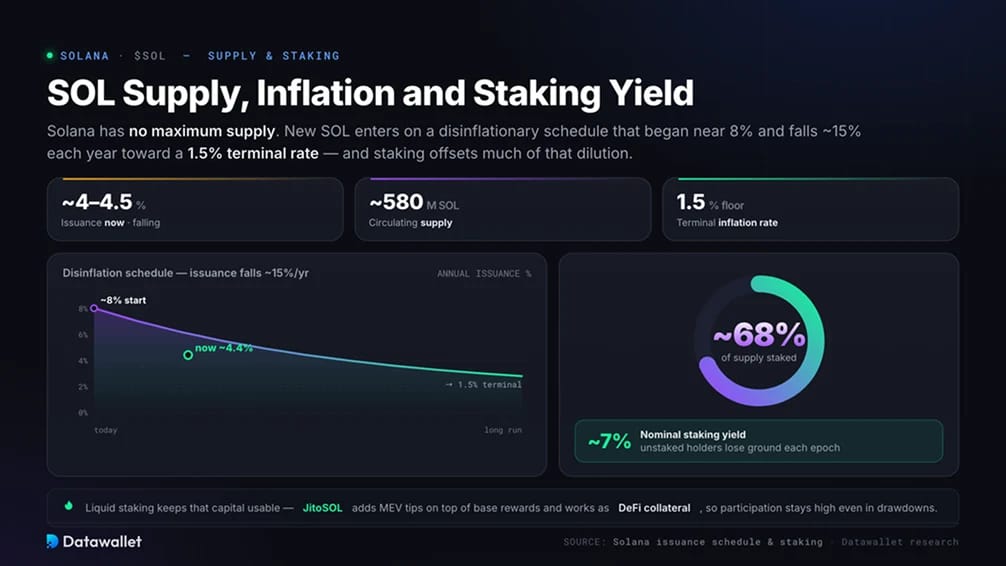
Spot Solana ETFs are now a primary swing factor for the SOL price. US funds crossed roughly $1.06 billion in cumulative inflows by mid-2026, led by the Bitwise Solana Staking ETF (BSOL), which took about 81% of the total and stakes its holdings for close to 7% yield. Fidelity's FSOL and Grayscale's converted trust hold the rest. We track each fund in our Solana staking statistics page.
A March 2026 SEC and CFTC interpretive release confirmed that protocol staking is not a securities transaction, letting issuers pass staking yield straight to shareholders. Much of the early inflow rotated out of Bitcoin and Ethereum funds, a clear institutional-rotation signal.
Treasury companies add a second bid. Forward Industries holds close to 7 million SOL and runs its own validator, part of a Solana treasury sector holding over 15 million SOL combined. That demand cuts both ways, since depressed share-to-asset valuations in 2026 raised the risk of forced selling into weakness.
Solana Throughput, Fees and the Reliability Question
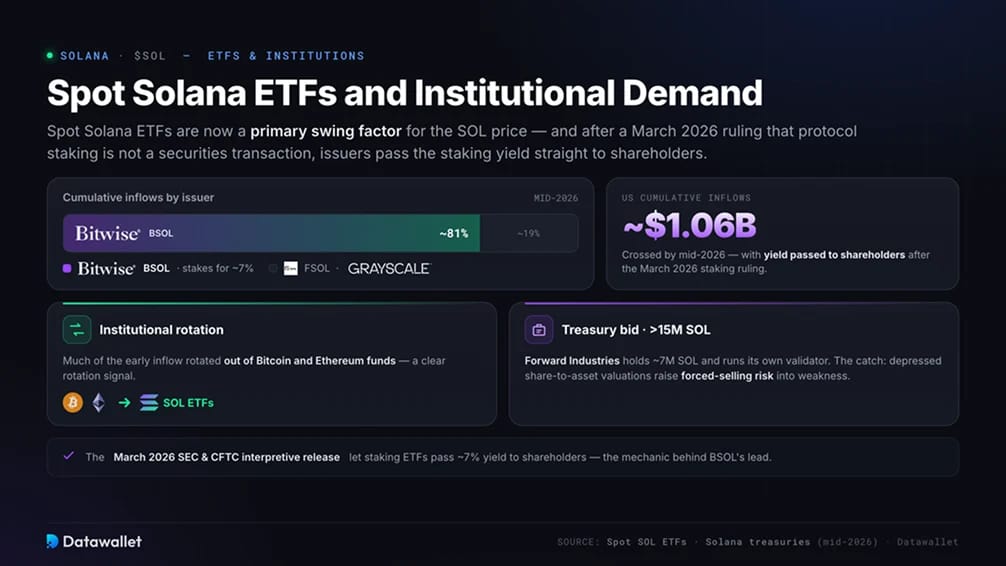
Solana's pitch is raw performance. Block times run near 400 milliseconds, real-world throughput sits between roughly 1,000 and 4,000 transactions per second, and median fees run about $0.00025, cheap enough for micropayments and high-frequency trading. That cost base is why payments firms and tokenization projects keep choosing the network.
The long-standing knock on Solana was reliability. With one validator client, Agave, a single bug could halt the chain, as past outages showed. Firedancer, an independent client built by Jump Crypto in C and C++, went live on mainnet in December 2025 and now runs a meaningful share of stake, ending that single-client dependency.
Finality is the next upgrade. A block now finalizes in roughly 12.8 seconds, with sub-second optimistic confirmation. The upcoming Alpenglow upgrade, approved by validators in September 2025 and expected on mainnet in late 2026, targets finality near 150 milliseconds. Faster, more reliable settlement strengthens the case for SOL as financial infrastructure rather than a speculative chip.
Solana as a Payments and Stablecoin Rail
Solana has grown into a serious settlement layer, not just a trading asset. Stablecoin supply on the network sits around $15 billion, led by USDC, with PYUSD and newer tokens growing fast. In February 2026 the chain processed roughly $650 billion in stablecoin transfers, the most of any blockchain that month.
Institutions are plugging in. Mastercard added Solana to its stablecoin settlement network, Western Union is launching its USDPT dollar token on the chain through Anchorage, and Solana hosts most tokenized equity (xStocks) trading. Each new payment corridor adds fee revenue and a non-speculative floor under demand.
This feeds back into the SOL price because validators earn priority fees and MEV from genuine transaction flow, not just trading. The more economic value the network settles, the tighter the link between usage and SOL's underlying worth.
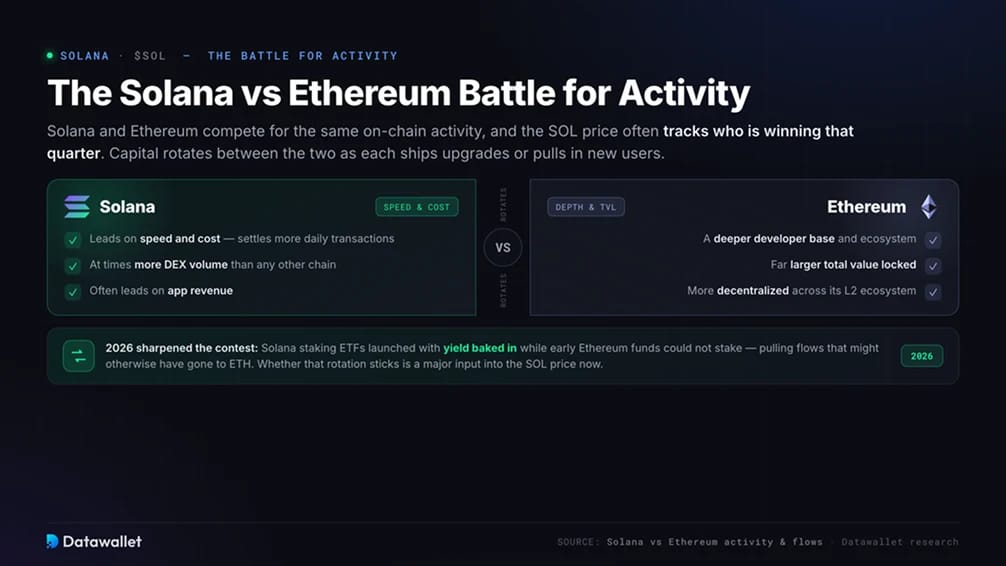
The Solana vs Ethereum Battle for Activity
Solana and Ethereum compete for the same on-chain activity, and the SOL price often tracks who is winning that quarter. Solana leads on speed and cost, settling more daily transactions and, at times, more DEX volume and app revenue than any other chain.
Ethereum counters with a deeper developer base, far larger total value locked, and a more decentralized validator set across its Layer 2 ecosystem. Capital rotates between the two as each ships upgrades or pulls in new users.
2026 sharpened the contest. Solana staking ETFs launched with yield baked in while early Ethereum funds could not stake, pulling flows that might otherwise have gone to ETH. Whether that rotation sticks is a major input into the SOL price now.
Risks That Shape the SOL Price
Several risks weigh on the SOL price, and holders should size positions with them in mind:
- No supply cap, so issuance keeps diluting holders who do not stake
- Reliability, since past outages still shape sentiment even as Firedancer cuts the single-client risk
- Activity concentration, with much on-chain volume riding memecoin and launchpad cycles that fade quickly
- Validator concentration and high hardware costs that pressure smaller operators and decentralization
- ETF and treasury flows that reverse fast, turning a tailwind into forced selling on a sharp down day
- Regulatory shifts, since the ETF staking-yield mechanic rests on a recent interpretive rule a future agency could revisit
- High beta to Bitcoin, so a broad drawdown tends to hit SOL harder than BTC
None of these are unique to Solana, but together they explain why SOL is more volatile than larger-cap assets.
A Short History of the Solana Price
Solana launched its mainnet beta in March 2020 with SOL near $0.50. A 2021 surge in DeFi, NFTs and cheap, fast transactions carried it above $250 for the first time.
The 2022 bear market and the FTX collapse, given FTX and Alameda's close ties to the ecosystem, drove SOL under $10 and led many to write the chain off. It recovered through 2023 and 2024 as the network stabilized and activity returned, hitting an all-time high near $294 in January 2025.
SOL has fallen by roughly half over the past year, trading near $72 in mid-2026, more than 70% below its peak even as ETFs and treasuries accumulate. To see where leveraged positions sit around the current SOL price and which levels could trigger the next cascade, use our live Solana liquidation heatmap.