





.png)
.png)



 All
All Binance
 Hyperliquid
 Bybit
Bybit HTX
HTX Gate
Gate OKX
OKX Bitget
 Aster
Aster Bitfinex
What Are Crypto Liquidations?
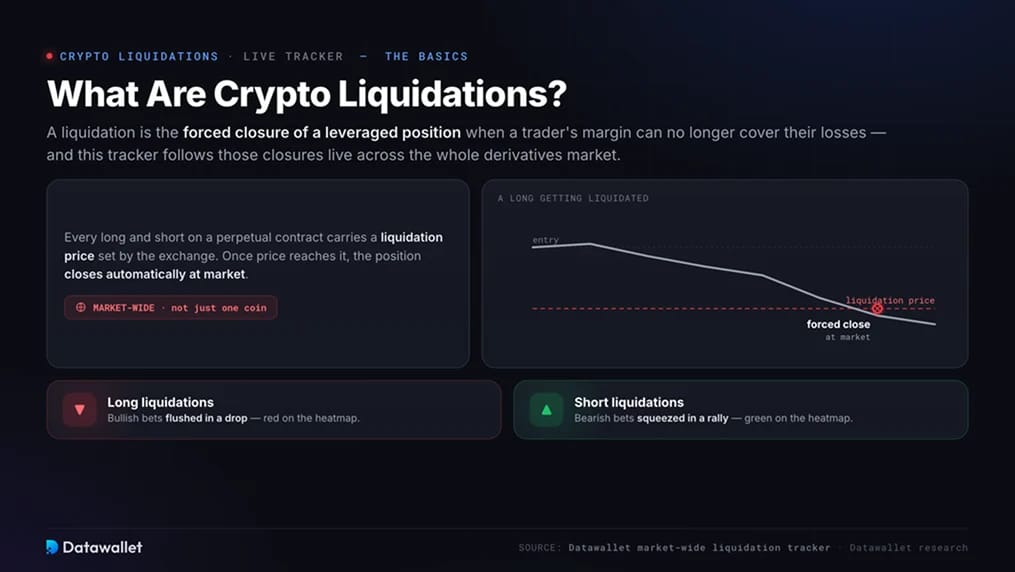
Crypto liquidations are the forced closure of leveraged positions when a trader's margin can no longer cover their losses. Every long and short on a perpetual futures contract carries a liquidation price set by the exchange, and once price reaches it the position closes automatically at market. This page tracks those forced closures live across the entire derivatives market, not just one coin.
The data spans several views of the same flow: a liquidation heatmap that sizes every asset by the value wiped out, an exchange table breaking the same activity down venue by venue, running totals for each timeframe, and a history chart that sets today against past cascades. Read together, they show which coins are taking the most damage, which exchanges are absorbing it, and whether longs or shorts are bearing the pain.
For a level-by-level view of where the next cluster sits on a single coin, the asset heatmaps for Bitcoin, Ethereum, Solana, and Hyperliquid drill into each market on its own.
How Crypto Liquidations Work
A liquidation is the forced closure of a leveraged position once its losses eat through the margin backing it. Knowing the mechanics is what separates a useful read from a scary number.
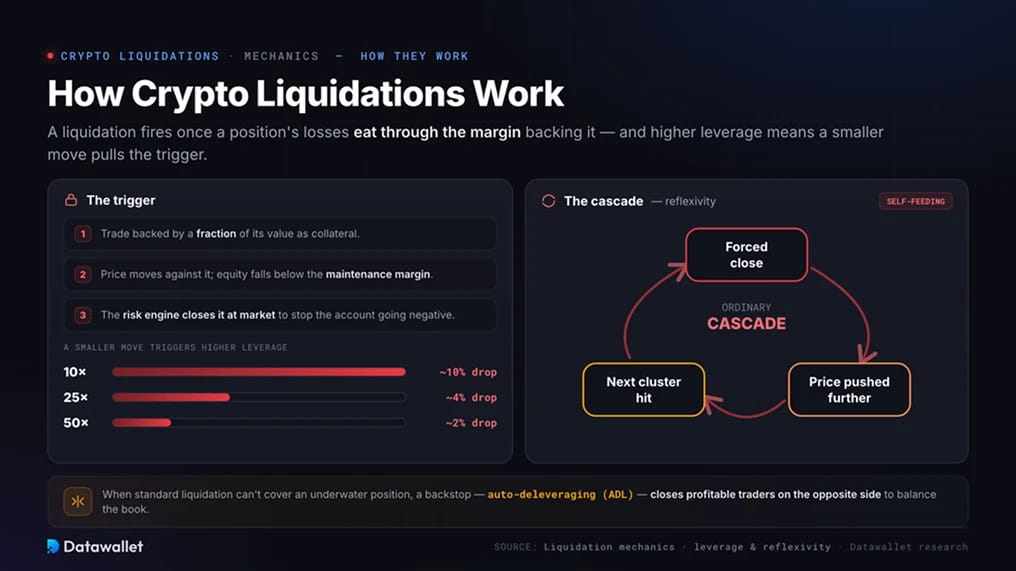
A leveraged trade is backed by a fraction of its value as collateral, and the exchange sets a maintenance margin the position must keep. If price moves against the trade and equity falls below that line, the risk engine closes the position at market to stop the account going negative. Higher leverage means a smaller move triggers it: a 10x long is liquidated by roughly a 10% drop, a 25x long by roughly 4%.
Liquidations move markets through reflexivity. A forced close is a market order pushing price the same way it is already moving, which drives the next cluster of positions through their own liquidation prices. That loop turns an ordinary sell-off into a cascade, and explains why so many of crypto's sharpest intraday moves trace back to leverage clearing rather than any shift in fundamentals. When standard liquidation cannot cover a position that has gone underwater, a backstop called auto-deleveraging (ADL) closes profitable traders on the opposite side to balance the book.
Direction tells you who is hurting. Long liquidations are bullish bets flushed in a drop. Short liquidations are bearish bets squeezed in a rally. When one side dominates, it reveals how the market was leaning before the move.
How to Read the Market-Wide Liquidations Data
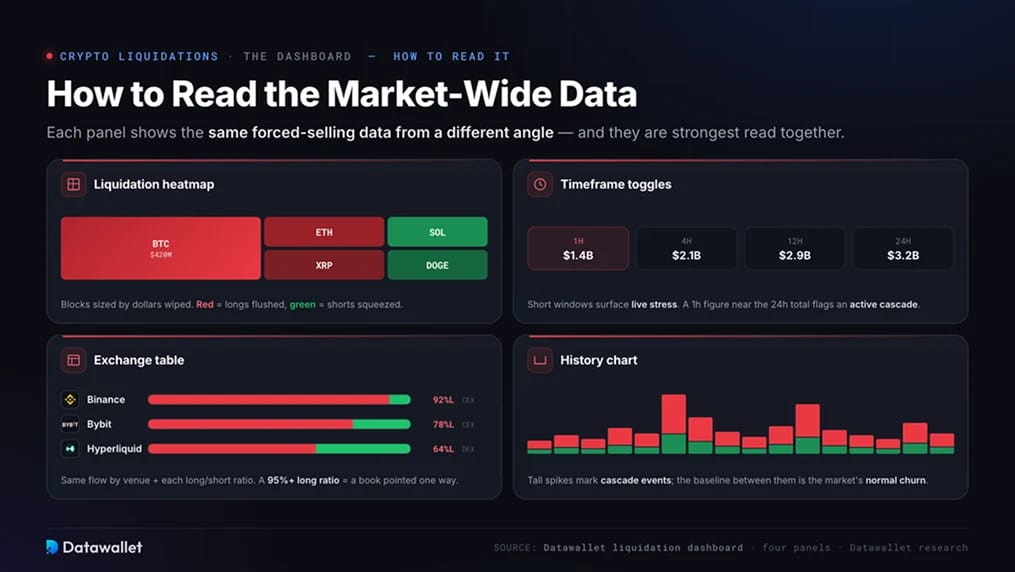
Each panel shows the same forced-selling data from a different angle, and they are strongest read together.
- The liquidation heatmap: Each block is sized by dollars liquidated over the selected window, so the biggest blocks mark where capital is being destroyed fastest. Red means longs being flushed; green means shorts being squeezed. A broad sell-off fills it red with BTC and ETH dominating; a short squeeze lights up green across the alts first.
- Timeframe toggles (1h / 4h / 12h / 24h): Short windows surface live stress; longer windows show whether a flush was one shock or a sustained grind. A 1h figure already near the 24h total flags an active cascade.
- The exchange table: The same liquidations by venue, with each one's long/short split and ratio. Binance, Bybit, and OKX are centralised; Hyperliquid, Aster, and Lighter are on-chain perpetual DEXs. A venue running a 95%+ long ratio had a book pointed almost entirely one way into the move.
- The history chart: Long and short liquidations over time. Tall spikes mark cascade events; the baseline between them is the market's normal churn. Comparing today against that baseline tells you whether a number is genuinely large.
Why Market-Wide Crypto Liquidations Matter
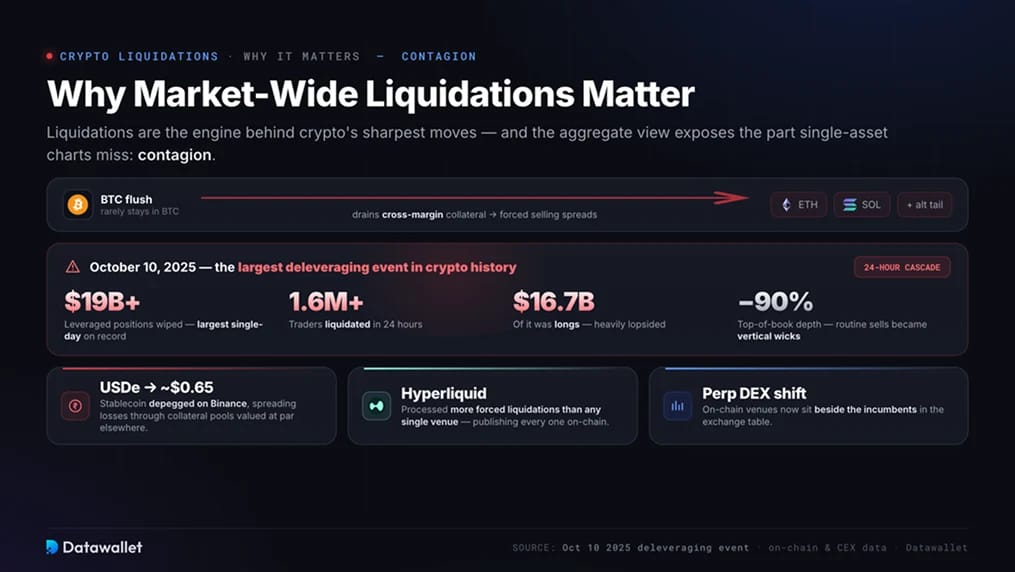
Liquidations are the engine behind crypto's sharpest moves, and the aggregate view exposes the part single-asset charts miss, which is contagion. Most leveraged books are correlated, so a flush in Bitcoin rarely stays in Bitcoin. It drains collateral from cross-margin accounts, forces selling in Ethereum, Solana, and the alt tail, and concentrates stress on whichever venues were most exposed.
The October 10, 2025 crash remains the clearest example and the largest deleveraging event in crypto history. A single tariff announcement tipped a market near record open interest into a cascade that wiped out more than $19 billion in leveraged positions in 24 hours, the largest single-day liquidation on record, hitting over 1.6 million traders. Roughly $16.7 billion of it was longs, leaving the market heavily lopsided.
A secondary trigger, the USDe stablecoin depegging to around $0.65 on Binance, spread losses through collateral pools that valued it at par elsewhere. Top-of-book depth on major venues fell more than 90% intraday, turning routine sell orders into vertical wicks.
The shift toward perpetual DEXs
Derivatives liquidations were a centralised-exchange story for most of crypto's history. That is no longer true. Perpetual DEXs now handle a large share of crypto futures activity, led by Hyperliquid, and on October 10 Hyperliquid processed more forced liquidations than any single venue while publishing every one on-chain. That transparency is why on-chain venues now sit beside the incumbents in the exchange table.
If you trade them, the best perpetual DEX and top futures exchange guides compare how their liquidation engines and fees differ.
A Note on Liquidation Data Accuracy
Most dashboards print their liquidation totals as hard numbers. They are not.
Since around 2021, the major centralised exchanges have capped their public feeds, with Binance, Bybit, and OKX pushing roughly one liquidation per second per contract instead of every event. During the bursts that matter most, when hundreds of positions clear per second, the public figure is a fraction of the real one. Bybit's own CEO put true liquidations in one 2025 sell-off near $8 to $10 billion against a reported $2 billion, and researchers at K33 have called the public data a vast understatement of actual volumes.
So read reported totals as a direction of travel rather than a precise count. They are reliable for spotting when leverage is clearing and which way the market leans, and weak as an exact dollar figure. On-chain venues like Hyperliquid are the exception, publishing every liquidation in full, which is partly why their reported share of any cascade looks so large.
Datawallet aggregates the best feed from each venue, though no public dataset captures the full picture in a genuine panic.
How to Trade Around Liquidation Data
Treat liquidation data as positioning context that sharpens other signals rather than a trigger on its own. The market-wide view helps with a few specific reads:
- Market-wide skew: When the heatmap and exchange tables run heavily red, the market is crowded long and exposed to a downside flush; a heavy green tilt means offside shorts and fuel for a squeeze. The aggregate ratio gauges crowding better than any single coin.
- Asset rotation: The biggest blocks show where leverage concentrated. Alts that liquidate far harder than BTC in percentage terms flag where speculative leverage stacked, and where the next move amplifies.
- Exchange divergence: When one venue's long/short ratio breaks from the rest, it can signal venue-specific positioning or a collateral problem, as the Binance USDe episode showed.
- Funding confluence: Liquidations read best next to funding rates and open interest. Rising open interest, extreme funding, and a one-sided liquidation tilt together is the classic crowded-trade setup before a violent unwind.
- Post-cascade voids: After a major event, the history chart shows leverage wiped out. Those flushed conditions often mark local capitulation, where forced selling has run its course, though deleveraging alone never guarantees a reversal.
Limitations and Risks
This models market structure. It does not record exact exchange data or predict price.
- Totals are estimated and under-reported: Public CEX feeds suppress real counts during the bursts that matter most, so use the figures directionally.
- Positioning is dynamic: A bright cluster or a heavy venue can change within hours as traders close, add margin, or rotate leverage.
- Venues differ: Centralised exchanges and on-chain DEXs run different liquidation engines, insurance funds, and ADL logic, and the aggregate blends them.
- Direction is not implied: The data shows where leverage is breaking and which side hurts, never which way price goes next. That depends on spot flow, ETF demand, and macro conditions outside the book.
- Liquidations lag the move: They confirm force was used. They do not tell you the move is finished.
Frequently Asked Questions
What counts as a liquidation?
A liquidation is the forced closure of a leveraged futures position when its losses fall below the exchange's maintenance margin. The exchange closes it at market to stop the account going negative, which makes it involuntary and different from a trader choosing to exit.
What is the difference between long and short liquidations?
Long liquidations are bullish positions force-closed in a price drop. Short liquidations are bearish positions squeezed in a rally. The balance between them across the market tells you which way leverage was leaning before the move.
Why is the reported liquidation total probably understated?
Most centralised exchanges cap their public feeds at roughly one liquidation per second per contract, so during fast cascades the real number runs several times higher than reported. Bybit's CEO and researchers at K33 have both flagged the gap. Treat headline totals as directional rather than precise.
Which exchanges show the most liquidations?
Binance, Bybit, and OKX long dominated the data. Since 2025, on-chain perpetual DEXs led by Hyperliquid have taken meaningful share and often post large volumes because they report every event on-chain. The exchange table reflects the current split.
Do large liquidations mean a reversal is coming?
Not reliably. Big liquidations often mark a washout that clears over-leveraged positions and can precede a bounce, but in a strong trend they are just a mid-move correction. Read them next to open interest and funding, never alone.