






 Tapbit
 Hyperliquid
 Coinbase Exchange
 Coinbase International Exchange
 OKX
OKX Bybit
Bybit CoinW
CoinW Gate
Gate Kraken
 DigiFinex
 Binance
 Bybit
Bybit Bitget
 OKX
OKX MEXC
MEXC Gate
Gate WhiteBIT
 KuCoin
 BingX
BingXWhat Moves the Hyperliquid Price
HYPE is the rare crypto token that trades more like a stock than a story. The exchange earns real fees, spends almost all of them buying HYPE back, and that programmatic bid sits under the price while scheduled unlocks push the other way.
The main drivers we track:
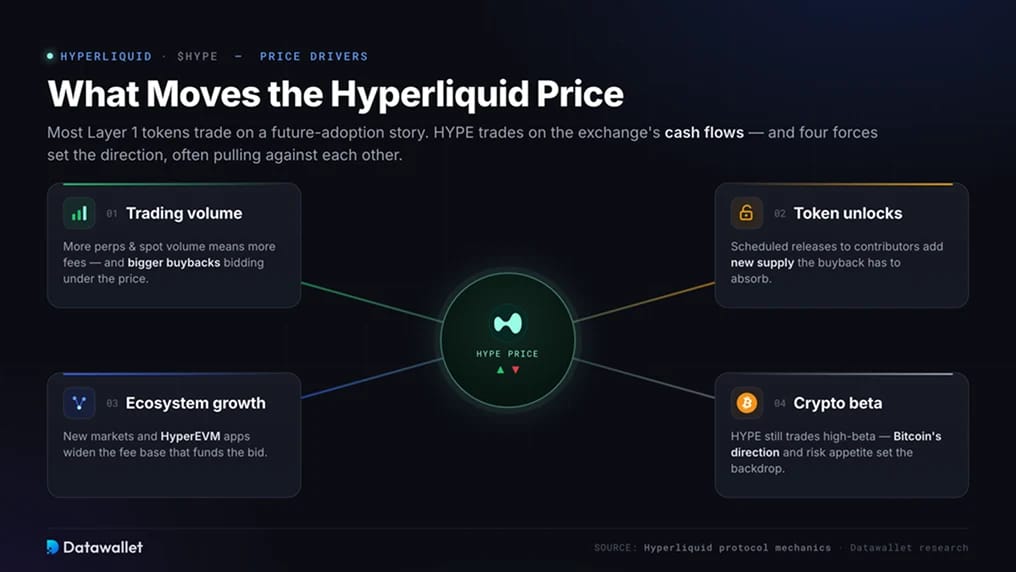
- The buyback flywheel, the demand floor, where almost all trading fees, about $1 million a day, buy HYPE on the open market, soon joined by a new stream routing USDC yield into the same bid.
- Trading volume, the ceiling on that bid, since buybacks only grow as fast as the roughly $1 billion a year the exchange earns.
- Token unlocks, the supply the buyback has to absorb, with monthly contributor releases into 2028 and a roughly $565 million unlock in June 2026.
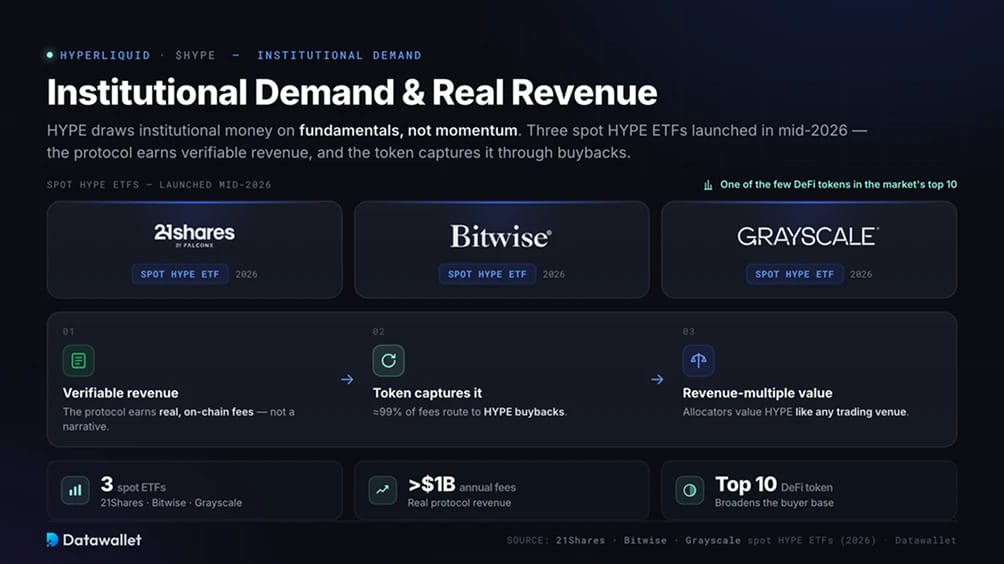
- Spot ETF demand, after Bitwise, 21Shares and Grayscale funds launched mid-2026 with one of the strongest debuts of any crypto ETF for its size.
- Treasury demand, led by Nasdaq-listed Hyperliquid Strategies (PURR), which trades near asset value because the buyback supports the token it holds.
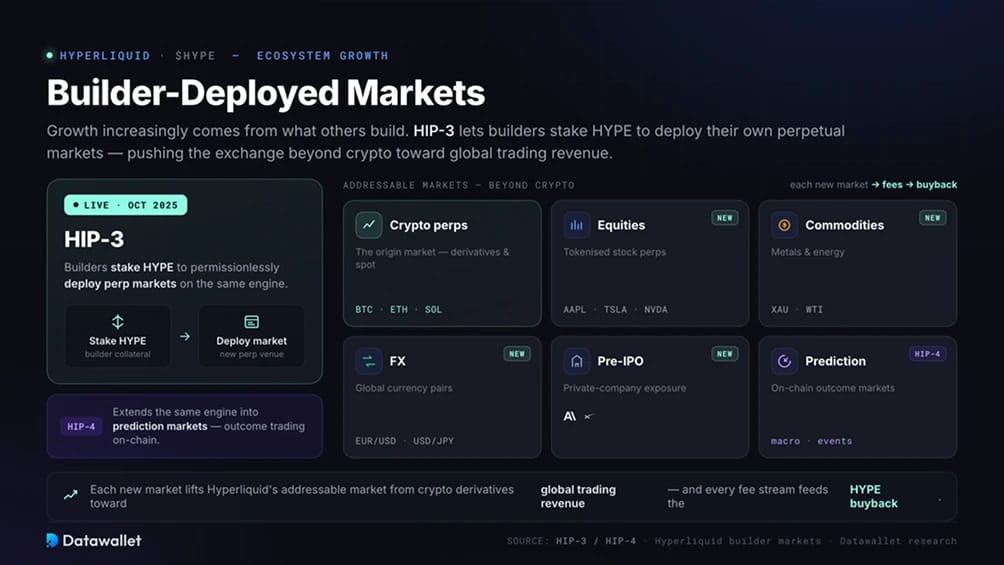
- Builder-deployed markets, where HIP-3 and HIP-4 widen the fee base into equities, FX, pre-IPO names and prediction markets.
- High beta to Bitcoin, so HYPE still swings with risk appetite and falls harder than the majors in a drawdown.
More than any major token, HYPE's price reads almost straight off the exchange's income statement. Rising volume funds bigger buybacks and lifts it, a weak quarter into a heavy unlock does the reverse, and the bid is only ever as strong as the next quarter of trading, which makes HYPE a leveraged bet on Hyperliquid continuing to win.
The HYPE Buyback Flywheel
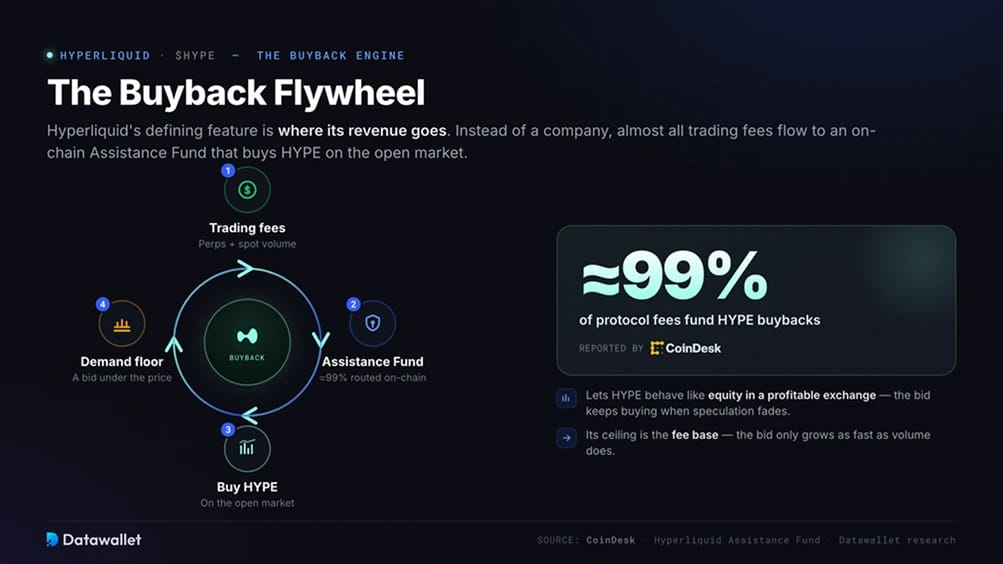
Hyperliquid's defining feature is where its revenue goes. Instead of a company, almost all trading fees flow to an on-chain Assistance Fund that buys HYPE on the open market. CoinDesk reports that roughly 99% of protocol fees fund buybacks, turning platform volume into steady, programmatic demand.
That model lets HYPE behave like equity in a profitable exchange. It also explains why HYPE held up through 2026's risk-off stretches while most altcoins sank, since the buyback keeps bidding when speculation fades. Its ceiling is the fee base, because the bid only grows as fast as volume does.
HYPE Supply, Unlocks and Float Tokenomics
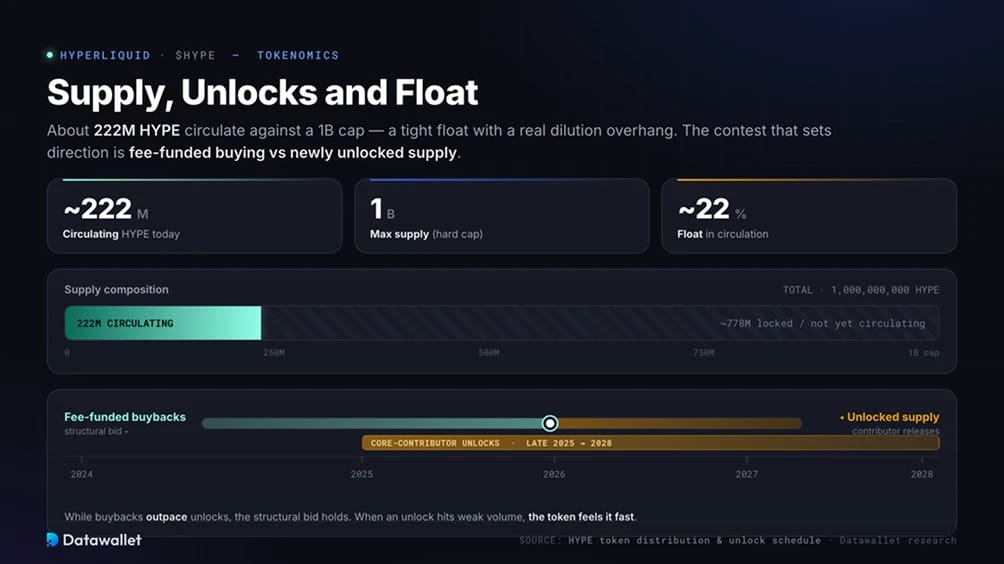
Around 222 million HYPE circulate against a one billion cap, so the float is tight and the dilution overhang is real. Core-contributor unlocks began in late 2025 and run through 2028, releasing tokens on a steady schedule the buyback has to offset.
A tight float sharpens rallies and deepens drawdowns. The contest that decides direction is fee-funded buying against newly unlocked supply. While buybacks outpace unlocks, the structural bid holds. When an unlock hits weak volume, the token feels it fast. Tracking the unlock calendar against daily fees shows which side has the upper hand.
One Hyperliquid Chain, Two Engines
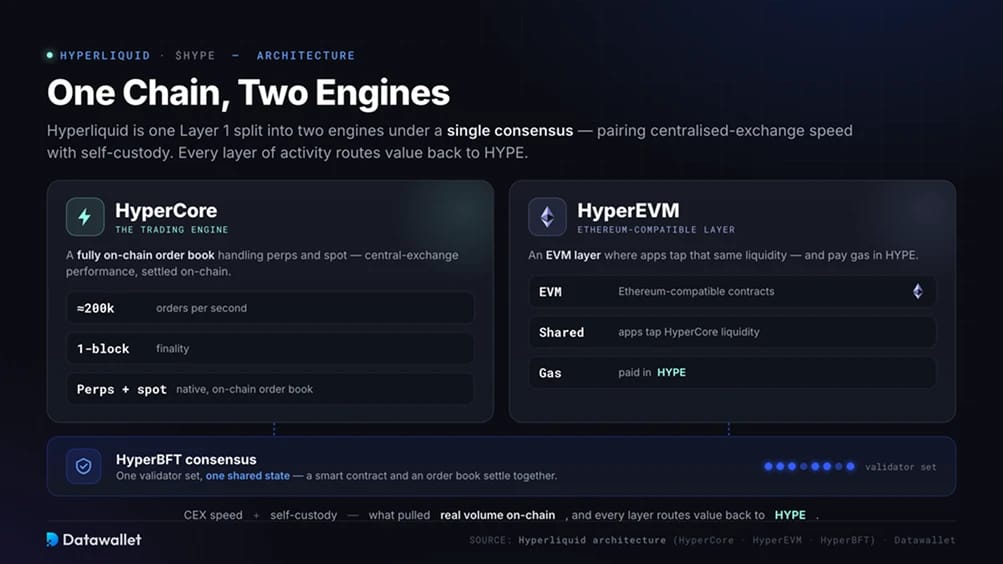
Hyperliquid is one Layer 1 split into two engines under a single consensus. HyperCore is the trading engine, a fully on-chain order book handling perps and spot at around 200,000 orders per second with one-block finality. HyperEVM is an Ethereum-compatible layer where apps tap that same liquidity and pay gas in HYPE.
Both run on the same HyperBFT validator set, so a smart contract and an order book settle against one state. That design pairs centralised-exchange speed with self-custody, which is what pulled real volume on-chain, and every layer of activity routes value back to HYPE. Our Hyperliquid explainer covers the full stack.
Builder-Deployed Markets and Ecosystem Growth
Hyperliquid's growth increasingly comes from what others build on it. HIP-3, live since October 2025, lets builders stake HYPE to deploy their own perpetual markets, pushing the exchange beyond crypto into equities, commodities, FX and pre-IPO names like Anthropic and SpaceX. HIP-4 extends the same engine into prediction markets.
Each new market is another fee stream feeding the buyback, and it lifts Hyperliquid's addressable market from crypto derivatives toward global trading revenue. The trade-off is added risk, since builder-deployed markets lean on staking, slashing and oracle design holding up under stress.
Institutional HYPE Demand and Real Revenue
Hyperliquid draws institutional money on fundamentals rather than momentum. Three spot HYPE ETFs launched in mid-2026 from 21Shares, Bitwise and Grayscale, and HYPE became one of the few DeFi tokens in the market's top ten. The pitch is simple: the protocol earns verifiable revenue, and the token captures it through buybacks.
For price, that widens the buyer base from crypto-native traders to allocators who value HYPE on revenue multiples, the way they would any trading venue. It also ties the token more tightly to risk sentiment, since ETF flows reverse as fast as they arrive. What matters now is whether fee revenue keeps growing into the valuation.
Risks That Shape the HYPE Price
HYPE carries risks the large-cap majors do not, to the same degree:
- Dilution: with circulating supply far below the one billion cap, unlocks through 2028 are a standing source of sell pressure;
- Regulation: the non-custodial, no-KYC model restricts the United States, Ontario and other jurisdictions, capping reach and inviting scrutiny (restricted countries);
- Validator concentration: an active set in the mid-20s is fast but more concentrated than larger proof-of-stake networks;
- Competition: centralised exchanges are moving into on-chain perps and newer venues undercut on fees, as our Hyperliquid vs Binance comparison shows.
None of these breaks the buyback thesis on its own, but each can cap upside or sharpen a drawdown. They are why HYPE stays a higher-risk position than the majors.
A Short History of the Hyperliquid Price
HYPE began trading near $4 at its November 2024 genesis, then closed the year around $35. It rallied through 2025 to a record near $59 in September as volume and revenue set highs, fell into the low $20s in early 2026 on broad altcoin weakness, and reached a fresh all-time high above $76 in June 2026.
Through all of it, HYPE has tracked the exchange beneath it. Volume records and the growing buyback drove the highs, market-wide risk-off drove the lows, and the tight float amplified both. Cumulative volume now runs into the trillions, annual fees have crossed a billion dollars, and Hyperliquid holds roughly 60% of on-chain derivatives open interest. Watch where leverage stacks on our live HYPE liquidation heatmap.