







Fees are one of the clearest reasons traders moved size onto Hyperliquid, but the structure runs deeper than a single maker and taker number. Volume tiers, staking, referrals, maker rebates, builder codes, and HIP-3 markets all change what you pay per fill.
Where the money goes differs from a centralized venue too. Instead of enriching a company, almost all of Hyperliquid's revenue is recycled into HYPE buybacks and burns, tying trading activity directly to the token.
Here is how every Hyperliquid fee works in 2026, and how to pay the least. 👇
How Do Hyperliquid Fees Work?
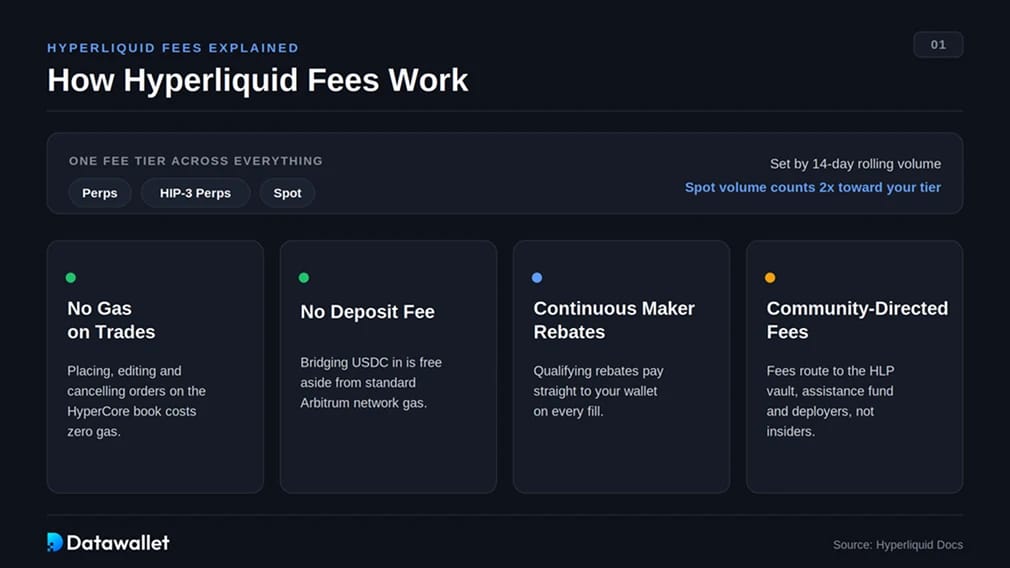
Your rolling 14-day volume sets your fees, assessed at the end of each day in UTC, per the official fee documentation. One tier applies across standard perps, HIP-3 perps, and spot, so activity in one market lowers costs everywhere.
Perps and spot use separate base schedules but share a single tier calculation. Spot volume counts double, using 14-day weighted volume = 14-day perps volume + 2 × 14-day spot volume. Sub-account volume rolls up to the master account, and all linked sub-accounts share the tier.
Several structural choices make Hyperliquid cheaper than the headline rates suggest:
- No gas on trades: Placing, modifying, and canceling orders on the HyperCore order book costs zero gas, so high-frequency quoting never bleeds fees on rejected fills.
- No deposit fee: Bridging USDC in is free aside from standard Arbitrum gas on your deposit transaction.
- Continuous maker rebates: When you qualify for a rebate, it pays directly to your wallet on each fill rather than being batched or claimed later.
- Community-directed fees: Fees route to the HLP vault, an assistance fund, and market deployers, not insiders, which is rare among exchanges.
New to order-book trading versus simple swaps? Our guide to perpetual versus spot trading is a useful primer before sizing positions.
Hyperliquid Perpetuals Fees
Perpetuals are Hyperliquid's core product and carry its lowest base rates. Takers start at 0.045% and makers at 0.015%, with both sides falling as 14-day volume climbs. At the top tiers, makers trade free and the largest makers earn a rebate.
The base perpetuals schedule below precedes any staking or referral discount, taken from Hyperliquid's published fee tiers.
In dollar terms, a $10,000 position costs $4.50 to open as a taker or $1.50 as a maker, so a taker round-trip runs about $9.00 before discounts. Posting resting limit orders with a post-only flag is the simplest way to guarantee the lower maker rate.
These rates sit near Binance and Bybit for takers while undercutting most decentralized rivals. For the wider picture, see our ranking of the best decentralized perpetuals exchanges.
Hyperliquid Spot Fees
Spot uses a higher base schedule, starting at 0.070% taker and 0.040% maker, but follows the same tiers and discounts. Since spot volume counts double toward your tier, active spot trading pulls your perp fees down faster than perps volume alone.
The base spot schedule is below, again before staking or referral discounts.
Two adjustments cut spot costs further. Pairs traded between two spot quote assets, such as stablecoin-to-stablecoin, get 80% lower taker fees, maker rebates, and volume contribution. Separately, aligned quote assets earn 20% lower taker fees, 50% better maker rebates, and 20% more volume contribution, so the quote asset you trade through changes your effective cost.
Hyperliquid HIP-3 Fees
HIP-3 went live on Hyperliquid mainnet in October 2025, letting anyone who stakes 500,000 HYPE deploy their own perpetual markets on HyperCore. These builder-deployed perpetuals inherit Hyperliquid's matching engine, margining, and liquidations, but carry their own fee economics.
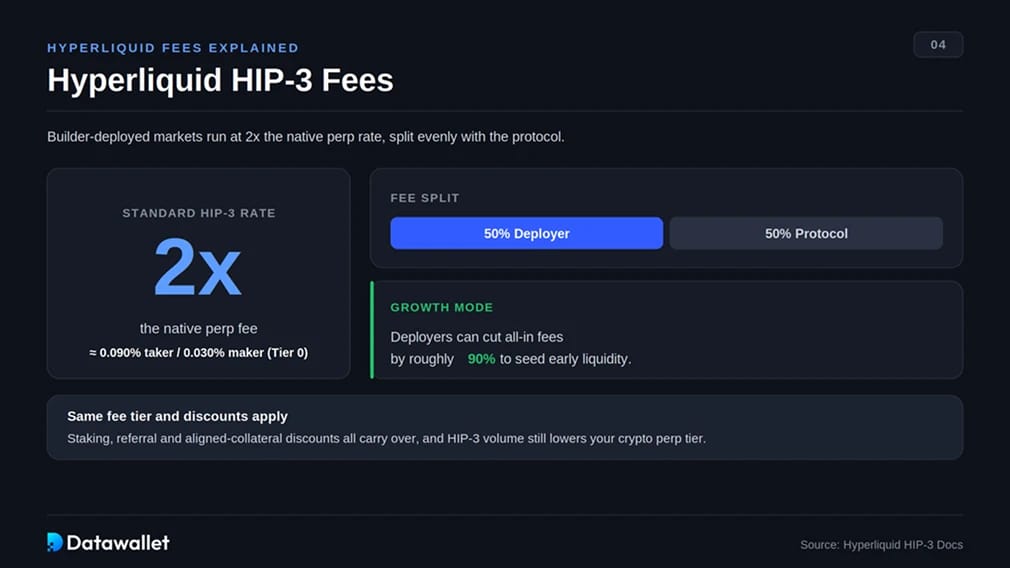
The headline difference is cost. The HIP-3 documentation sets standard fees at double the validator-operated rate, with the deployer keeping 50% and the protocol taking 50%. Hyperliquid collects the same fee it would on a native market while the deployer earns the rest. At Tier 0, that puts base HIP-3 fees near 0.090% taker and 0.030% maker before discounts.
The HIP-3 model has a few moving parts:
- Standard rate: HIP-3 assets default to double the native perp fee, split evenly between deployer and protocol.
- Growth mode: Deployers can enable growth mode on an asset, cutting protocol fees, rebates, and volume contribution by roughly 90% to attract early liquidity.
- Configurable share: Deployers set an extra fee share of 0% to 300% (0% to 100% in growth mode). Above 100%, the protocol fee rises to match.
- Discounts carry over: Staking, referral, and aligned-collateral discounts all still apply to HIP-3 markets.
Your single tier spans HIP-3 too, so trading stock or commodity perps still lowers the volume threshold for your crypto perp fees.
Stocks, Commodities & TradFi Fees
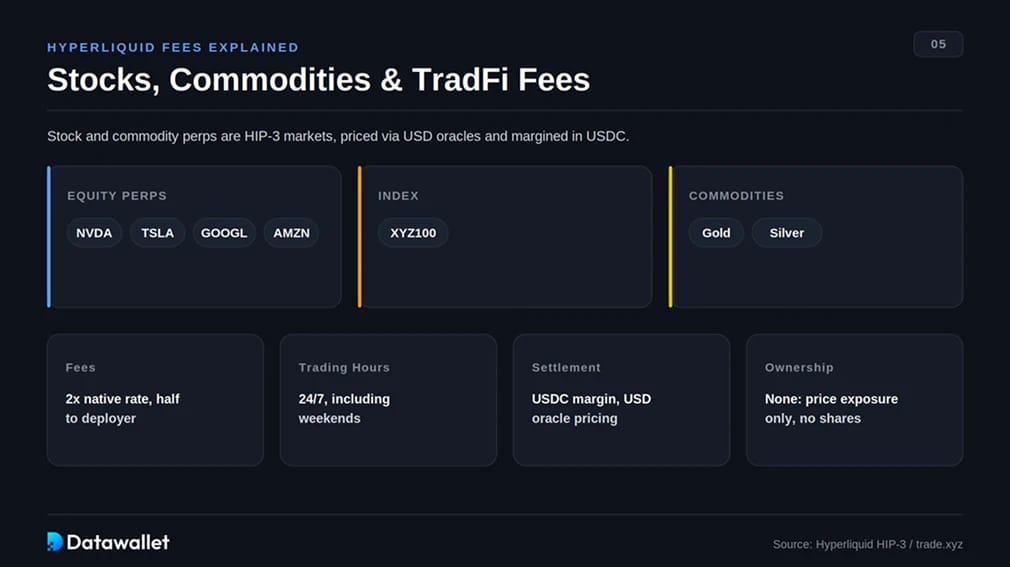
HIP-3's most visible use has been bringing traditional assets on-chain. trade.xyz, built by the Hyperunit team, became the first major deployer and now runs perpetuals on US equities such as NVDA, TSLA, GOOGL, and AMZN, a synthetic Nasdaq-style index (XYZ100), and commodities like gold and silver benchmarked to COMEX front-month futures. By May 2026, HIP-3 open interest hit roughly $2.5 billion, much of it in stocks and commodities rather than crypto.
For fees, these are HIP-3 perps, so the same rules apply: roughly double the native rate, half to the deployer, unless growth mode is on. A few specifics matter:
- USDC margin, USD oracles: Stock and commodity perps are margined in USDC and priced against off-chain oracles tracking the underlying, not actual shares or bullion.
- 24/7 trading: Markets like NVDA and TSLA trade around the clock, including weekends, though oracle prices can lag outside US market hours.
- No ownership: A stock perp is price exposure only, with no shares, dividends, or voting rights, the key distinction from buying equities through a broker.
- Variable leverage: Caps differ by market and are set by the deployer, often lower on newer or thinner equity perps than on BTC or ETH.
Because pricing leans on oracle accuracy and liquidity is thinner than crypto majors, check the live app for the current spread, funding, and leverage cap before entering.
Hyperliquid Funding Fees
Funding is not a fee Hyperliquid keeps. It is a periodic payment exchanged directly between longs and shorts to keep the contract price tethered to its index, and the protocol takes no cut.
Hyperliquid settles funding every hour, more frequent than the eight-hour cadence on most centralized venues, which shortens price dislocations. The rate combines a premium component, based on the perp-to-index gap, with a small fixed interest component, capped at 4% per hour in extreme conditions. Above index, longs pay shorts; below it, shorts pay longs. Track live rates across exchanges on our crypto funding rates tracker.
Deposit & Withdrawal Fees
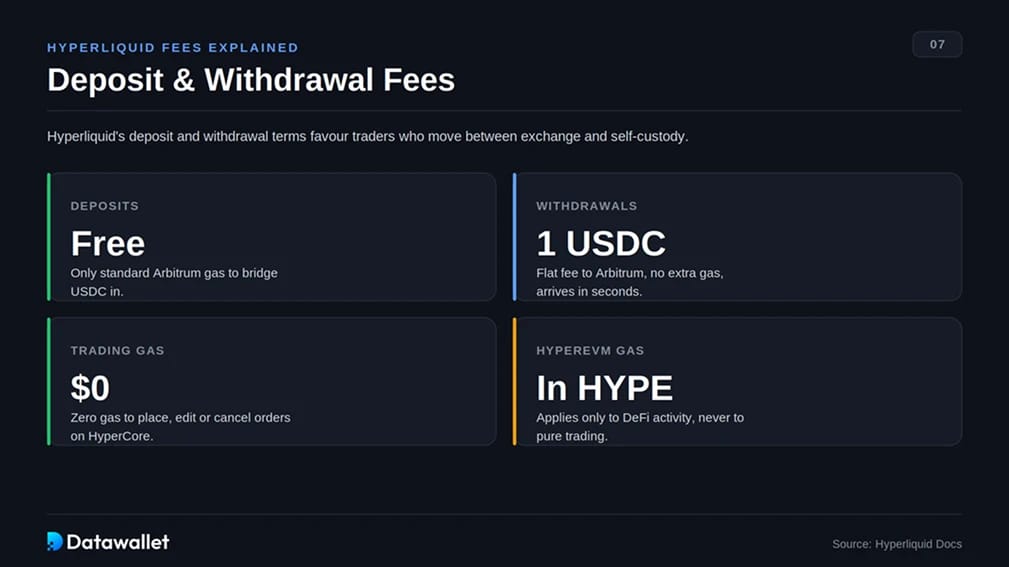
Hyperliquid's deposit and withdrawal terms favor traders who rotate between the exchange and self-custody.
- Deposits: Free on Hyperliquid's side. You only pay standard Arbitrum gas to bridge USDC in.
- Withdrawals: A flat 1 USDC is deducted from any USDC withdrawal to Arbitrum, with no separate gas, and funds usually arrive in seconds.
- Trading gas: Zero on the HyperCore order book for placing, editing, and canceling orders.
- HyperEVM gas: DeFi activity on HyperEVM, like lending or liquid staking, pays gas in HYPE. Pure trading never touches it.
These terms compound over time. A trader moving funds monthly pays a few dollars on Hyperliquid against tens or hundreds on venues that charge percentage-based or network-based withdrawals.
Builder Code Fees
Builder codes are an optional layer that third-party interfaces can charge on top of Hyperliquid's own fees, letting wallets, bots, and front-ends earn revenue for routing your order. They settle entirely on-chain.
The builder codes documentation caps the fee at 0.1% on perps and 1% on spot, and the user must pre-approve a maximum and can revoke it anytime. Builder codes apply to both sides of a perp trade but not the buying side of spot. Trade directly on the official Hyperliquid app and you pay no builder fee at all. At the ecosystem level the layer is significant, with third-party front-ends generating tens of millions in builder revenue.
Hyperliquid Fee Discounts
This is where Hyperliquid gets cheap. Several discounts stack on the volume schedule, and combining them can push effective fees toward zero.
HYPE Staking Discounts
Staking HYPE unlocks a percentage discount across both perps and spot, on top of your tier. It scales with the amount staked, per the fee documentation.
A Tier 0 wallet staking for the 40% Diamond discount pays an effective 0.027% taker fee instead of 0.045%. Because the discount multiplies against the volume tier, a high-volume staker reaches some of the lowest fees on any major venue. Staking can also be linked, attributing a separate wallet's HYPE to a trading wallet, though linking is permanent and hands the staking wallet control of the trading account.
Referral Discounts
A referral code gives a 4% discount on the first $25 million of volume across spot and perps. The referrer earns 10% of their referees' fees for each referee's first $1 billion in volume, and you can create your own code once your account passes $10,000 in volume. The discount does not extend to sub-accounts or vaults. Our Hyperliquid referral code guide covers activating one correctly.
Maker Rebates
The most aggressive discount goes to liquidity providers. When your share of venue maker volume is high enough, your maker fee flips negative, so Hyperliquid pays you to trade.
Stacked, the discounts compound. A referral code (4%) plus Bronze staking (10%) at Tier 0 brings a 0.045% taker fee to roughly 0.043%, and the savings widen sharply as volume and staking tiers rise.
Where Do Hyperliquid Fees Go?
Hyperliquid's fee destination is part of its appeal. On most exchanges, fees accrue to the company or insiders. Here the documentation states fees are directed entirely to the community, split between the HLP vault, an assistance fund, and market deployers.
The assistance fund is the centerpiece. Per DefiLlama, the large majority of perp and spot fees, excluding builder and deployer cuts, flow to it, where they convert to HYPE and burn, permanently cutting supply. A smaller share funds the HLP vault that backstops liquidity, and spot and HIP-3 deployers keep up to 50% of fees from their own assets. The buyback-and-burn runs at the protocol level against every fill, funding payment, and spot trade. With more than $1.2 billion in cumulative fees since launch, that flywheel has real scale.
Final Thoughts
Hyperliquid rewards traders who understand its fees. The base rates are competitive alone, but the edge comes from stacking the volume tier with HYPE staking, a referral code, and, for liquidity providers, maker rebates that pay you to quote. For most active retail traders, posting maker orders and staking even a small amount of HYPE meaningfully lowers cost.
Two areas deserve attention. Stock, commodity, and other HIP-3 perps run at double the native rate unless growth mode is active, and funding, while not a protocol fee, can outweigh maker and taker fees on a held position. Checking the live app for the current schedule, funding rate, and any builder fee before sizing a trade is the best habit, since Hyperliquid has revised its parameters several times since launch.
.webp)