What is Cash Cat (CASHCAT)?
Cash Cat is a memecoin deployed on Robinhood Chain, the Ethereum Layer 2 network that Robinhood switched on at its London keynote on 1 July 2026. Its name revives a real piece of Robinhood company history rather than a borrowed internet meme.
An anonymous developer launched the token days after mainnet, and it became the first breakout asset on the new network. Robinhood did not create it, does not list it, and states plainly that third-party projects on its permissionless chain carry no company endorsement.
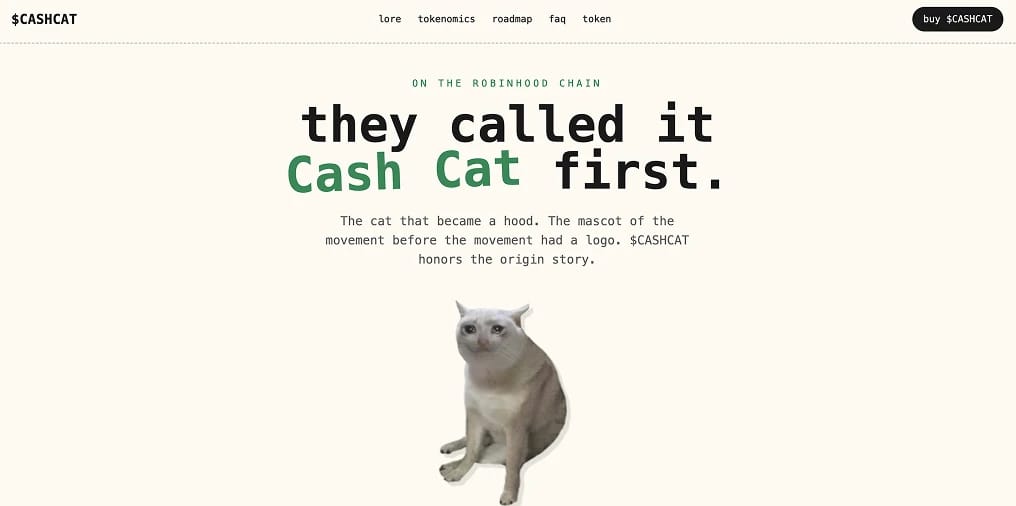
The project makes no pretence of substance. Its own website describes CASHCAT as "fan fiction with a ticker" and declares that the utility "is cat," a self-aware framing that helped it spread across crypto social media.
The token's value rests on narrative alone. There is no product, revenue, or roadmap, only a nostalgic link to a recognisable brand and the attention it generated during the chain's first weeks.
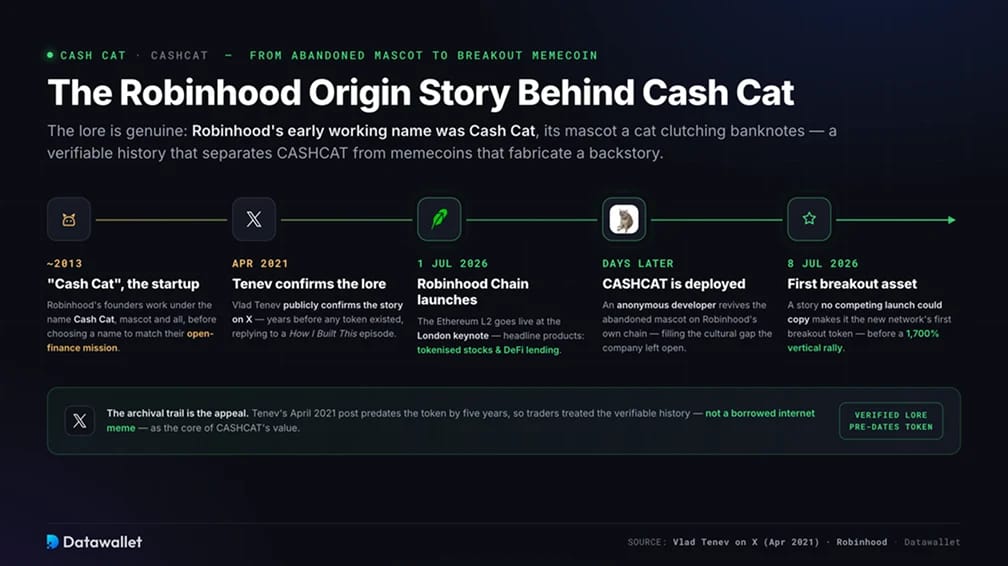
The Robinhood Origin Story Behind Cash Cat
The lore is genuine. Tenev has recounted in interviews that Robinhood's early working name was Cash Cat and its mascot was a cat clutching banknotes, before the founders chose Robinhood to match their mission of opening finance to small investors.
Tenev confirmed it publicly on X in April 2021, years before any token existed, while responding to a How I Built This podcast episode on the company's founding. That archival trail separates CASHCAT from memecoins that fabricate a backstory, and traders treated the verifiable history as the core of its appeal.
When Robinhood Chain launched with tokenised stocks and DeFi lending as its headline products, the community filled the cultural gap the company left open. Reviving the abandoned mascot on Robinhood's own chain gave the token a story no competing launch could copy.
How Does Cash Cat Work?
CASHCAT is a standard fungible token on Robinhood Chain, which is fully EVM-compatible, so it behaves like any ERC-20 asset. It sits in MetaMask or any Ethereum wallet once the network is added, as shown in our Robinhood Chain MetaMask guide.
The verified contract address is 0x020bfC650A365f8BB26819deAAbF3E21291018b4 on Robinhood Chain mainnet. Confirm that string before trading, because copycat tokens with the same name have appeared on Solana and other networks and have no connection to the original.
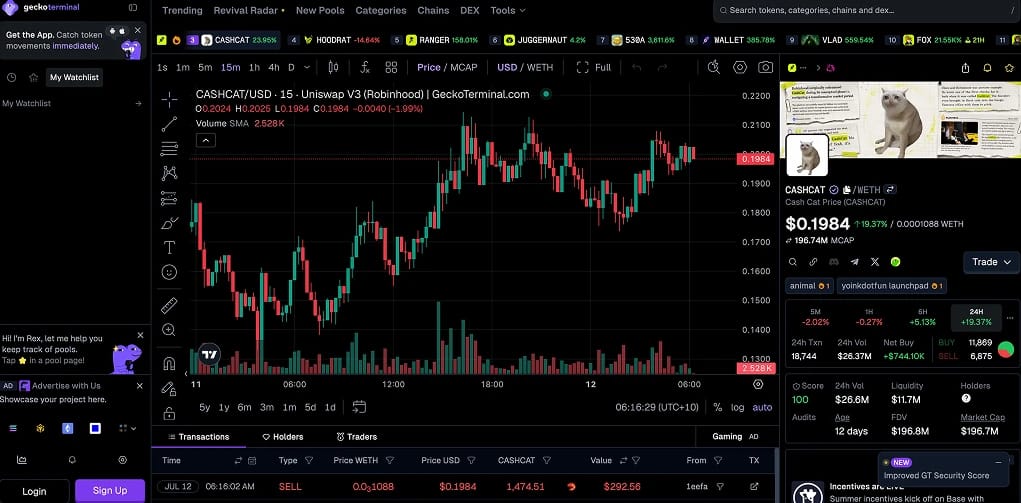
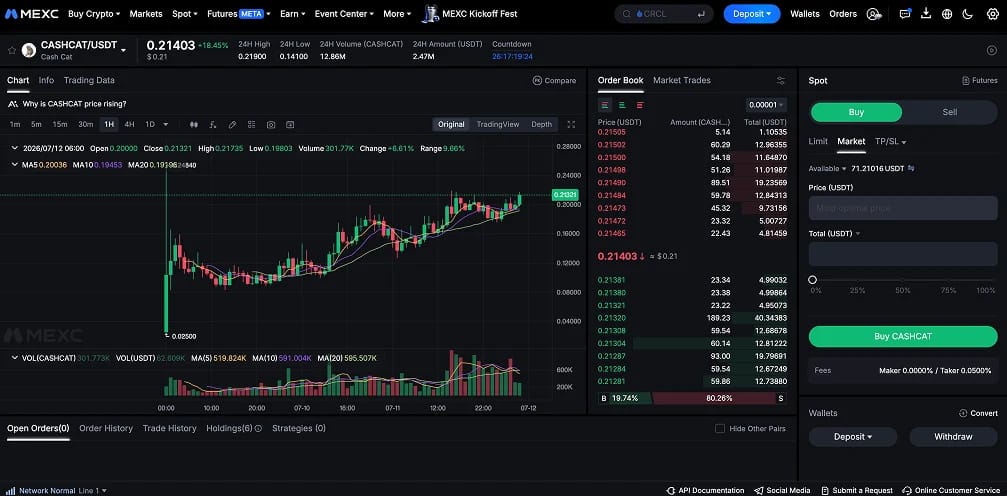
Most trading takes place on Uniswap V3 deployed on Robinhood Chain, where the CASHCAT/WETH pair has handled the bulk of volume since launch, per CoinGecko. MEXC added a centralised CASHCAT/USDT market on 8 July, and Pump.fun opened support for Robinhood Chain tokens the same day, letting its users trade without moving funds across networks first.
Cash Cat Tokenomics
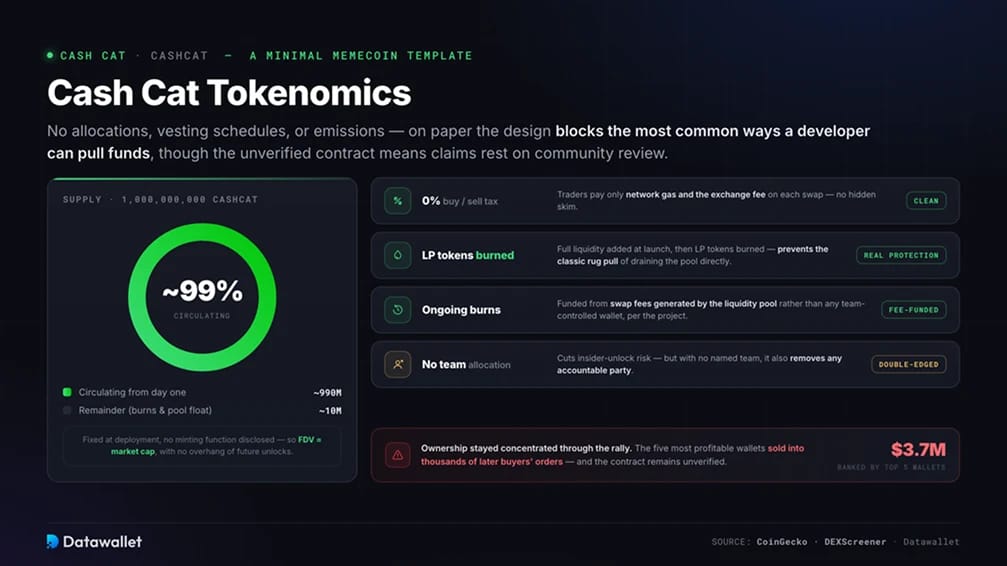
CASHCAT follows a minimal memecoin template with no allocations, vesting schedules, or emissions. On paper the design blocks the most common ways a developer can pull funds, though the unverified contract means the claims rest on community review rather than a formal audit.
Here is how the token's supply and structure break down:
- Total supply: 1 billion CASHCAT, fixed at deployment with no minting function disclosed, so the fully diluted valuation matches the market capitalisation.
- Circulating supply: Roughly 990 million tokens trade freely per CoinGecko, meaning close to the entire supply entered the market from day one.
- Transaction taxes: Buys and sells carry a 0% tax, so traders pay only network gas and the exchange fee on each swap.
- Liquidity: The deployer added the full liquidity pool at launch and burned the liquidity provider (LP) tokens, which prevents the classic rug pull of draining the pool directly.
- Burns: The project states that ongoing token burns are funded from swap fees generated by the liquidity pool rather than from any team-controlled wallet.
- Team allocation: None has been disclosed, and no named team exists, which cuts insider unlock risk but also removes any accountable party.
The structure looks clean for the category, and burned liquidity is a real protection. Even so, ownership stayed concentrated through the rally. The five most profitable wallets banked roughly $3.7 million between them while thousands of later buyers absorbed their sell orders.
The Vlad Tenev Effect and the July Rally
Tenev spent the chain's first week talking down the exact asset class that would define it. He told CNBC on 2 July that memecoins were largely a dead end because assets without utility serve no lasting purpose, pointing to tokenised real-world assets as crypto's durable direction.
Six days later, with CASHCAT already climbing, he posted that while Robinhood is building its chain to be the best for real-world assets, "it works great for memes too," and followed the token's X account. Markets read the reversal as tacit approval from the operator of the underlying network, and the price went vertical within hours.
Onchain trackers broadcast a handful of enormous early wins to millions of viewers, covered in the next section, and the publicity pulled fresh buyers into a pool that early holders were already selling into.
The frenzy lifted the whole network. Robinhood Chain recorded roughly $564 million in daily DEX volume on 8 July, briefly overtaking Hyperliquid. CASHCAT alone contributed about $98 million, and daily active addresses approached 200,000.
Cash Cat Early Wallets and the Crash
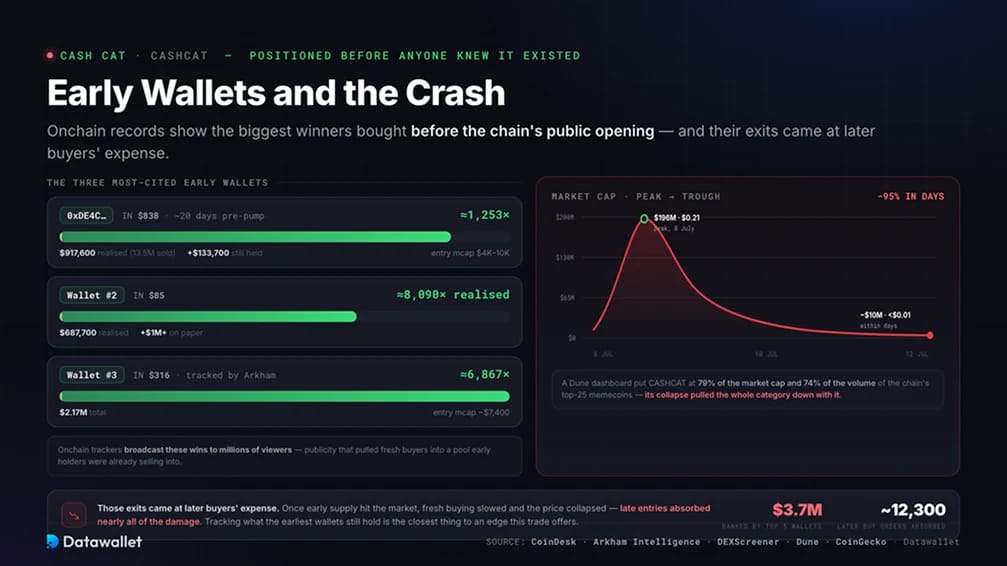
Onchain records show the biggest CASHCAT winners were positioned before almost anyone knew the token existed. The most cited wallet, ending in 0xDE4C, bought 15.04 million tokens for about $838 roughly 20 days before the 8 July pump, an entry at a market capitalisation between $4,000 and $10,000, before the chain's public opening on 1 July.
That wallet sold 13.5 million tokens for around $917,600 during the surge and kept 1.5 million worth roughly $133,700, a return near 1,253 times its stake. A second wallet ran $85 into about $687,700 realised plus over $1 million on paper, and Arkham Intelligence tracked a third that turned $316 into $2.17 million from an entry near a $7,400 market capitalisation.
Those exits came at later buyers' expense. DEXScreener shows the five most profitable wallets banked close to $3.7 million, selling into roughly 12,300 orders from traders who arrived after the pump. Once that early supply hit the market, the price fell from a peak near $0.21 and a $196 million market capitalisation to below $0.01 and roughly $10 million within days, per CoinGecko.
A Dune dashboard showed CASHCAT holding about 79% of the market capitalisation and 74% of the volume across the chain's top 25 memecoins, so its collapse pulled the whole category down with it. Tracking what the earliest wallets still hold is the closest thing to an edge this trade offers.
How to Buy Cash Cat
CASHCAT can be bought onchain through Uniswap on Robinhood Chain or through the centralised exchanges that listed it. Follow these steps for the onchain path:
- Set up MetaMask or another EVM wallet and add Robinhood Chain using Chain ID 4663.
- Fund the wallet with ETH for gas, through the official bridge or an aggregator, as covered in our guide to bridging to Robinhood Chain.
- Open Uniswap, connect your wallet, and select Robinhood Chain as the network.
- Paste the contract address 0x020bfC650A365f8BB26819deAAbF3E21291018b4 to load the genuine token.
- Enter your amount, review the slippage and price impact, and confirm the swap.
- The tokens appear in your wallet once the transaction settles, usually within seconds.
If you prefer a centralised venue, MEXC runs a CASHCAT/USDT spot pair, which removes the bridging and gas steps. Whichever path you choose, size the position as pure speculation rather than an investment.
Risks of Buying Cash Cat
CASHCAT trades on an infant chain with limited tooling and history, which sharpens every standard memecoin risk. Consider these before buying:
- Unverified contract: The smart contract has no published third-party audit, and aggregators flag it as unverified, so the safety claims around supply and burns rest on community inspection alone.
- Anonymous deployer: No team, company, or individual stands behind the token, leaving holders with no accountable party if something breaks or a hidden function surfaces.
- Extreme volatility: A 1,700% rise followed by a fall of more than 90% inside one week shows the realistic range of outcomes, and late entries absorbed nearly all of the damage.
- Copycats and scams: Lookalike Cash Cat tokens exist on other chains, impersonator accounts push fake contracts, and researchers have flagged honeypot tokens elsewhere on Robinhood Chain that trap buyers' funds.
- Thin liquidity: Depth concentrates in one main trading pair, so exits during a sell-off can suffer heavy slippage or fail to fill anywhere near the quoted price.
- No Robinhood backing: The company has confirmed no affiliation, so any expectation of a listing, integration, or rescue rests on hope rather than any stated plan.
Memecoins with strong communities have recovered from worse drawdowns, so a rebound stays possible, but CASHCAT belongs in the highest-risk bracket of an already speculative category.
What Cash Cat Means for Robinhood Chain
The episode handed Robinhood a strange first chapter. The company built its chain for tokenised stocks and onchain lending, yet the asset that brought 140,000 first-time users in a single day was a cat token its CEO had dismissed the week before.
The precedent is familiar. Coinbase pitched Base as infrastructure for serious onchain applications, then watched memecoins and social speculation supply its early activity while the intended ecosystem matured, and Robinhood Chain appears to be tracing the same curve.
Speculation has costs as well as benefits. Researchers estimate memecoins drove more than 75% of the chain's recent trading, and the surrounding scam activity, including honeypots and cloned tokens, pressures Robinhood to improve user protections without abandoning the permissionless design that made the frenzy possible.
CASHCAT proved a week-old network can host nine-figure speculative volume, and that proof will draw the next wave of launches to Robinhood Chain regardless of where this particular cat lands.
Final Thoughts
Cash Cat compressed an entire memecoin life cycle into ten days, from anonymous deployment through a CEO-fuelled vertical rally to a collapse of more than 90%. Few assets have demonstrated narrative-driven speculation so quickly or so publicly.
The token still holds the strongest story on its chain, a genuine origin myth that no rival can replicate, and attention could return if Robinhood Chain keeps growing. Anyone trading it should verify the contract, expect violent swings, and treat every dollar committed as money they can afford to lose.