





 CoinUp.io
 Binance
 Deribit Spot
 Coinbase Exchange
 Coinbase International Exchange
 BTCC
BTCC Toobit
 OrangeX
 KuCoin
 Tapbit
 Binance
 Gate
Gate Bybit
Bybit Hyperliquid
 Bitget
 MEXC
MEXC OKX
OKX WhiteBIT
 KuCoin
 BingX
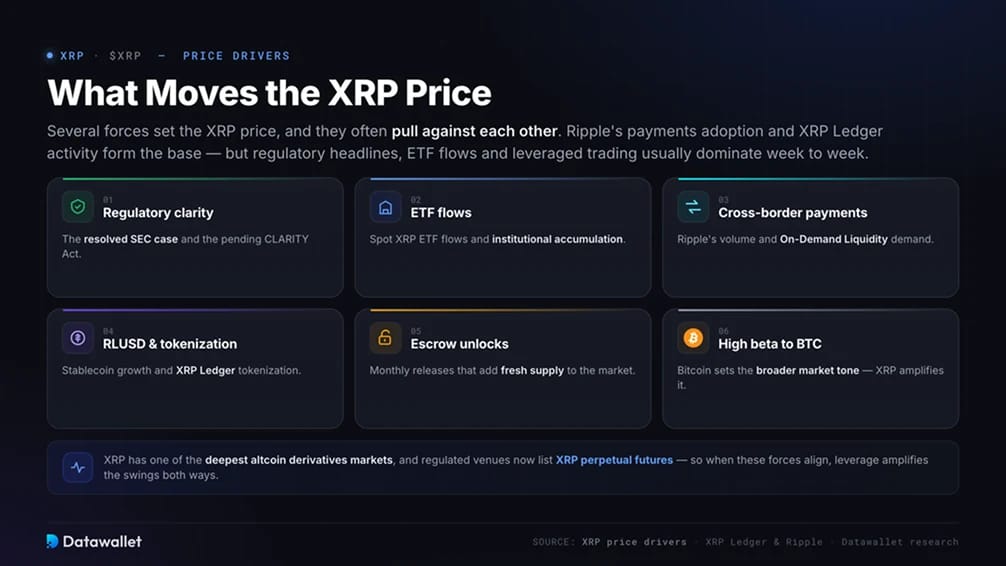
BingXWhat Moves the XRP Price
More than almost any major crypto, XRP moves on what Washington does next. With the SEC case settled and spot ETFs live, the price now hangs on the CLARITY Act and on whether Ripple's fast-growing business actually needs XRP at all.
The main drivers we track:
- The CLARITY Act, the dominant swing catalyst, which cleared the House and a Senate committee but is not yet law, with a White House push for mid-2026 and real risk of slipping past the November midterms.
- Spot ETF demand, where XRP funds have pulled over $1.4 billion since late 2025 and kept drawing capital while Bitcoin and Ethereum funds bled, a bid that can reverse fast on a sharp down day.
- The utility gap, where Ripple's own RLUSD now settles most ledger activity and XRP earns only a fee far too small to move supply.
- RLUSD and XRPL tokenization, with the stablecoin near $1.7 billion and on-ledger real-world assets past $2 billion after deals like the JPMorgan, Mastercard and Ondo Treasury settlement.
- Escrow unlocks, since Ripple can release up to 1 billion XRP a month, steady supply that caps rallies even when demand holds up.
- Treasury company demand, the newest source of buying, led by Evernorth raising over $1 billion to accumulate and actively manage roughly 470 million XRP.
- High beta to Bitcoin, so a broad drawdown hits XRP harder than BTC.
The pattern of 2026 has been catalysts landing and XRP barely responding, because the wins keep accruing to Ripple and RLUSD rather than the token. A durable move higher likely needs the CLARITY Act to pass in full, or Ripple's corridors to push real settlement volume back onto XRP instead of its stablecoin.
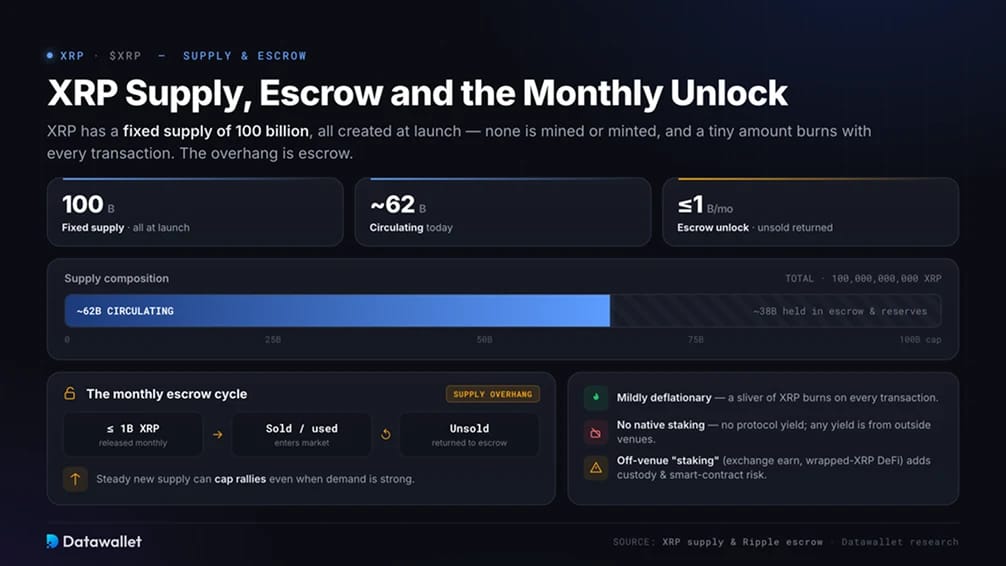
XRP Supply, Escrow and the Monthly Unlock
XRP has a fixed supply of 100 billion, all created at launch. None is mined or minted, and a tiny amount burns with every transaction, making the asset mildly deflationary over time. Circulating supply sits near 62 billion.
The overhang is escrow. Ripple holds a large share of XRP in escrow and can release up to 1 billion per month, returning whatever it does not sell. Markets watch these unlocks closely, since steady new supply can cap rallies even when demand is strong.
Unlike proof-of-stake coins, XRP has no native staking, so there is no protocol yield. Any yield comes from outside venues like exchange earn programs or wrapped-XRP DeFi, which add custody and smart-contract risk. We break down those options in our XRP staking guide.
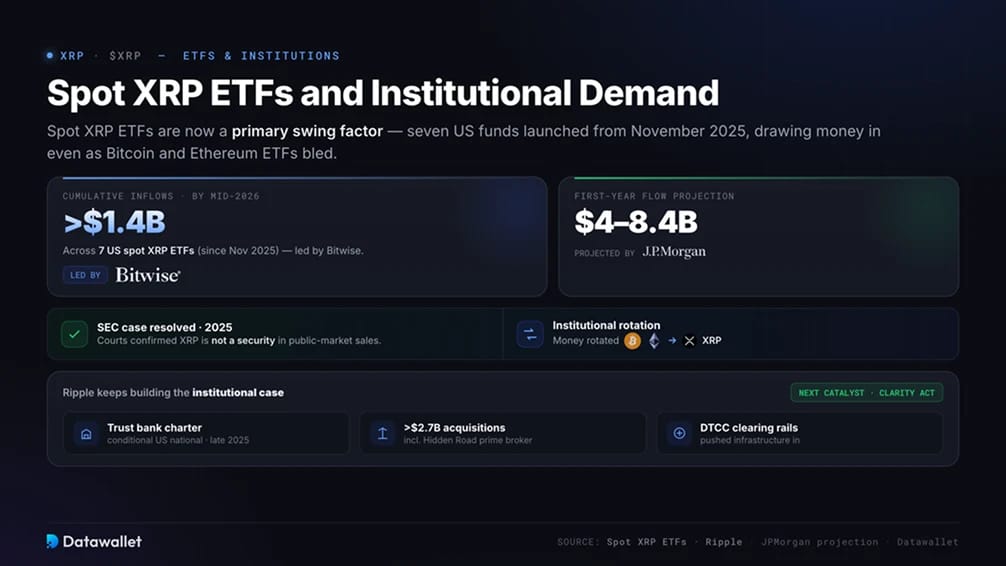
Spot XRP ETFs and Institutional Demand
Spot XRP ETFs are now a primary swing factor for the price. Seven US funds launched from November 2025, led by Bitwise, drawing more than $1.4 billion in cumulative inflows by mid-2026, with money rotating in even as Bitcoin and Ethereum ETFs bled. JPMorgan projects $4 billion to $8.4 billion in first-year flows.
These products followed the end of the SEC case. Ripple's lawsuit with the SEC concluded in 2025, with both sides dropping appeals and courts confirming XRP is not a security in public-market sales. That clarity let asset managers file and regulators approve.
Ripple keeps building the institutional case. It won a conditional US national trust bank charter in late 2025, spent over $2.7 billion on acquisitions including prime broker Hidden Road, and pushed its infrastructure into the DTCC's clearing rails. The pending CLARITY Act, which would classify XRP as a digital commodity, is the next catalyst traders watch.
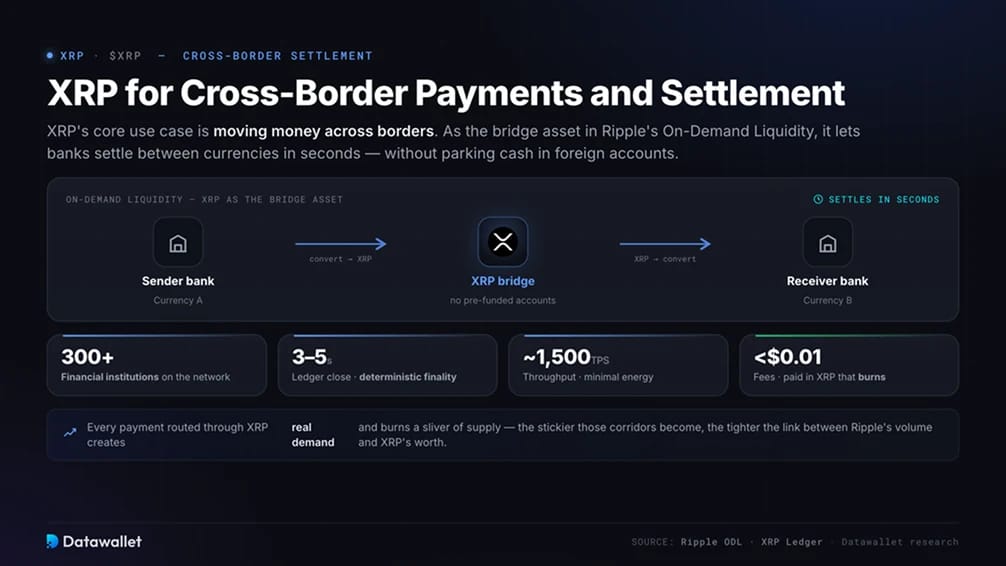
XRP for Cross-Border Payments and Settlement
XRP's core use case is moving money across borders. As a bridge asset in Ripple's On-Demand Liquidity, it lets banks and payment firms settle between currencies in seconds without parking cash in foreign accounts. Ripple's network reaches over 300 financial institutions targeting the multi-trillion-dollar remittance and settlement market.
The XRP Ledger is built for this. Ledgers close every 3 to 5 seconds with deterministic finality, throughput runs near 1,500 transactions per second, and fees cost fractions of a cent, paid in XRP that burns. No mining means energy use stays minimal.
Every payment routed through XRP creates real demand and burns a sliver of supply. The stickier those corridors become, the tighter the link between Ripple's volume and XRP's underlying worth.
RLUSD, Tokenization and the XRP Ledger
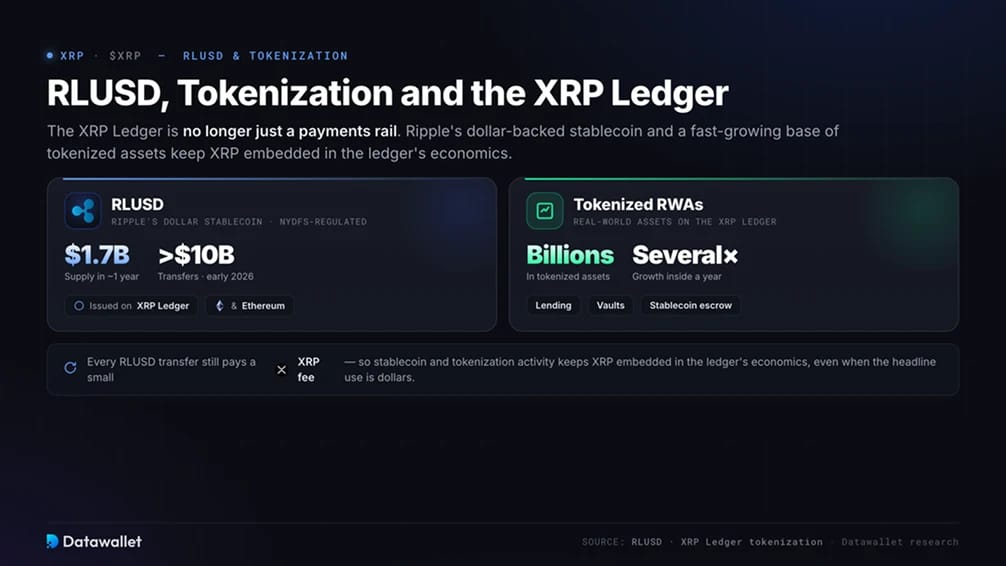
The XRP Ledger is no longer just a payments rail. RLUSD, Ripple's dollar-backed stablecoin, launched in late 2024 and passed $1.7 billion within about a year, regulated by New York's financial regulator and issued on both the XRP Ledger and Ethereum. It moved well over $10 billion in transfers in early 2026 alone.
Tokenized real-world assets are the other growth area. The XRP Ledger now holds billions in them, up several-fold inside a year, alongside new features for lending, vaults and stablecoin escrow. Our RLUSD explainer covers the stablecoin in detail.
Every RLUSD transfer still pays a small XRP fee, so stablecoin and tokenization activity keeps XRP embedded in the ledger's economics even when the headline use is dollars, not the token.
The Utility Debate Around XRP
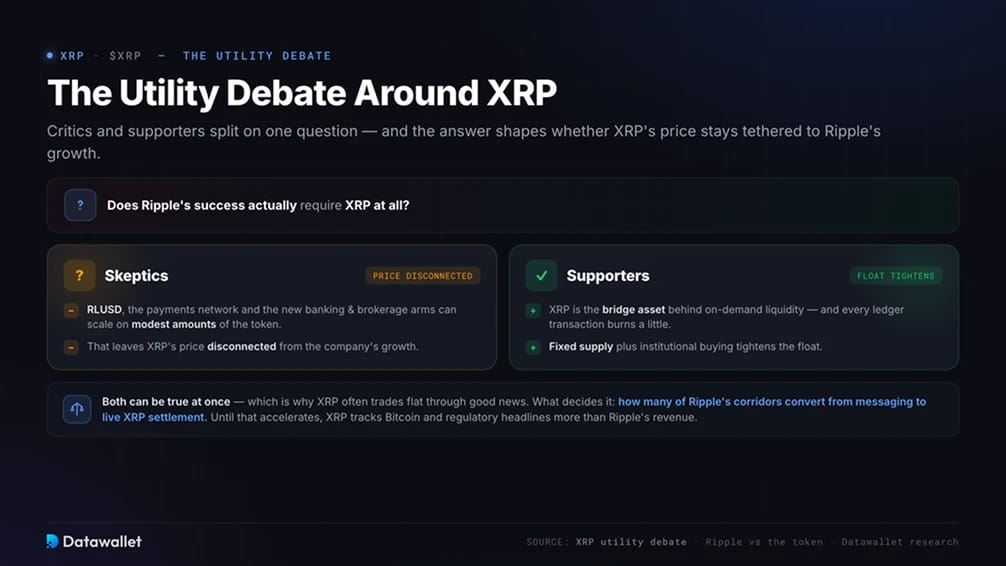
Critics and supporters split on one question: does Ripple's success require XRP at all? Skeptics argue that RLUSD, the payments network and the new banking and brokerage arms can scale on modest amounts of the token, leaving its price disconnected from the company's growth.
Supporters counter that XRP is the bridge asset behind on-demand liquidity, that every ledger transaction burns a little, and that fixed supply plus institutional buying tightens the float. Both can be true at once, which is why XRP often trades flat through good news.
How many of Ripple's corridors convert from messaging to live XRP settlement decides this. Until that accelerates, XRP tracks Bitcoin and regulatory headlines more than Ripple's revenue.
Risks That Shape the XRP Price
Several risks weigh on the XRP price, and holders should size positions with them in mind:
- Escrow overhang, since Ripple can release up to 1 billion XRP a month
- Ownership concentration, with Ripple's escrow and large whale wallets holding much of the supply
- The utility gap, if Ripple's business grows without driving proportional XRP demand
- Regulatory risk, since the CLARITY Act is not yet law and future agency action could revisit the asset's status
- Competition from other stablecoins, payment rails and faster correspondent banking
- ETF flows that reverse quickly, turning a steady bid into selling on a sharp down day
- High beta to Bitcoin, so a broad drawdown hits XRP harder than BTC
None of these are unique to XRP, but together they explain why the token can lag even when headlines look bullish.
A Short History of the XRP Price
The XRP Ledger launched in 2012, and XRP traded for fractions of a cent in its early years, hitting an all-time low near $0.003 in 2014. The 2017 bull market was its first breakout, lifting XRP from under a cent to a record high in the mid-$3 range in January 2018.
The years that followed were defined by the SEC. The agency sued Ripple in December 2020, capping XRP until the case concluded in 2025, with courts confirming XRP is not a security on public exchanges. That resolution sparked a rally back toward the old peak, near $3.66 in July 2025, before XRP gave most of it back.
XRP has since fallen by roughly half over the past year to near $1.15 in mid-2026, well below its high even as ETFs accumulate. Whether it breaks higher now hinges on real XRP demand catching up with Ripple's institutional progress.