







What is Ripple's RLUSD Stablecoin?
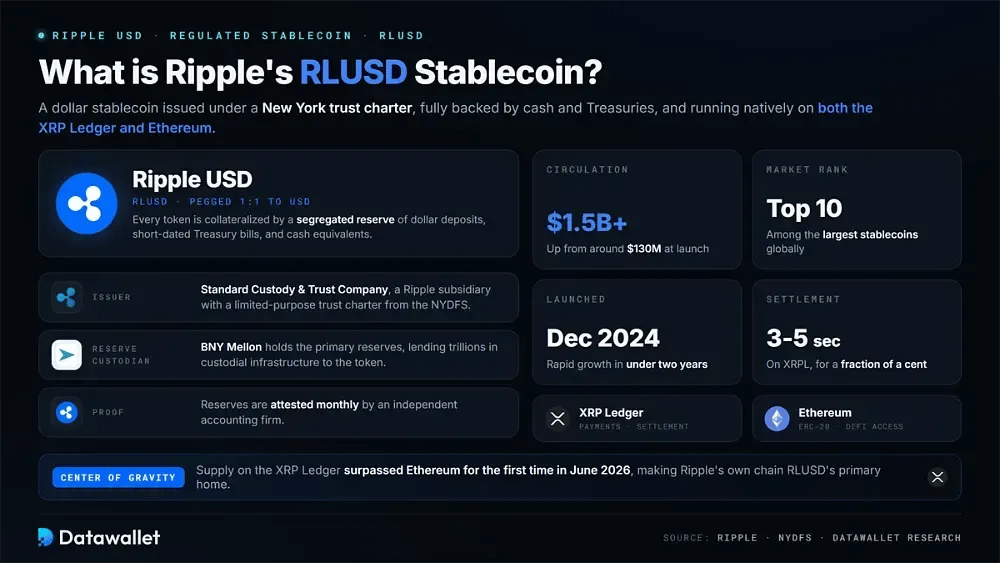
Ripple USD (RLUSD) is a stablecoin pegged one-to-one to the US dollar and issued by Standard Custody & Trust Company, a Ripple subsidiary holding a limited-purpose trust charter from the New York Department of Financial Services. It runs natively on both the XRP Ledger and Ethereum, bridging Ripple's payments network with Ethereum's DeFi ecosystem.
Every token is fully collateralized by a segregated reserve of US dollar deposits, short-dated Treasury bills, and cash equivalents. Reserves are attested monthly by an independent accounting firm, and in a major credibility signal, banking giant BNY Mellon now serves as the primary reserve custodian, lending its trillions in custodial infrastructure to Ripple's stablecoin.
The dual-chain design shapes how RLUSD is used. On the XRP Ledger transactions settle in three to five seconds for a fraction of a cent, ideal for payments and settlement, while the Ethereum version follows standard ERC-20 mechanics, plugging into lending markets, decentralized exchanges, and smart-contract applications.
Since its December 2024 launch, RLUSD has grown rapidly, climbing from around $130 million to more than $1.5 billion in circulation and ranking among the ten largest stablecoins globally. Notably, supply on the XRP Ledger surpassed Ethereum for the first time in June 2026, signaling that Ripple's own chain is becoming RLUSD's center of gravity.
How Does RLUSD Stablecoin Work?
RLUSD maintains its dollar peg through a straightforward mint-and-burn model, where tokens are created only when dollars are deposited and destroyed when redeemed. The three sections below break down issuance, peg stability, and cross-chain movement.
1. Minting and Redemption
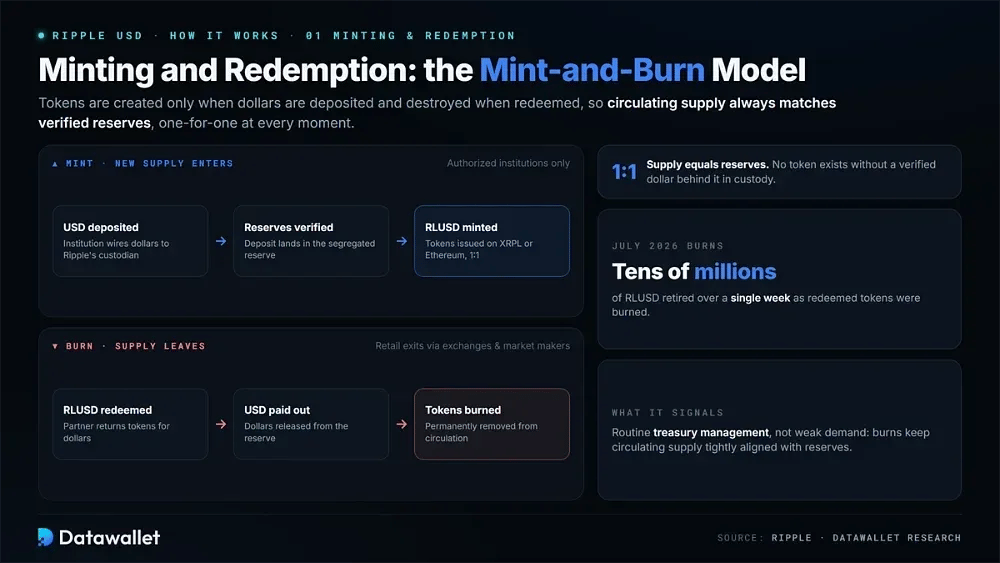
New RLUSD enters circulation only when an authorized institution deposits an equivalent sum of US dollars with Ripple's custodian, which mints tokens on the requested blockchain. This ensures circulating supply always matches verified reserves held in custody, one-for-one at every moment.
Redemption reverses the process. Institutional partners with direct agreements redeem RLUSD for dollars, after which the returned tokens are burned and permanently removed from supply. Retail holders typically redeem indirectly through exchanges and market makers rather than dealing with the issuer directly.
Ripple actively manages this supply, and in July 2026 it burned tens of millions of RLUSD over a single week as redeemed tokens were retired. These burns reflect routine treasury management rather than any weakness in demand, keeping circulating supply tightly aligned with reserves.
2. Maintaining the Dollar Peg
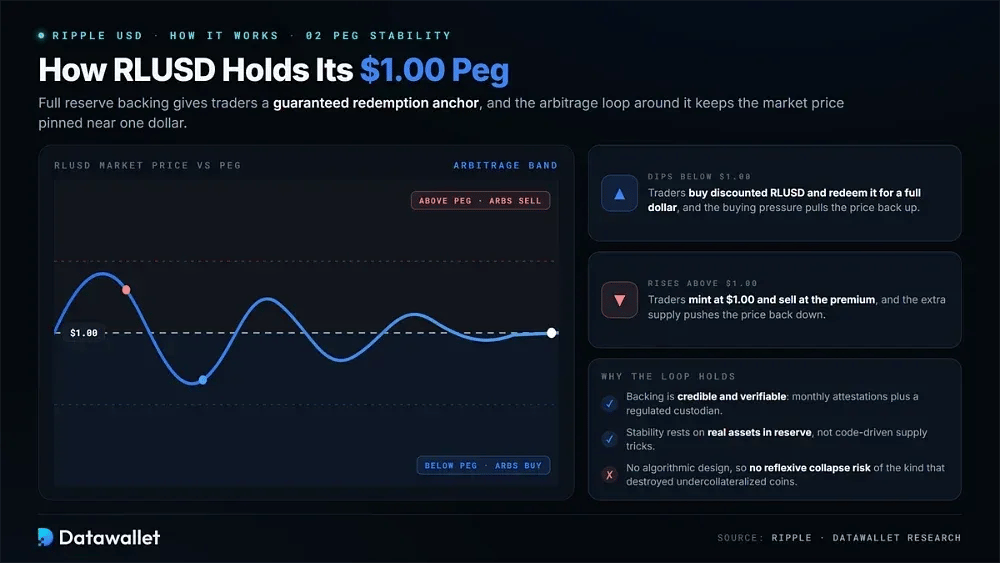
RLUSD holds its value through a combination of full reserve backing and market arbitrage. Because every token is redeemable for a dollar, traders have a clear incentive to correct any deviation, buying RLUSD when it dips below a dollar and selling when it rises above.
This arbitrage loop keeps the price anchored near $1.00 across exchanges. The mechanism only works because the backing is credible and verifiable, which is why monthly attestations and a regulated custodian matter so much to maintaining confidence in the peg.
Unlike algorithmic stablecoins that rely on code-driven supply adjustments, RLUSD's stability rests entirely on real assets held in reserve. This design avoids the reflexive collapse risk that has destroyed undercollateralized stablecoins in the past.
3. Moving RLUSD Across Chains
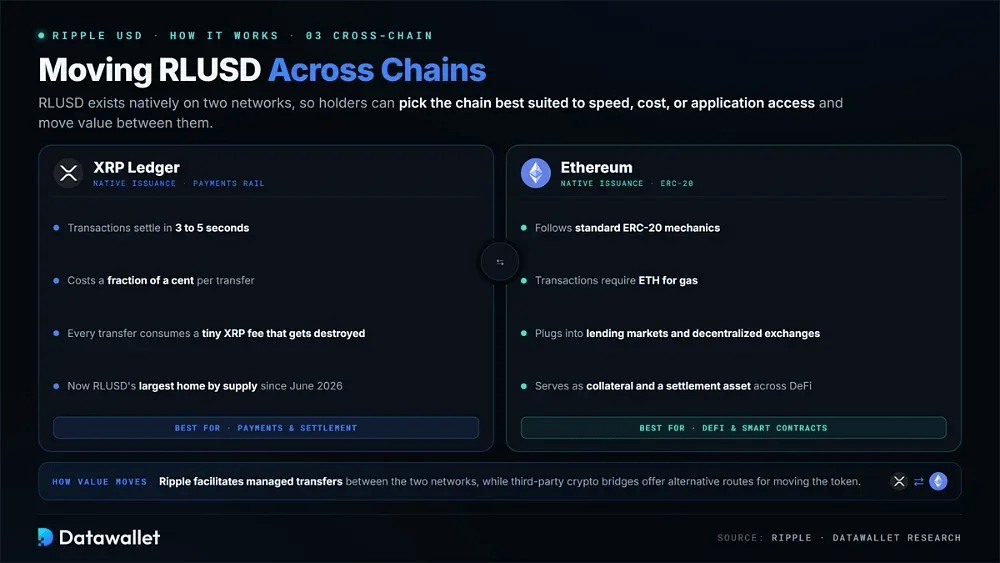
Because RLUSD exists natively on two blockchains, holders can move value between the XRP Ledger and Ethereum depending on their needs. Ripple facilitates managed transfers, while third-party crypto bridges offer alternative routes for moving the token across networks.
Each network handles fees differently. On the XRP Ledger, every RLUSD transfer consumes a tiny XRP fee that gets destroyed, while Ethereum transactions require ETH for gas. This dual-chain flexibility lets users pick the network best suited to speed, cost, or application access.
How to Buy RLUSD
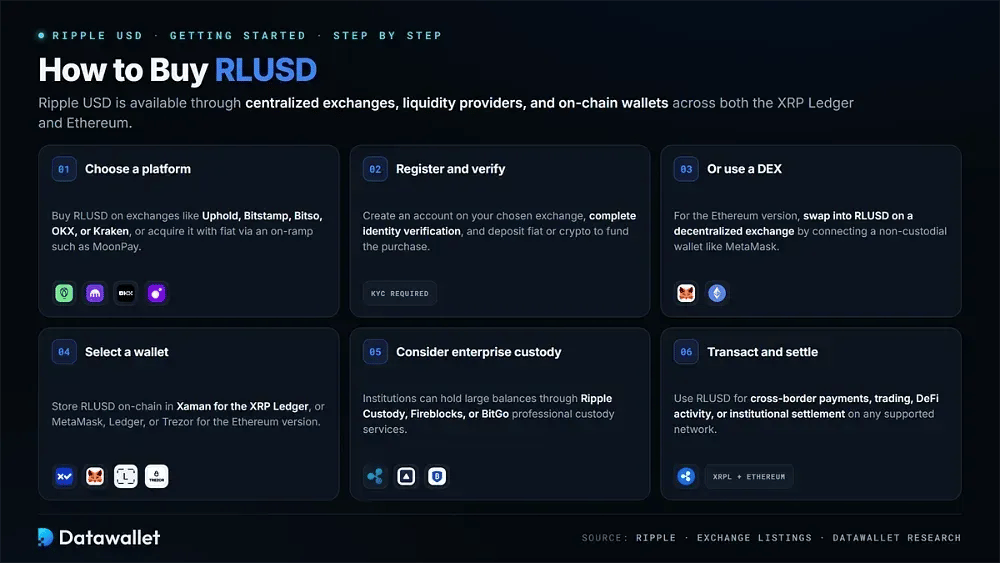
RLUSD is available through centralized exchanges, liquidity providers, and on-chain wallets across both the XRP Ledger and Ethereum. The steps below cover how to purchase, store, and use Ripple USD safely:
- Choose a platform: Buy RLUSD on exchanges like Uphold, Bitstamp, Bitso, OKX, or Kraken, or acquire it directly with fiat through an on-ramp provider such as MoonPay.
- Register and verify: Create an account on your chosen exchange, complete identity verification, and deposit fiat or crypto to fund your purchase.
- Use a decentralized exchange: For the Ethereum version, swap into RLUSD on a DEX by connecting a non-custodial wallet like MetaMask directly to the platform.
- Select a wallet: Store RLUSD on-chain in a compatible wallet such as Xaman for the XRP Ledger, or MetaMask, Ledger, or Trezor for the Ethereum version.
- Consider enterprise custody: Institutions can hold RLUSD securely through professional custody providers including Ripple Custody, Fireblocks, or BitGo for large balances.
- Transact and settle: Use RLUSD for cross-border payments, trading, DeFi activity, or institutional settlement across any supported platform or network.
Reserves, Custody, and Transparency
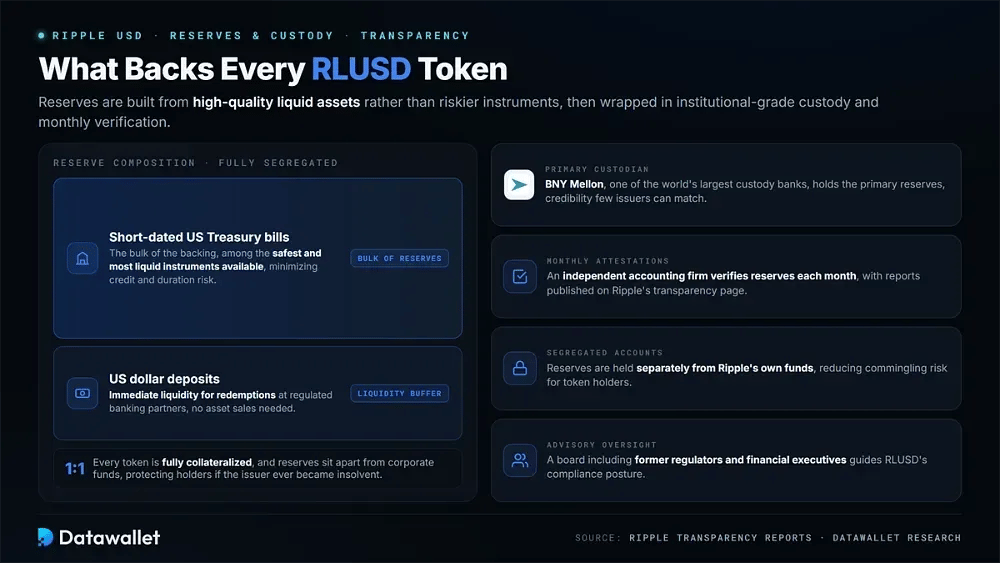
Ripple built RLUSD around institutional-grade backing, and its reserve structure is central to the token's pitch. Every token is supported by high-quality liquid assets rather than riskier instruments, distinguishing it from other stablecoins that have faced reserve scrutiny.
The reserve composition and oversight break down as follows:
- Cash deposits: A portion of reserves sits in US dollar deposits at regulated banking partners, providing immediate liquidity for redemptions without needing to sell any assets.
- Treasury bills: The bulk of backing is held in short-dated US government Treasuries, among the safest and most liquid instruments available, minimizing both credit and duration risk.
- BNY Mellon custody: The primary reserve custodian is BNY Mellon, one of the world's largest custody banks, bringing institutional credibility that few stablecoin issuers can match.
- Monthly attestations: An independent accounting firm verifies the reserves each month, with reports published on Ripple's transparency page so anyone can confirm full backing.
- Segregated accounts: Reserves are held separately from Ripple's corporate funds, protecting token holders in the event of issuer insolvency and reducing commingling risk.
- Advisory oversight: A board including former regulators and financial executives guides RLUSD's compliance posture, reinforcing its regulation-first positioning with institutions.
RLUSD Regulatory Stance and Compliance
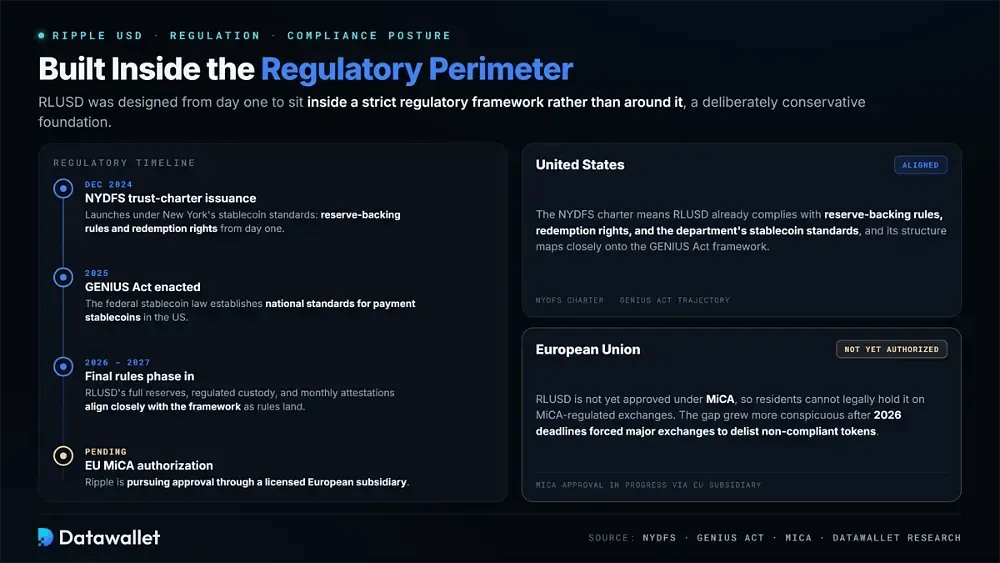
RLUSD was designed from day one to sit inside a strict regulatory perimeter rather than around it. Its NYDFS trust-charter issuance means it complies with reserve-backing rules, redemption rights, and the department's stablecoin standards, a deliberately conservative foundation.
The US regulatory picture strengthened considerably with the GENIUS Act, the federal stablecoin law enacted in 2025 that establishes national standards for payment stablecoins. RLUSD's existing structure, full reserves, regulated custody, and monthly attestations, aligns closely with the GENIUS Act framework as final rules phase in through 2026 and 2027.
Europe remains the notable gap. RLUSD is not yet authorized under the EU's Markets in Crypto-Assets regulation, so residents cannot legally hold it on MiCA-regulated exchanges, and Ripple is pursuing approval through a licensed European subsidiary. That absence became more conspicuous after MiCA's 2026 deadlines forced major exchanges to delist several non-compliant tokens.
What is the Relationship Between RLUSD and XRP?
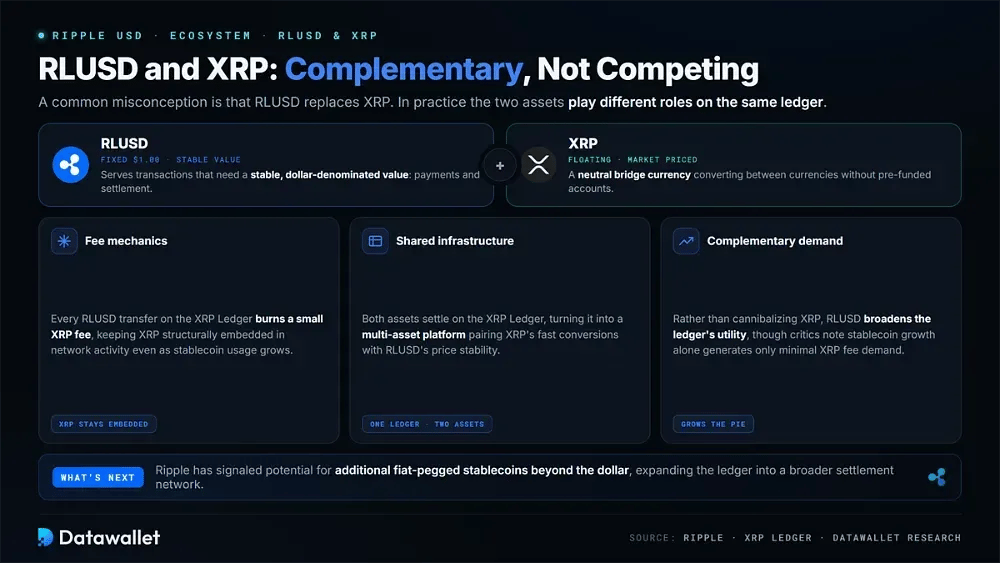
A common misconception is that RLUSD replaces or competes with XRP, when in practice the two assets play complementary roles on the same ledger. Understanding the distinction clarifies how Ripple's ecosystem fits together.
The key differences and connections are:
- Price behavior: RLUSD holds a fixed dollar value for stable payments and settlement, while XRP floats freely as a market-priced digital asset used for liquidity and bridging.
- Bridge function: XRP acts as a neutral bridge currency, converting between two currencies without pre-funded accounts, whereas RLUSD serves transactions that specifically need a stable, dollar-denominated value.
- Fee mechanics: Every RLUSD transfer on the XRP Ledger still burns a small XRP fee, keeping XRP structurally embedded in network activity even as stablecoin usage grows.
- Shared infrastructure: Both assets settle on the XRP Ledger, turning it into a multi-asset platform where institutions can pair XRP's fast conversions with RLUSD's price stability.
- Complementary demand: Rather than cannibalizing XRP, RLUSD broadens the ledger's utility, though critics note that stablecoin growth alone generates only minimal XRP fee demand.
- Future currencies: Ripple has signaled potential for additional fiat-pegged stablecoins beyond the dollar, which would further expand the ledger into a broader settlement network.
Use Cases of RLUSD
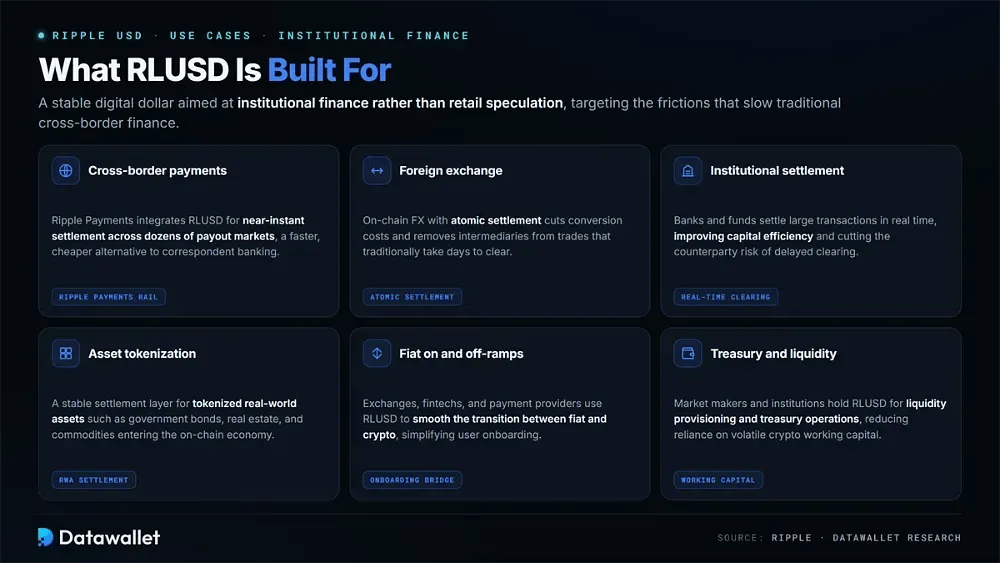
RLUSD is built for institutional finance rather than retail speculation, functioning as a stable digital dollar across payments, trading, and settlement. Its design targets the specific frictions that slow traditional cross-border finance:
- Cross-border payments: Ripple Payments integrates RLUSD to enable near-instant settlement across dozens of payout markets, offering a faster, cheaper alternative to slow correspondent-banking transfers.
- Foreign exchange: RLUSD supports on-chain FX with atomic settlement, cutting conversion costs and removing intermediaries from currency trades that traditionally take days to clear.
- Institutional settlement: Banks and funds use RLUSD for real-time settlement of large transactions, improving capital efficiency and reducing the counterparty risk inherent in delayed clearing.
- Asset tokenization: RLUSD acts as a stable settlement layer for tokenized real-world assets such as government bonds, real estate, and commodities entering the on-chain economy.
- Fiat on and off-ramps: Exchanges, fintechs, and payment providers use RLUSD to smooth the transition between fiat and crypto, simplifying user onboarding across their platforms.
- Treasury and liquidity: Market makers and institutions hold RLUSD for liquidity provisioning and treasury operations, reducing reliance on more volatile crypto assets for working capital.
RLUSD Adoption and Growth in 2026
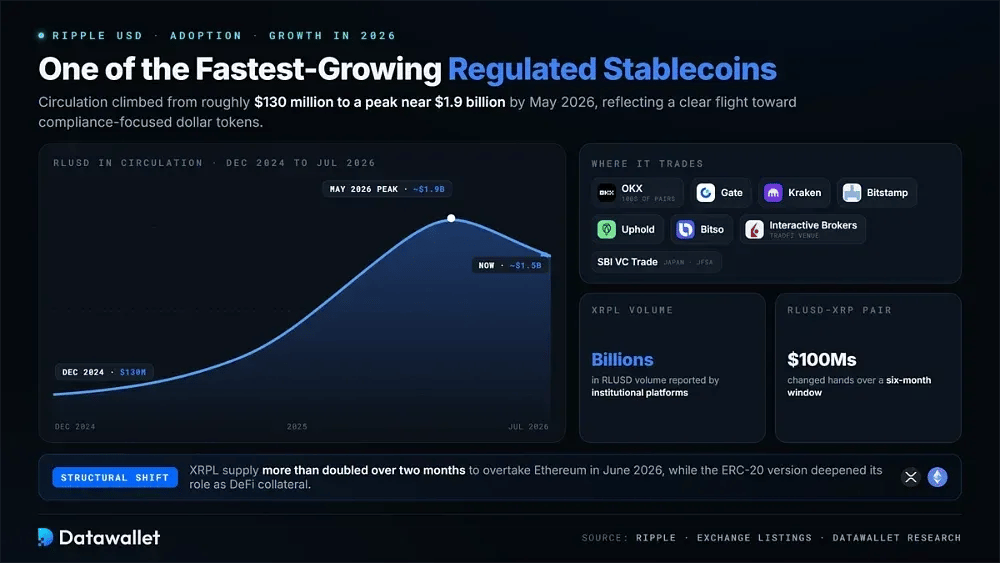
RLUSD has been one of the fastest-growing regulated stablecoins on the market, expanding well beyond its initial exchange listings. Its circulation climbed from roughly $130 million to a peak near $1.9 billion by May 2026 before settling around $1.5 billion, placing it among the ten largest stablecoins globally and reflecting a clear flight toward compliance-focused dollar tokens.
Exchange support widened its reach considerably. RLUSD secured listings on OKX with hundreds of trading pairs, alongside Gate, Kraken, Bitstamp, Uphold, and Bitso, while regulated traditional-finance venues joined too, including SBI VC Trade in Japan under JFSA oversight and Interactive Brokers.
Perhaps the most telling shift was structural. Supply on the XRP Ledger overtook Ethereum in June 2026, more than doubling over two months as Ripple's native chain became RLUSD's primary home, while the Ethereum version deepened its role as collateral and a settlement asset across decentralized lending and liquidity venues within DeFi protocols.
Institutional platforms also reported billions in RLUSD volume on the XRP Ledger, with hundreds of millions changing hands on the RLUSD-to-XRP pair over a six-month window. Together these trends show RLUSD gaining traction on both the institutional and on-chain fronts simultaneously.
Risks and Limitations of RLUSD
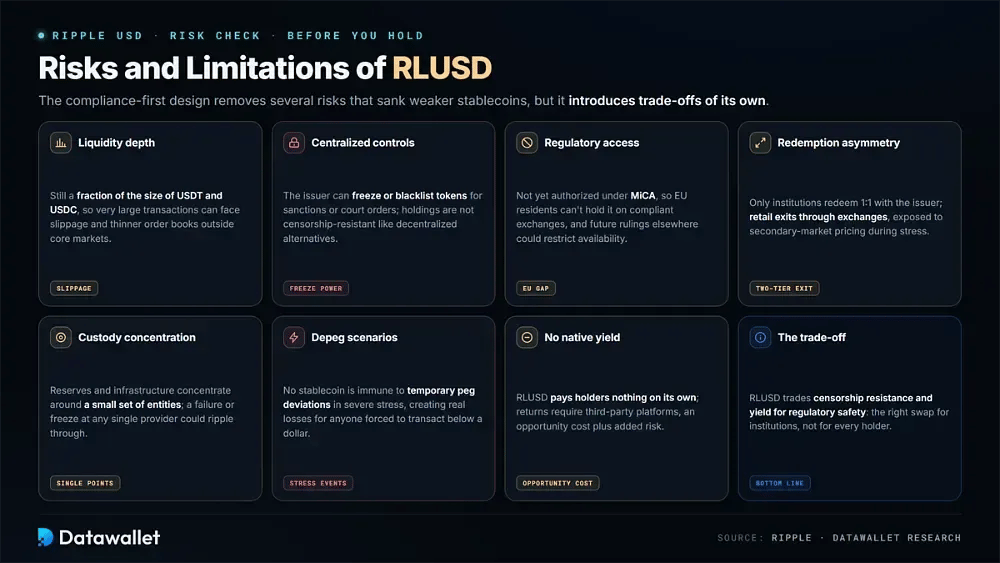
RLUSD's compliance-first design removes several risks that have sunk weaker stablecoins, but it introduces trade-offs of its own that holders should weigh carefully.
The main considerations before using it are:
- Liquidity depth: RLUSD remains a fraction of the size of USDT and USDC, so very large transactions can face slippage and thinner order books, particularly on pairs outside the core XRP Ledger and Ethereum markets.
- Centralized controls: As a regulated, fully custodial stablecoin, the issuer can freeze or blacklist specific tokens to comply with sanctions or court orders, meaning holdings are not censorship-resistant like decentralized alternatives.
- Regulatory access: RLUSD is not yet authorized under the EU's MiCA framework, so European residents cannot hold it on compliant exchanges, and future rulings elsewhere could similarly restrict where the token is legally available.
- Redemption asymmetry: Only institutions with direct agreements can redeem RLUSD one-to-one with the issuer, while retail holders must exit through exchanges and market makers, exposing them to secondary-market pricing during stress.
- Custody concentration: Reserves and infrastructure concentrate around a small set of entities including the issuer and its primary custodian, so an operational failure or account freeze at any single provider could ripple through the system.
- Depeg scenarios: Although fully backed, no stablecoin is immune to temporary peg deviations during severe market stress or banking disruptions, which can create real losses for anyone forced to transact below a dollar.
- No native yield: RLUSD pays holders nothing on its own, so parking capital in it carries an opportunity cost versus yield-bearing alternatives, and any returns require depositing it into third-party platforms that add their own risks.
Ripple USD vs Other Stablecoins
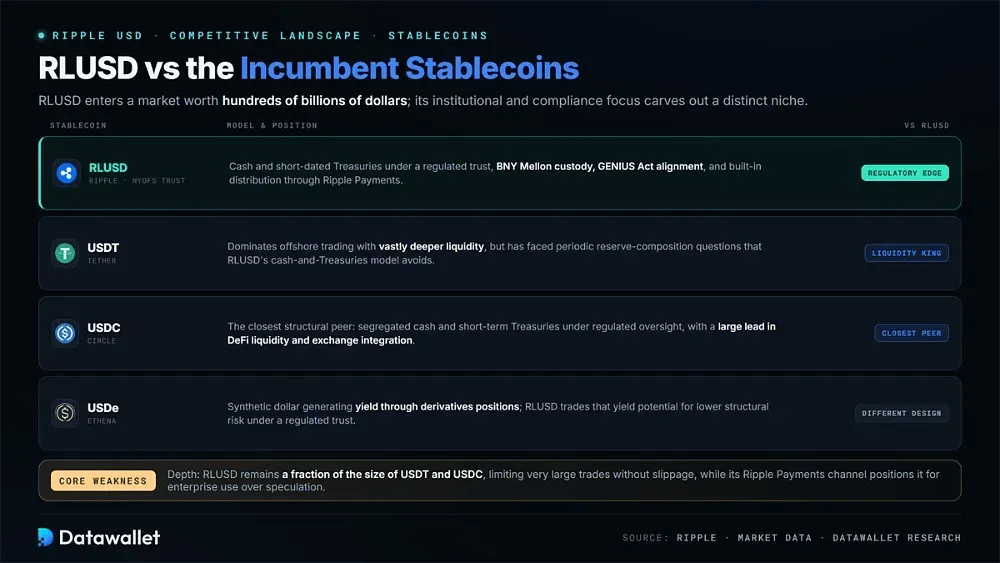
RLUSD enters a stablecoin market worth hundreds of billions of dollars, but its institutional and compliance focus carves out a distinct niche. Comparing it to the incumbents clarifies where it fits and where it still falls short:
- Versus USDT: Tether dominates offshore trading with vastly deeper liquidity, but RLUSD avoids the reserve-composition questions that have periodically dogged USDT, leaning instead on cash and Treasuries.
- Versus USDC: Like USDC, RLUSD is backed by segregated cash and short-term Treasuries under regulated oversight, but Circle's token holds a large lead in DeFi liquidity and exchange integration.
- Versus USDe: Unlike Ethena's synthetic USDe, which generates yield through derivatives positions, RLUSD is fully fiat-backed under a regulated trust, trading yield potential for lower structural risk.
- Liquidity gap: RLUSD's core weakness is depth, since it remains a fraction of the size of USDT and USDC, which limits its usefulness for very large trades without price slippage.
- Regulatory edge: RLUSD's NYDFS charter, BNY Mellon custody, and GENIUS Act alignment give it a compliance profile that appeals to institutions wary of less-regulated alternatives.
- Adoption path: Its integration into Ripple Payments provides a built-in distribution channel that most standalone stablecoins lack, positioning it for enterprise use over speculative trading.
Final Thoughts
RLUSD has established itself as one of the most credible regulated stablecoins in a remarkably short time. By pairing a conservative reserve structure with BNY Mellon custody and NYDFS oversight, Ripple built a dollar token designed to satisfy the institutions that legacy finance answers to.
Its momentum is real but its position is not yet secure. Growth past $1.5 billion and the XRP Ledger overtaking Ethereum show genuine traction, yet RLUSD remains a fraction of USDT and USDC, and its absence from the EU under MiCA leaves a meaningful market closed for now.
For institutions seeking a compliant digital dollar, RLUSD offers a compelling combination of transparency, regulation, and native integration into Ripple's payment rails. Whether it can close the liquidity gap on the incumbents will determine if it becomes core settlement infrastructure or a strong regional alternative among regulated stablecoins.
%20Explained.webp)