







MiCA Licensed Crypto Exchanges Compared
1. Kraken
Kraken belongs to a category most of the market never reached. Under MiCA a firm can hold custody and exchange permissions without ever being cleared to run an order-book marketplace, and of the roughly 300 authorised firms only a small fraction carry that trading-platform permission. Kraken does. The Central Bank of Ireland authorised Payward Europe Solutions Limited on 25 June 2025 across seven of the ten CASP services, a second Irish company carries an e-money licence, and regulated derivatives come from a Cypriot MiFID firm.
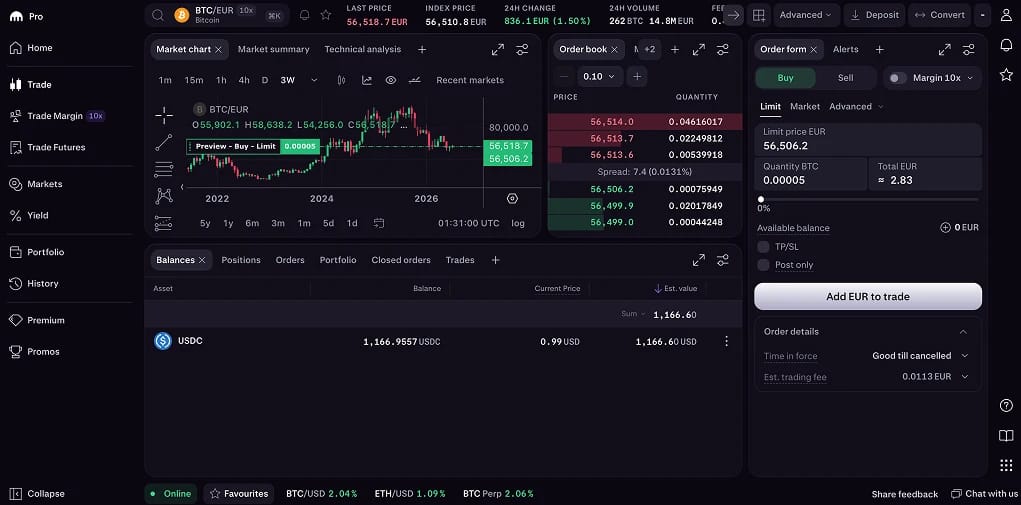
Trading euros is where Kraken pulls away from the field. Our BTC/EUR limit orders filled against the deepest order book we have measured on any compliant venue, and pricing stays sharp at 0.16% maker and 0.26% taker across more than 600 markets. SEPA Instant deposits arrived free in under ten seconds every time we tried them, and the proof-of-reserves programme has run since 2014, a longer track record than any rival on this page.
Its security history completes the case. No major customer-fund breach has hit the platform since it opened in 2011, which no other name in our top three can claim, and the Irish authorisation arrived without a single public supervisory concern. Weighted for authorisation depth, regulator rigour and incident history, nothing else here matches it, and our Kraken review covers the platform end to end.
Pros
- One of the few CASPs authorised to operate a trading platform, holding seven of the ten MiCA services.
- Central Bank of Ireland regulation alongside e-money and MiFID permissions.
- SEPA Instant deposits at no cost, the deepest euro order books we tested, and proof of reserves since 2014.
Cons
- The compliant EU version drops USDT trading and several tokens.
- Financial disclosures are voluntary because the company is privately held.
- Kraken Pro asks more of a first-time buyer than a simple broker screen does.
2. Coinbase
Coinbase ranks second because its claims can be checked in ways no private rival allows. EU customers contract with Coinbase Luxembourg S.A., which the CSSF authorised on 20 June 2025 under authorisation number N00000004, while an Irish company carries the e-money licence behind euro balances. A Nasdaq listing means audited accounts reach the SEC every quarter, statutory reporting no other exchange here files.
Honest scoring puts the May 2025 incident in this section, mirrored by the hack entry in Bybit's. Coinbase disclosed that bribed overseas support contractors had copied personal data, including names, contact details and ID images, from roughly 69,000 accounts, though no funds, passwords or private keys were taken. The company rejected a $20 million ransom demand, offered the same sum as a bounty, repaid customers hit by follow-on scams, dropped the contractor, and estimated costs of up to $400 million. Publishing all of that within the week was the right response, but our incident-history criterion scores the breach itself, and the breach is what holds Coinbase at second.
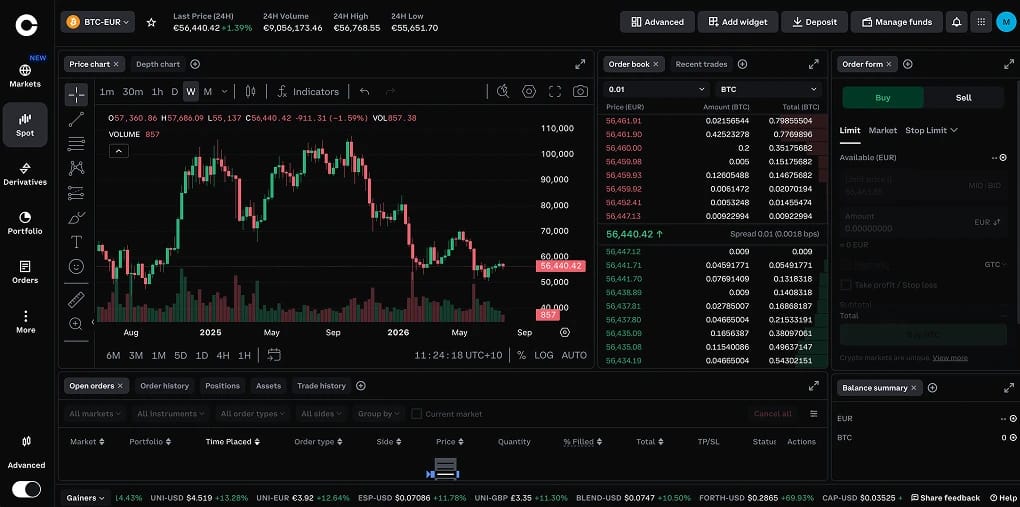
As a first regulated purchase, nothing else here is smoother. Deposits over SEPA Instant arrive in seconds, the app surfaces the licensed entity and risk warnings without any hunting, and account opening produced the least friction of the six. The bill for that polish is real, since standard trading runs 0.40% maker and 0.60% taker, Simple Buy adds a spread on top, the market list stays short, and USDT is absent. Our Coinbase review goes deeper on the platform.
Pros
- CSSF authorisation with EEA-wide passporting and a numbered public licence entry.
- Audited accounts filed with the SEC every quarter as a Nasdaq-listed company.
- The smoothest regulated onboarding of the six, plus free SEPA Instant deposits.
Cons
- Simple Buy spreads and standard fees are the steepest on this page.
- The May 2025 contractor data breach counts against it even though no funds were taken.
- A short market list and no USDT pair.
3. Bybit EU
Bybit answers a different question, which is how cheaply a licensed venue can price spot trading. Austria's FMA authorised Bybit EU GmbH on 28 May 2025, the Vienna company passports into 29 EEA countries through bybit.eu, and Malta alone sits outside its coverage. Every one of its 600+ markets trades at a flat 0.10%, and since late June the global bybit.com site has been winding down for EEA residents, leaving the Austrian entity as the only compliant option.
Read the licence closely before assuming it mirrors the global product. The ESMA register entry lists five of the ten CASP services, custody, both exchange permissions, placing and transfers, and stops short of trading-platform operation, the permission Kraken carries. High-leverage derivatives are also missing for EEA retail. Our perpetuals DEX comparison maps the self-custody alternative and our Bybit country guide shows which products appear in which markets.
The February 2025 theft belongs in the score too. Attackers linked to North Korea's Lazarus Group drained roughly 401,000 ETH, about $1.5 billion and the largest exchange theft recorded, before Bybit rebuilt reserves and covered every affected customer within days. A licence resolves the platform's legal standing. It cannot rewrite that history.
Pros
- FMA Austria authorisation passported across 29 EEA markets.
- A flat 0.10% fee on every pair in a 600+ asset list.
- EUR deposits by SEPA, card, Apple Pay or Google Pay.
Cons
- Five of ten CASP services, without trading-platform permission or retail derivatives.
- The largest exchange theft on record sits in its recent past.
- Maltese residents cannot open an account.
4. OKX
OKX is the pick when centralised trading and self-custody need to work in one app, because its built-in Web3 wallet moves balances between the exchange account and on-chain positions without a separate tool. Malta's MFSA authorised OKX Europe Limited on 27 January 2025, among the earliest MiCA approvals granted anywhere, and the company added a MiFID II derivatives licence in March 2025 and a payment institution permission for OKX Card this February.
Pricing undercuts everything above it at 0.08% maker and 0.10% taker, SEPA Instant handles euro deposits, and monthly proof-of-reserves reports rest on independently verifiable cryptographic proofs. Anyone moving beyond spot trading into on-chain swaps or yield will notice the difference the integrated wallet makes. Our OKX review examines the rest.
Malta is the asterisk. ESMA's July 2025 peer review concluded the MFSA had authorised a CASP while material issues remained open and pressed for tighter checks, and the island's Financial Intelligence Analysis Unit fined OKX's local company €1.1 million in April 2025 over anti-money-laundering shortcomings dating to 2023. The passport works exactly like an Irish or Luxembourg one. The vetting behind it, on our weighting, does not.
Pros
- Integrated Web3 wallet linking exchange balances with DeFi and DEX positions.
- The cheapest spot pricing of any venue on this page.
- Monthly proof of reserves with cryptographic verification, plus SEPA Instant deposits.
Cons
- Authorised by a regulator ESMA has publicly pressed to tighten its checks.
- Fined €1.1 million in April 2025 over legacy anti-money-laundering shortcomings.
- USDT trading is unavailable on the EU entity.
5. Bitpanda
Bitpanda makes sense when crypto is one sleeve of a wider portfolio rather than the whole of it. The Vienna platform, running since 2014, answers to three separate MiCA authorisations granted by Germany's BaFin in January 2025, by Malta's MFSA soon after, and by Austria's FMA in April 2025, so no single supervisory dispute could sever its EU access.
Deutsche Bank enlisted Bitpanda's technology arm to help build its coming crypto custody service, a telling endorsement from German banking, and the group reports around 20 million customers. A single account covers a recurring Bitcoin savings plan, fractional shares, ETFs and physical metals through separately permissioned sister companies, funding by SEPA, PayPal or card is free, and verification passed quickly when we signed up.
Pricing is the compromise. Crypto trades carry a spread near 1.49% instead of a published maker-taker schedule, tolerable on a monthly purchase and punishing on anything frequent, and the coin selection trails every trading-first venue above. For a buy-and-hold investor spreading money across asset classes, it does its job.
Pros
- Three MiCA authorisations spanning BaFin, the MFSA and Austria's FMA.
- Crypto, fractional shares, ETFs and metals held in a single account.
- No-cost funding by SEPA, PayPal or card in a simple interface.
Cons
- A roughly 1.49% spread prices out frequent trading.
- Fewer coins than any trading-focused rival here.
- No professional order-book interface for advanced users.

6. Gate
Gate is here for one reason, which is coverage of tokens the conservative venues will never list. The group has run an exchange since 2013, and its EU standing sits with the Maltese arm. Malta's MFSA authorised Gate Technology Ltd on 29 September 2025 across six of the ten CASP services, exchange and custody among them, and added a payment institution licence for the same company this February.
More than 1,000 markets trade on the compliant version, new small-cap listings arrive earlier than anywhere else on this page, and spot pricing of 0.09% maker and 0.10% taker with SEPA deposits keeps costs down. Monthly proof of reserves built on zero-knowledge proofs shows coverage well above full backing, and our Gate review assesses the wider exchange, including a security history that predates the EU entity.
Both Malta caveats from the OKX section transfer directly, and a deep long-tail list means plenty of illiquid, high-risk tokens that deserve research before any large order. Treat it as the specialist for coverage. A first euro is better spent on the platforms higher up.
Pros
- The largest tradable selection of any MiCA licensed venue here.
- Low 0.09% / 0.10% spot pricing with SEPA euro deposits.
- Earliest access to small-cap listings inside the regulated market.
Cons
- Shares Malta's ESMA supervisory caveat with OKX.
- Many thin, illiquid tokens sit in the long-tail selection.
- Users must confirm the licensed EU entity serves their account.
What to Check Before Choosing a MiCA Licensed Exchange
With the transition finished, the fee table matters less than proof that a platform is lawfully allowed to custody your euros and that the company on your account matches a licence. Before depositing we run these checks:
- Confirm the legal entity: Brands do not hold licences, companies do. Look up the precise legal name (Coinbase Luxembourg S.A., Bybit EU GmbH, Gate Technology Ltd) in the ESMA register, checking an authorised entry exists. A non-EU affiliate serving your account leaves you without MiCA's protections.
- Read the service list: Each authorisation names up to ten services, and many firms carry custody, exchange and execution while lacking permission to operate a trading platform. Anyone who wants a live order book instead of a broker screen should confirm the register entry includes that permission.
- Judge the regulator and the operator: Passporting makes every licence equal in law without making every approval equal in scrutiny. In July 2025 ESMA criticised Malta's MFSA over a CASP approved with open issues, while the Irish, Luxembourg and German records stay clean. A listed operator whose accounts face an external audit also offers verification a private company cannot.
- Test a deposit and scan the markets: Send a small SEPA Instant deposit first, which should arrive within ten seconds and usually free. Then read the market list, because compliance stripped USDT pairs, removed privacy coins, and imposed a 20-business-day pause on newly listed tokens. Make sure what you plan to trade still exists before moving serious money.
What is MiCA and Why Does the Licence Matter?
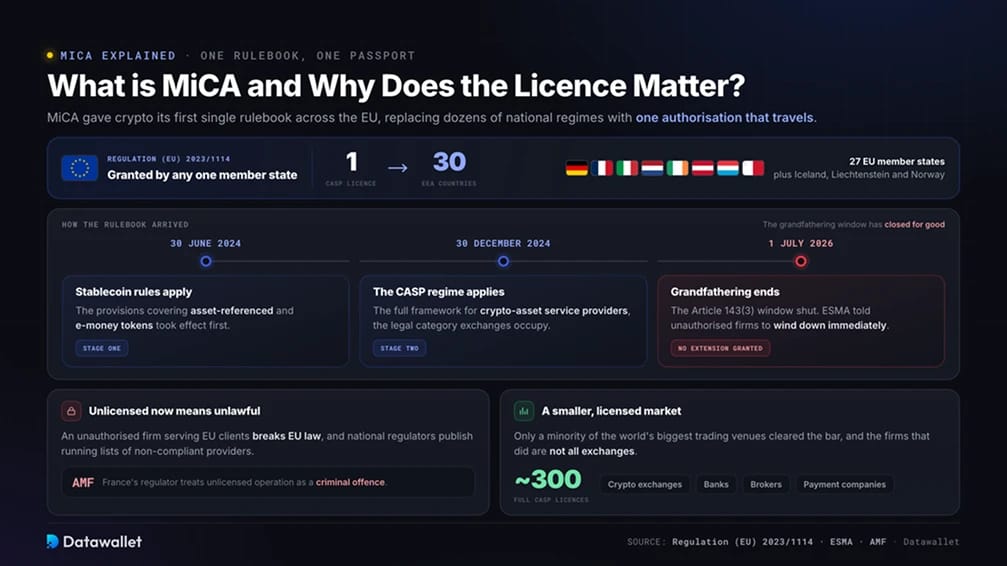
MiCA, formally Regulation (EU) 2023/1114, gave crypto its first single rulebook across the EU and replaced dozens of national regimes with one authorisation that travels. Approval from any member state passports into all 27 EU member states together with Iceland, Liechtenstein and Norway, the 30 countries of the EEA. The essentials:
- A rollout in two stages: The stablecoin provisions, which govern asset-referenced tokens alongside e-money tokens, took effect on 30 June 2024, and the full framework for crypto-asset service providers, the legal category exchanges occupy, followed on 30 December 2024.
- The transition is over: Article 143(3) let firms with older national registrations continue during a grandfathering window, which has now closed for good. Days before the cut-off, ESMA instructed unauthorised providers to begin winding down EU activity immediately and ruled out any extension.
- Unlicensed means unlawful: An unauthorised firm serving EU clients now breaks EU law. France's AMF treats the offence as criminal, and national regulators publish running lists of non-compliant providers.
- A smaller, licensed market: Around 300 firms hold full CASP authorisation, spanning exchanges, banks, brokers and payment companies, and only a minority of the world's biggest trading venues appear among them.
For market-by-market picks, our guide to the best crypto exchanges in Europe goes country by country, with individual pages covering Germany, France and Italy.
Which Exchanges Missed the MiCA Deadline?
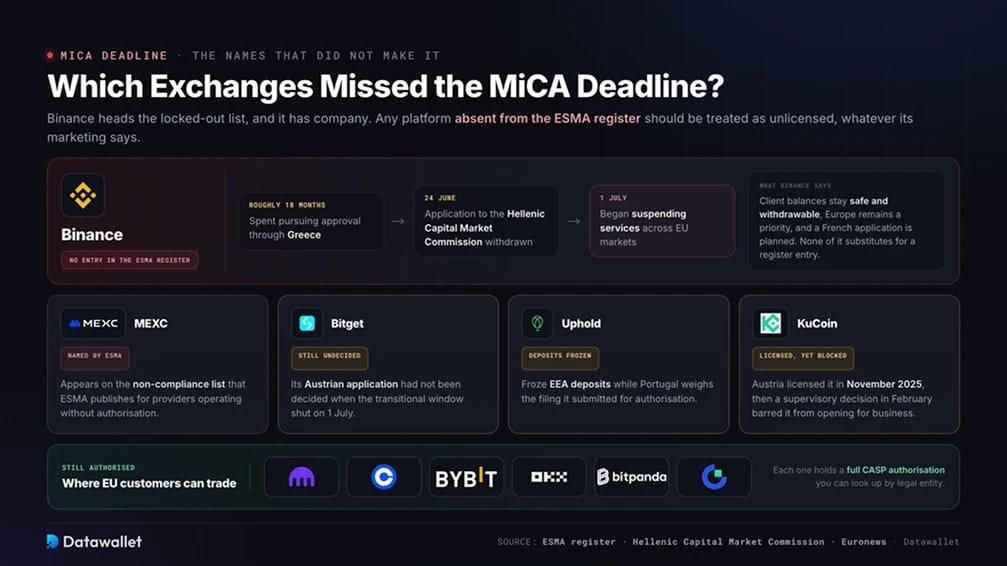
Binance heads the locked-out list. Roughly 18 months of pursuing approval through Greece ended when it pulled its application to the Hellenic Capital Market Commission on 24 June, and it began suspending services across EU markets from 1 July. Client balances stay safe and withdrawable by its account, the company insists Europe remains a priority, and a French application is planned, yet none of that substitutes for an entry in the ESMA register. Our Binance restricted countries page follows its access market by market.
Others share its position. ESMA's non-compliance list names MEXC, Bitget's Austrian application had not been decided when the window shut, and Uphold froze EEA deposits while Portugal weighs its filing. KuCoin occupies the oddest spot, licensed by Austria in November 2025 yet blocked from opening for business by a supervisory decision issued this February.
Any platform absent from the register should be treated as unlicensed whatever its marketing says, and a licensed fallback from this list is worth holding ready.
MiCA Capital Requirements for Licensed Exchanges
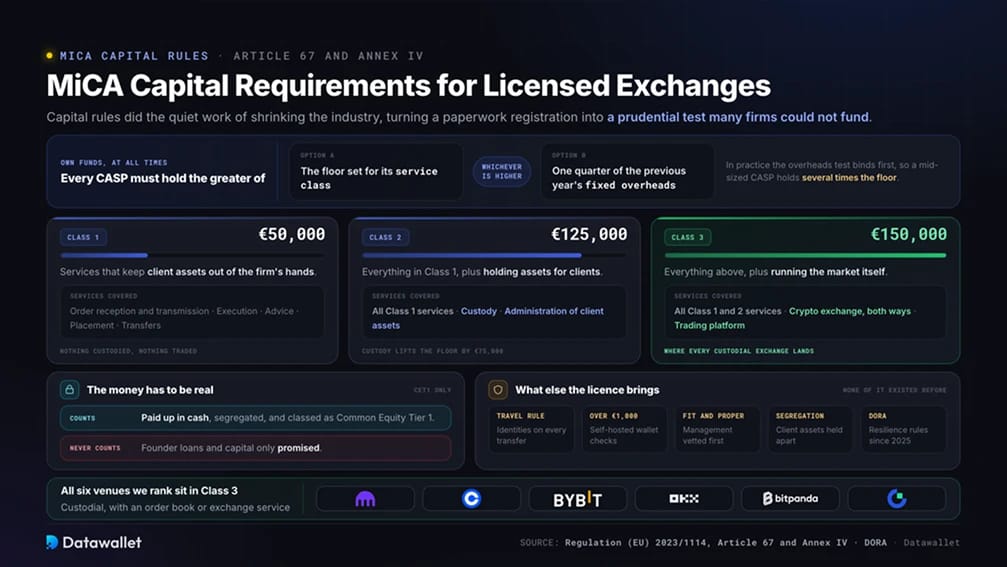
Capital rules did the quiet work of shrinking the industry, because they converted a paperwork registration into a prudential test many firms could not fund. Article 67 and Annex IV oblige every CASP to keep own funds at or above the greater of a class-based floor and one quarter of the previous year's fixed overheads. The floors run:
- Class 1, €50,000: Applies to services that keep client assets out of the firm's hands, covering order reception and transmission, execution, advice, placement, transfers and portfolio management.
- Class 2, €125,000: Adds custody and administration of client crypto-assets to everything in Class 1.
- Class 3, €150,000: Adds crypto-to-cash and crypto-to-crypto exchange plus trading-platform operation. Every custodial exchange with an order book lands in this class, so €150,000 is the minimum for the six venues above.
Quality standards on the money matter as much as the amount. Own funds must be paid in cash, sit in a segregated account and count as Common Equity Tier 1, which rules out founder loans and capital merely promised. In practice the overheads formula binds before the floor does, so a mid-sized CASP typically holds several times the minimum.
Beyond capital, the regime brings the Travel Rule, which attaches sender and recipient identity details to every transfer between providers, additional scrutiny when more than €1,000 moves to a self-hosted wallet, fit-and-proper vetting of management, segregation of client assets, and DORA operational-resilience obligations applying since January 2025. Legacy national registrations demanded almost none of this, which explains how few of them survived the conversion.
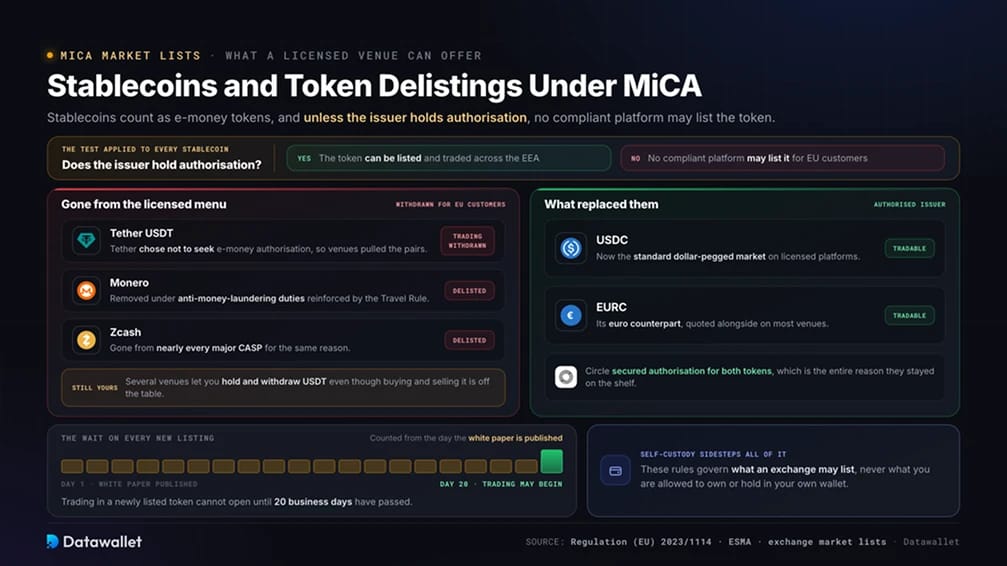
Stablecoins and Token Delistings Under MiCA
Open a licensed venue after years on an offshore one and the missing markets stand out before anything else. Stablecoins count as e-money tokens under MiCA, and unless the issuer itself holds authorisation, no compliant platform may list the token. Where that leaves things:
- USDT trading is gone: Tether chose not to seek e-money authorisation, and joint ESMA and European Commission guidance told licensed venues to end services in non-compliant stablecoins by the close of Q1 2025, and a sell-only period ran to 31 March 2025. Several venues still permit holding and withdrawing USDT even though buying and selling it is off the table.
- USDC and EURC took over: Circle became the first global stablecoin issuer to comply with MiCA through a French e-money licence granted on 1 July 2024, making USDC the standard dollar-pegged market and EURC its euro counterpart across most licensed platforms.
- Privacy coins vanished: Monero and Zcash disappeared from nearly every major CASP under anti-money-laundering duties reinforced by the Travel Rule, and the EU's new anti-money-laundering regulation bans licensed providers from handling anonymity-enhancing coins outright from 2027.
- Fresh listings pause first: A new token's white paper must be notified to a national regulator at least 20 working days before it can be published, and offering or trading the token follows publication, a built-in lead time that drags on the meme-coin cycle.
Self-custody sidesteps every one of these limits, since the rules govern exchange listings rather than what you may own. Our best crypto wallets guide compares the options for that.
DAC8 and Crypto Taxes in Europe
Licensing law and tax law travel together in headlines and nowhere else. MiCA decides who may offer crypto services, while each member state keeps setting what its residents owe on gains. What did change is how much tax offices now see:
- Reporting is now automatic: DAC8, Council Directive (EU) 2023/2226, requires licensed providers to gather transaction and balance records on their clients from this January and hand them to the national tax authority, and cross-border sharing starts by September 2027. Hiding gains from an office that receives your trade history is a losing bet.
- Tax rates remain national: Germany exempts crypto held past a year, France charges occasional gains a flat 30%, Italy applies 26% above a small threshold, and the Netherlands applies its wealth tax to a presumed return. Country specifics are in our Europe exchange guide.
- Records are still your job: Provider reporting does not replace your own log of each disposal and its euro value at the time.
Tax rules shift and this is general guidance rather than advice, so run your own situation past a local adviser before you file.
Buying Bitcoin on a MiCA Licensed Exchange
For anyone in the EU the low-cost pattern is simple. Fund euros by SEPA Instant on an authorised platform and buy on the spot market rather than a convenience screen. Our sequence:
- Check the licence: Look the entity up in the ESMA register and check the services attached. Those five minutes outrank any review, ours included.
- Pass verification: Verify using a passport or national identity card, keeping the account name identical to your bank's records, since a name mismatch is the usual cause of a stalled first transfer.
- Deposit by SEPA Instant: Settlement takes seconds and costs nothing on Kraken, Coinbase and OKX. Cards work at a markup, so reserve them for small top-ups.
- Use the spot market: A BTC/EUR limit order usually beats the one-click purchase screen by 1% to 3% once spreads are counted.
- Settle custody: Leave coins on the exchange if you trade often. Move long-term holdings to a hardware wallet.
Followed in order, the steps keep fees minimal, keep your bank comfortable, and keep every transaction inside the licensed and reported system from day one.
Final Thoughts
Start from the licence, then choose by use case. Kraken is our overall pick because authorisation depth, regulator rigour and a clean security record carry the most weight, and no other platform here combines the trading-venue permission, a Central Bank of Ireland licence and a breach-free record stretching back to 2011.
Past the top pick, the choice follows what you need. Coinbase is the verifiable, beginner-first pick with statutory disclosure no rival matches, Bybit EU wins on flat-fee spot value, OKX on Web3 access, Bitpanda on multi-asset investing, and Gate on long-tail selection inside the perimeter.
The market has already been sorted by the deadline, and familiar names, Binance above all, ended up outside it. Check the register entry for your chosen entity, send a trial SEPA Instant deposit from your own account, and verify your assets still trade before committing. Those checks say more than any star rating.
Our Methodology
We limited the field to platforms holding full MiCA CASP authorisation and broadly open to EU and EEA users, then verified every licence in the ESMA register, opened live accounts, deposited euros by SEPA, placed real trades and compared each compliant version against its global product.
This cycle we weighted the depth of each authorisation, the rigour of the issuing regulator, and each platform's security incident history most heavily, which is why Kraken, holding the rarer trading-platform permission under Central Bank of Ireland supervision with no major breach on its record, sits first. Scoring ran across six criteria:
- Licence Depth and Supervisory Standing: Which legal entity holds the authorisation, which supervisor granted it, how many of the ten services it spans, and whether any public concern hangs over that supervisor. Trading-platform permission under a clean-record supervisor scored highest, and this criterion carries the heaviest weight.
- Security Record and Transparency: Each platform's incident history alongside audited financial statements, proof-of-reserves attestations, and timely public disclosure. A record free of customer-facing breaches scored above a well-handled incident.
- EUR Funding: How quickly SEPA and SEPA Instant deposits arrived, what cards cost, and whether our banks queried the first transfer.
- Fees and Liquidity: Published maker and taker rates plus the full cost of converting euros to BTC and back, measured with live BTC/EUR and ETH/EUR orders.
- Asset Availability: What each compliant market list retains after the USDT withdrawal, privacy-coin delistings and the new-listing waiting period.
- Product and Custody: Derivatives coverage under the EU entity, Web3 and self-custody features, and how easily assets leave the platform.
Firms without a live register entry and non-EU affiliates serving European users without a passport were excluded. Testing ran through late June and July, after the transitional period closed.
.webp)