







Compare Top Italian Cryptocurrency Exchanges
1. Kraken
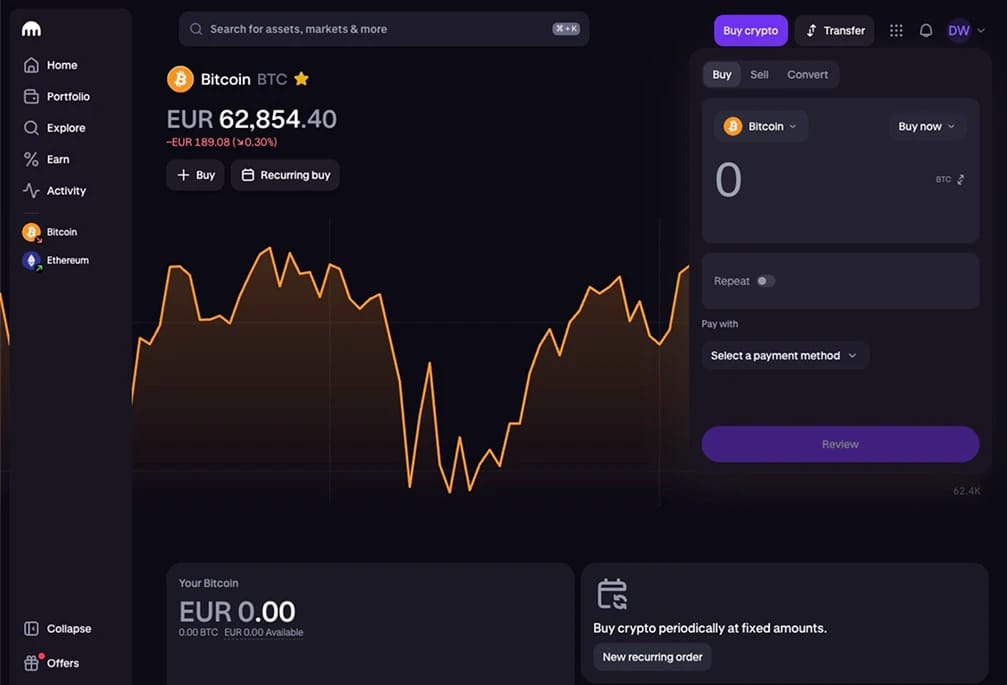
Kraken is the best option for Italian residents, as it has obtained MiCA CASP authorization from the Central Bank of Ireland, passports into Italy under CONSOB policies, and, in 14 years of operation, has never suffered a major breach. It maintains regularly audited 1:1 proof of reserves.
Kraken Pro fees open at 0.4% maker and 0.8% taker, roughly a third of Bitpanda's spread on an equivalent buy. SEPA deposits from an Italian IBAN are free, and SEPA Instant settles within a minute. The Krak Crypto Debit Card offers a 1% cashback on balances with no FX charge.
What holds it back for newcomers is the Pro screen, which rewards order-book familiarity, and the one-tap Instant Buy, which widens the spread. If you want regulation, free euros in, an Italian user interface, local customer support, and the lowest real cost on BTC, ETH, or SOL, this is the pick.
Pros
- Full MiCA CASP authorization via the Central Bank of Ireland, with passporting to Italy.
- Free SEPA and fast SEPA Instant deposits from a domestic IBAN, no currency conversion.
- Deepest BTC/EUR liquidity here, plus a Proof of Reserves record since 2014.
Cons
- The Pro interface has a slight learning curve versus one-tap buy apps.
- Instant Buy carries a wider spread, so beginners can overpay if they skip the order book.
- Native staking options for Italian residents are narrower than those of some peers.
2. Bybit
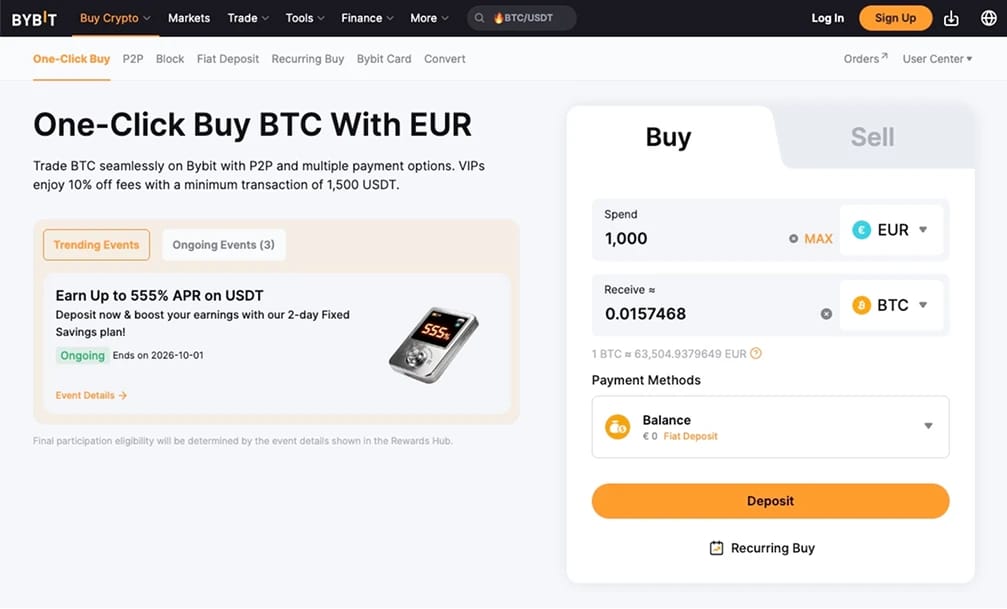
Bybit is where active traders go for asset depth. It offers one of the widest selections of cryptocurrencies here (2,800+), spot fees from 0.10%, copy trading, trading bots, crypto loans, earn options, and routine Proof of Reserves, and it obtained its MiCA authorization through Austria.
From Italy, you can fund over SEPA, card, Apple/Google Pay, or a busy P2P market, with the app in Italian. Its response to the 2025 exploit is telling: it kept customers whole and processed withdrawals without a pause, which says something about how it behaves under stress.
If you have outgrown a buy button and want low spot fees, deep derivatives, and copy trading in one place, Bybit stands out. Although it’s a global exchange, it still caters to residents by providing a user interface accessible in Italian and local customer service via 24/7 live chat.
Pros
- Has obtained MiCA authorization and can legally operate across Italy and Europe.
- Kept customers whole and withdrawals open through its 2025 exploit, and undergoes regular Proof of Reserves publication.
- Diverse product offerings, such as copy trading, grid trading bots, staking, lending, borrowing, demo trading, and the Bybit Card.
Cons
- Derivatives trading services are not available to EU residents.
- Better suited as a trading venue than a long-term custody home.
- Onboarding assumes more trading experience than Bitpanda or Young Platform.
3. Gate
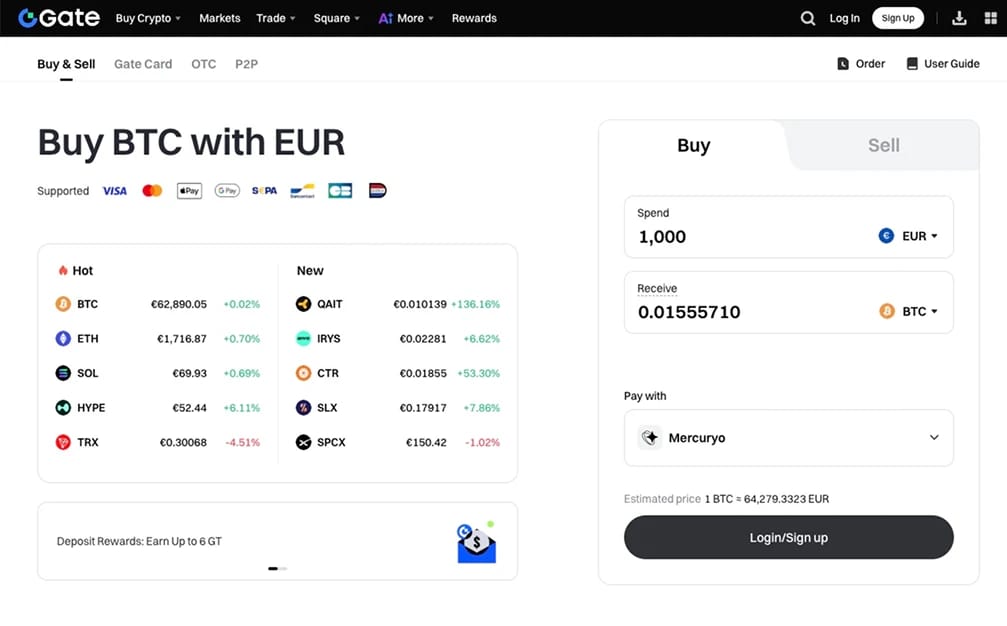
Gate is the pick when range is the point. It lists 4,800+ coins, making it the place to find small-cap coins that regulated European apps will never carry. It is covered under MiCA too: Gate Technology Ltd holds a MiCA authorization for exchange and custody, passported across the EU.
In Italy, it supports funding through SEPA, card, or P2P, and standard spot fees are a flat 0.20%, reduced by holding GT, its native token. Gate has traded since 2013, ranks among the top three in global trading volume, and publishes zk-proof reserves above 120%.
The trade-off is focus. With thousands of listings, plenty are thin, volatile micro-caps that demand real research before you touch them, and the interface throws more at you than Young Platform. For a diversified hunter who wants reach with MiCA cover, Gate fits.
Pros
- 4,800+ assets, the widest selection here, from large caps to fresh listings.
- MiCA authorization via Malta (MFSA) for exchange and custody, passported across the EU.
- Top-three global volume since 2013, with zk-proof reserves above 120%.
Cons
- Many low-cap listings are thin and volatile and need real research.
- There are no local customer support options for Italian residents.
- EUR funding is less polished than the euro-first European venues.
4. Bitpanda
Bitpanda is the broadest European all-rounder and is popular here. The Vienna-based exchange was an early holder of MiCAR licenses across Germany (BaFin), Austria (FMA), and Malta (MFSA), and folds crypto in with stocks, ETFs, and metals under one login.
It feels built for a less technical user. The Italian interface is complete, KYC was fast, and SEPA, SEPA Instant, card, and Apple Pay all funded from a domestic account. The piani di accumulo take the effort out of averaging into BTC or ETH, and the tax export is shaped for Italian filing.
The cost is buried in the spread. Bitpanda quotes one price rather than a maker/taker fee, and that margin, near 1.49% on many pairs, is what you pay for the simplicity. As a single home for crypto, equities, and metals, it simplifies the investing process.
Pros
- Among the first to hold MiCAR licenses across BaFin, FMA, and MFSA.
- One app for crypto, stocks, ETFs, and metals, with a fully Italian interface.
- Automated savings plans that take the effort out of euro-cost-averaging.
Cons
- Spread-based pricing (around 1.49%) is the highest effective cost here.
- No transparent maker/taker structure to optimize against.
- Advanced order tooling is thin versus Kraken or Bybit.
.webp)
5. Young Platform
Young Platform is the local choice, and for some residents, that counts above all else. Based in Turin and now past 800,000 users, it is on the OAM register, holds a French AMF license, and is progressing through MiCA CASP authorization. No other option here was designed around Italy first.
Its edge is funding. Beyond SEPA and card, it plugs into Satispay, the app already on most Italian phones, so a first deposit feels routine rather than technical. Flat 1% fees are fair, the app is uncluttered, and the YNG token hands holders fee discounts and club perks.
The cost of staying local is in the range. The 90+ asset list is short compared to other exchanges. We keep core positions here and step out to a deeper venue for anything unusual. If you intend to hold long-term, check where its CASP application stands before the June 2026 cut-off.
Pros
- OAM registered and AMF licensed, built specifically for the Italian market.
- Flat 1% fees and native Italian-language support.
- Tax exports are designed around Quadro RW and Quadro RT.
Cons
- Narrower asset selection (90+) than the global exchanges.
- Thinner liquidity on smaller-cap pairs.
- MiCA CASP authorization is still in progress; confirm the status ahead of 30 June 2026.
.webp)
6. Hyperliquid
Hyperliquid deals with the licensing question by deleting it. There is nothing to register for and no fiat rail: you hold your own funds, bridge USDC from Arbitrum, and trade against an order book that runs entirely on-chain.
With no company between you and the market, there is no exchange-to-bank transfer for an Italian institution to flag. It leans hard into derivatives: 130+ perpetuals at up to 100x leverage, maker rebates on most pairs, and an on-chain book with no in-house market maker filling your orders.
One thing to be honest about: self-custody does not hide you from tax. Wallet balances still belong in your Quadro RW as foreign assets carrying IVAFE, and any disposal is still taxed at 33%. For traders living on-chain, it excels; for a first spot purchase, begin on a regulated venue above.
Pros
- No KYC and no exchange account, removing the bank-side transfer query.
- Self-custody throughout, removing platform insolvency and freeze risk.
- On-chain order book with no internal market-maker conflict on fills.
Cons
- No direct euro on-ramp; source USDC through a licensed venue or P2P first.
- Wallet and bridging carry a learning curve and key-management risk.
- Derivatives-heavy product that does not suit buy-and-hold.
.webp)
How to Choose a Crypto Exchange in Italy
The right platform is not the one advertising the lowest fee. In Italy, two things determine whether it goes well: whether the venue can meet the regulatory cut-off and whether your euros move without resistance. Work through these before committing real money:
- Start with the license. Once the OAM window shuts on 30 June 2026, only MiCA-authorised providers can serve you. Favor platforms already authorized or a local venue with a live application. CONSOB lists who plans to stay.
- Move a small amount first. A free SEPA Instant deposit from your IBAN is the cheapest, quickest route in; cards usually add 2% to 4%. Send 50 to 100 euros in and straight back out, in banking hours, before scaling up.
- Know your bank's posture. Some traditional banks still slow or query outbound transfers to crypto venues for AML checks, while crypto-friendly banks and neobanks (Banca Sella, Revolut, N26, Fineco) let them through. Learning this early avoids a stuck bonifico.
- Price the full round trip. A "no-fee" spread app can work out to be dearer than a clear 0.26% taker fee. Put 100 euros through, convert back to euros, and compare what returns to your account.
Crypto and Bitcoin Regulation in Italy
Italy applies the EU's Markets in Crypto-Assets framework, written into law by Legislative Decree 129/2024. Two regulators and one deadline define the landscape:
- MiCA implementation under D.Lgs. 129/2024: CONSOB authorizes CASPs, in consultation with Banca d'Italia, to cover AML and stablecoin (EMT and ART) issuers. To serve Italian residents, a platform must hold a MiCA CASP authorization, granted here or passported from another EU state.
- The OAM register and the deadline: Italian VASPs previously registered with the Organismo Agenti e Mediatori. The decree required a CASP application by 30 December 2025, with the transition ending on 30 June 2026. Anyone who did not file must shut down and return client funds.
- First domestic CASP authorized: Most large venues reach Italy by passporting an EU license from elsewhere. CONSOB issued its first Italian CASP authorization on 7 May 2026, with more pending. Check the current status before depositing.
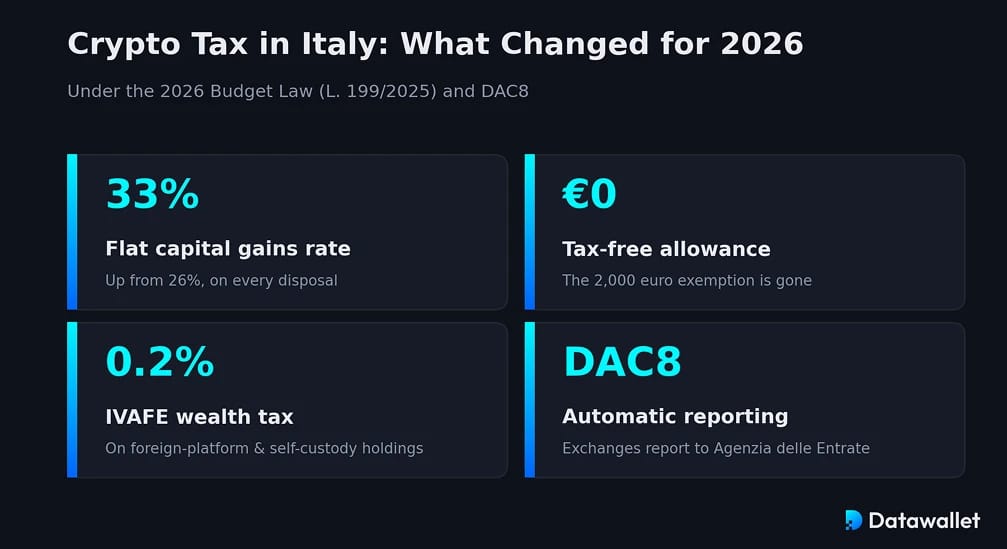
- DAC8 automatic reporting (live since January 2026): Under DAC8, CASPs report client crypto data to the Agenzia delle Entrate and share it across the EU. The authority sees your activity whether or not you declare it.
- Stablecoins under MiCA: USDT has been removed from MiCA-regulated platforms, so the compliant euro and dollar options on Italian-accessible venues are generally USDC and EURC.
Owning and trading crypto is legal in Italy on authorized platforms, and MiCA gives residents clearer protections than the old regime. The price is a one-off industry reset, which is why your chosen venue should be one positioned to clear the OAM transition rather than exit through it.
How Does Italy Tax Crypto?
Cryptocurrency taxation in Italy has been updated since 2025. The 2026 Budget Law (L. 199/2025) raised the rate on gains from 26% to 33% and eliminated the 2,000-euro allowance, while DAC8 automatically feeds your exchange data to the authority.
The 2026 overhaul made Italian crypto tax heavier:
- 33% on gains, no exemption: From 1 January 2026, disposals are taxed at a flat 33%, up from 26%, and the 2,000 euro allowance is gone. A 20,000 euro gain now costs 6,600 euros. Compliant euro stablecoins (EMTs) can fall to 26%, but BTC, ETH, and most assets sit at 33%.
- What triggers it: Selling for euros, spending, and swapping into an asset with different characteristics all count. Like-for-like swaps usually do not, per Agenzia delle Entrate guidance, though that line is drawn on a case-by-case basis.
- Where it is filed: Gains and transactions go in Quadro RT, foreign holdings and IVAFE in Quadro RW, through the Modello Redditi PF (or Modello 730 if eligible). Keep euro-valued records of every buy and sell, since the cost-basis method matters and rebuilding it later is grim.
- Income events: Staking and similar rewards are taxed when received, with a fresh gain calculated if you later sell higher. DeFi and yield farming sit in a gray zone with no dedicated circular, so a commercialista earns the fee once you go past plain buy-and-hold.
Recent Budget Laws have sometimes opened an elective substitute tax that resets cost basis to a set date at a reduced flat rate. Whether it exists in a given year, and at what rate, follows that year's Budget Law, so confirm with a commercialista.
With DAC8 live, assume the Agenzia delle Entrate already holds your data; penalties for an omitted Quadro RW are steep.
Cryptocurrency Adoption in Italy
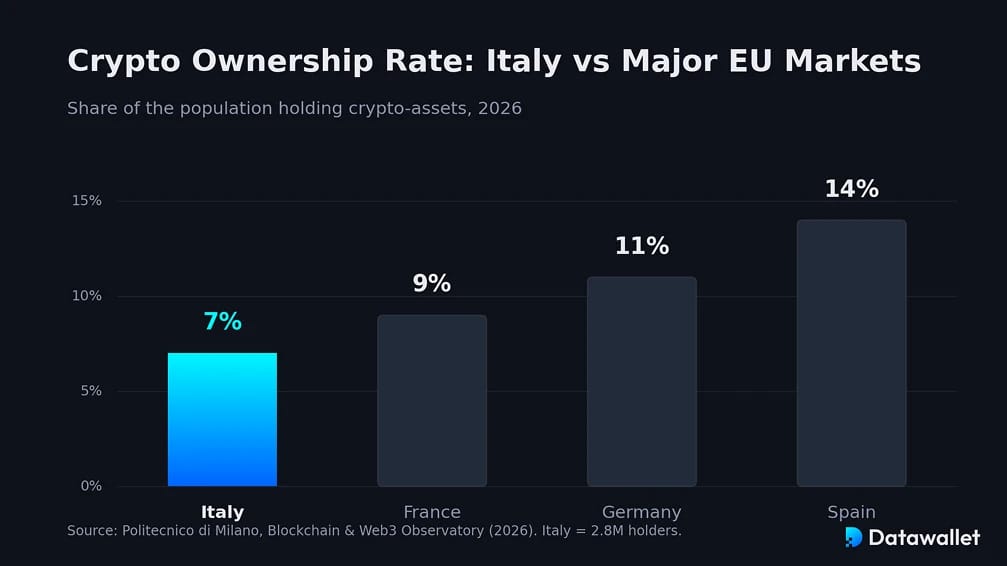
Italy is a sizeable but still-developing market by European standards. The Politecnico di Milano's Blockchain and Web3 Observatory puts ownership at roughly 2.8 million people, about 7% of the population, with a further 11% intending to buy.
That sits below France (around 9%), Germany (11%), and Spain (14%). Statista's wider forecast models user penetration near 28.93% in 2026. A few forces shape the picture:
- Clarity pulling activity onshore: MiCA enforcement and the OAM-to-CASP move steered users onto authorized, EU-regulated platforms. The Observatory links the climb in holders straight to clearer rules.
- A real local champion: Young Platform reached past 800,000 users by building around Italian-language support, Satispay funding, and tax tools that fit the national filing system. A truly domestic exchange is rare in Europe and lowers the bar for first-time buyers.
- Banks and neobanks stepping in: Banca Sella moved early into crypto access, and the spread of Revolut and N26 among younger Italians made buying from inside a familiar banking app feel ordinary.
- A cautious, savings-first investor: Italian retail tends to be conservative, which is why scheduled piani di accumulo on Bitpanda and Young Platform draw more interest than fast trading.
The trajectory is steady catch-up rather than leadership, but it is consistent. Clearer rules, a credible local platform, and bank participation are the load-bearing supports, and each firmed up this year even as the tax bill rose.
How to Buy Bitcoin in Italy
The cleanest route for an Italian resident in 2026 is the Kraken path: verify with your ID, fund euros over SEPA Instant from your IBAN, and buy BTC on the Pro order book.
This is how to buy BTC in Italy with Kraken:
- Open and verify your account. Register with Kraken and complete KYC with your carta d'identità or passport plus codice fiscale. The account name must match your ID, and verification usually clears within minutes to a few hours.
- Send euros over SEPA Instant. Transfer from your Italian IBAN to the bank details Kraken shows for your account. SEPA Instant lands inside a minute and a standard bonifico within one banking day, both free on Kraken in testing.
- Buy BTC on Kraken Pro. Open the BTC/EUR market, place a limit order at or near the spread, and confirm. Use the Pro book rather than Instant Buy, which offers a wider margin.
- Log the purchase for tax. Record the euro cost and the date. From 2026, every disposal is taxed at 33%, and clean records make the Quadro RT and Quadro RW far easier to file.
- Decide on custody. Active traders can leave BTC on Kraken; long-term holders should withdraw to a hardware wallet (see our best crypto wallets guide). Self-custodied BTC still belongs in your Quadro RW.
If you would rather stay on a fully Italian platform, the Young Platform equivalent is to verify with your ID, top up over SEPA or Satispay, buy BTC at the flat 1% fee, and use the built-in Italian tax export when you file.
Final Thoughts
There is no single best exchange here, only the best one for a given goal. Want the cheapest path on a regulated venue with the deepest euro liquidity among exchanges serving Italy? That is Kraken.
Two things should stay pinned in any Italian resident's mind this year: the 30 June MiCA cut-off and the 33% rate paired with automatic DAC8 reporting.
Settle on a platform that will still be authorized once the OAM window closes, hold euro-valued records of every transaction, and work on the basis that the Agenzia delle Entrate can already see what you are doing.
Our Methodology
We ran each platform through the routine an Italian resident would follow: account creation, KYC, a euro deposit over SEPA and SEPA Instant from a domestic IBAN, live spot orders, and a withdrawal back to both an Italian bank and a neobank. Six factors drove the scoring:
- Trust Score: Our rating out of 5 weighs MiCA or OAM standing, security and custody track record, audit and Proof of Reserves transparency, and how long the platform has run. A completed MiCA CASP authorization scored at the top.
- Italian Access and Onboarding: Whether the platform takes an Italian ID, works in Italian, and how smoothly verification completes.
- EUR Funding Methods: SEPA, SEPA Instant, card, and local rails such as Satispay, each checked for settlement speed, fees, and minimums.
- Asset Selection and Liquidity: Market and limit orders on BTC/EUR, ETH/EUR, and a mid-cap pair, judged on spread, depth, and fill quality.
- Off-Ramp Reliability: Withdrawals to Italian banks and neobanks, timed for transit, friction, and any AML review on a first transfer.
- All-In Cost: Maker and taker fees, embedded spreads, deposit and withdrawal charges, and the round-trip cost on a 1,000 euro BTC trade.
We left out platforms that no longer take Italian residents, venues without a credible MiCA CASP path before 30 June 2026, and exchanges with serious unresolved compliance issues. Testing ran from February to May 2026.
%20(1)%20(1).webp)