






Compare Top European Crypto Exchanges
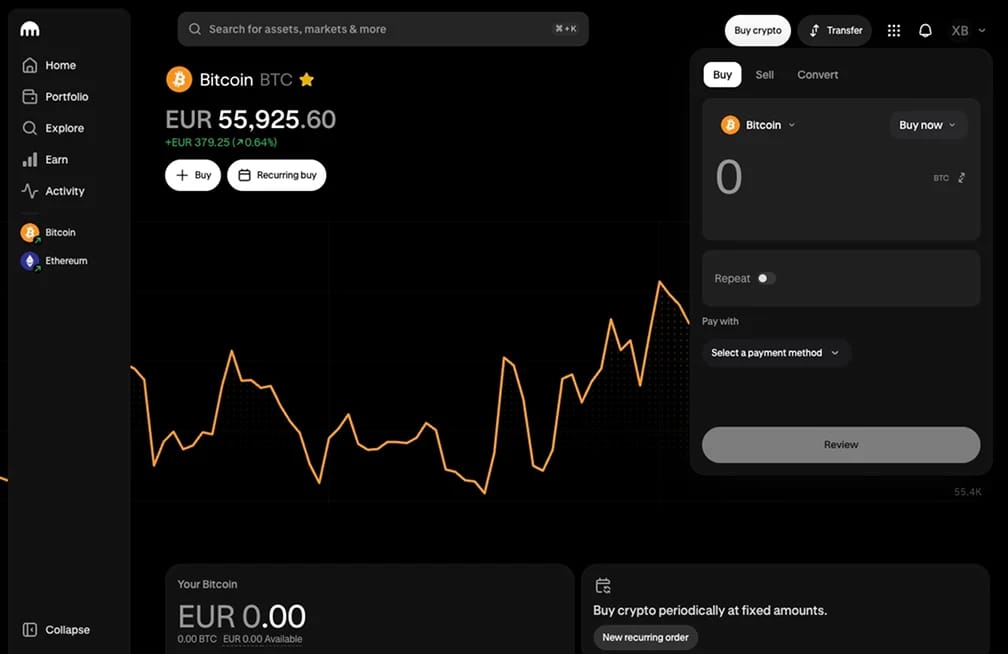
1. Kraken
Kraken leads our European ranking because of its regulatory standing and strong euro markets. In June 2025, the Central Bank of Ireland granted its first MiCA authorization to Kraken's operating company, Payward Europe Solutions Limited. Regulated futures for eligible clients are handled by a second group company supervised in Cyprus under MiFID II. It is one of the few exchanges that can offer both spot and futures trading in the EU.
Its liquidity provides the clearest advantage. DefiLlama's tracker of MiCA-authorized venues ranked Kraken first for spot and perpetuals depth in July 2026, ahead of Coinbase and other major exchanges. European clients can trade around 450 cryptocurrencies alongside tokenized US stocks. Kraken has also never experienced a security breach and has kept customers' funds secure since 2011.
Fees vary depending on the interface you choose. Kraken Pro starts at 0.25% for maker orders and 0.40% for taker orders. Following a July 2026 overhaul, accounts can qualify for discounts through held balances rather than trading volume alone. SEPA deposits are free, but purchases on the simple interface include a charge of nearly 1% plus a spread. Our Kraken review explains the difference fee by fee.
Pros
- Kraken's European company holds MiCA authorization from the Central Bank of Ireland, one of the EU's strictest supervisors, with passporting across all 30 EEA countries.
- DefiLlama records show deeper order books than any other MiCA-authorized exchange, reducing slippage on large euro trades.
- Regular, independently verified Proof of Reserves reports support a clean security record dating to 2011.
Cons
- Entry pricing on Kraken Pro starts at 0.25% maker and 0.40% taker, above the base rates charged by Bybit, OKX, and Gate.
- The basic interface costs several times more than Pro, making the trading terminal the economical choice.
- Accessing regulated futures requires separate onboarding with the Cyprus entity, including another questionnaire and additional checks.
2. Bybit
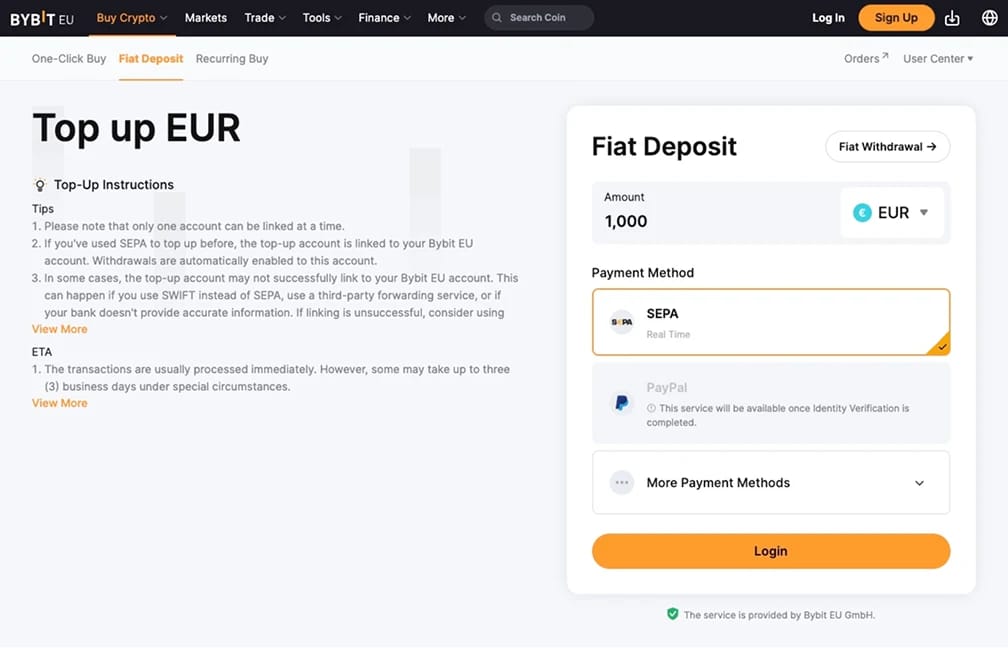
Bybit created a separate European exchange instead of modifying its global platform. Bybit EU GmbH operates bybit.eu from Vienna under the MiCA authorization granted by Austria's FMA in May 2025. Its coverage reaches every EEA country apart from Malta. In August 2026, the regulator granted Bybit Payments GmbH an e-money permission, placing the group's euro payment services under dedicated supervision.
Of the six exchanges, Bybit has the most straightforward pricing. Spot orders carry a flat 0.10% fee. Customers can deposit through SEPA or SEPA Instant, while cards and mobile payment methods include Google Pay and Apple Pay. The platform lists roughly 600 assets and retains the familiar layout of its global exchange. Copy portfolios, grid and DCA bots, 10x spot margin, Earn products, and a cashback card are also available.
There are two important limitations. Perpetual futures remain unavailable while the investment firm application submitted through Bybit X GmbH awaits a decision in Austria. Unfortunately, the global and EU entities do not offer the same products. The $1.4 billion cold wallet exploit from February 2025 also remains part of the platform's history, although every customer was repaid within days. Both issues receive a closer examination in our Bybit review.
Pros
- The two Vienna companies are supervised by Austria's FMA. Bybit EU GmbH holds MiCA authorization, while Bybit Payments GmbH received the e-money permission in August 2026.
- Free instant euro transfers and a flat 0.10% spot commission make Bybit the cheapest full-service platform to fund and trade.
- Active users receive more tools than on any rival here, including copy trading, automated bots, and a broad Earn selection.
Cons
- EEA derivatives remain unavailable while the investment firm application undergoes review.
- The February 2025 cold wallet exploit removed $1.4 billion, making it the industry's largest, although all clients were made whole.
- USDT pairs are unavailable because of MiCA requirements, and the European catalog is much smaller than the global listing.
3. Coinbase
Coinbase is our choice for institutions and users who prefer an audited, publicly listed counterparty. Shares trade on Nasdaq, and the company publishes quarterly accounts. EEA services are provided by Coinbase Luxembourg S.A., which has held MiCA authorization from Luxembourg's CSSF since mid-2025. It was one of the earliest exchanges to gain MiCA approval.
A recent enforcement case marks its European record. In November 2025, Ireland's central bank fined Coinbase Europe Limited roughly EUR 21.5 million. Coding errors had allowed more than 30 million transactions worth EUR 176 billion to pass without money-laundering screening, resulting in the regulator's first crypto-sector enforcement action. Coinbase settled the case and repaired the system.
Trading costs change sharply between the two interfaces. Coinbase's simple app makes purchasing straightforward but adds a 2% markup. Advanced Trade uses live order books and starts at 0.40% maker and 0.60% taker. For institutions, Coinbase Prime provides segregated cold custody at scale. Our Coinbase review and Coinbase fees guide explain which tier fits each type of user.
Pros
- Coinbase's Nasdaq listing requires audited quarterly reports, giving it a level of financial disclosure unmatched by the privately held exchanges in this ranking.
- Its Luxembourg company holds CSSF authorization under MiCA for the whole EEA. Corporate clients can also access prime brokerage and cold custody.
- Beginners receive the most polished experience of the six, from account setup to recurring purchases and staking.
Cons
- Advanced Trade fees start at 0.40% maker and 0.60% taker, four to six times the cost of a comparable order on Bybit or OKX.
- The group carries a EUR 21.5 million Irish penalty from November 2025, although the entity involved no longer handles EEA customers.
- Its catalog of roughly 250 assets is limited beside the selections on Gate and Bybit.
.webp)
4. OKX
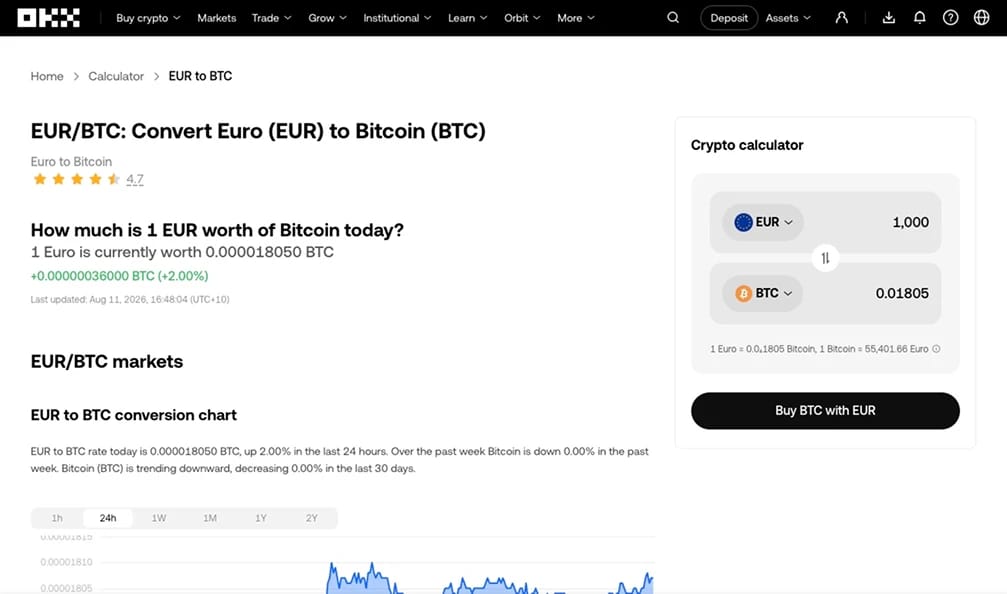
OKX posts the lowest base trading fees covered in this guide. Maker commissions begin at 0.08%, with taker orders priced at 0.10%. The Maltese hub received MiCA authorization from the MFSA in January 2025, followed two months later by MiFID II investment firm permission for regulated derivatives. A payment institution license granted in February 2026 covers stablecoin payments.
That final approval supports several newer products. Launched with Mastercard in January 2026, the OKX Card converts USDC and other compliant stablecoins when customers pay at checkout. Transfers between users run through OKX Pay. The integrated Web3 wallet supports more than 130 blockchains and can swap assets on decentralized venues, allowing a move from exchange custody to self-custody inside the same app.
The compliance record is strong but not spotless. Malta's anti-money-laundering authority fined the local company just over EUR 1 million in April 2025 for historical failings. Three months later, ESMA's peer review called on the MFSA to strengthen its authorization process. Both events came before the present structure. Our OKX review assesses them alongside the exchange's products.
Pros
- Maker and taker commissions start at 0.08% and 0.10%, the lowest base rates among the six exchanges before volume discounts.
- One Maltese hub holds MiCA and MiFID II permissions alongside a payment institution license, covering spot markets, regulated derivatives, and stablecoin payments.
- Of the platforms tested, OKX provides the smoothest regulated route into DeFi through its integrated wallet and DEX access.
Cons
- Placing a self-custody wallet beside the exchange account can confuse beginners and create room for irreversible errors.
- An anti-money-laundering fine issued in Malta in April 2025, combined with ESMA's criticism of the MFSA's process, weakens an otherwise strong licensing record.
- Its Earn yields and staking coverage are less extensive than the dedicated offerings from Bybit and Kraken.
5. Gate
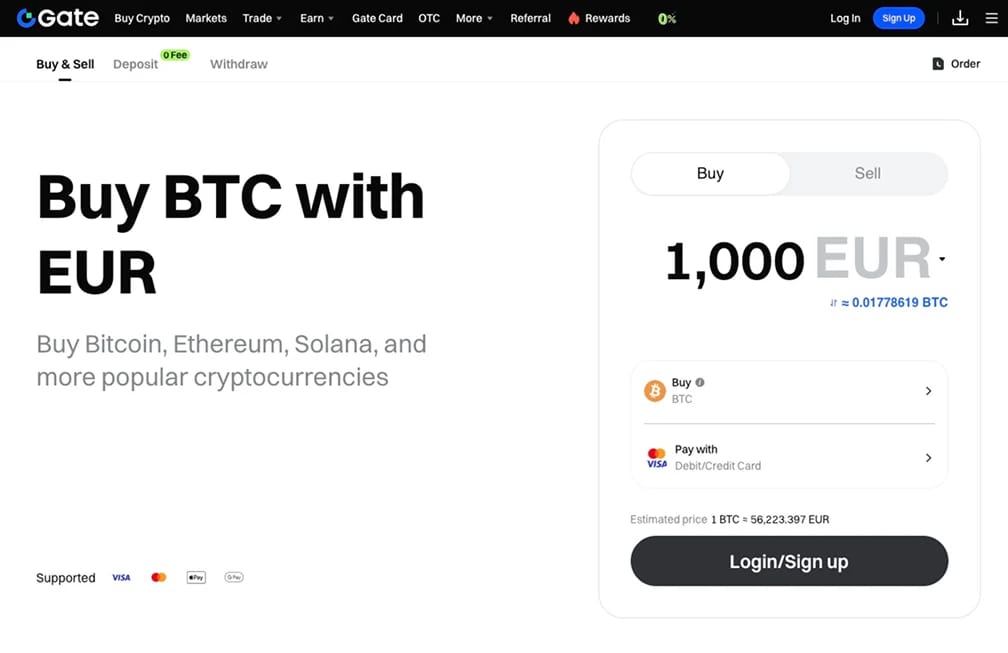
Gate ranks fifth because of its access to smaller crypto assets. Gate Technology Ltd, the group's Maltese company, secured MiCA authorization from Malta's MFSA in September 2025. An EU payment institution license followed in February 2026. The European exchange lists more than 1,000 cryptocurrencies, giving EEA residents the widest lawful selection in this ranking.
Spot trading begins at 0.09% maker and 0.10% taker. Each account also includes automated bots and copy portfolios, plus Earn products and a launchpad for new token sales. This is a smaller offering compared to the global exchange. Gate will often list assets months before Kraken or Coinbase, if those exchanges add them at all.
Usability is the main compromise. Several layers of menus and a crowded promotional layout make the platform harder to learn. Liquidity also falls quickly outside major assets, where the bid-ask spread can exceed any saving on commission. Euro funding is limited to SEPA and cards, with no support for mobile wallets. Our Gate review explains why we see Gate as a secondary account rather than a primary exchange.
Pros
- Gate's Maltese entity holds both MiCA authorization and a separate EU payment license, covering crypto trading and euro payment services.
- With more than 1,000 cryptocurrencies, no other authorized European exchange offers a broader asset selection.
- Entry fees of 0.09% maker and 0.10% taker include access to trading bots and the launchpad without another subscription.
Cons
- Spreads can exceed the headline commission saving when trading obscure assets with thin liquidity.
- Beginners face a steeper learning curve than on the other five exchanges.
- SEPA and cards are the only euro deposit methods, with no mobile wallet or e-money support.
6. Bitpanda
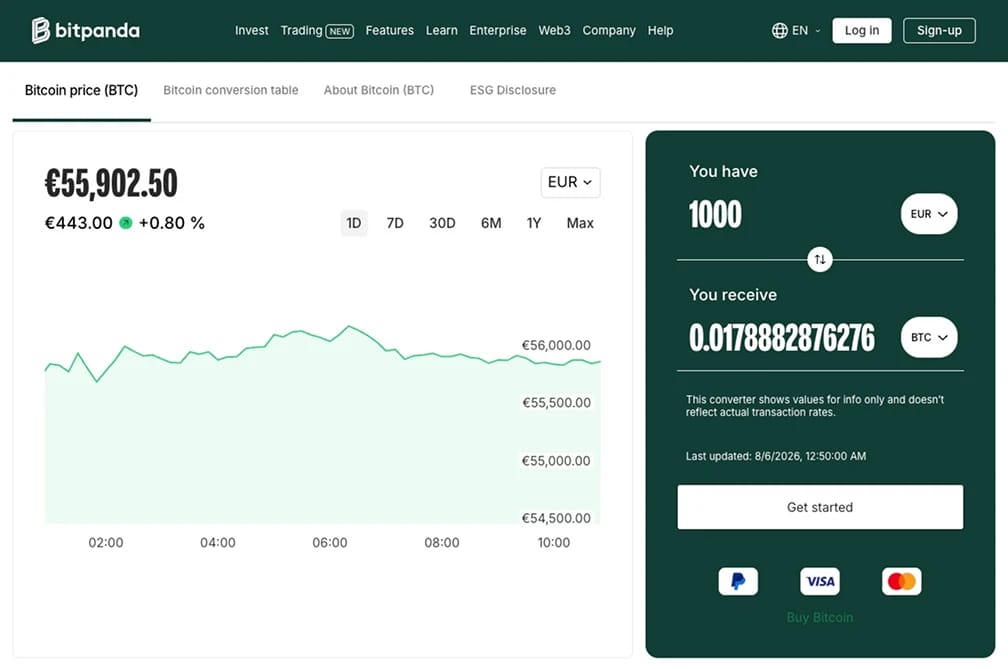
Bitpanda fits investors who want traditional investments and crypto inside one account. During 2025, the Vienna-based company secured MiCA approvals in Germany, Malta, and Austria, giving it a licensing record unmatched by its rivals. Other group entities hold a MiFID II investment firm permission and an e-money license. Bitpanda reported 7.4 million users and EUR 371 million in adjusted revenue for 2025.
Its design favors regular investing over active trading. The catalog includes more than 600 cryptocurrencies, fractional stocks and ETFs, commodities, and precious metals. Automated savings plans can draw a fixed euro amount from a bank account each week or month. Customers may then spend any balance with the Bitpanda Card, which converts the chosen holding at the payment terminal.
This convenience is expensive. Instant purchase markups can reach 1.49%, several times the cost of placing a limit order on Kraken or Bybit. The spread-based model also withholds the precise charge until checkout. Active traders will generally pay less elsewhere. Our Bitpanda countries guide details where the platform operates.
Pros
- Bitpanda holds MiCA authorization in three EU member states, the strongest licensing record among European crypto platforms.
- A single account supports crypto and fractional equities, along with ETFs and metals. Savings plans automate euro cost averaging.
- Customers can spend any holding through the Bitpanda Card and earn cashback.
Cons
- Markups of up to 1.49% make instant purchases the most expensive regular trading method in this ranking.
- Spread-based quotes are difficult to compare with the transparent order books used by competing exchanges.
- The absence of margin, futures, and trading bots limits its value for active strategies.
How to Choose a Crypto Exchange in Europe
All six platforms hold full MiCA authorization. The choice therefore comes down to the quality of the supervisor, access to convenient euro funding, and how well the fee structure matches your order size. Complete these five checks before depositing funds.
- Verify the entity, not the brand: Authorizations are granted to specific legal companies, such as Bybit EU GmbH rather than Bybit. Locate the company named in the platform's terms, then confirm it through ESMA's public register. Our list of the best MiCA-licensed crypto exchanges includes platforms that meet this standard.
- Match the fee model to your habits: Bybit's flat 0.10% commission works well for smaller accounts. High-volume traders may receive larger discounts through Kraken Pro or OKX.
- Price the full round trip: Trading commission is only one cost. Simple purchase screens may include a spread, and withdrawal fees apply when funds leave the platform. Test a small purchase and withdrawal before committing a larger sum.
- Weigh security history and reserve reporting: Give preference to exchanges that publish Proof of Reserves, which provides periodic evidence that client assets are fully held. Past incidents should be judged by how they were resolved. Kraken has never lost customer funds, while Bybit repaid its record theft within days.
- Confirm your products are live in the EEA: MiCA applies to spot trading and custody. Derivatives require separate MiFID II investment firm permission, explaining why some authorized exchanges cannot offer perpetuals. Before opening an account, check whether European users can access the staking products, futures, or stablecoins you need.
Crypto & Bitcoin Regulation in Europe
Buying, holding, and trading crypto is legal across the EU. MiCA created a single crypto rulebook under which authorization from one national regulator can be passported across the 27 EU member states. Iceland, Liechtenstein, and Norway are also covered, bringing the market to about 450 million people.
The framework developed through several key dates:
- 30 June 2024: MiCA's stablecoin provisions took effect, requiring issuers to hold an EU e-money permission. Tether chose not to apply, prompting exchanges to remove USDT pairs for European customers.
- 30 December 2024: The authorization system for exchanges and custodians became active. That same day, the Dutch regulator granted the first CASP approvals.
- During 2025: Major exchanges gained authorization through different national regulators. OKX and Bitpanda received approvals in January, followed by Bybit in May. Kraken and Coinbase completed the process by mid-year.
- November 2025: Ireland's central bank issued its first penalty against a crypto company, fining Coinbase Europe Limited EUR 21.5 million for transaction-monitoring failures.
- 1 January 2026: DAC8 took effect, requiring licensed exchanges to collect clients' transaction records for automatic reporting to tax authorities.
- 24 June 2026: Binance abandoned its Greek application shortly before the deadline. ESMA instructed unauthorized providers to close their EU operations immediately.
- 1 July 2026: Transitional arrangements ended across every member state. Binance halted services for EU residents apart from withdrawals, leaving roughly 300 authorized firms in the legal market.
Regulatory scrutiny continues. Through 2026 and into 2027, ESMA and national authorities are reviewing how authorized exchanges secure and store customer assets. The European Commission is also consulting on whether perpetual futures should fall under MiFID or MiCA, with submissions due by the end of August 2026.
.webp)
What Is MiCA and Which Countries Does It Cover?
The Markets in Crypto-Assets Regulation, Regulation (EU) 2023/1114, is the EU's single law for crypto markets, setting rules on capital, client asset segregation, market abuse, and token disclosures. It applies word for word in all 27 EU member states plus Iceland, Liechtenstein, and Norway through the EEA Agreement, 30 countries in total.
One license opens all of them. A regulator such as Ireland's Central Bank, Austria's FMA, or Malta's MFSA authorizes a provider once, and passporting grants the right to serve clients across the entire area. The issuing country matters less than the license itself, so a German resident can trade on a Luxembourg-authorized platform with identical protections.
Several European countries sit outside MiCA entirely, each running its own national regime:
- United Kingdom: The FCA published final crypto rules in June 2026, with its regime taking effect on 25 October 2027. A MiCA passport carries no rights there, and FCA authorization grants no EEA access.
- Switzerland: FINMA supervises the sector under the DLT Act, a framework that predates MiCA and operates independently of it.
- Ukraine, Serbia, and the non-EEA Balkan states: National laws of varying maturity apply, with several drafted to mirror MiCA ahead of possible EU accession.
- Andorra, Monaco, and San Marino: The European microstates are not EEA members, so MiCA does not bind them, though Monaco has aligned parts of its law with the EU framework.
How Is Crypto Taxed in Europe?
Each member state sets its own crypto tax rules. MiCA regulates market conduct but does not standardize taxation, creating differences large enough to affect an investor's net return. The examples below are for general orientation rather than tax advice.
- Germany: Private investors can sell coins tax-free after holding them for more than twelve months, one of the world's most favorable rules. Shorter holdings are subject to personal income tax rates.
- France: Occasional traders pay a 30% flat tax on realized gains under the prélèvement forfaitaire unique. Professional trading activity is treated as income.
- Italy: On 1 January 2026, the substitute tax on crypto gains increased from 26% to 33%, while the former EUR 2,000 exemption ended. MiCA-compliant euro stablecoins retain the 26% rate.
- Spain: Tax begins at 19% and rises progressively to 30% on the portion of gains above EUR 300,000. Foreign-held crypto is subject to mandatory reporting.
- The Netherlands: Crypto holdings fall within Box 3. A deemed return of 6% on assets above the allowance is taxed at 36%, regardless of whether the owner realized a profit.
DAC8 adds an EU-wide reporting layer by extending automatic information exchange to crypto. Since 1 January 2026, licensed exchanges have been required to record clients' purchases and sales. Tax authorities across the bloc will receive the first data files during 2027.
.webp)
Cryptocurrency Adoption in Europe
Crypto ownership in Europe's largest markets remains in the low double digits. According to the 2026 ADAN and IPSOS barometer, around 11% of French adults own crypto, and 93% recognize it. The typical holder allocates about 14% of their savings to the asset class. Surveys from Germany, Italy, the Netherlands, and Belgium report comparable results.
Euro-denominated stablecoins are recording clearer growth. A Decta study of MiCA-compliant euro tokens found that their combined market value increased 128% in the year to June 2026. The total rose from $295.6 million to $673.9 million, led by Circle's EURC and Société Générale's EURCV. Eight euro tokens now meet the requirements, compared with five one year earlier.
Public-sector money is developing along a similar path. The ECB completed the digital euro's preparation phase in October 2025 and is planning a twelve-month pilot from the second half of 2027. If the supporting regulation passes, the first issuance could take place in 2029. Bulgaria became the euro's 21st member in 2026, expanding the potential footprint of the digital euro and compliant euro stablecoins.
.webp)
How to Buy Bitcoin in Europe
The cheapest way to buy Bitcoin in Europe is to fund an account through a free SEPA transfer and submit a limit order from the professional trading screen. These steps apply to all six exchanges in this guide.
- Pick a licensed venue: Confirm the operating company's entry in ESMA's records before registering. Kraken remains our leading recommendation for most European users, while Bybit is the lower-cost alternative for active traders.
- Complete identity verification: Submit a passport or national ID and finish the liveness check in one session. Incomplete verification can restrict deposits and block withdrawals. Every detail must match the identity document.
- Deposit euros by SEPA or SEPA Instant: Standard transfers are free and usually settle within one business day. SEPA Instant arrives within seconds when supported. Cards process immediately but commonly add fees of 1.5% or more.
- Place a limit order for BTC/EUR: Use the professional trading interface and choose your price. The express purchase button adds a hidden markup that can cost several times more than the displayed commission.
- Move long-term holdings into self-custody: Transfer coins intended for long-term storage to a hardware device. Our best crypto wallets shortlist compares the leading choices. Confirm both the address and network before approving a transfer.
Export trading records every quarter instead of trying to reconstruct them at tax time. DAC8 gives your tax authority access to the platform's account of your activity, and the figures in your filing must match.
Final Thoughts
Europe began the second half of 2026 with a single licensed market in which every active exchange answers to a named regulator. The July deadline ended the regulatory gray area and pushed Binance aside. Investors can now compare authorized exchanges without first questioning whether those platforms may legally operate.
Kraken ranks first for supervision, liquidity, and its long security record. Bybit leads on cost and trading tools, while Coinbase offers the strongest institutional transparency. OKX combines low base fees with Web3 access. Gate has the broadest altcoin catalog, and Bitpanda brings crypto together with equities and ETFs. Each platform addresses a different need, so active investors may keep accounts with two exchanges.
The exchange choice matters less than two basic habits. Fund the account through a bank transfer instead of a card, then place limit orders rather than buying through the express screen. Keep dated records as well, since DAC8 has made documentation central to European crypto tax reporting.
Our Methodology
Our test pool included only exchanges with full MiCA authorization that accept customers across the EEA. We assessed each platform using six measures:
- Trust score: Datawallet assigns a rating out of 5 based on supervisory quality and reserve transparency, together with incident history and the number of years without a breach.
- License verification: Each operating company was checked against ESMA's records, including the precise services covered by its authorization.
- Euro funding: We deposited euros through SEPA and SEPA Instant, then tested cards. We recorded settlement times and whether mobile wallets were supported.
- True trading cost: We completed a BTC/EUR trade through each account and combined the commission with the spread and withdrawal fee.
- Asset range in the EEA: Counts refer to the catalog offered by the European entity rather than the global brand, because MiCA-related delistings determine what EEA customers can purchase.
- European relevance: Scores reflect language availability and local payment support, as well as euro-pair liquidity and each company's legal presence within the bloc.
Testing concluded in August 2026 after the transitional period had ended. We completed a final authorization check against public registers on the date of publication. Our editorial methodology explains the comprehensive research and fact-checking process.
.webp)