





 CoinUp.io
 Binance
 BTCC
BTCC Azbit
Azbit Toobit
 XT.COM
 Tapbit
 OrangeX
 CoinW
CoinW LBank
LBank Binance
 Bybit
Bybit MEXC
MEXC Bitget
 OKX
OKX Hyperliquid
 WhiteBIT
 Gate
GateWhat Moves the BNB Price
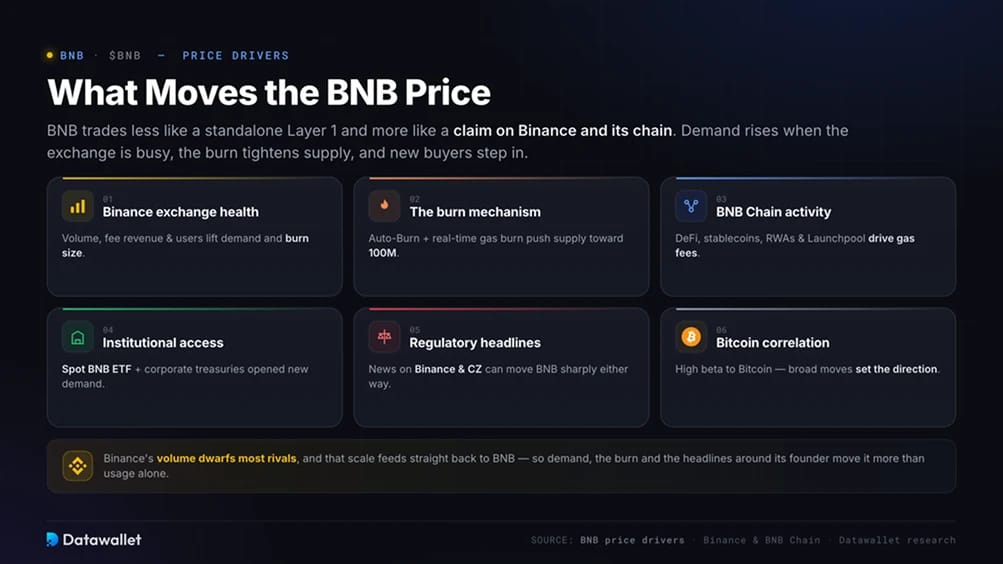
BNB trades less like a standalone Layer 1 and more like a claim on Binance and its chain. Demand rises when the exchange is busy, the burn tightens supply, and new buyers like spot ETFs and treasury companies step in. Binance's volume dwarfs most rivals, as our Bybit vs Binance comparison shows, and that scale feeds straight back to BNB. The main forces:
- Binance exchange health: trading volume, fee revenue and user growth lift BNB demand and the size of each quarterly burn.
- The burn mechanism: a quarterly Auto-Burn and a real-time gas burn keep removing coins, pushing supply toward 100 million.
- BNB Chain activity: DeFi, stablecoins, RWAs and Launchpool usage drive gas fees that both burn BNB and signal real demand.
- Institutional access: VanEck's spot BNB ETF and corporate BNB treasuries opened regulated and balance-sheet demand in 2025 and 2026.
- Regulatory headlines: news around Binance and CZ can move BNB sharply in either direction.
- Bitcoin correlation: BNB carries high beta to Bitcoin, so broad crypto moves usually set the direction.
BNB Supply and the Quarterly Burn
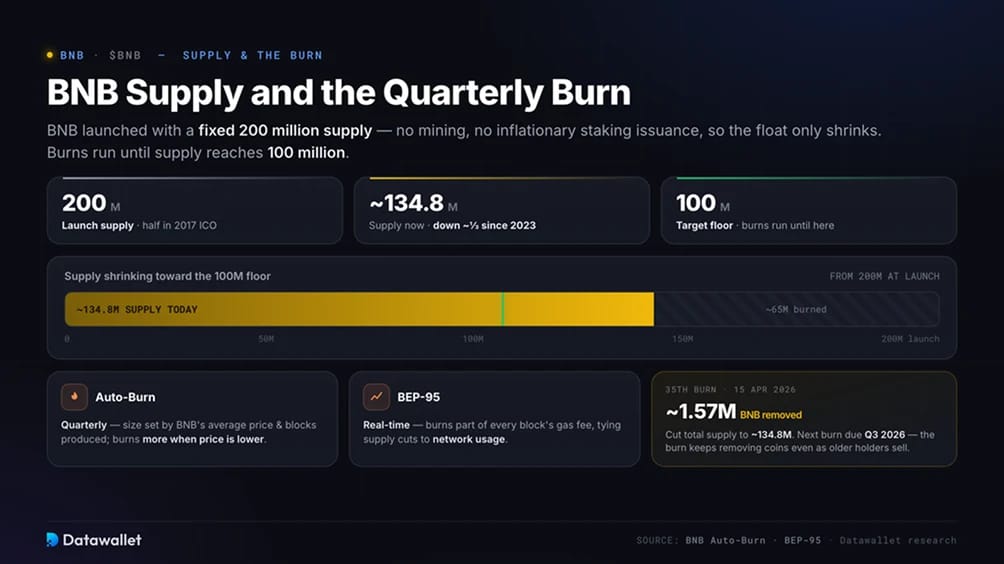
BNB launched with a fixed 200 million supply, half sold in the 2017 ICO. There is no mining and no inflationary staking issuance, so the float only shrinks. The quarterly Auto-Burn sets its size from BNB's average price and the blocks produced that quarter, burning more when the price is lower. BEP-95 burns part of every block's gas fee in real time, tying supply cuts to network usage.
The 35th burn, on 15 April 2026, removed about 1.57 million BNB and cut total supply to roughly 134.8 million, down about a third since 2023. Burns run until supply reaches 100 million, with the next due in Q3 2026.
That capped, shrinking supply anchors the BNB case - while exchange and on-chain activity hold up, the burn removes coins even as older holders sell.
Spot BNB ETFs and Institutional Demand
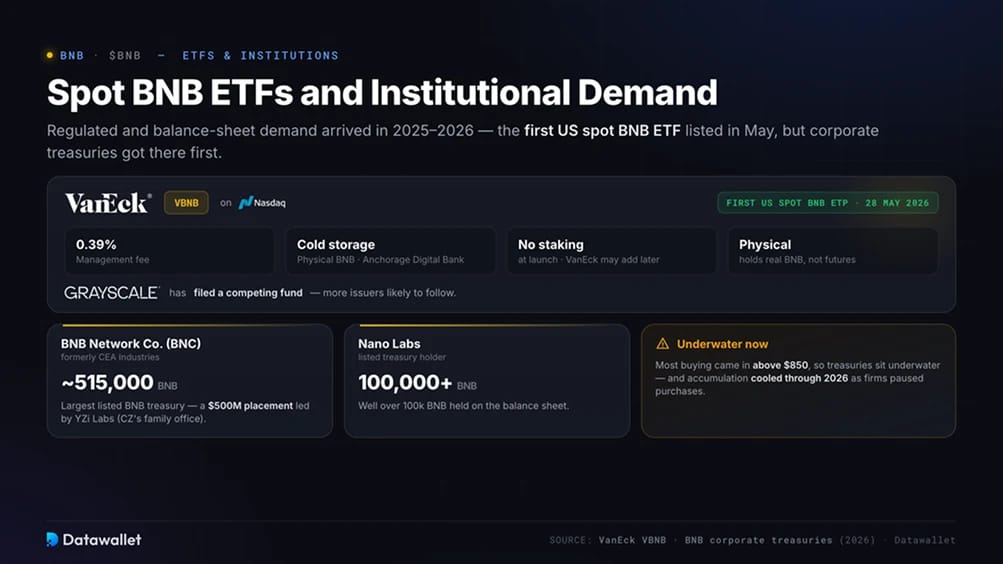
On 28 May 2026, VanEck listed the VanEck BNB ETF (VBNB) on Nasdaq, the first US spot BNB exchange-traded product (VanEck). It holds physical BNB in cold storage with Anchorage Digital Bank, charges a 0.39% fee, and does not stake at launch, though VanEck can add staking later. Grayscale has filed a competing fund.
Corporate treasuries arrived first. CEA Industries, now BNB Network Company (BNC), raised $500 million in a placement led by YZi Labs, the family office of CZ, and built the largest listed BNB treasury at roughly 515,000 coins. Nano Labs holds well over 100,000 BNB. Most of that buying came in above $850, so these vehicles sit underwater now, and treasury accumulation cooled through 2026 as firms paused purchases.
BNB Chain, PoSA and Sub-Second Blocks
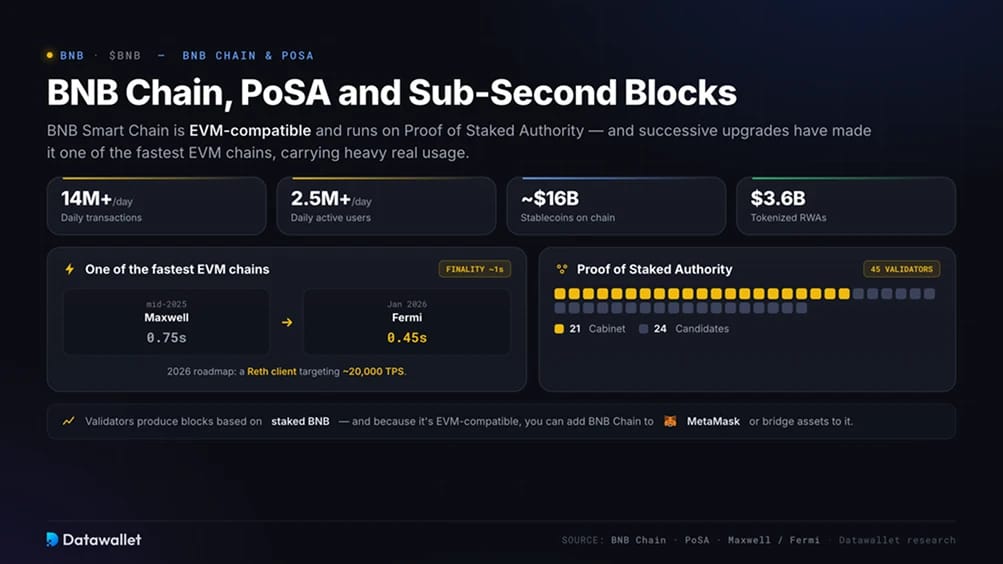
BNB Smart Chain is EVM-compatible and runs on Proof of Staked Authority, where 45 validators, 21 Cabinet and 24 Candidates, produce blocks based on staked BNB (BNB Chain docs). Successive upgrades made it one of the fastest EVM chains: Maxwell cut block time to 0.75 seconds in mid-2025, and Fermi took it to 0.45 seconds in January 2026, with finality near one second.
That speed carries heavy usage. VanEck cited more than 14 million daily transactions, over 2.5 million daily active users, about $16 billion in stablecoins and $3.6 billion in tokenized real-world assets on the chain. The 2026 roadmap targets a Reth client and roughly 20,000 transactions per second.
To use those apps, add BNB Chain to MetaMask or bridge assets to it.
What Gives BNB Its Utility
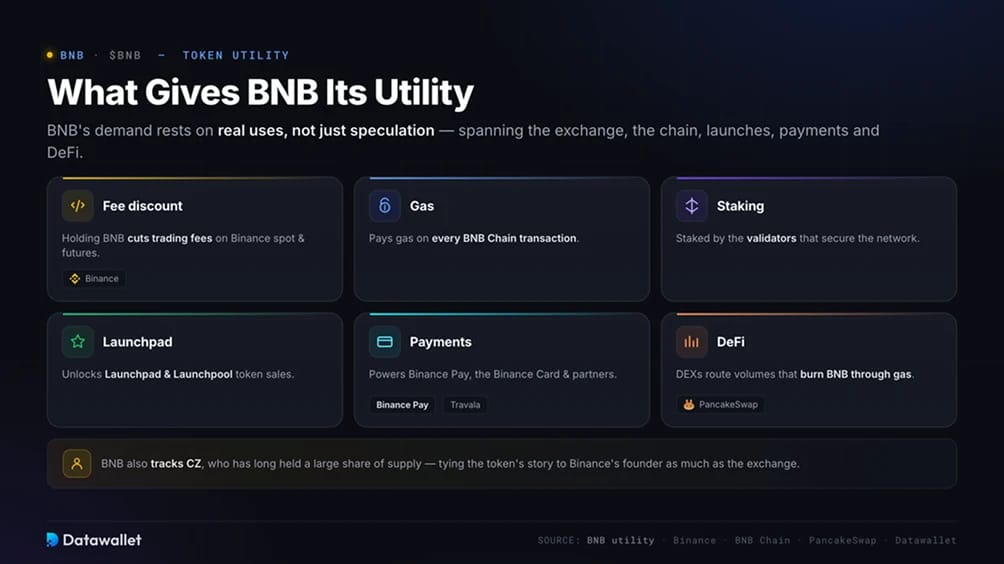
BNB's demand rests on real uses, not just speculation. On Binance, holding it cuts trading fees on spot and futures. On BNB Chain, it pays gas on every transaction and is staked by the validators that secure the network. It also unlocks Launchpad and Launchpool sales and powers payments through Binance Pay, the Binance Card and partners like Travala.
The chain's DeFi layer adds more demand. PancakeSwap and other decentralized exchanges on BNB Chain route volumes that burn BNB through gas. The token also tracks CZ, who has long held a large share of supply, which ties BNB's story to Binance's founder as much as the exchange.
The Binance Dependency and Centralization Debate
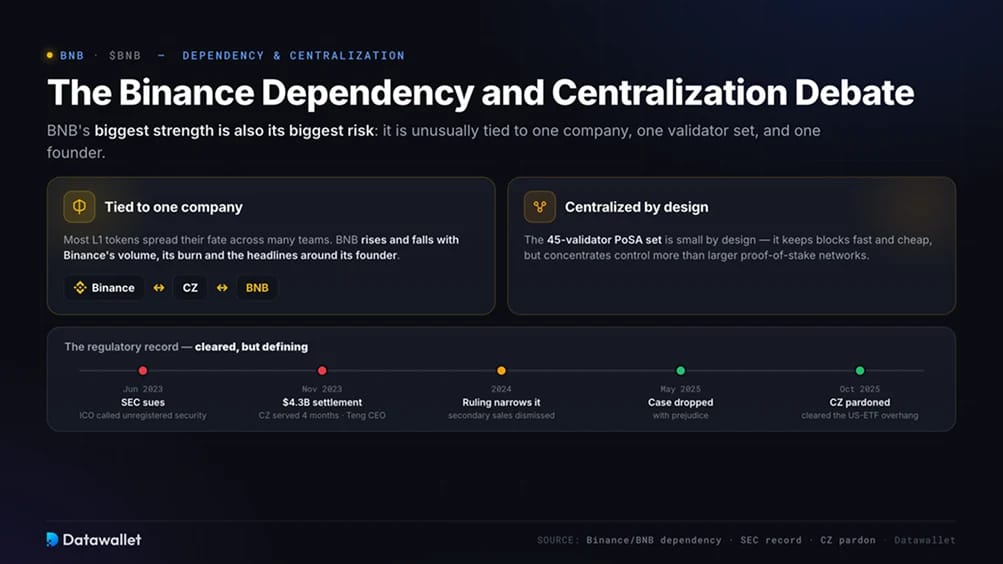
BNB's biggest strength is also its biggest risk: it is unusually tied to one company. Most Layer 1 tokens spread their fate across many independent teams, while BNB rises and falls with Binance's volume, its burn and the headlines around its founder. The 45-validator PoSA set is small by design, which keeps blocks fast and cheap but concentrates control more than larger proof-of-stake networks.
The regulatory record sits under all of this. The SEC's 2023 case called BNB's ICO an unregistered security, and a 2024 ruling let that claim proceed while dismissing secondary-market sales, before the agency dropped the case with prejudice in May 2025. Binance separately pleaded guilty and paid a $4.3 billion US settlement in 2023, CZ served four months, and Richard Teng became CEO.
Trump pardoned CZ in October 2025. That cleared the overhang blocking a US ETF, but the dependence on Binance, and on CZ, is the debate that still defines BNB.
Risks That Shape the BNB Price
The forces that drive BNB also cut the other way. The main risks:
- Binance dependency: any serious hit to the exchange's volume, reputation or legal standing strikes BNB harder than a more decentralized token.
- Centralization: a 45-validator PoSA set is efficient but concentrated, raising governance and censorship concerns.
- Regulatory return: the SEC case is closed, but licensing fights continue in some regions and a future administration could revisit enforcement.
- Slowing burns: the burn shrinks with activity, so weaker trading and on-chain usage would soften the deflationary support.
- Treasury reversals: corporate holders bought near higher prices, and forced or strategic selling could add supply.
- Bitcoin beta: BNB usually falls faster than Bitcoin in drawdowns, so a broad sell-off is the largest near-term risk.
A Short History of the BNB Price
BNB sold for cents in its July 2017 ICO and bottomed near $0.04 that year. It stayed a niche exchange token until the 2020 launch of BNB Smart Chain, whose cheap fees drew DeFi users during Ethereum's congestion and lifted BNB into the top ranks. The 2021 bull market carried it to the high hundreds.
Regulation shaped the next phase. The SEC's June 2023 suit knocked BNB down about 9% in a day to near $282. The case being dropped in May 2025, a friendlier US stance and CZ's October 2025 pardon then helped BNB reach an all-time high around $1,370 that month. It has since eased to roughly 57% below that peak while holding the #4 spot by market cap.