






Top 10 Tether (USDT) Statistics & Trends (2026)
Tether circulates roughly $185 billion in USDT while holding approximately $141 billion in US Treasury exposure, a position that ranks it as the 17th largest holder of American government debt globally and places it ahead of several sovereign nations including Taiwan and Israel.
The table below tracks the metrics that define Tether's position in 2026:
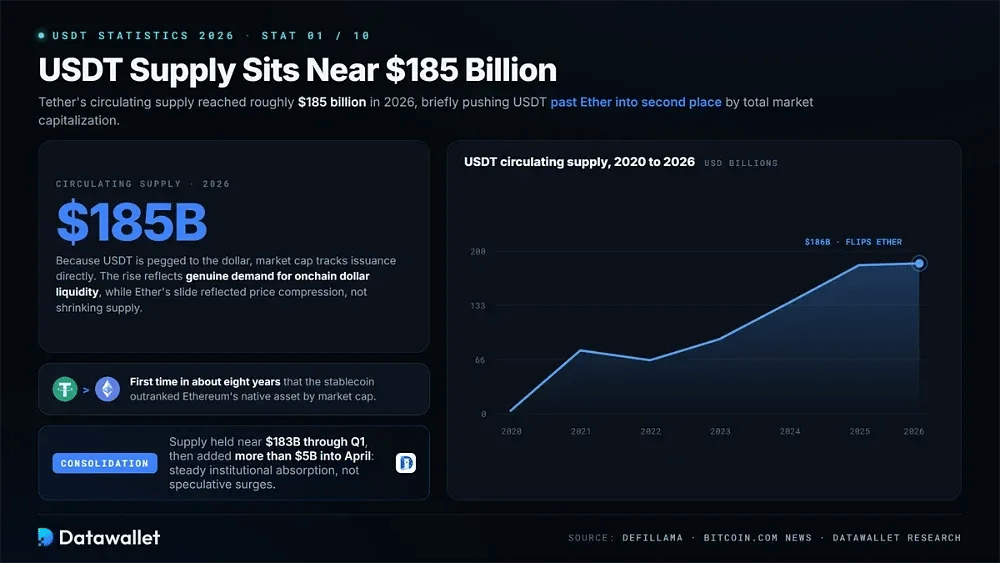
1. USDT Supply Sits Near $185 Billion
Tether's circulating supply reached roughly $185 billion in 2026, a figure that briefly pushed USDT past Ether into second place by total market capitalization. That crossover was the first time in about eight years that the stablecoin outranked Ethereum's native asset.
The mechanics behind that milestone are worth separating. USDT's market cap tracks issuance directly because the token is pegged to the dollar, so its rise reflected genuine demand for onchain dollar liquidity, while Ether's decline reflected price compression rather than any shrinkage in supply.
Growth has since flattened into consolidation. Supply held near $183 billion through the first quarter before adding more than $5 billion into April, according to DefiLlama's stablecoin dashboard, suggesting steady institutional absorption rather than the speculative surges of previous cycles.
2. Tether's Market Dominance Fell to 57.96%
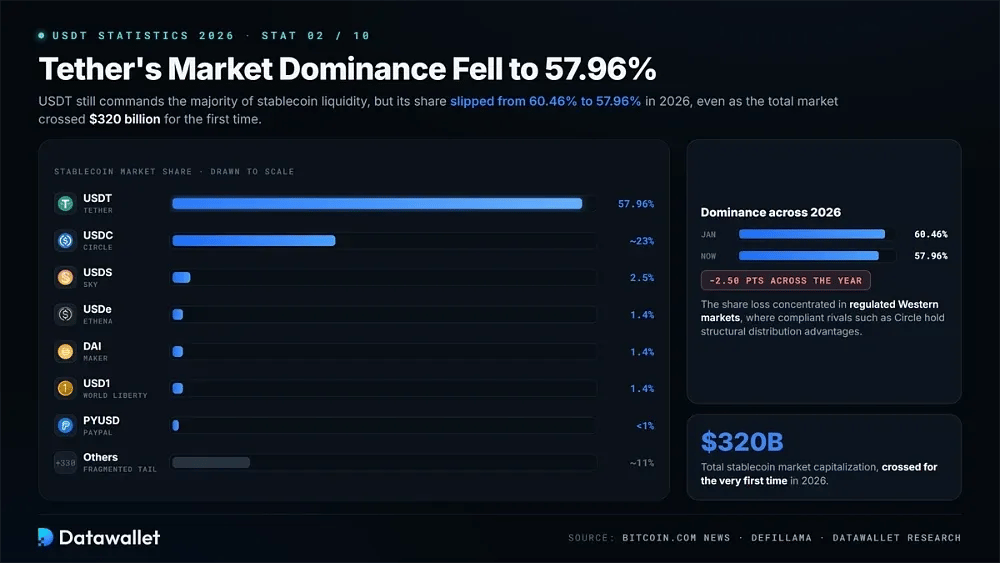
Tether still commands the majority of stablecoin liquidity, but its grip loosened measurably during 2026. USDT dominance slipped from 60.46% to 57.96% across the year, even as the overall stablecoin market crossed $320 billion in total capitalization for the very first time.
The current competitive landscape breaks down as follows:
- USDT (57.96%): Retains dominance through exchange integration and emerging market adoption, holding roughly $185 billion in circulating supply.
- USDC (roughly 23%): Circle's regulated alternative benefits directly from MiCA compliance and preferential treatment on US-regulated trading venues.
- USDS (2.5%): Sky's dollar serves decentralized finance ecosystems where protocol-native collateral matters more than exchange listing depth.
- USDe (1.4%): Ethena's synthetic dollar captures yield-seeking demand through delta-neutral hedging rather than traditional fiat reserve backing.
- DAI (1.4%): The original decentralized stablecoin remains overcollateralized by crypto assets with no central issuer able to freeze balances.
- USD1 (1.4%): World Liberty Financial's entrant gained rapid traction following its late-2025 launch across major centralized trading platforms.
- PYUSD (under 1%): PayPal's stablecoin targets merchant settlement and retail payments rather than competing for exchange trading liquidity.
- Others (roughly 11%): More than 330 remaining projects split a fragmented tail, including bank-issued and institution-backed dollar tokens.
That erosion matters considerably more than the absolute numbers first suggest, because the share loss concentrated precisely in regulated Western markets where compliant competitors such as Circle now enjoy structural distribution advantages that Tether simply cannot match from its current offshore position.
3. Tron Overtook Ethereum With $90 Billion in USDT
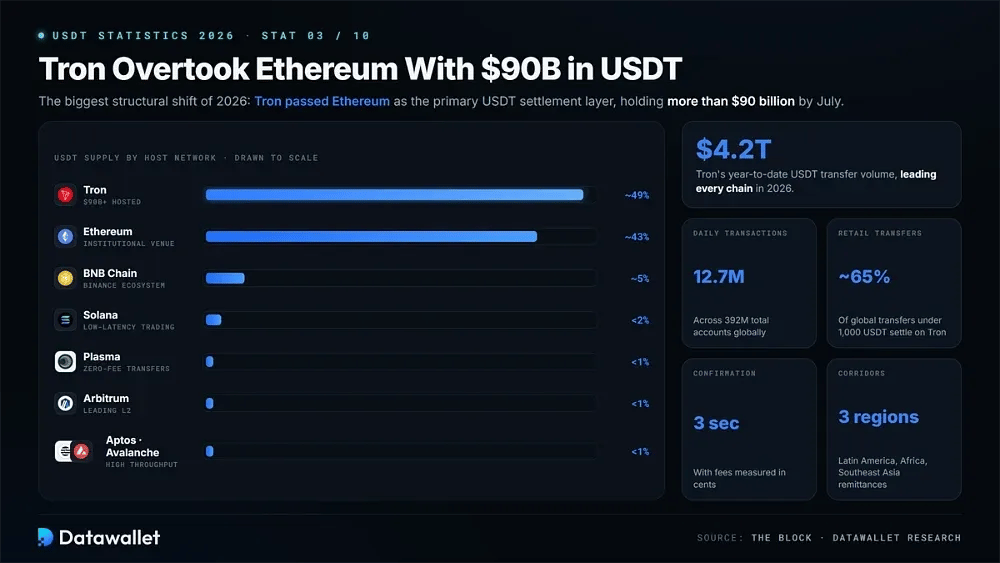
The most significant structural shift of 2026 was Tron surpassing Ethereum as the primary USDT settlement layer. Circulating supply on Tron exceeded $90 billion by July, with the network leading all chains at roughly $4.2 trillion in year-to-date transfer volume.
The leading USDT host networks now rank as follows:
- Tron (roughly 49%): Hosts more than $90 billion, processing 12.7 million daily transactions across 392 million total accounts globally.
- Ethereum (roughly 43%): Remains the institutional settlement venue where deep decentralized finance liquidity and large-value transfers concentrate most heavily.
- BNB Chain (roughly 5%): Functions as the primary liquidity layer serving the Binance ecosystem and its associated trading pairs.
- Solana (under 2%): Supports low-latency trading applications where sub-second finality matters more than settlement depth or institutional integration.
- Plasma (under 1%): A purpose-built stablecoin chain gaining steady traction for zero-fee USDT transfers and payment-focused consumer applications.
- Arbitrum (under 1%): Serves as the leading Layer 2 destination for Ethereum-based USDT liquidity seeking cheaper execution.
- Aptos and Avalanche (under 1% each): High-throughput alternatives holding several hundred million each for cross-chain collateral and regional trading.
Tron's advantage is structural rather than a matter of technical prestige. With three-second confirmations and fees measured in cents, it captured roughly 65% of global retail transfers under 1,000 USDT, and Tron-compatible wallets now dominate remittance corridors across Latin America, Africa, and Southeast Asia.
4. Tether Has Frozen Over $4.4 Billion in USDT
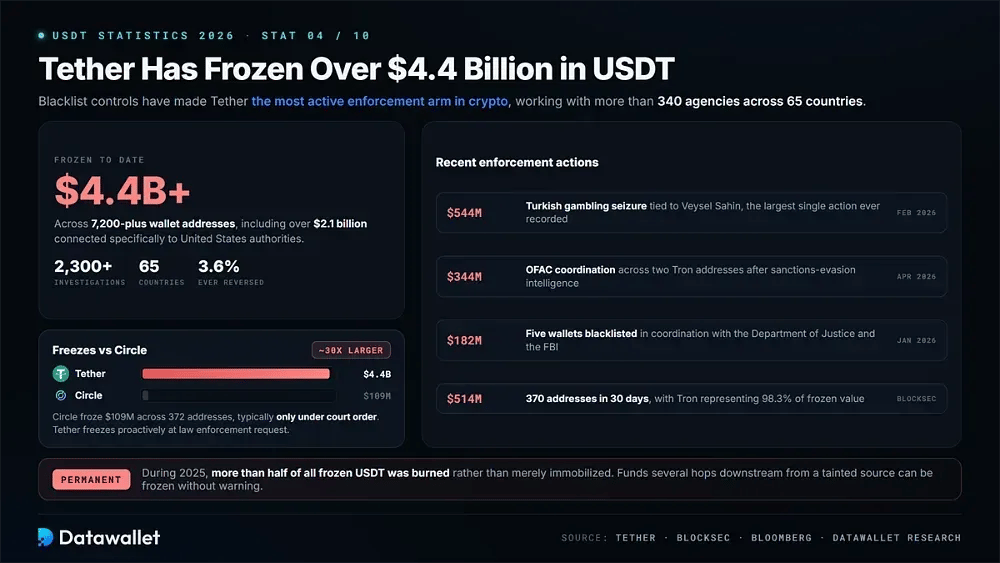
Tether's ability to blacklist addresses has made it the most active enforcement arm anywhere in crypto. The company has frozen more than $4.4 billion in USDT across 7,200-plus wallet addresses to date, including over $2.1 billion connected specifically to United States authorities.
The scale of that enforcement dwarfs competitors. Circle has frozen roughly $109 million in USDC across 372 addresses over a comparable period, making Tether's activity around 30 times larger. The philosophical difference is that Circle typically acts only under court order, while Tether freezes proactively at law enforcement request.
Recent enforcement actions illustrate the pace:
- Turkish gambling seizure: Tether froze $544 million tied to Veysel Sahin at Istanbul prosecutors' request, its largest single enforcement action ever recorded.
- April OFAC coordination: A $344 million freeze across two Tron addresses followed sanctions-evasion intelligence shared with United States authorities.
- January Tron action: Roughly $182 million was blacklisted across five wallets in coordination with the Department of Justice and the FBI.
- Thirty-day snapshot: BlockSec data recorded 370 addresses blacklisted holding $514.64 million, with Tron representing 98.3% of value.
- Global reach: Tether now works with more than 340 agencies across 65 countries, supporting over 2,300 investigations worldwide to date.
- Permanent destruction: During 2025, more than half of all frozen USDT was subsequently burned rather than merely immobilized in place.
- Low reversal rate: Only about 3.6% of blacklisted addresses have ever been removed from the list, making these freezes effectively permanent.
For users, the practical implication is that USDT balances carry a counterparty risk entirely absent from decentralized alternatives. Funds received several transaction hops downstream from a tainted source can be frozen without any warning, and often before formal legal proceedings have concluded.
5. Q1 2026 Profit Reached $1.04 Billion
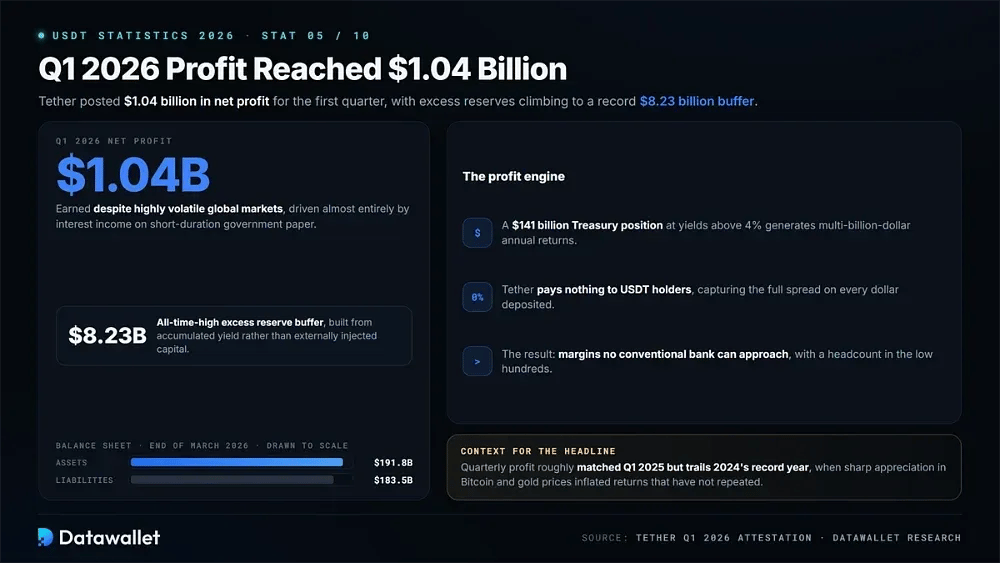
Tether reported $1.04 billion in net profit for the first quarter of 2026, with excess reserves climbing to a record $8.23 billion. Total assets stood at approximately $191.8 billion against liabilities of $183.5 billion as of the end of March.
That performance is driven almost entirely by interest income on short-duration government paper. With Treasury yields holding above 4%, a $141 billion position generates multi-billion-dollar annual returns while Tether pays nothing to USDT holders, producing margins no conventional bank can approach.
Context matters for the headline figure. Quarterly profit roughly matched Q1 2025 but trails 2024's record year, when sharp appreciation in Bitcoin and gold prices inflated returns that have not repeated. The $8.23 billion buffer represents accumulated yield rather than externally injected capital.
6. Treasury Exposure Ranks Tether 17th Globally
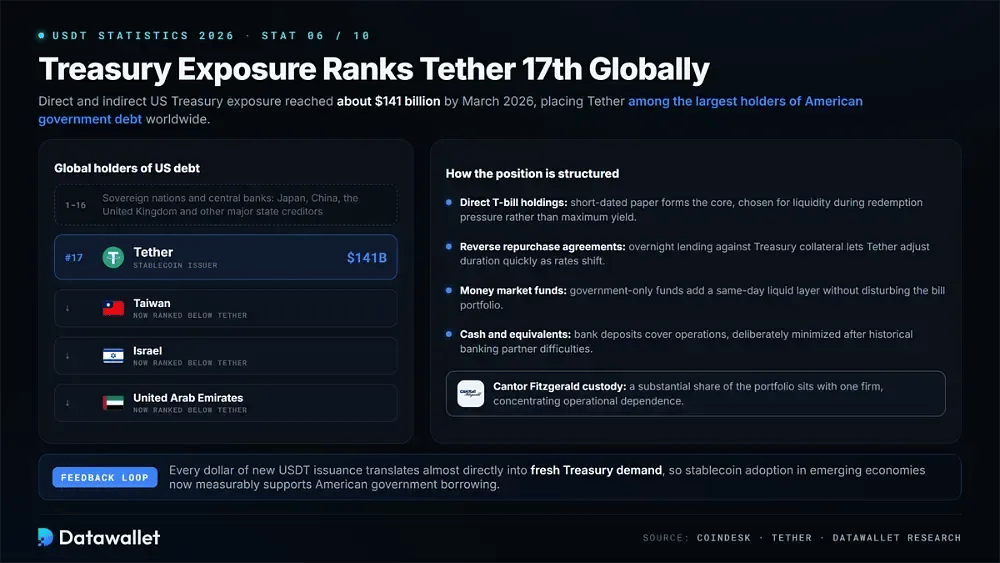
Direct and indirect United States Treasury exposure reached approximately $141 billion by March 2026, making Tether the 17th largest holder of American government debt worldwide. That position now sits ahead of sovereign nations including Taiwan, Israel, and the United Arab Emirates.
The reserve structure behind that position breaks down as follows:
- Direct T-bill holdings: Short-dated government paper forms the core allocation, chosen for liquidity during redemption pressure rather than maximum available yield.
- Reverse repurchase agreements: Overnight lending against Treasury collateral adds flexibility, letting Tether adjust duration exposure quickly as rate conditions shift.
- Money market funds: Government-only funds provide a further liquid layer that can be redeemed same-day without disturbing the underlying bill portfolio.
- Cash and equivalents: Bank deposits cover immediate operational needs, though Tether deliberately minimizes this exposure after historical banking partner difficulties.
- Cantor Fitzgerald custody: A substantial share of the Treasury portfolio is custodied through the firm, concentrating operational dependence on one institution.
- Sovereign comparison: The $141 billion position exceeds the American debt holdings of most individual nations, placing Tether among the largest global creditors.
This creates an unusual feedback loop between crypto and sovereign debt markets. Every dollar of new USDT issuance translates almost directly into fresh Treasury demand, meaning that stablecoin adoption across emerging economies now measurably supports the market for American government borrowing.
7. Gold and Bitcoin Reserves Total $27 Billion
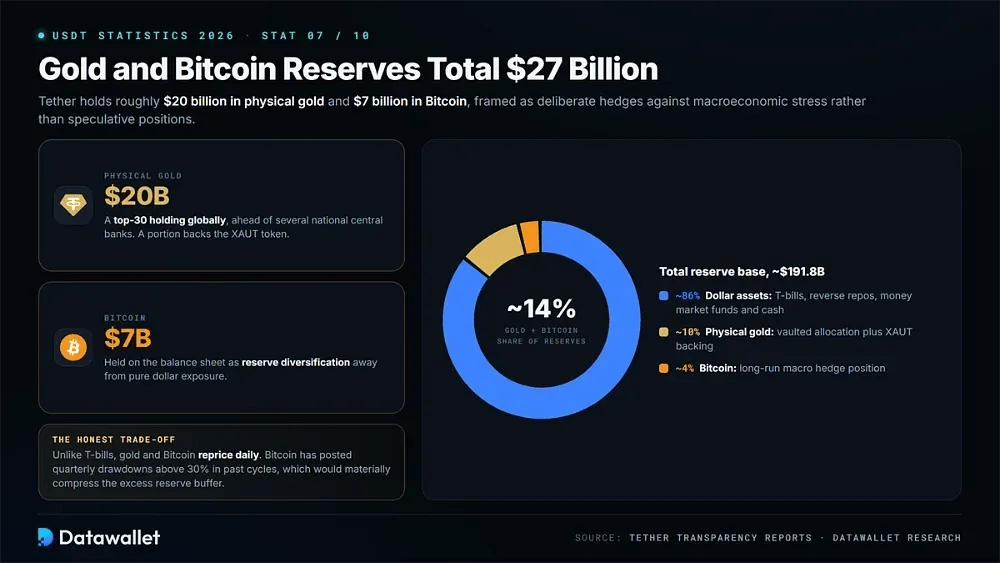
Tether holds roughly $20 billion in physical gold alongside $7 billion in Bitcoin, together representing about 14% of the total reserve base. Management frames both allocations as deliberate hedges against macroeconomic stress rather than speculative positions on either asset's future price direction.
The gold position alone places Tether among the top 30 holders globally, ahead of several national central banks. A portion backs Tether Gold, the XAUT token, while the remainder sits on the balance sheet as reserve diversification away from pure dollar exposure.
The trade-off is honest volatility risk. Unlike Treasury bills, gold and Bitcoin reprice daily and can swing the excess reserve figure in either direction. Bitcoin has recorded quarterly drawdowns above 30% in past cycles, which would materially compress the buffer during a sharp correction.
8. Tether Serves More Than 500 Million Users
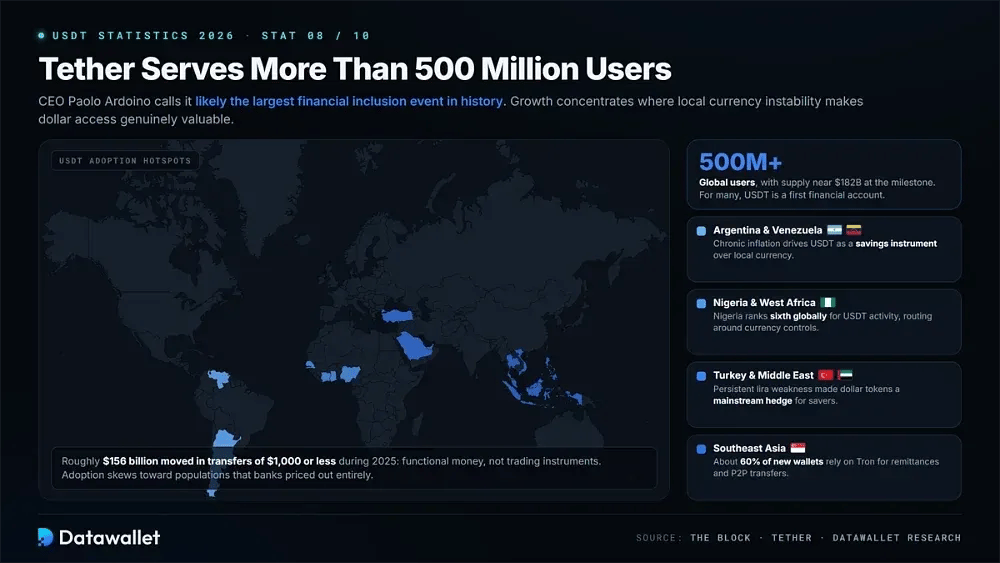
Tether surpassed 500 million users globally, a milestone that CEO Paolo Ardoino has described as likely the largest financial inclusion event in history. Growth concentrates in economies where local currency instability makes dollar access genuinely valuable rather than merely convenient for ordinary savers.
Regional adoption patterns show where that demand actually originates:
- Argentina and Venezuela: Chronic inflation drives USDT adoption as a savings instrument, with residents holding stablecoins rather than depreciating local currency.
- Nigeria and West Africa: Nigeria ranks sixth globally for USDT activity, with stablecoins routing around currency controls and scarce dollar liquidity.
- Southeast Asia: Roughly 60% of new regional wallets rely on Tron for remittances, savings, and everyday peer-to-peer transfers between households.
- Turkey and Middle East: Persistent lira weakness has made dollar-denominated tokens a mainstream hedge among retail savers and small businesses.
- Small-value payments: Roughly $156 billion moved in transfers of $1,000 or less during 2025, indicating genuine everyday transactional use.
- Unbanked focus: Adoption skews toward populations that traditional banks priced out entirely, making USDT a first financial account for many.
The composition of these users differs sharply from crypto's speculative base. These are people using dollar tokens as functional money rather than trading instruments, which is precisely why emerging market demand has proved far more durable than exchange-driven speculative flows.
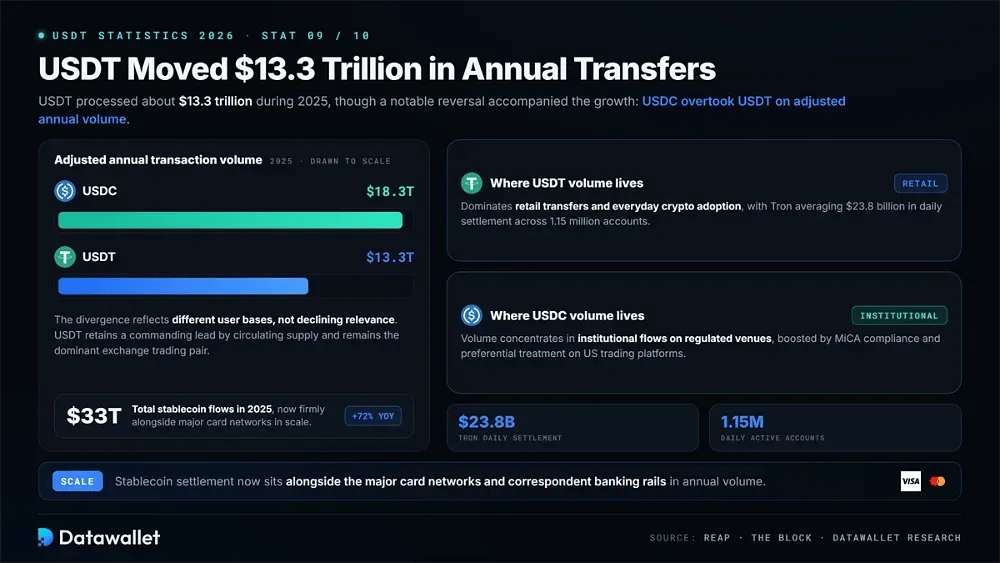
9. USDT Moved $13.3 Trillion in Annual Transfers
USDT processed approximately $13.3 trillion in transfers during 2025, forming part of roughly $33 trillion in total stablecoin flows that grew 72% year-over-year. Those volumes now place stablecoin settlement firmly alongside the major card networks and traditional correspondent banking rails in scale.
A notable reversal accompanied that growth during the year. USDC overtook USDT on adjusted annual transaction volume, processing $18.3 trillion against Tether's $13.3 trillion, even though USDT retains a commanding lead by circulating supply and remains by far the dominant exchange trading pair.
The divergence reflects different user bases rather than declining relevance. USDC volume concentrates in institutional flows on regulated venues, while USDT dominates retail transfers and everyday crypto adoption, with Tron averaging $23.8 billion in daily settlement across 1.15 million accounts.
10. KPMG Began Tether's First Full Audit
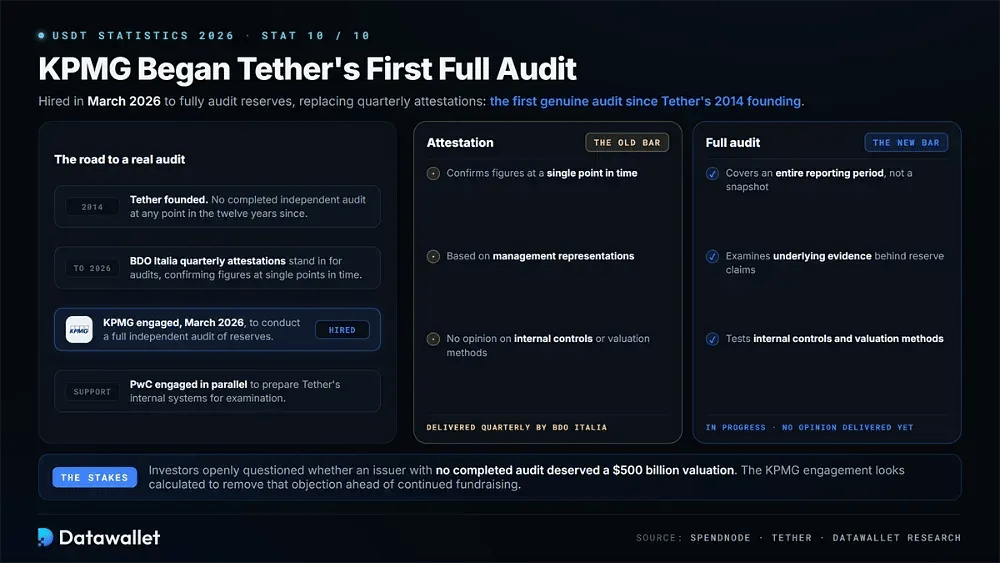
Tether hired KPMG in March 2026 to conduct a full independent audit of its reserves, with PwC engaged to prepare internal systems. This would be the company's first genuine audit since its 2014 founding, replacing the quarterly attestations published by BDO Italia.
The distinction is substantive rather than cosmetic. An attestation confirms figures at a single point in time based on management representations, while a full audit examines internal controls, valuation methods, and the underlying evidence supporting reserve claims across an entire reporting period.
Completion would finally resolve the criticism that has followed Tether longest. Investors openly questioned whether a stablecoin issuer with no completed audit deserved a $500 billion valuation, and the KPMG engagement appears calculated to remove that specific objection ahead of continued fundraising efforts.
What is Tether (USDT)?
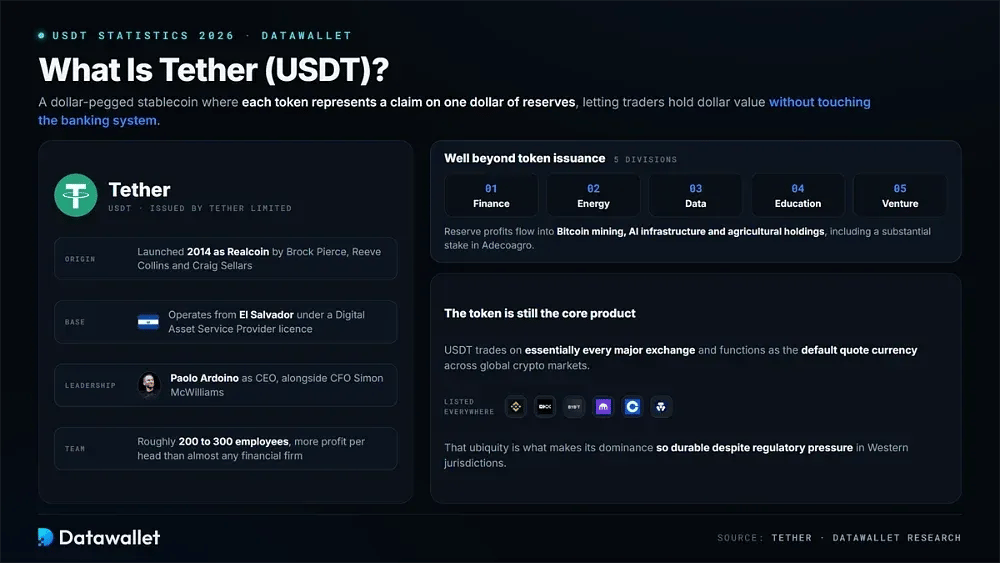
Tether is a dollar-pegged stablecoin issued by Tether Limited, originally launched as Realcoin in 2014 by Brock Pierce, Reeve Collins, and Craig Sellars. Each token represents a claim on one dollar of reserves, allowing traders to hold dollar value without touching the banking system.
The company operates from El Salvador under a Digital Asset Service Provider licence, having relocated from its earlier British Virgin Islands structure. Paolo Ardoino serves as CEO alongside CFO Simon McWilliams, leading roughly 200 to 300 employees who generate more profit per head than almost any financial firm globally.
Tether's function has drifted well beyond simple token issuance in recent years. The group now spans five divisions covering finance, energy, data, education, and venture investment, deploying reserve profits into Bitcoin mining, artificial intelligence infrastructure, and agricultural holdings including a substantial stake in Adecoagro.
The token itself remains the core product, with USDT tradable on essentially every major exchange and functioning as the default quote currency across global crypto markets. That ubiquity is what makes its dominance so durable despite regulatory pressure in Western jurisdictions.
How Does Tether Work?
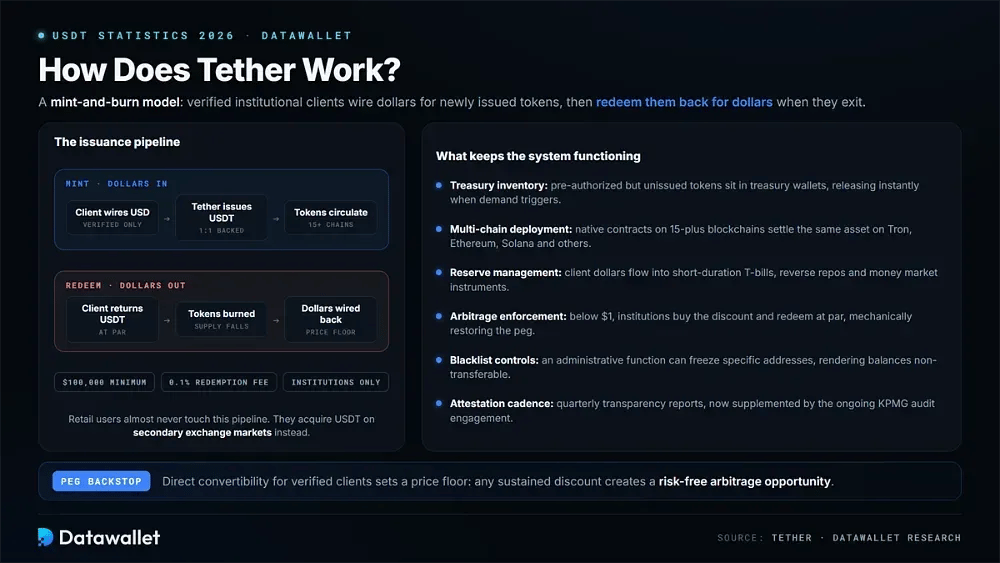
Tether operates a mint-and-burn model in which verified institutional clients wire dollars to receive newly issued tokens, then redeem those tokens back for dollars when they exit. Retail users almost never interact with this pipeline directly, instead acquiring USDT on secondary exchange markets.
The mechanics that keep the system functioning include:
- Authorized issuance: Only verified institutional customers can mint or redeem directly, with a $100,000 minimum and 0.1% redemption fee applying at scale.
- Treasury inventory: Pre-authorized but unissued tokens sit in treasury wallets until demand triggers release, letting Tether respond instantly without new contract deployments.
- Multi-chain deployment: Native USDT contracts exist across 15-plus blockchains, so the same asset settles on Tron, Ethereum, Solana, and others simultaneously.
- Reserve management: Client dollars flow into short-duration Treasury bills, reverse repos, and money market instruments selected for liquidity rather than yield maximization.
- Arbitrage enforcement: When USDT trades below a dollar, institutions buy the discount and redeem at par, mechanically pushing the stablecoin peg back toward parity.
- Blacklist controls: Smart contracts include an administrative function letting Tether freeze specific addresses, rendering their balances permanently non-transferable on request.
- Attestation cadence: Quarterly transparency reports disclose reserve composition, now supplemented by the ongoing KPMG audit engagement begun in 2026.
- Redemption backstop: Direct convertibility for verified clients establishes a price floor, since any sustained discount creates a risk-free arbitrage opportunity.
Is Tether Regulated in 2026?
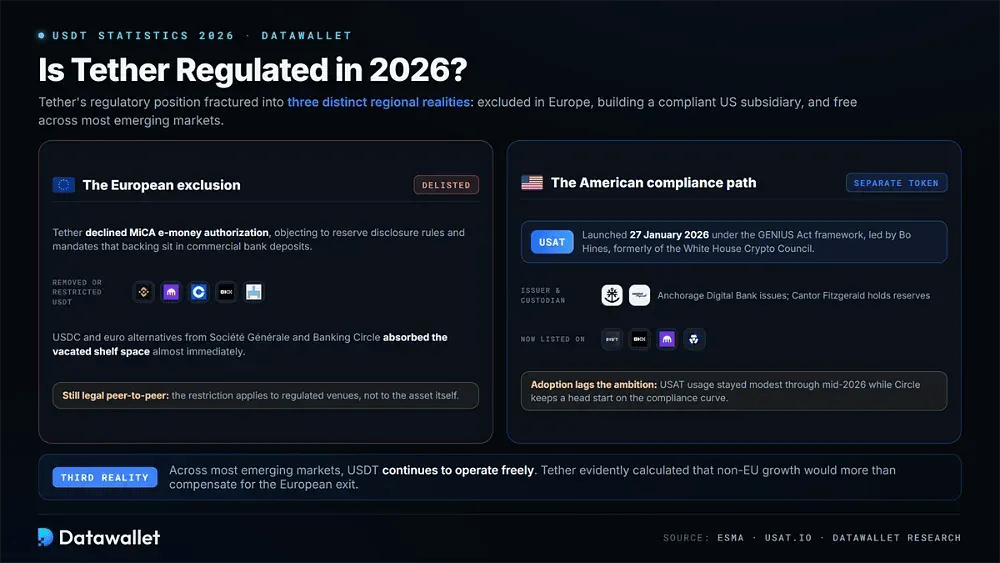
Tether's regulatory position fractured into three distinct regional realities during 2026, with the company simultaneously excluded from MiCA-licensed European exchanges, building an entirely separate and fully compliant United States subsidiary, and continuing to operate freely across most emerging markets worldwide.
The European Exclusion
Tether declined to seek e-money token authorization under Europe's MiCA framework, objecting publicly to reserve disclosure requirements and to rules mandating that a substantial portion of backing sit in commercial bank deposits. That refusal carried an immediate and direct commercial cost.
The result was a cascade of delistings, with Binance, Kraken, Coinbase, OKX, and Bitstamp removing or restricting USDT for European users. Circle's USDC and euro-denominated alternatives from Société Générale and Banking Circle absorbed the vacated shelf space almost immediately across the bloc.
Tether's European market share collapsed as a direct consequence, though the company evidently calculated that non-EU growth would more than compensate. The restriction applies to regulated venues rather than to the asset itself, so peer-to-peer USDT transfers remain entirely legal for European individuals.
The American Compliance Path
The United States took the opposite approach, with the GENIUS Act creating a federal framework that foreign issuers can eventually join. Tether responded on 27 January 2026 by launching USAT, a separate dollar-backed token issued through Anchorage Digital Bank with Cantor Fitzgerald as reserve custodian.
Bo Hines, formerly executive director of the White House Crypto Council, leads the American subsidiary. USAT carries the reserve composition and disclosure posture the statute requires, and now lists on Bybit, OKX, Kraken, and Crypto.com, competing directly against USDC on regulated domestic rails.
Adoption has lagged the ambition. USAT usage remained modest through mid-2026 while Circle retains a considerable head start on the compliance curve. Legacy USDT keeps American availability only if Treasury certifies El Salvador as a comparable jurisdiction, which has not happened, or through the GENIUS Act registration path.
How Does Tether Make Money?
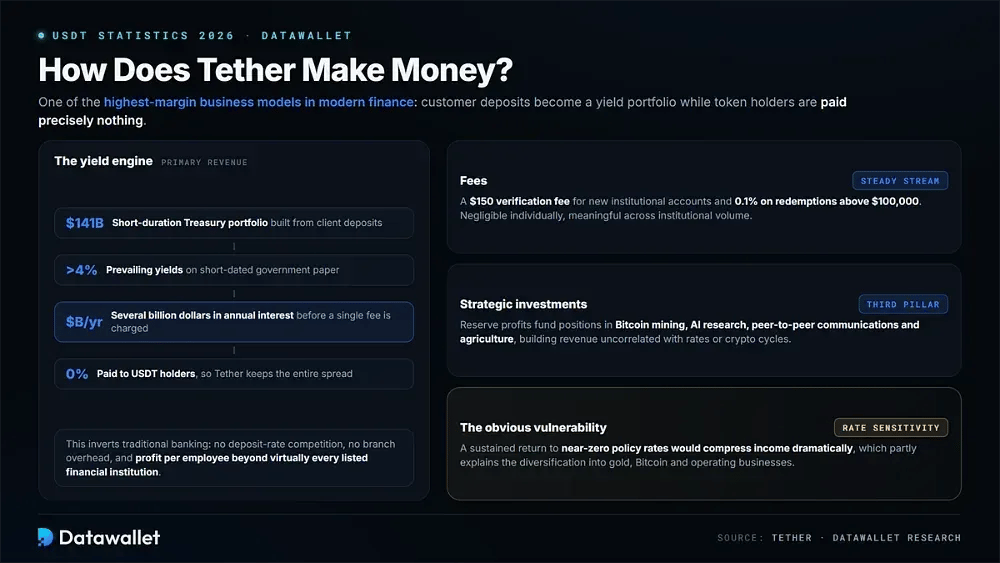
Tether operates one of the highest-margin business models found anywhere in modern finance today, converting customer deposits into a large yield-generating portfolio while paying token holders precisely nothing, unlike the many platforms now offering stablecoin interest rates on deposited balances.
Interest on Reserve Assets
The overwhelming majority of revenue comes from interest earned on the Treasury portfolio itself. Holding roughly $141 billion in short-duration government paper at yields above 4% generates several billion dollars in annual income before a single fee is charged to any user.
This model inverts traditional banking economics. Where banks compete on deposit rates and absorb branch overhead, Tether captures the full spread with a headcount in the low hundreds, producing profit per employee figures that exceed virtually every listed financial institution.
The obvious vulnerability here is rate sensitivity over the longer term. A sustained return to near-zero policy rates would compress this income dramatically, which partly explains the diversification into gold, Bitcoin, and operating businesses, alongside the broader tokenization trend now reshaping reserve assets.
Fees and Strategic Investments
Direct fees form a smaller but notably steady revenue stream. Tether charges a $150 verification fee for new institutional accounts and applies a 0.1% fee on redemptions above $100,000, costs that are negligible individually but meaningful when aggregated across institutional volume.
Reinvestment provides the third pillar of the model. Reserve profits fund the venture arm's positions across Bitcoin mining infrastructure, artificial intelligence research, peer-to-peer communications, and agricultural assets, deliberately building revenue streams uncorrelated with both prevailing interest rates and crypto market cycles.
USDT Risks in 2026
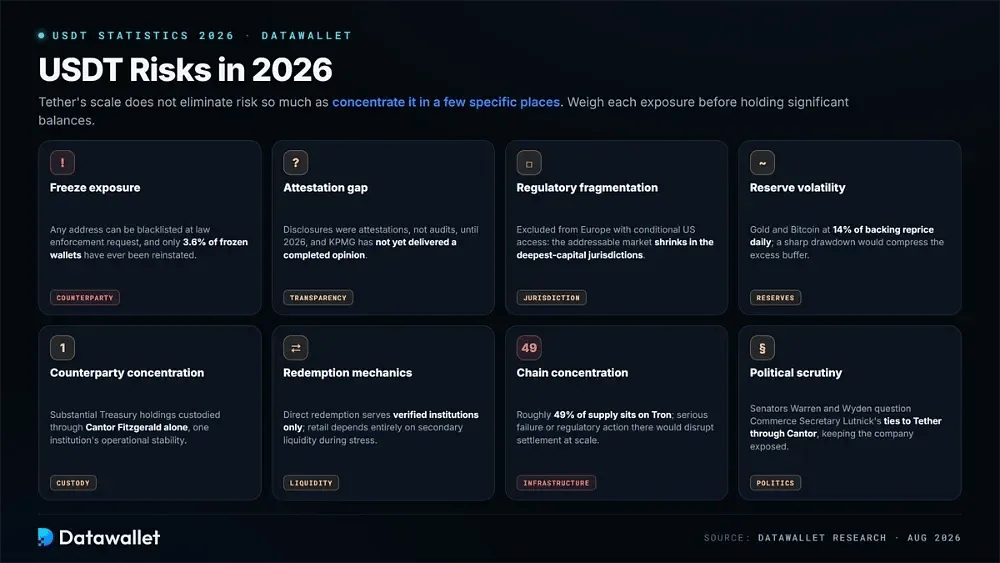
Tether's enormous scale does not eliminate risk so much as concentrate it in a few specific places, and holders face a set of exposures that differ meaningfully from decentralized assets, regulated bank deposits, or alternative stablecoins issued under stricter regulatory frameworks.
Weigh each of these risks before holding significant USDT balances:
- Freeze exposure: Tether can blacklist any address at law enforcement request, and only 3.6% of frozen wallets have ever been reinstated.
- Attestation gap: Reserve disclosures remained attestations rather than audits until 2026, and the KPMG engagement has not yet delivered a completed opinion.
- Regulatory fragmentation: Exclusion from Europe and conditional American access mean USDT's addressable market now shrinks in exactly the jurisdictions with deepest capital.
- Reserve volatility: Gold and Bitcoin holdings representing 14% of backing reprice daily, and a sharp drawdown would compress the excess reserve buffer materially.
- Counterparty concentration: Substantial Treasury holdings are custodied through Cantor Fitzgerald, creating dependency on a single institution's operational and financial stability.
- Redemption mechanics: Direct redemption is available only to verified institutional clients, so retail holders depend entirely on secondary market liquidity during stress.
- Chain concentration: With roughly 49% of supply on Tron, a serious failure or regulatory action against that network would disrupt an enormous share of settlement.
- Political scrutiny: Senators Warren and Wyden have questioned Commerce Secretary Lutnick's ties to Tether through Cantor Fitzgerald, keeping the company politically exposed.
Final Thoughts
Tether enters the second half of 2026 larger and more profitable than ever, yet facing genuine structural pressure for the first time. Supply near $185 billion and $141 billion in Treasuries confirm systemic importance, while falling dominance and European exclusion show the moat is not impenetrable.
The KPMG audit is the variable that matters most. A clean opinion would neutralize the criticism that has shadowed Tether for a decade and strengthen the case for both institutional adoption and its ambitious valuation. Delay or qualification would do the opposite at a particularly inconvenient moment.
For users, the practical takeaway is that USDT is best understood as private infrastructure rather than a neutral digital dollar. It works remarkably well for most needs, but carries freeze, issuer, and regulatory risks worth weighing before storing balances in any crypto wallet long term.
Our Methodology
This article draws on quarterly attestations, on-chain enforcement trackers, regulator publications and independent market data to assess Tether's position in 2026.
- Issuer disclosures: Tether's Q1 2026 BDO attestation and transparency reports for reserve composition, excess capital, Treasury exposure and quarterly profit figures.
- On-chain data: DefiLlama for circulating supply, dominance and chain distribution, alongside TRONSCAN and Token Terminal for network-level transfer volume and account activity.
- Enforcement tracking: BlockSec's Phalcon compliance tracker and Tether's own freeze announcements for blacklisted address counts, frozen balances and network concentration.
- Regulatory sources: ESMA's MiCA framework, the GENIUS Act statutory text and Treasury implementation rules for jurisdiction-specific treatment of USDT and USAT.
- Primary reporting: Bloomberg, Reuters, CoinDesk, The Block and the Financial Times for enforcement actions, fundraising developments and the KPMG audit engagement.
- Attestation caveat: Reserve figures come from attestations rather than a completed audit, meaning they confirm point-in-time balances without examining underlying internal controls.
- Snapshot caveat: Supply, dominance and frozen totals shift continuously as Tether mints, redeems and blacklists, so figures reflect the research window rather than live values.
%20Statistics%20%26%20Trends%20in%202026.webp)