







Which Countries Does HTX Restrict?
HTX restricts some or all products for residents of 54 listed jurisdictions under clause 1.2 of the HTX Platform User Agreement, last updated in September 2026. Its full ban covers every product, including deposits, withdrawals and spot trading, meaning buying and selling coins at the current price. A second restriction applies only to derivatives such as futures, leaving spot trading available.
The current clause contains 46 entries under the full ban and 8 under the derivatives restriction. HTX considers a person "from" a jurisdiction if they reside there or are physically present there. For companies, this means the place of incorporation or main place of business.
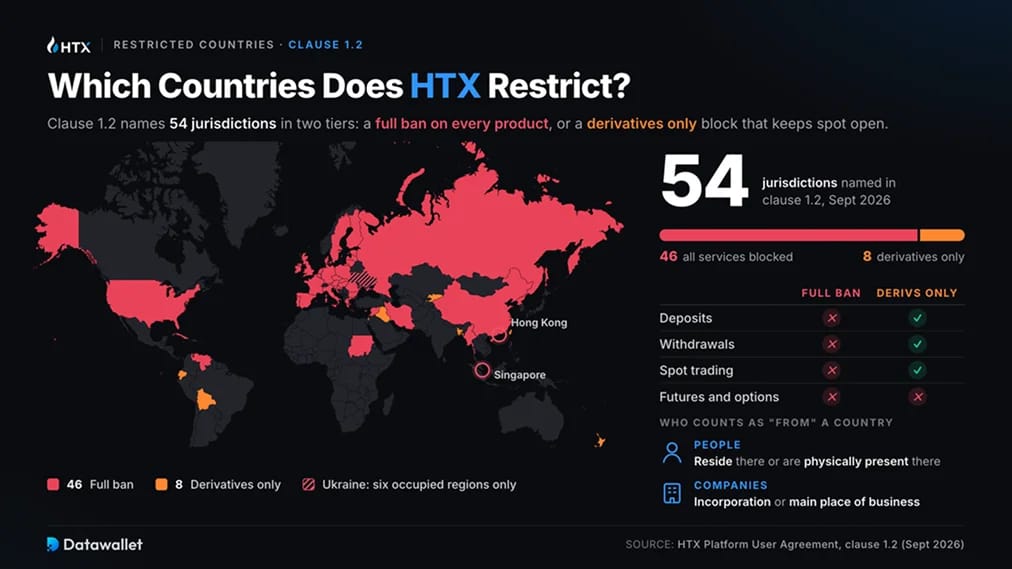
HTX Restricted Countries List
The table groups each entry by region and restriction level.
The EU entry covers Austria, Belgium, Bulgaria, Croatia, Cyprus, the Czech Republic, Denmark, Estonia, Finland, France, Germany, Greece, Hungary, Ireland, Italy, Latvia, Lithuania, Luxembourg, Malta, the Netherlands, Poland, Portugal, Romania, Slovakia, Slovenia, Spain and Sweden.
Norway, Iceland, Liechtenstein and Switzerland are absent from the clause. These countries generally apply the same Russia sanctions as the EU, so residents should check national rules before depositing funds.
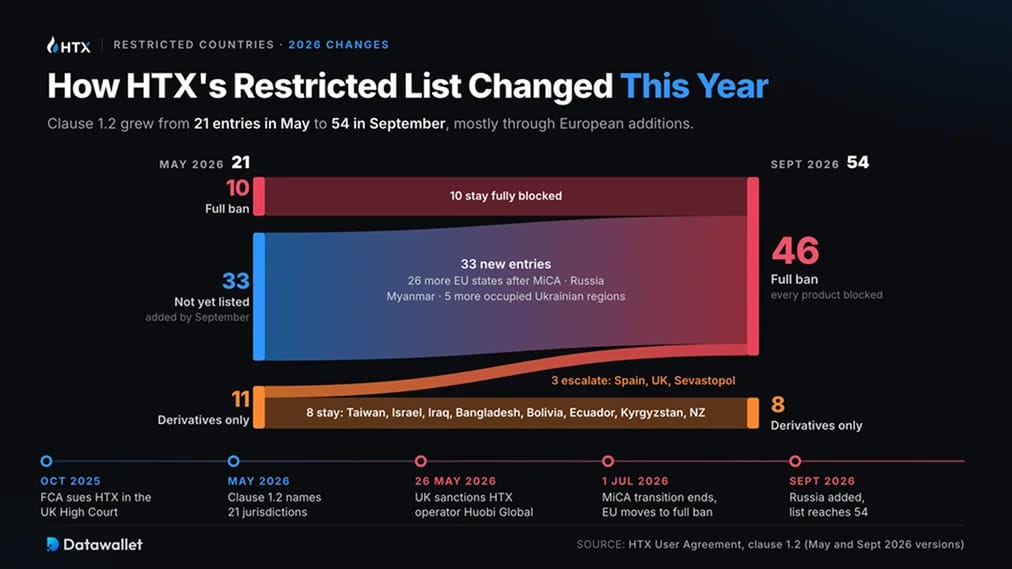
How HTX's Restricted List Changed This Year
In May 2026, clause 1.2 named 21 jurisdictions, with ten blocked from all services and eleven restricted to spot trading. The list has since more than doubled, largely through European additions. Many users who could trade in May have lost access.
The main changes to clause 1.2:
- European Union: Spain was the only EU country listed in May, with restrictions limited to derivatives. All 27 member states moved to the full ban after July 1, 2026, when MiCA's transition period ended. MiCA is the EU law requiring a license to serve EU residents.
- United Kingdom: A retail derivatives restriction became a full ban following an October 2025 lawsuit by the Financial Conduct Authority (FCA) and UK sanctions against HTX's operator in May 2026.
- Russian Federation: Russia first appeared in the September 2026 agreement and is the newest addition. Russian-language exchange guides published in late September still described HTX as open to Russian residents, indicating how recent the change is. We found no public HTX announcement explaining it.
- Occupied Ukraine: Only Sevastopol was listed in May, and its restriction covered derivatives alone. All services are now blocked in Sevastopol, Crimea, Donetsk, Luhansk, Kherson and Zaporizhzhia.
- Myanmar: The full ban now includes Myanmar, which faces US, UK and EU sanctions programs.
- Derivatives list: Taiwan, Israel, Iraq, Bangladesh, Bolivia, Ecuador, Kyrgyzstan and New Zealand remain subject only to derivatives restrictions. Residents can still trade spot markets.
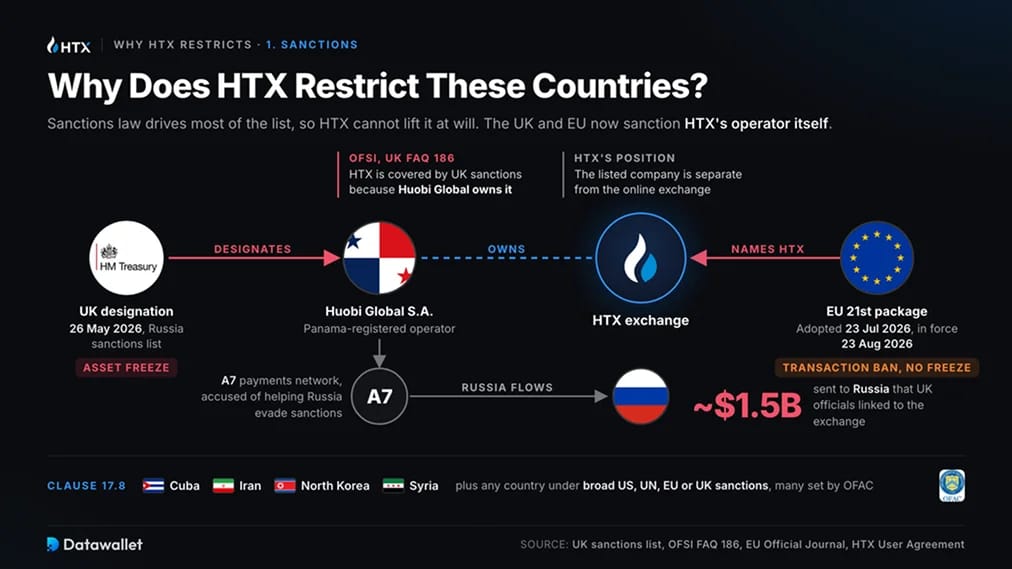
Why Does HTX Restrict These Countries?
Sanctions law accounts for most of HTX's restrictions, preventing the exchange from lifting them at its own discretion. The UK and EU now sanction HTX's operator itself. Local licensing requirements explain the remaining entries.
1. Sanctions on Countries and on HTX Itself
The sanctions measures that shape HTX's country list:
- UK designation: The UK government added Huobi Global S.A. to its Russia sanctions list on May 26, 2026. It said the Panama-registered company provided financial services to A7, a payments network the UK accuses of helping Russia avoid sanctions. Officials linked the exchange to about $1.5 billion sent to Russia.
- HTX covered by the freeze: FAQ 186 in the UK Financial Sanctions FAQs states that HTX is subject to UK sanctions because Huobi Global owns the exchange. The Office of Financial Sanctions Implementation (OFSI), the UK Treasury unit responsible for enforcing financial sanctions, added the clarification. HTX maintains that the listed company is separate from the online exchange.
- EU transaction ban: Adopted on July 23, 2026, the EU's 21st Russia sanctions package names "HTX (Huobi Global SA)". The regulation in the EU Official Journal prohibits EU persons and companies from making any direct or indirect transaction with HTX from August 23, 2026. It does not freeze assets.
- Country sanctions: Clause 17.8 specifically names Cuba, Iran, North Korea and Syria, while excluding any country under broad US, UN, EU or UK sanctions. Many of these rules originate with the US Office of Foreign Assets Control (OFAC), the Treasury office that administers US sanctions programs.
- Russia and occupied regions: These additions followed UK and EU accusations that the exchange served Russian sanctions evasion networks.
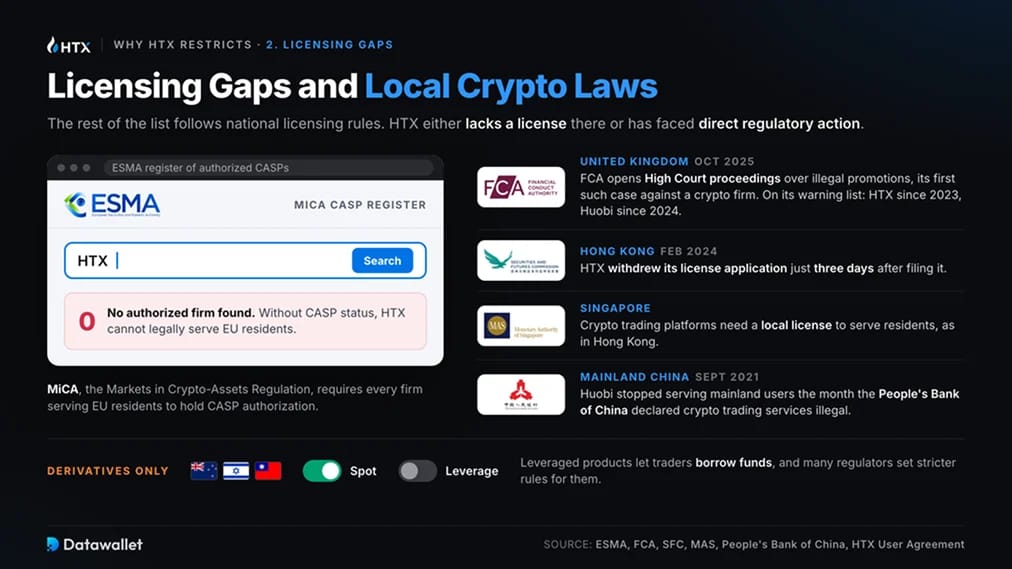
2. Licensing Gaps and Local Crypto Laws
National licensing rules account for the other restrictions. HTX either lacks a license in these jurisdictions or has faced direct regulatory action.
Licensing pressures behind the other restrictions:
- MiCA in the EU: Under the Markets in Crypto-Assets Regulation, firms need authorization as a crypto-asset service provider (CASP). HTX is absent from ESMA's register of authorized firms and therefore cannot legally serve EU residents.
- FCA lawsuit in the UK: In October 2025, the FCA began High Court proceedings over illegal promotion of crypto services to UK consumers. This was its first court case of this type against a crypto firm. HTX has been on the FCA warning list since 2023, and Huobi since 2024.
- Hong Kong and Singapore: Crypto trading platforms need local licenses in both jurisdictions. HTX withdrew its Hong Kong application in February 2024, just three days after filing it.
- Mainland China: Huobi stopped serving mainland users in September 2021, the same month the People's Bank of China declared crypto trading services illegal.
- Derivatives-only markets: HTX keeps spot trading available in places such as New Zealand, Israel and Taiwan but blocks leveraged products, which allow traders to borrow funds. Many regulators impose stricter requirements on these products.
HTX Supported Countries
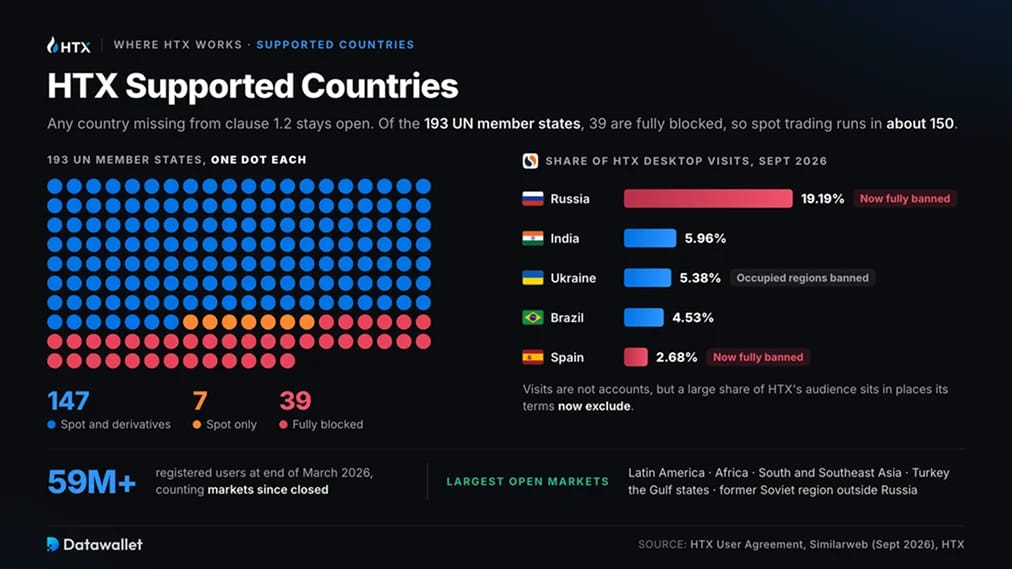
HTX remains available in countries not named in clause 1.2. Of the 193 UN member states, 39 are fully blocked. Spot trading therefore remains open in about 150 countries, most of which also retain derivatives access.
Its largest open markets span Latin America, Africa, South and Southeast Asia, along with Turkey, the Gulf states and the former Soviet region outside Russia. At the end of March 2026, HTX reported more than 59 million registered users. That figure includes accounts in markets it subsequently closed.
Russia accounted for 19.19% of desktop visits in September 2026, making it HTX's largest traffic source, according to Similarweb data. India contributed 5.96%, followed by Ukraine at 5.38%, Brazil at 4.53% and Spain at 2.68%. Although visits do not equal accounts, these figures show that a substantial part of HTX's audience comes from jurisdictions its terms now exclude.
Open Markets Where HTX Has No License
Being absent from clause 1.2 does not establish that HTX is authorized to operate in a country. Several regulators in open markets have issued public warnings about the exchange.
- Philippines: An April 2026 advisory from the Securities and Exchange Commission (SEC) said HTX was neither registered nor licensed as a crypto service provider. People promoting it locally could face criminal penalties, the regulator warned.
- India: In December 2023, the Financial Intelligence Unit (FIU-IND) sent a show-cause notice to Huobi and eight other offshore exchanges, demanding an explanation for operating without registration. FIU-IND also requested that their websites be blocked. We found no public record of HTX registering with FIU-IND since then.
- Malaysia: The Securities Commission took enforcement action against Huobi Global in 2021 for running an unregistered digital asset exchange.
- Pakistan: HTX's No Objection Certificate from the national regulator permits preparatory work only. The exchange has not received the license needed for full commercial operations.
Traders can compare locally compliant platforms in our guides to the best crypto exchanges in India and the best crypto exchanges in Pakistan.
Can I Use HTX in the USA?
US residents cannot use any HTX product under the full ban in clause 1.2. Visitors are covered too. A non-American who is physically in the United States is treated as "from" the country for the purposes of the agreement.
HBUS, Huobi's US partner exchange, halted trading in December 2019. HTX has not returned. The SEC's March 2026 settlement of its separate case against Justin Sun concerned the TRX and BTT tokens and left HTX's US status unchanged. Residents can compare regulated platforms in our list of the best crypto exchanges in the USA.
Can UK and EU Residents Still Use HTX?
Neither UK nor EU residents can use HTX. Both regions face a full ban under the exchange's terms, with additional restrictions imposed by sanctions law.
What UK and EU account holders should know:
- UK asset freeze: Sanctions freeze funds held with designated persons, and OFSI considers HTX covered. UK persons holding a balance on the exchange should seek legal advice and ask OFSI about a license before moving funds.
- FCA court case: The High Court paused the FCA's case until September 22, 2026, to allow settlement negotiations. No settlement had been made public when we updated this page. Any advertising agreement would leave the sanctions in place.
- EU withdrawal window: The EU measure prohibits transactions without freezing assets. EU, EEA and Swiss nationals and residents can seek permission from their national authority to withdraw funds or close an account. However, the request must be made within three months of August 23, putting the deadline around November 23, 2026.
- Transfers from other exchanges: Several large exchanges warned of extra compliance checks on HTX transfers following the UK designation. Binance later said it would stop processing transactions with HTX from August 23.
- Stablecoin freezes: Following sanctions reviews, USD1 stablecoin issuer World Liberty Financial froze certain HTX addresses in June 2026. HTX then delisted USD1. Our World Liberty Financial explainer explains how the stablecoin works.
European traders seeking a supervised venue can compare the best MiCA-licensed crypto exchanges. For UK alternatives, see our guide to the best crypto exchanges in the UK.
Is HTX Available in Russia?
HTX's current terms prohibit all services in Russia. The Russian Federation appears on the full ban list in the September 2026 user agreement, a major change for a country that supplied the exchange's largest share of web traffic through most of 2026.
Under clause 4.4, HTX can limit services, freeze withdrawals or close accounts belonging to users from restricted jurisdictions. Russian residents with remaining balances should expect these checks. Local media reported in May that several Russian exchange services had stopped accepting HTX transfers, which may make withdrawals slower than usual. Our guide to the best crypto exchanges in Russia lists platforms that continue to serve the country.
What Fiat Currencies Does HTX Support?
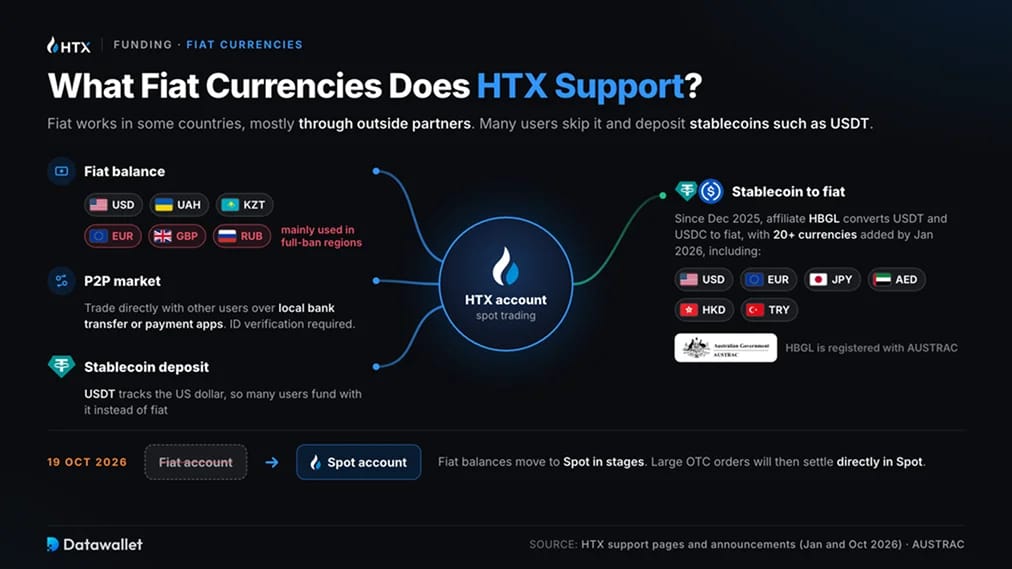
HTX supports fiat money, or government-issued currency, in some countries. Most funding methods rely on outside partners. Many users instead deposit stablecoins such as USDT, which track the US dollar.
The main fiat options on HTX:
- Fiat balance: The exchange's support page lists EUR, USD, RUB, UAH, KZT and GBP as currencies available for crypto purchases from a fiat balance. EUR, GBP and RUB are mainly used in regions now subject to the full ban.
- Peer-to-peer (P2P) market: Buyers and sellers trade crypto directly, paying through local bank transfers or payment apps. Completed identity verification is required.
- Stablecoin-to-fiat conversion: In December 2025, HTX Group affiliate HBGL began converting USDT and USDC to fiat. HBGL is registered with the Australian Transaction Reports and Analysis Centre (AUSTRAC). HTX said in January 2026 that the service had added more than 20 currencies, including USD, EUR, JPY, AED, HKD and TRY.
- Account change in October 2026: HTX announced on October 19, 2026, that all Fiat account balances will move to the Spot account in stages. Over-the-counter (OTC) trades for large orders will then settle directly in the Spot account.
HTX Licenses and Regulation
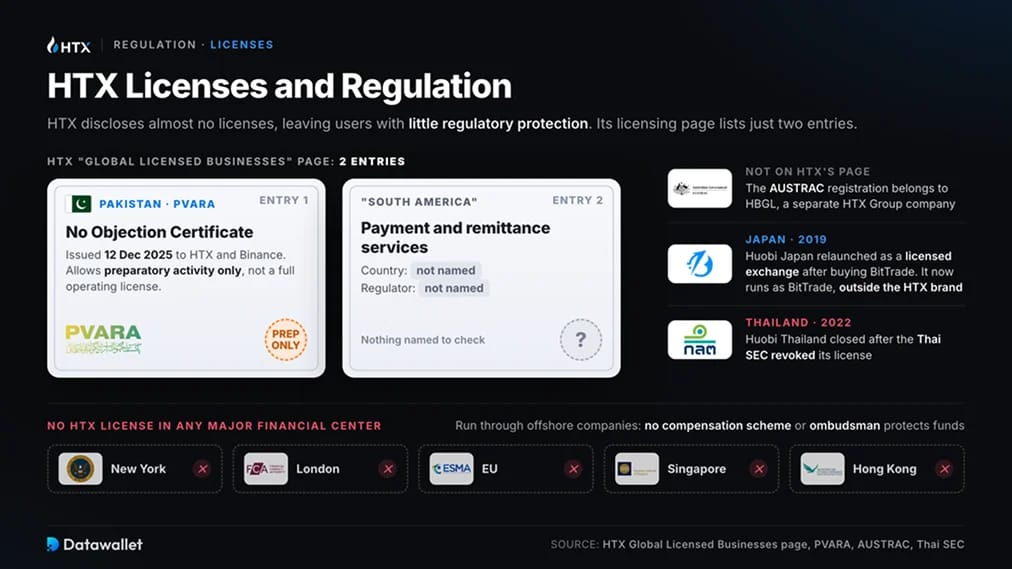
HTX discloses almost no licenses, leaving users with little regulatory protection. Its Global Licensed Businesses page contains two entries. One identifies a No Objection Certificate from the Pakistan Virtual Assets Regulatory Authority (PVARA). The other describes payment and remittance services in "South America" without naming a country or regulator.
PVARA issued the certificate to HTX and Binance on December 12, 2025. It explicitly permits preparatory activity under the regulator's oversight and is not a full operating license. Australia's AUSTRAC registration belongs to the separate company HBGL and is absent from HTX's own licensing page.
Earlier licenses and regulatory actions linked to Huobi:
- Japan: After acquiring BitTrade, Huobi Japan relaunched in 2019 as a licensed exchange. It now operates as BitTrade, outside the HTX brand.
- Thailand: Huobi Thailand closed after the Thai SEC revoked its license in 2022.
Operating mainly through offshore companies, HTX holds no license in any major financial center. Users rely on the exchange's own controls, with no compensation scheme or financial ombudsman protecting their funds.
Does HTX Require KYC?
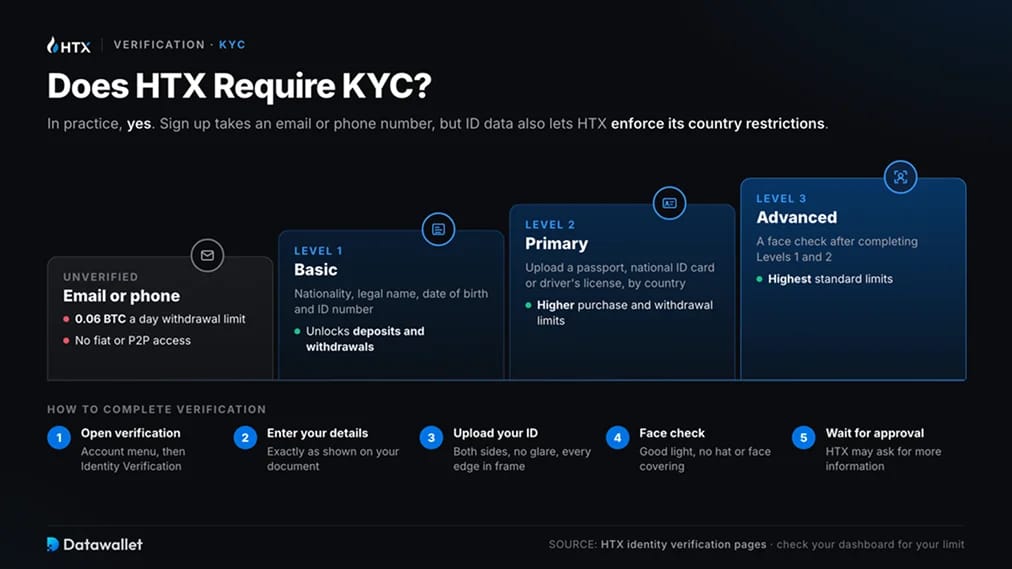
Nearly all practical use of HTX requires KYC (know your customer), the checks used to confirm identity, nationality and country of residence. Registration needs only an email address or phone number. Without verification, however, accounts have very low withdrawal limits and no access to fiat or P2P services.
Nationality and document data also help HTX enforce its country restrictions. The exchange can request fresh checks when its rules change.
1. HTX Verification Levels
- Level 1, Basic: Entering nationality, legal name, date of birth and ID number unlocks deposits and withdrawals.
- Level 2, Primary: Higher purchase and withdrawal limits require an uploaded passport, national ID card or driver's license, depending on the country.
- Level 3, Advanced: After completing Levels 1 and 2, users take a face check to obtain the highest standard limits.
- Unverified accounts: HTX publishes a withdrawal limit of 0.06 BTC per day for accounts without ID verification. Check your account dashboard for the limit that applies to you.
2. How to Complete HTX Verification
- Open the verification page: Log in through the website or app, then select Identity Verification from the account menu.
- Enter your details: Provide your nationality, full legal name, date of birth and ID number exactly as shown on your document.
- Upload your document: Photograph both sides of your ID clearly, avoiding glare and keeping every edge in the frame.
- Complete the face check: Follow the camera prompts in a well-lit place without a hat or face covering.
- Wait for approval: HTX reviews your documents and may request further information before increasing your limits.
Can You Use HTX With a VPN?
A VPN (virtual private network) hides your IP address without changing your legal location. Because clause 1.2 defines "from" through residence and physical presence, connecting through a VPN does not remove a country's restrictions. HTX can freeze withdrawals or close the account under clause 4.4.
UK and EU users also face personal legal risk, as dealing with HTX can breach national sanctions law. Verification documents will usually reveal their country of residence anyway.
About HTX
Leon Li founded Huobi in Beijing in 2013, building it into one of Asia's largest exchanges. Tron founder Justin Sun is widely reported to have taken control in 2022. The business rebranded to HTX in September 2023, although it describes Sun as a global adviser.
In September 2023, HTX lost about $8 million from a hot wallet, an internet-connected wallet used for withdrawals. Another loss of about $30 million followed in November 2023. The exchange said it covered user losses in both cases.
TRM Labs said in July 2026 that HTX was rotating its hot wallets to new addresses in a way that weakened sanctions screening. HTX denied the claim. A September dark web listing also claimed to hold data on 6.5 million HTX users, but that claim was unverified.
The exchange publishes monthly Merkle tree proof of reserves reports, allowing users to check that their balances are included in its holdings. Its 48th consecutive monthly report, based on an October 1, 2026 snapshot, showed reserve ratios of 104% for BTC, 102% for ETH and 104% for USD stablecoins. HTX prepares the reports itself, without an independent audit of its liabilities. Our HTX review examines fees, products and security in more detail.
Final Thoughts
Between May and September 2026, HTX's restricted list expanded from 21 entries to 54. The additions follow UK and EU sanctions against its operator and remove the exchange from the region responsible for its largest share of traffic.
Registration and trading remain available in roughly 150 countries. Users should complete verification and enable two-factor authentication. Before making a large deposit, check clause 1.2 again, as HTX reserves the right to change the list without notice. Allow for delays on transfers between HTX and other exchanges, which may undergo sanctions screening.
.webp)