
What Are Maker and Taker Fees in Crypto?
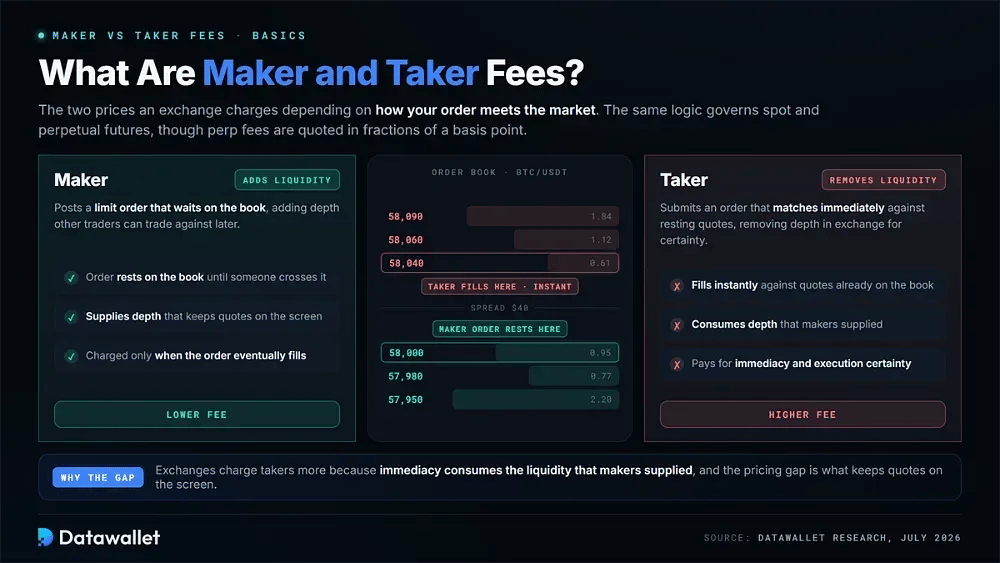
Maker and taker fees are the two prices an exchange charges depending on how your order meets the market. A maker posts a limit order that waits on the book, adding depth other traders can trade against later.
A taker submits an order that matches immediately against those resting quotes, removing depth in exchange for certainty. Exchanges charge takers more because immediacy consumes the liquidity that makers supplied, and the pricing gap is what keeps quotes on the screen.
The same logic governs spot markets and perpetual futures, though the absolute numbers differ sharply. Perp fees are quoted in fractions of a basis point because leveraged notional turns over far faster than spot balances.
Maker vs Taker Fees on Crypto Exchanges
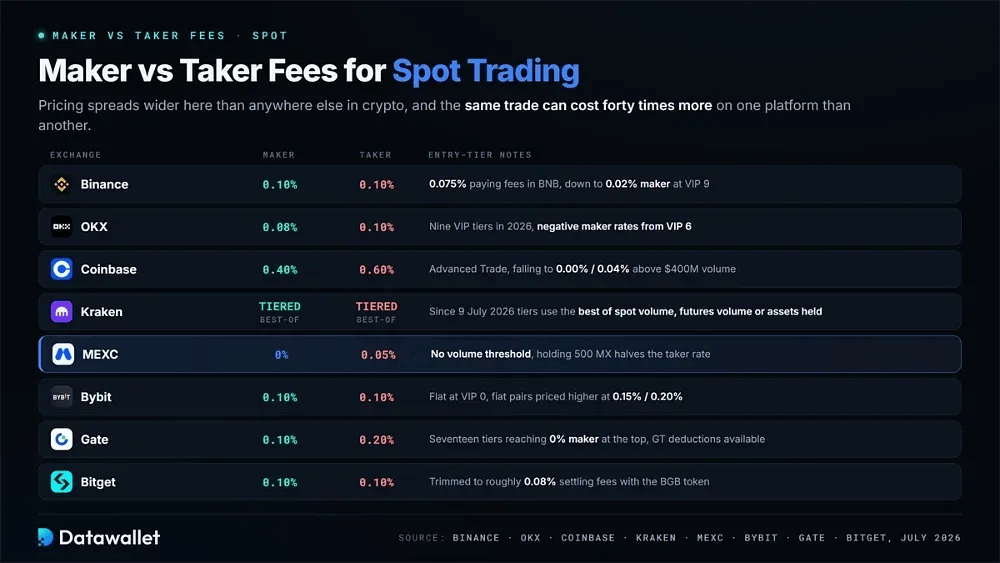
Rates differ enormously between platforms, products and tiers, so the same trade can cost forty times more on one platform than another. The three sections below cover spot books, derivatives and onchain perpetuals separately.
Maker vs Taker Fees for Spot Trading
Spot trading settles the underlying asset immediately, and pricing here spreads wider than anywhere else in crypto because retail-facing platforms bundle convenience into the rate.
Spot maker-taker schedules differ sharply across the major platforms:
- Binance: Charges 0.10% on both sides at the base tier, dropping to 0.075% when fees are paid in BNB and 0.02% maker at VIP 9.
- OKX: Prices spot at 0.08% maker and 0.10% taker, with a VIP ladder expanded to nine tiers during 2026 and negative maker rates from VIP 6.
- Coinbase: Advanced Trade starts at 0.40% maker and 0.60% taker, falling to 0.00% and 0.04% above $400 million, with eligible stable pairs free for makers.
- Kraken: Since 9 July 2026, Kraken Pro sets tiers using the best of spot volume, futures volume or assets held on the platform.
- MEXC: Applies 0% maker and 0.05% taker to most listings with no volume threshold, and holding 500 MX halves the taker rate.
- Bybit: Charges a flat 0.10% both ways at VIP 0, with fiat pairs priced higher at 0.15% maker and 0.20% taker.
- Gate: Opens at 0.10% maker and 0.20% taker across seventeen tiers, reaching 0% maker at the top with GT-based deductions available.
- Bitget: Lists 0.10% spot for standard accounts, trimmed to roughly 0.08% for traders settling fees with the BGB token.
Maker vs Taker Fees in Futures and Derivatives Trading
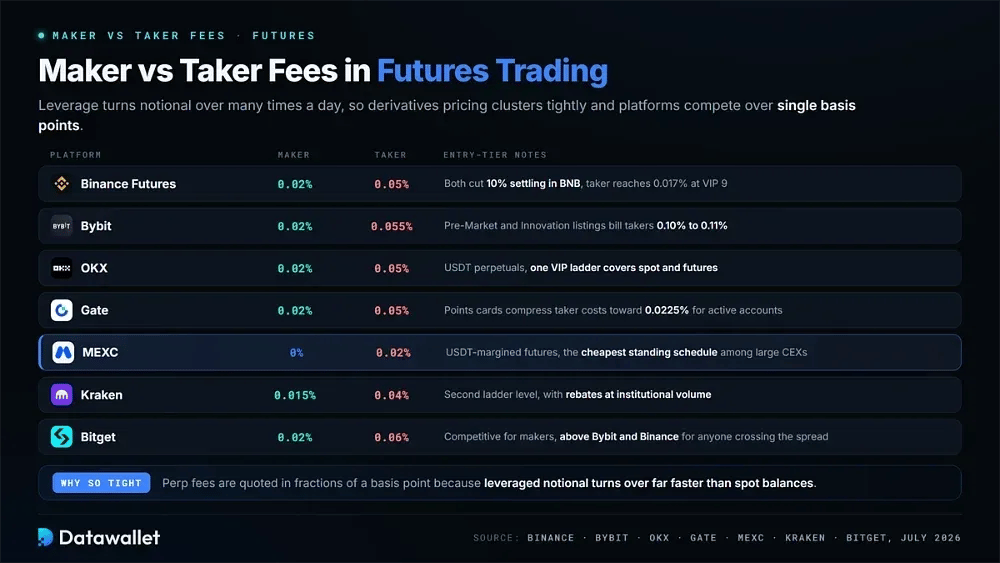
Derivatives pricing clusters tightly because leverage turns over notional many times a day, so platforms compete over single basis points rather than tenths of a percent. Our ranking of the best crypto futures exchanges covers depth alongside cost.
These are the entry-tier derivatives rates on the largest platforms:
- Binance Futures: Bills 0.02% maker and 0.05% taker at VIP 0, cutting both by 10% when fees settle in BNB and reaching 0.017% taker at VIP 9.
- Bybit Futures: Charges 0.02% maker and 0.055% taker on standard perpetuals, while newly listed Pre-Market and Innovation contracts bill takers 0.10% to 0.11%.
- OKX Futures: Applies 0.02% maker and 0.05% taker on USDT perpetuals at the regular tier, with the same VIP ladder covering spot and futures.
- Gate: Matches OKX at 0.02% and 0.05%, and points cards can compress taker costs toward 0.0225% for consistently active accounts.
- MEXC: Runs 0% maker and 0.02% taker on USDT-margined futures, the cheapest standing schedule among large centralized platforms.
- Kraken: Uses a separate derivatives ladder where the second level already reaches 0.015% maker and 0.04% taker, with rebates at institutional volume.
- Bitget: Sits at 0.02% maker and 0.06% taker, competitive for makers but above Bybit and Binance for anyone crossing the spread.
Maker vs Taker Fees on Decentralized Exchanges
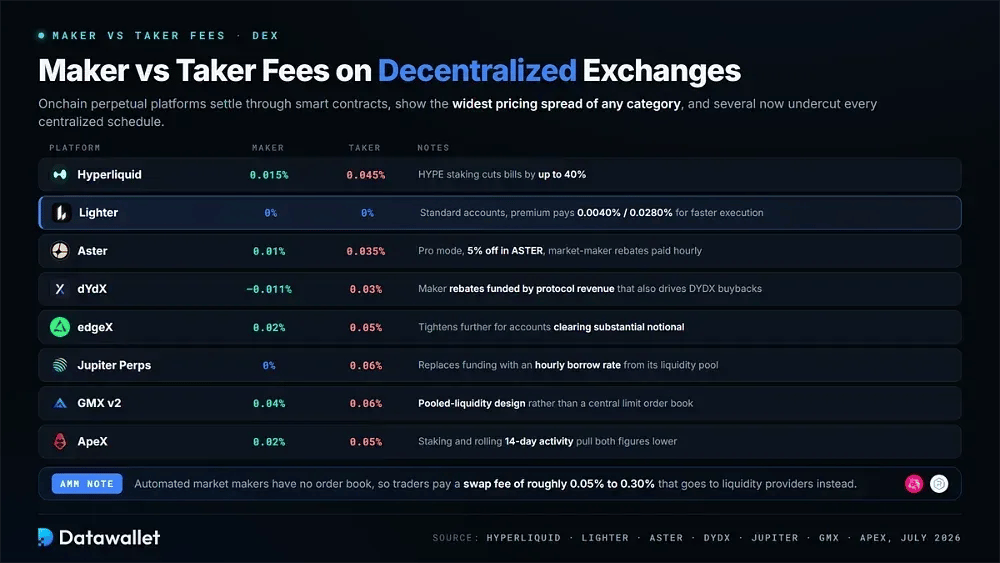
Onchain platforms settle through smart contracts rather than an operator's ledger, and several now undercut every centralized schedule. Our guide to the best decentralized perpetuals exchanges ranks them on depth as well as pricing.
Onchain perpetual platforms show the widest pricing spread of any category:
- Hyperliquid: Charges 0.015% maker and 0.045% taker, with volume tiers reaching 0.024% and HYPE staking cutting bills by up to 40%.
- Lighter: Gives standard accounts 0% on both sides, while opt-in premium accounts pay 0.0040% maker and 0.0280% taker for faster execution.
- Aster: Prices Pro mode at 0.01% maker and 0.035% taker, applies a 5% discount for fees paid in ASTER, and pays market-maker rebates hourly.
- dYdX: Rewards makers with rebates reaching –0.011% while takers start near 0.03%, funded by protocol revenue that also drives DYDX buybacks.
- edgeX: Runs close to 0.02% maker and 0.05% taker, tightening further for accounts clearing substantial notional across its order book.
- Jupiter Perps: Charges no maker fee and 0.06% on takers, replacing funding payments with an hourly borrow rate drawn from its liquidity pool.
- GMX v2: Bills roughly 0.04% maker and 0.06% taker, reflecting a pooled-liquidity design rather than a competitive central limit order book.
- ApeX: Opens near 0.02% maker and 0.05% taker, with staking and rolling fourteen-day activity pulling both figures meaningfully lower.
Note: Automated market makers such as Uniswap and Raydium have no order book, so traders pay a swap fee of roughly 0.05% to 0.30% that goes to liquidity providers instead of the protocol.
Why Crypto Exchanges Charge Maker and Taker Fees
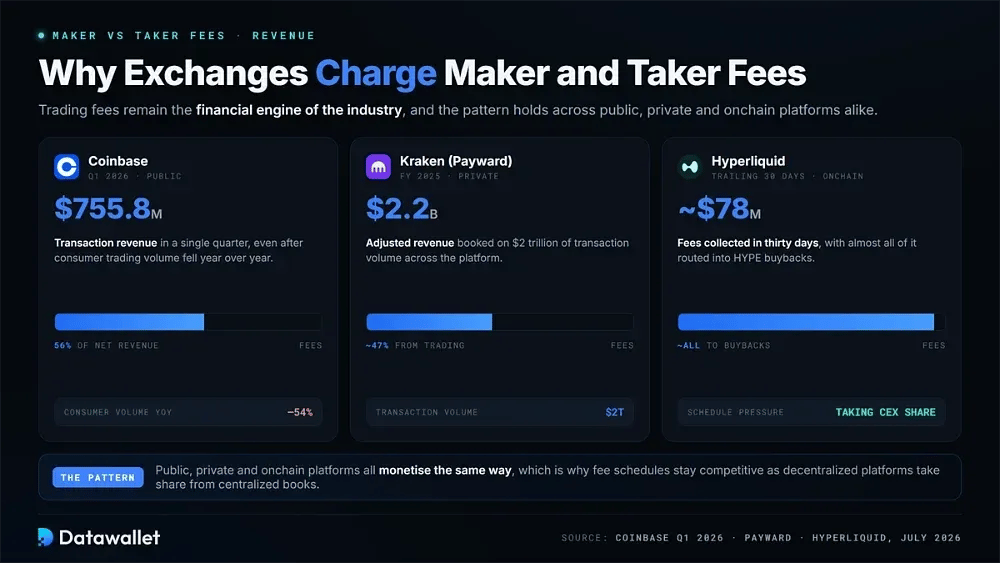
Trading fees remain the financial engine of the industry. Coinbase reported $755.8 million of transaction revenue in the first quarter of 2026, equal to 56% of net revenue, even after consumer trading volume fell 54% year over year.
The same pattern holds privately. Payward, Kraken's parent, booked $2.2 billion of adjusted revenue for 2025 on $2 trillion of transaction volume, with roughly 47% of that total coming directly from trading rather than custody or payments.
Onchain platforms monetise identically. Hyperliquid collected about $78 million in fees over the past thirty days and routes almost all of it into HYPE buybacks, which is why fee schedules stay competitive as decentralized platforms take share from centralized books.
Difference Between Maker and Taker Orders
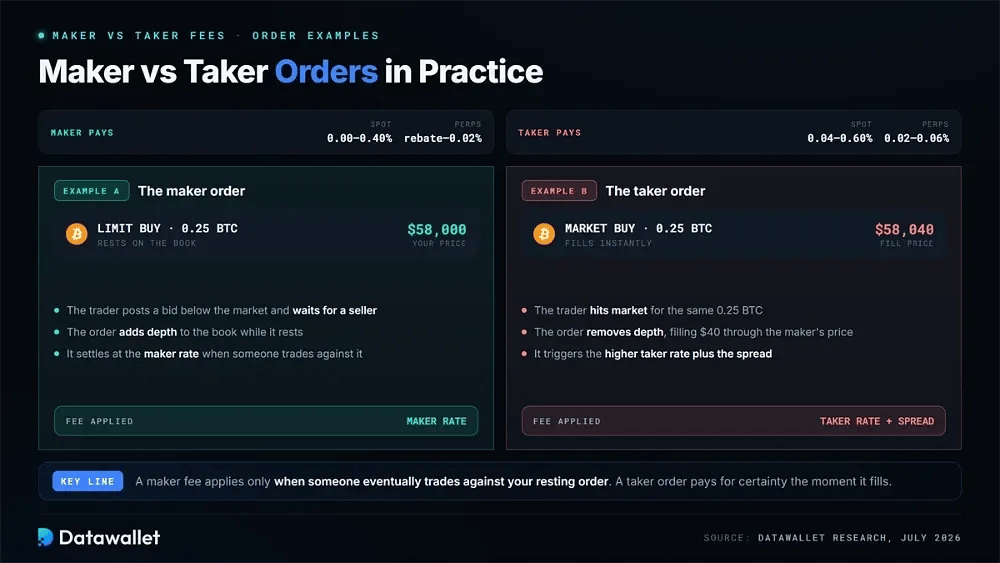
Maker orders sit on the book at a price nobody has crossed yet, and the maker fee applies only when someone eventually trades against them. Spot makers typically pay 0.00% to 0.40%, while perpetual makers pay between a small rebate and 0.02%.
Taker orders fill instantly against resting quotes using market orders or limits priced through the spread. Spot takers usually pay 0.04% to 0.60%, and perpetual takers pay roughly 0.02% to 0.06% before any discount applies.
Two examples show the split in practice:
- Example A: A trader posts a limit buy at $58,000 for 0.25 BTC and waits for a seller. The order adds depth, so it settles at the maker rate.
- Example B: A trader hits market for the same 0.25 BTC and fills instantly at $58,040. The order removes depth, triggering the higher taker rate plus the spread.
How Maker Fees Affect Crypto Traders
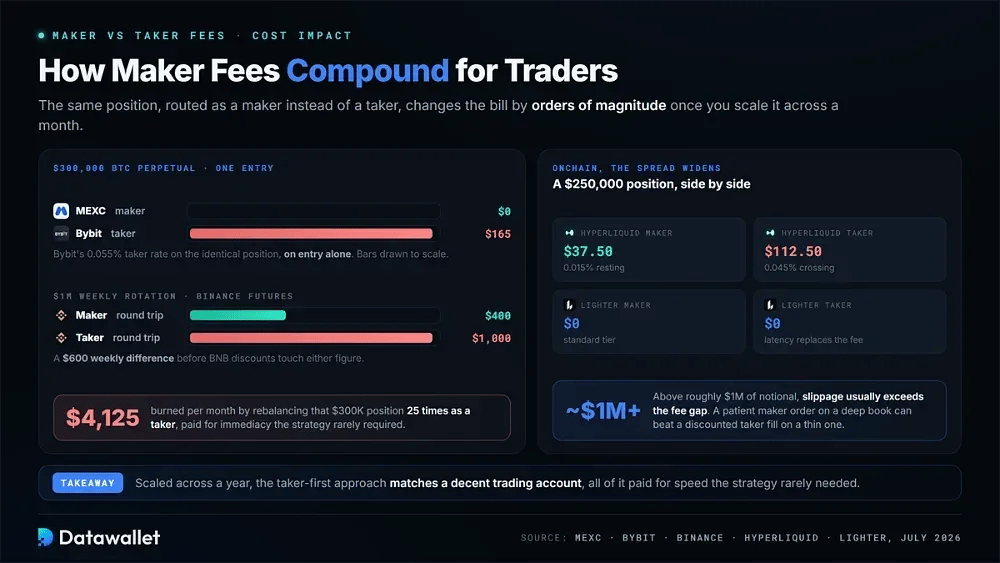
Maker pricing compounds quietly. On MEXC, opening a $300,000 BTC perpetual as a maker costs nothing, while the same position taken at Bybit's 0.055% costs $165 on entry alone.
Rebalance that position twenty-five times a month and the taker-first approach burns $4,125 that never touches your thesis. Scale it across a year and the number matches a decent trading account, all of it paid for immediacy the strategy rarely required.
Mid-sized flow shows the same gap. A trader rotating $1 million weekly through Binance Futures pays $400 per round trip as a maker against $1,000 as a taker, a $600 weekly difference before BNB discounts touch either figure.
Onchain, the spread widens further. A $250,000 Hyperliquid position costs $37.50 as a maker or $112.50 as a taker, while the identical trade on Lighter's standard tier costs nothing on either side, with execution latency replacing the fee.
Size changes the calculation again. Above roughly $1 million of notional, slippage usually exceeds the fee gap, so a patient maker order on a deep book can beat a discounted taker fill on a thin one by several thousand dollars.
How to Lower Your Maker and Taker Fees
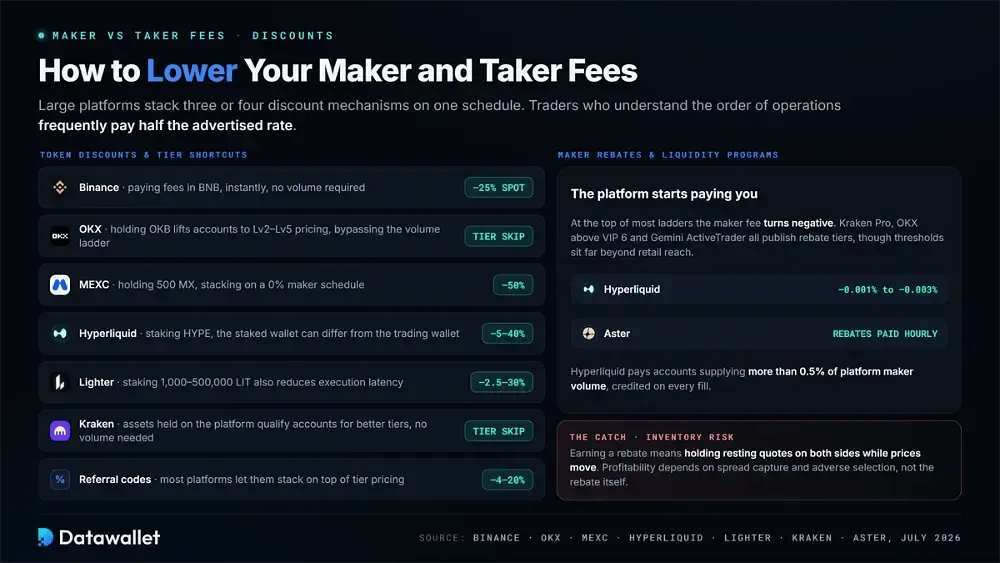
Every large platform now stacks three or four discount mechanisms on one schedule, and traders who understand the order of operations frequently pay half the advertised rate without changing strategy.
Volume Tiers and Token Discounts
Tier progression is automatic, but token-based discounts require a deliberate decision about holding an asset whose price can move against you faster than the savings accumulate.
These discount programs move rates the furthest:
- Binance: Paying fees in BNB removes 25% from spot rates and 10% from futures, applying instantly without any volume requirement.
- OKX: Holding OKB lifts regular accounts through Lv2 to Lv5 pricing, bypassing the volume ladder that most retail accounts never reach.
- MEXC: Holding 500 MX halves trading fees, stacking on a schedule that already charges makers nothing across most listings.
- Hyperliquid: Staking HYPE cuts fees by 5% to 40%, and the staked wallet can differ from the trading wallet entirely.
- Lighter: Staking between 1,000 and 500,000 LIT trims premium fees by 2.5% to 30% while also reducing execution latency at each level.
- Kraken: Assets held on the platform now qualify accounts for better tiers, so long-term holders benefit without generating any trading volume.
- Referrals: Codes typically shave 4% to 20% from taker fees, and most platforms let referral discounts stack on top of tier pricing.
Maker Rebates and Liquidity Programs
At the top of most ladders, the maker fee turns negative and the platform starts paying you. Kraken Pro, OKX above VIP 6 and Gemini ActiveTrader all publish rebate tiers, though the volume thresholds sit far beyond retail reach.
Onchain programs are more accessible. Hyperliquid pays –0.001% to –0.003% to accounts supplying more than 0.5% of platform maker volume, credited on every fill, while Aster displays a zero maker fee and disburses rebates hourly.
The catch is inventory risk. Earning a rebate means holding resting quotes on both sides while prices move, so market-making profitability depends on spread capture and adverse selection rather than the rebate itself.
Order Types That Protect Your Maker Rate
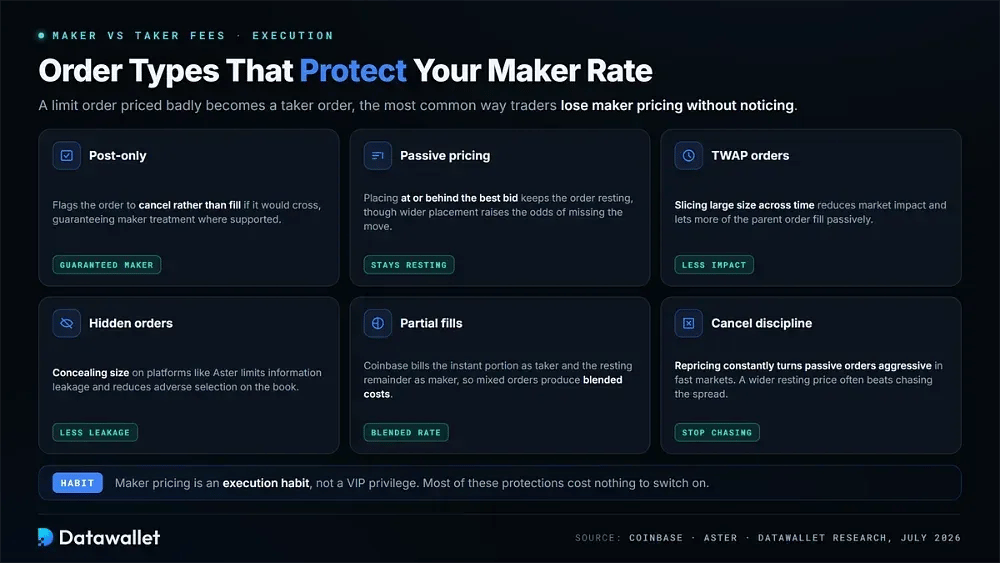
A limit order priced badly becomes a taker order, which is the most common way traders lose maker pricing without noticing it happened.
Use these execution habits to stay on the maker side:
- Post-only: Flags the order to cancel rather than fill if it would cross, guaranteeing maker treatment on platforms that support the instruction.
- Passive pricing: Placing at or behind the best bid keeps the order resting, though wider placement raises the odds of missing the move entirely.
- TWAP orders: Slicing large size across time reduces market impact and lets more of the parent order fill passively at maker rates.
- Hidden orders: Concealing size on platforms like Aster limits information leakage, which reduces adverse selection while quotes sit on the book.
- Partial fills: Coinbase bills the instantly matched portion as taker and the resting remainder as maker, so mixed orders produce blended costs.
- Cancel discipline: Repricing constantly turns passive orders aggressive during fast markets, so a wider resting price often beats chasing the spread.
Maker and Taker Fees vs Other Trading Costs
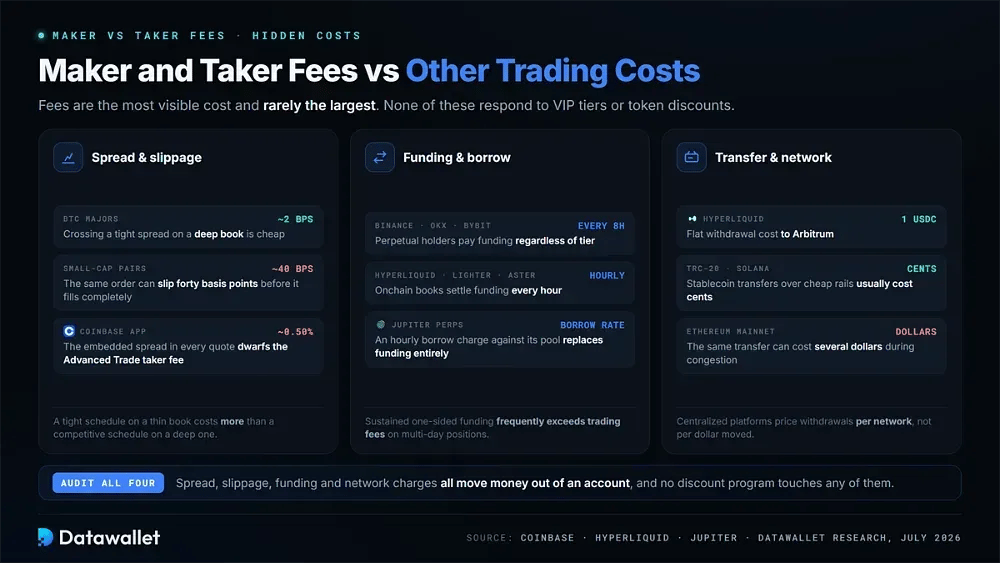
Fees are the most visible cost and rarely the largest. Spread, slippage, funding and network charges all move money out of an account, and none of them respond to VIP tiers or token discounts.
Spread and Slippage
A tight schedule on a thin book costs more than a competitive schedule on a deep one. Crossing a two-basis-point spread on BTC is cheap, but the same order in a small-cap pair can slip forty basis points before it fills completely.
Retail interfaces bury this cost. The standard Coinbase app embeds a spread of roughly 0.50% into every quote, which dwarfs the Advanced Trade taker fee, and insufficient liquidity on smaller pairs pushes real costs higher still.
Funding and Borrow Costs
Perpetual holders pay funding regardless of tier. Binance, OKX and Bybit settle every eight hours, while Hyperliquid, Lighter and Aster Pro settle hourly, and no discount program touches these payments because they move between traders.
Sustained one-sided funding rates frequently exceed trading fees on multi-day positions. Jupiter Perps replaces funding with an hourly borrow rate charged against its liquidity pool, which behaves differently again for anyone holding through quiet markets.
Transfer and Network Costs
Moving collateral has its own price list. Hyperliquid charges a flat one USDC to withdraw to Arbitrum, Lighter charges nothing beyond Ethereum gas, and centralized platforms price withdrawals per network rather than per dollar.
Network choice matters more than most traders assume. Sending stablecoins over TRC-20 or Solana usually costs cents, while the same transfer over Ethereum can cost several dollars during congested periods.
Mistakes Traders Make With Maker and Taker Fees
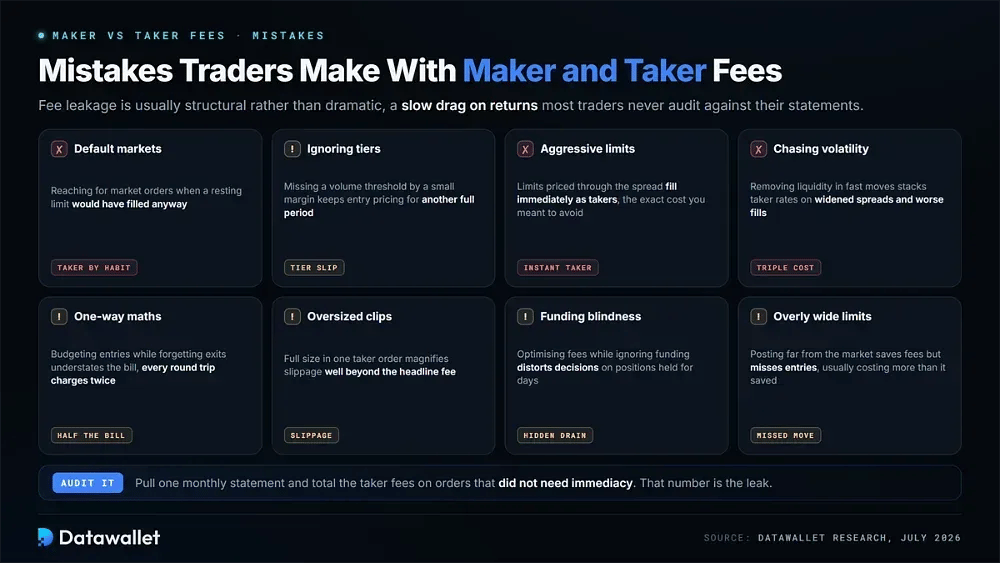
Fee leakage is usually structural rather than dramatic, showing up as a slow drag on returns that most traders never audit against their monthly statements.
These are the errors that cost the most money:
- Default markets: Reaching for market orders when a resting limit would have filled anyway converts a maker rate into a taker rate unnecessarily.
- Ignoring tiers: Missing a volume threshold by a small margin keeps an account on entry pricing for another full assessment period.
- Aggressive limits: Limit orders priced through the spread fill immediately as takers, producing the exact cost the trader intended to avoid.
- Chasing volatility: Removing liquidity during fast moves stacks a higher taker rate on top of widened spreads and materially worse fills.
- One-way maths: Budgeting entry costs while forgetting exits understates the real bill, since every round trip charges twice.
- Oversized clips: Sending full size into a single taker order magnifies slippage well beyond the headline fee on all but the deepest books.
- Funding blindness: Optimising fees while ignoring funding produces distorted decisions, particularly on perpetual positions held for several days.
- Overly wide limits: Posting far from the market saves fees but misses entries, which usually costs more than the basis points it saved.
Final Thoughts
Maker pricing wins over any reasonable time horizon. Every major platform charges makers less, several pay them outright, and the discount compounds hardest for the frequent, planned entries that make up most disciplined trading.
Taker pricing earns its cost when timing genuinely matters, such as exiting a position during a liquidation cascade or entering a market that is repricing faster than a resting order can follow.
The practical move is to pick a platform whose schedule suits your style, then remove cost in layers: claim the token or staking discount, use post-only flags, and check funding before assuming the cheapest rate is the cheapest trade. Our lowest-fee exchange rankings compare the current field in full.