







What Is Collector Crypt?
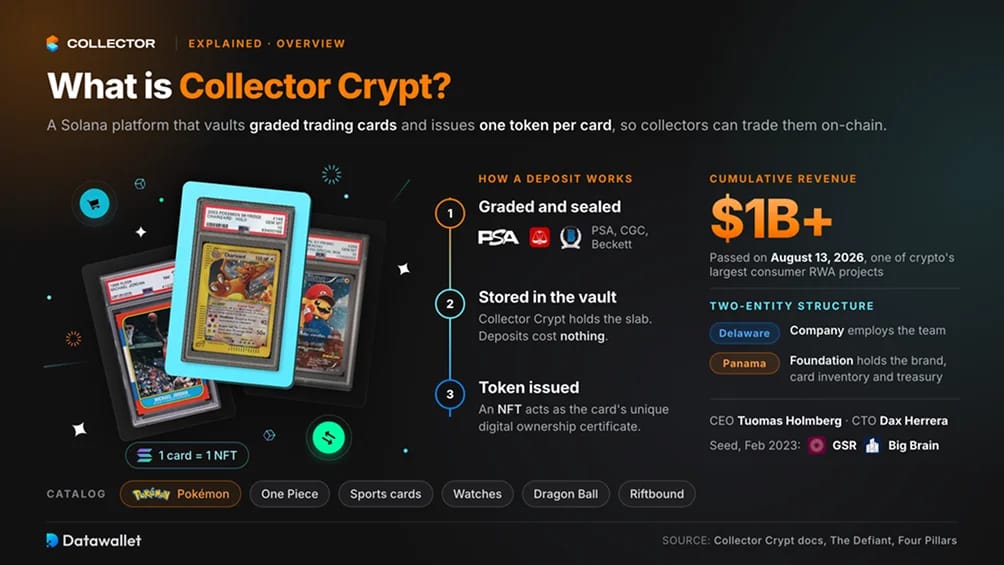
Collector Crypt lets collectors own and trade physical trading cards through tokens on the Solana blockchain. To deposit a card, a collector sends one that a grading company such as PSA, CGC or Beckett has authenticated and sealed in a plastic case. Collector Crypt then stores the card in its vault and issues a token for it at no cost. This non-fungible token (NFT) acts as a unique digital ownership certificate for that card.
Led by CEO Tuomas Holmberg and CTO Dax Herrera, the company closed a seed round in February 2023. Backers included market maker GSR, Big Brain Holdings and several other funds. Four Pillars research describes a structure in which a Delaware company employs the team, while a Panama foundation holds the brand, card inventory and treasury.
Cumulative revenue passed $1 billion on August 13, 2026, making Collector Crypt one of crypto’s largest consumer real-world asset (RWA) projects. Its catalog has expanded beyond Pokémon to include One Piece, sports cards, watches, Dragon Ball and Riftbound. The platform is a clear consumer example of asset tokenization, a sector covered in our tokenization statistics.
How Collector Crypt Works
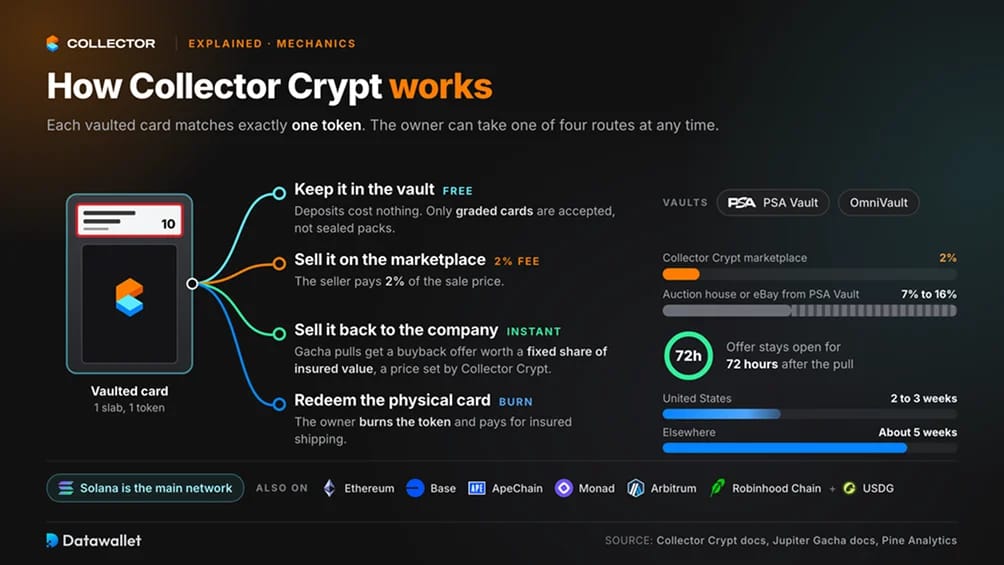
Each physical card sits in a vault and corresponds to exactly one blockchain token. Owners can trade, sell back or redeem their cards at any time.
A vaulted card can be used in these ways:
- Keep it in the vault: Deposits are free, but only graded cards are accepted, not sealed packs. Storage partners include PSA Vault and OmniVault. Each card page identifies its vault, per Jupiter's Gacha documentation.
- Sell it on the marketplace: Sellers pay 2% of the sale price. By comparison, selling a high-value card through an auction house or eBay from the PSA Vault costs between 7% and 16%, according to Pine Analytics.
- Sell it back to the company: Cards pulled from a Gacha pack come with an instant buyback offer lasting 72 hours. The offer represents a fixed share of the card's insured value, a reference price set by Collector Crypt.
- Redeem the physical card: The owner permanently destroys, or burns, the token and pays for insured shipping. Delivery takes about two to three weeks in the United States and about five weeks elsewhere.
Solana remains the main network because its low transaction fees make small purchases practical. Collector Crypt has also deployed its card contract on Ethereum, Base, ApeChain, Monad, Arbitrum and Robinhood Chain. Buyers on Robinhood Chain have been able to pay for packs in the dollar-backed stablecoin USDG since September 25, 2026. The Base deployment has seen very little use.
How the Collector Crypt Gacha Machine Works
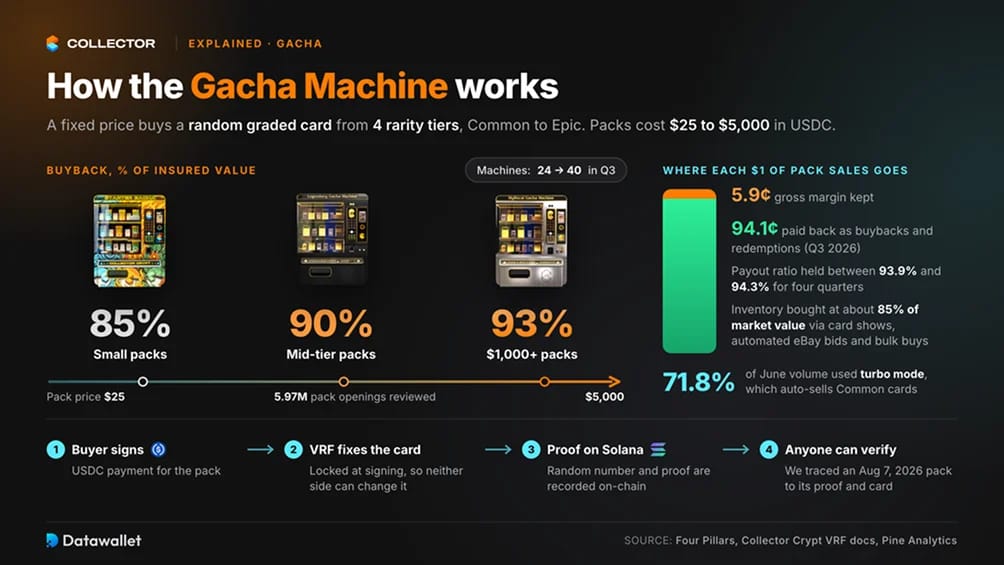
Named after Japanese capsule-toy machines, the Gacha Machine sells a random graded card at a fixed price. Buyers pay in USDC and receive a card from one of four rarity tiers, ranging from Common to Epic. Pack prices run from $25 to $5,000. During the third quarter of 2026, the number of machines increased from 24 to 40.
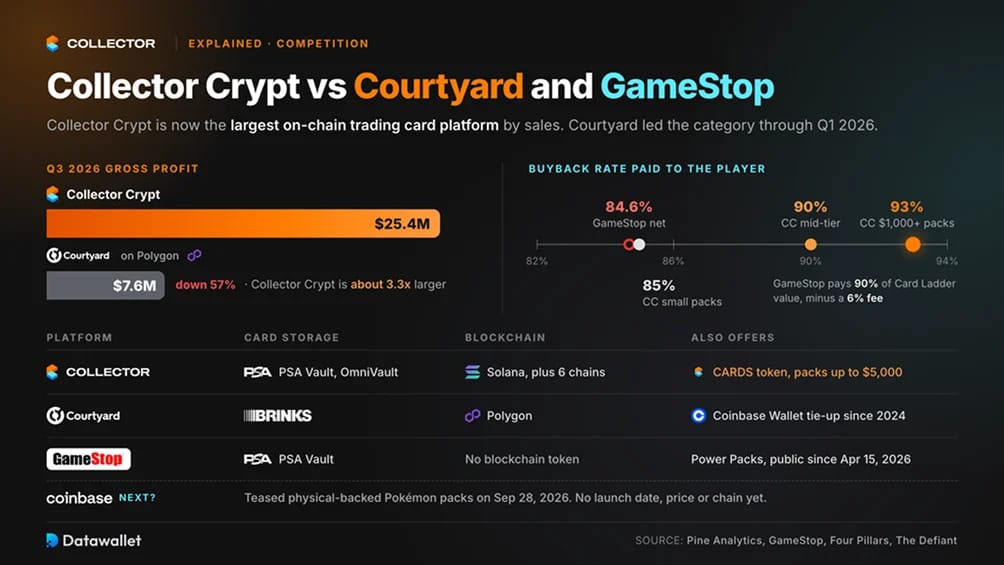
More expensive packs offer higher buyback rates. According to the Four Pillars review of 5.97 million pack openings, small packs pay 85% of insured value, mid-tier packs pay 90%, and packs costing $1,000 or more pay 93%. Most buyers sell their cards straight back. In June 2026, “turbo mode”, which automatically sells back Common cards, accounted for 71.8% of pack volume.
A verifiable random function (VRF) underpins the draw’s fairness. This cryptographic method generates a random number alongside a proof anyone can check. As the VRF documentation explains, the card is fixed when the buyer signs the payment, preventing either side from changing the result. The proof is recorded on Solana. We followed the documentation’s worked example, tracing a real August 7, 2026 pack from its order reference to the on-chain proof and awarded card.
Collector Crypt retains a small share of each dollar spent. Third-quarter buybacks and redemptions equaled 94.1% of revenue, leaving a gross margin of 5.9%. That payout ratio has stayed between 93.9% and 94.3% for four quarters. To fund the buyback offers, the company sources inventory at around 85% of market value through card shows, automated eBay bidding and bulk purchases.
Collector Crypt Growth and Recent Developments
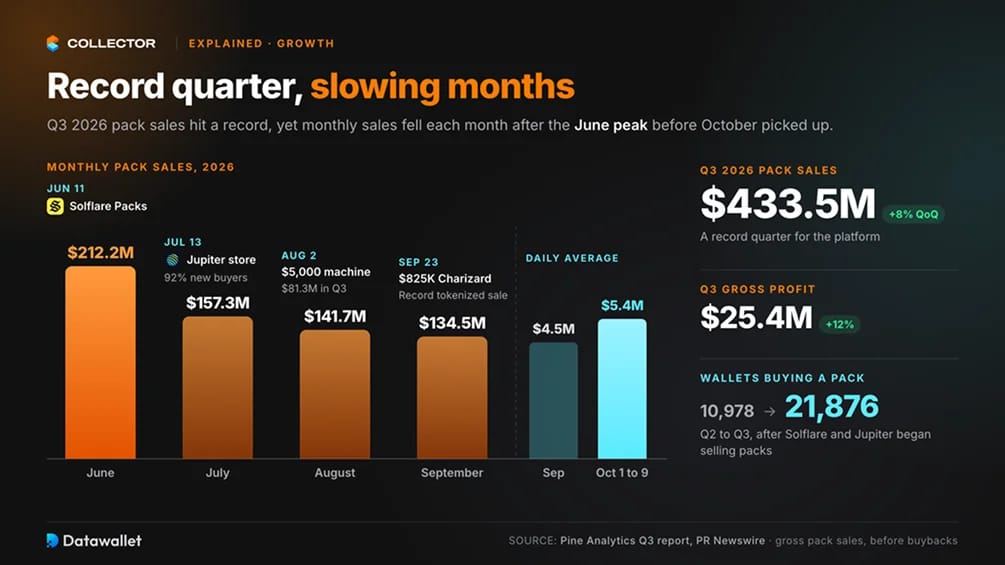
Third-quarter pack sales set a record at $433.5 million, up 8% from the second quarter, while gross profit rose 12% to $25.4 million. Monthly sales nevertheless slowed after reaching $212.2 million in June. They fell to $157.3 million in July, $141.7 million in August and $134.5 million in September. The first nine days of October brought an improvement, with daily sales averaging $5.4 million against September’s $4.5 million.
These figures include every dollar paid for packs. Data sites reporting revenue after buybacks show much smaller totals. Check which measure a source uses before comparing Collector Crypt with applications such as Pump.fun.
Distribution has expanded into other applications. Solflare launched Solflare Packs on June 11, 2026, adding the machines to one of the most popular Solana wallets. Jupiter opened its storefront on July 13. Pine found that 92% of sampled Jupiter buyers had never purchased from Collector Crypt before, and the total number of wallets buying a pack doubled from 10,978 in the second quarter to 21,876 in the third.
Spending remains concentrated among a small group. The 548 wallets that each spent at least $100,000 generated 83% of third-quarter sales; 85 wallets spent more than $1 million each. These buyers also moved toward more expensive packs. A $5,000 machine launched on August 2 recorded $81.3 million in quarterly sales, while sales of $1,000 packs dropped from $132.1 million to $53.4 million.
Direct trading between users totaled $8.6 million in the third quarter, about 2% of the business, though high-value sales are growing. On September 23, a PSA 10 1999 1st Edition Base Set Charizard sold for $825,000. Collector Crypt called it the largest tokenized card sale on record. The seller paid exactly 2% in fees, far below the cost of a traditional auction.
CARDS Tokenomics: Supply, Unlocks and Value
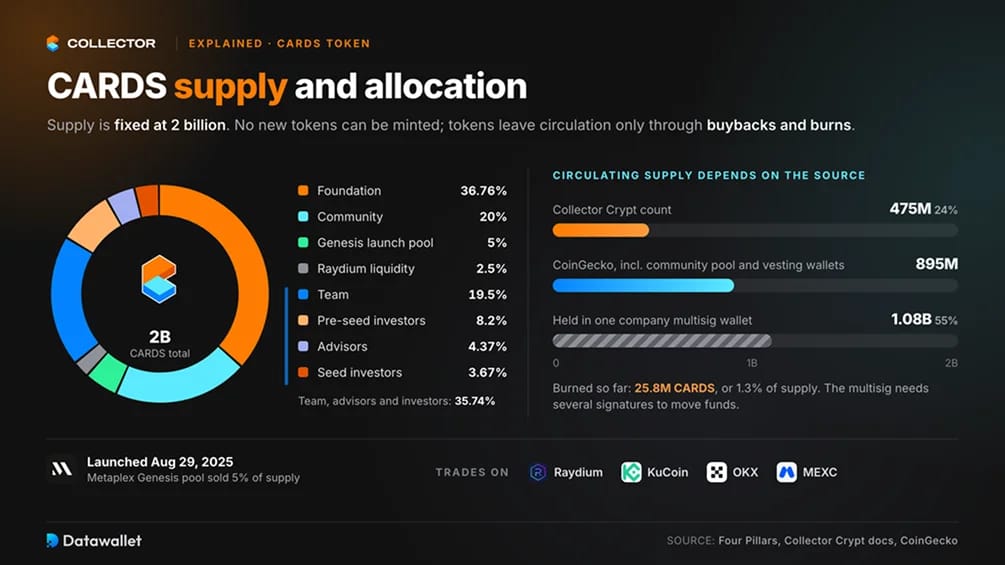
CARDS launched on August 29, 2025, through a Metaplex Genesis launch pool that sold 5% of the supply. Its total supply is fixed at 2 billion tokens. No additional tokens can be created. Tokens leave circulation only through buybacks and permanent burns.
Four Pillars reports the CARDS supply split as follows:
- Foundation: 36.76%, held as the company treasury.
- Community: 20%, paid out as usage rewards and airdrops (free token distributions).
- Team: 19.5%.
- Pre-seed investors: 8.2%.
- Genesis launch pool: 5%, sold at the public launch.
- Advisors: 4.37%.
- Seed investors: 3.67%.
- Raydium liquidity pool: 2.5%, used to start trading on Raydium.
Pre-seed tokens finished unlocking on August 29, 2026. Team, advisor and seed allocations now unlock on the 29th of each month until July 29, 2027, under a schedule enforced on-chain by the Streamflow vesting contract. The next release, on October 29, 2026, amounts to about 59 million CARDS, mostly for the team. It is tracked on our token unlock calendar.
Reported circulating supply varies by source. Collector Crypt counts 475 million CARDS, or 24% of supply. CoinGecko includes the community pool and vesting wallets, bringing its figure to 895 million. A single company multisig wallet holds 1.08 billion CARDS, or 55% of supply, and requires several signatures to move funds.
Holders receive monthly free packs based on their balance, along with extra airdrop weight and Card Club access. CARDS grants neither a share of profit nor voting rights. The buyback program spent $567,000 on 3.3 million CARDS in the third quarter, while total burns have reached 25.8 million tokens, or 1.3% of supply. Monthly vesting releases are roughly 55 times larger than the amount removed by buybacks.
CARDS trades on Raydium and centralized exchanges including KuCoin, which listed the token on July 9, 2026, OKX and MEXC. After reaching about $0.38 in September 2025, the price fell to $0.119 on July 27, 2026, then recovered to $0.32 on October 11. Live prices are available on CoinGecko.
Collector Crypt vs Courtyard and GameStop Power Packs
Collector Crypt is now the largest on-chain trading card platform by sales. Courtyard, a Polygon platform that led the category through the first quarter of 2026, earned $7.6 million in the third quarter, down 57%. Collector Crypt was about 3.3 times larger on the same measure. GameStop joined the market when Power Packs opened to the public on April 15, 2026. Its service uses PSA-graded cards held in the PSA Vault without a blockchain token.
Collector Crypt offers the most expensive packs and the highest buyback rates on large packs, as well as a tradable token. Courtyard uses Brink’s for storage and has worked with Coinbase Wallet since 2024. Buyers who prefer the familiarity of a large public retailer may favor GameStop, which pays 90% of Card Ladder value minus a 6% fee, or about 84.6% net.
Coinbase could become a larger competitor. It teased Pokémon packs backed by physical cards on September 28, 2026, without specifying a launch date, price or blockchain. Such a product could expand the category while taking market share from Collector Crypt.
The Risks of Collector Crypt
Pack buyers and token holders face risks despite the strong sales figures.
- Concentrated spending: A few hundred wallets generate most sales. The top 100 alone accounted for 54% of third-quarter spending. Revenue could fall quickly if they pull back, as the decline from June to September showed.
- Thin margins and card prices: The business keeps about 6 cents of each dollar spent. Trading card prices determine both inventory value and margins, leaving both exposed to a fall in the Pokémon market. The company has no protection against that decline.
- Token supply pressure: About 59 million CARDS unlock each month until July 2027, compared with about 1.1 million removed through buybacks. Holders have no legal claim on company profit. The token’s value therefore depends on foundation decisions that have not yet been documented.
- Custody and transparency: Each token relies on a physical card held by Collector Crypt or its vault partners. The company also sets the insured values used for buybacks. Pine noted that the public blockchain does not reveal where most of the quarter’s gross profit is held.
- Gambling-style mechanics: Paying a fixed price for a random card that can be sold back for cash resembles gambling under many countries’ laws. Pine found no enforcement action in the third quarter, but rules governing paid random rewards vary by country and could change.
- Price swings and promotion: Between June 19 and July 27, 2026, CARDS fell about 63% after a public $4 price target from a large crypto investor’s family office attracted wide attention. Low circulating supply allows sharp price moves in either direction.
This article is not investment advice. Before taking a position in CARDS, follow monthly pack sales, the unlock schedule and the size of the buyback.
Final Thoughts
Collector Crypt has demonstrated demand for graded trading cards sold through digital packs at very large scale. Its vault and verifiable randomness address real problems in physical card trading, as does the 2% marketplace fee. Partners now distribute its packs through popular Solana wallets and trading apps.
Most revenue, however, returns to players, and a small group of large buyers accounts for most sales. CARDS captures none of the profit, with insider unlocks continuing until mid-2027.
For collectors, Collector Crypt offers a credible, low-cost way to buy, store and sell graded cards. Token holders are betting on future foundation decisions. Competition from Coinbase and GameStop will test the platform’s ability to retain its lead.
.webp)