




What is Meteora?
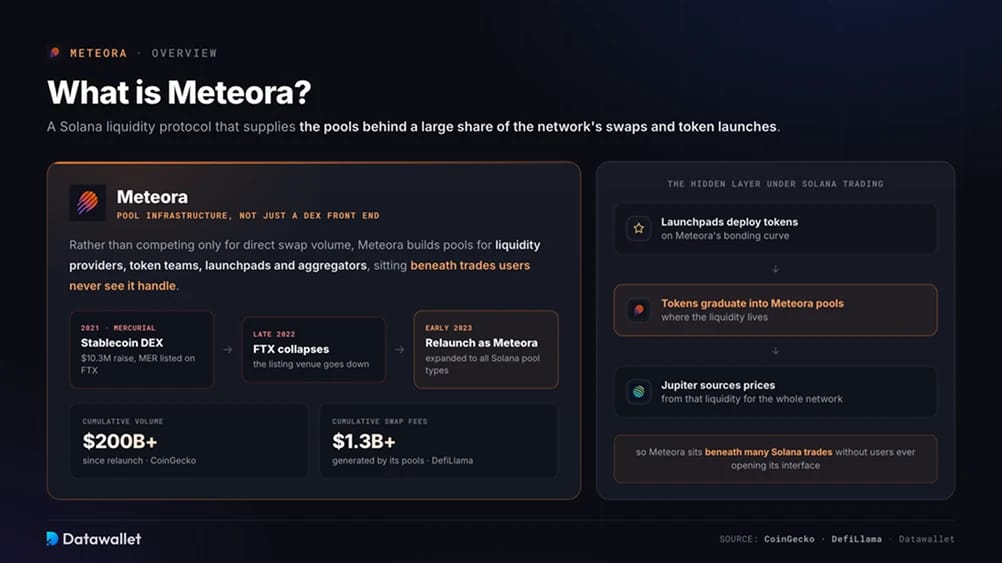
Meteora is a decentralized exchange and liquidity protocol on Solana. Rather than competing only for direct swap volume, it provides pool infrastructure for liquidity providers, token teams, launchpads, and aggregators across the network.
The project started in 2021 as Mercurial Finance, a stablecoin-focused exchange that raised $10.3 million through a token sale and listed its MER token on FTX. Following FTX’s collapse in late 2022, the team relaunched the protocol as Meteora in early 2023 and expanded its scope to cover all types of Solana pools.
Since the relaunch, Meteora has processed more than $200 billion in cumulative trading volume, according to CoinGecko. Its pools have also generated over $1.3 billion in cumulative swap fees, based on DefiLlama data.
Its biggest structural advantage is its position as launch infrastructure for new Solana tokens. Launchpads can deploy tokens on Meteora’s bonding curve and graduate them into its pools. The Jupiter aggregator then sources prices from that liquidity, placing Meteora beneath many trades without users interacting with its interface directly.
How Does Meteora Work?
Meteora operates a suite of pool programs covering each stage of a token's life, from its initial launch and active trading to the management of idle capital.
1. Dynamic Liquidity Market Maker (DLMM)
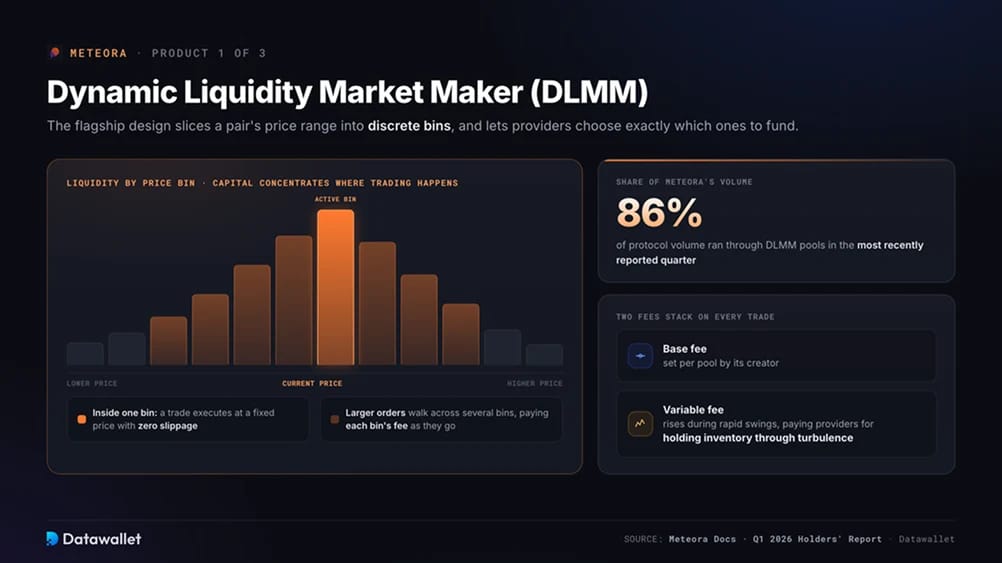
The DLMM is Meteora's flagship pool design. It divides a trading pair's price range into discrete bins. Liquidity providers decide which bins to fund, allowing them to concentrate capital around active prices instead of spreading it across the full range.
A trade contained within one bin executes at a fixed price with zero slippage, so the buyer receives the quoted rate. Larger orders move through several bins and pay the fee attached to each one, keeping execution predictable on volatile pairs.
Alongside its base fee, the DLMM applies a variable fee that increases during rapid price swings. This compensates providers for holding inventory through more turbulent markets. The design accounted for 86% of protocol volume in the most recently reported quarter.
2. DAMM v1 and DAMM v2
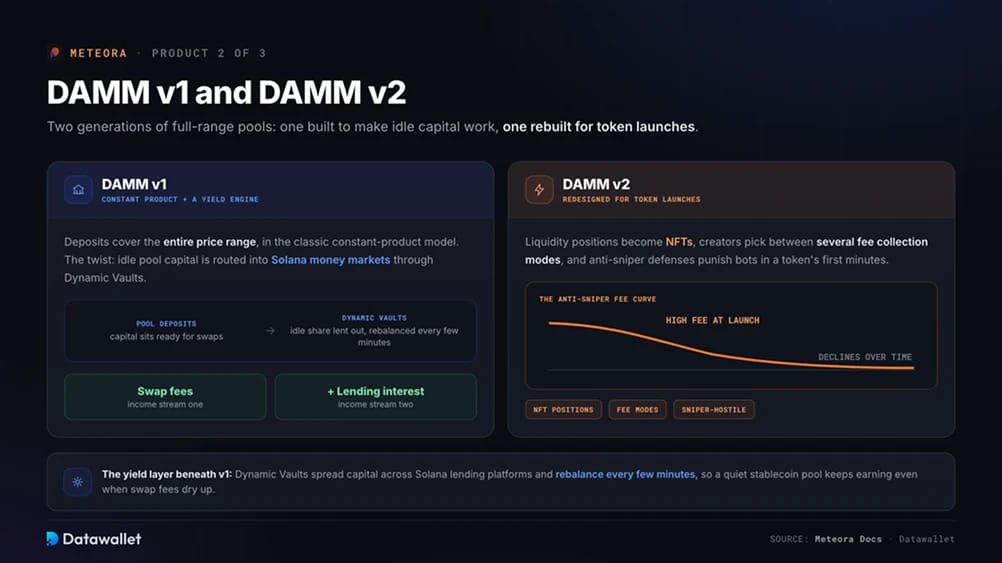
Dynamic AMM pools follow the constant-product model familiar from early automated market makers, with deposits covering the entire price range. DAMM v1 routes idle pool capital into Solana money markets through Dynamic Vaults, letting deposits earn lending interest in addition to swap fees.
DAMM v2 redesigned the model for token launches. Liquidity positions are represented as NFTs, while pool creators can choose between several fee collection modes. Its anti-sniper features include high initial fees that decline over time, making it more difficult for bots to extract value during a token's first minutes of trading.
3. Dynamic Bonding Curve (DBC)
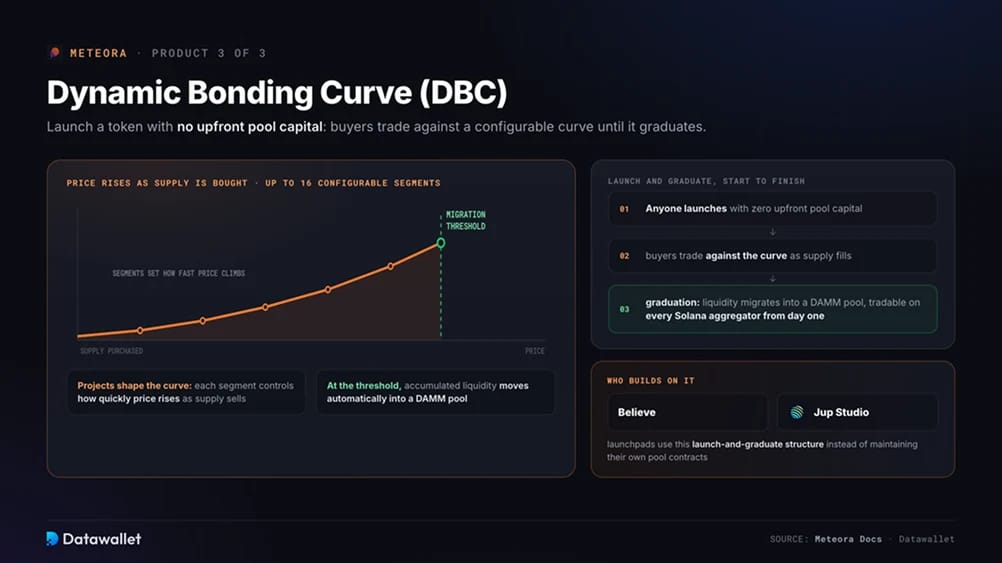
The Dynamic Bonding Curve allows anyone to launch a token without providing upfront capital for a pool. Buyers trade against a price curve containing up to 16 configurable segments, giving the project control over how quickly the price rises as the available supply is purchased.
After the token reaches its migration threshold, the accumulated liquidity moves automatically into a DAMM pool for continued trading. Launchpads such as Believe and Jupiter's Jup Studio use this launch-and-graduate structure instead of maintaining their own pool contracts. Graduated tokens are then tradable across Solana aggregators from day one.
4. Dynamic Vaults
Dynamic Vaults form the yield layer beneath DAMM v1. They distribute deposited capital across Solana lending platforms and rebalance every few minutes to pursue the best available rates while retaining enough liquidity for swaps and withdrawals.
Liquidity providers therefore gain another source of income. During quiet periods, a stablecoin pool can continue earning lending interest even when swap fees are limited.
5. Launch and Distribution Tools
The Alpha Vault gives vetted early supporters access to tokens before public trading begins. It offers first-come-first-served and proportional-share modes designed to reduce the advantage usually held by bots. The Presale Vault supports more structured offerings through whitelists and tiered access.
Dynamic Fee Sharing distributes collected pool fees among several recipients onchain. A launch team can direct revenue to its treasury, stakers, or contributors. Stake2Earn builds on this system by allocating a share of locked pool fees to a token's leading stakers.
How to Provide Liquidity on Meteora
Providing liquidity is Meteora’s main use case. Its DLMM interface requires more active choices than a conventional pool deposit.
Follow these steps to open a DLMM position:
- Prepare a wallet: Install a Solana wallet such as Phantom or Solflare. Fund it with both tokens in the pair and keep spare SOL for transaction fees.
- Open the official app: Visit meteora.ag directly and verify the domain. Fake versions of popular DeFi sites often appear in advertisements and search results.
- Pick a pool: Compare available pools for the pair by fee rate, bin step, and existing deposits. A high advertised yield often indicates a riskier or newly launched token.
- Choose a strategy: Use spot for an even distribution across bins, curve to concentrate liquidity near the current price, or bid-ask to place more capital around the edges of the range.
- Set your range: Choose the price band covered by your capital. Narrow ranges earn more per dollar while active, but stop generating fees once the price moves outside them.
- Deposit and confirm: Approve the transaction through your wallet, then check that the position appears in the portfolio view with the correct token amounts.
- Monitor the position: Watch whether the market price remains inside your range and track accumulated fees. Out-of-range positions remain idle until the price returns or you adjust them.
- Claim or close: Collect earned fees periodically. When closing the position, withdraw both tokens and remember that the final ratio depends on the current price.
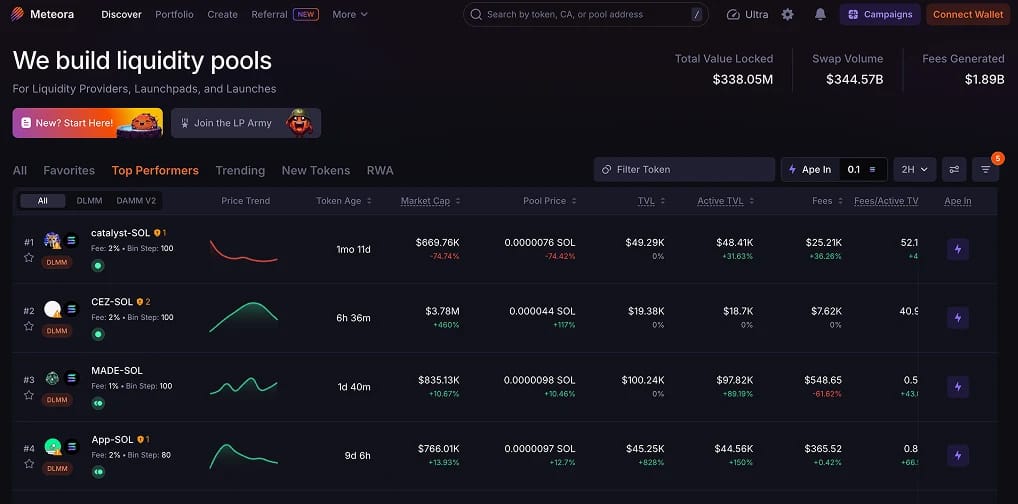
Meteora Trading Fees
Meteora does not have a single fee schedule because pool creators determine their own base rates. Most active DLMM and DAMM v2 pools charge between 0.04% and 0.20% to compete for aggregator volume. Launch pools can begin with much higher fees that gradually decline, discouraging snipers during early trading.
DLMM pools also charge a variable fee based on recent volatility. Traders pay more during violent price movements, while liquidity providers receive additional compensation for the higher risk. Meteora retains 5% of collected fees from standard DLMM pools and up to 20% from launch configurations.
Around the MET launch, the team reported an average protocol take rate of approximately 9.7% of all fees generated by its pools. Applied to billions of dollars in monthly volume, this share finances operations and the MET buyback program.
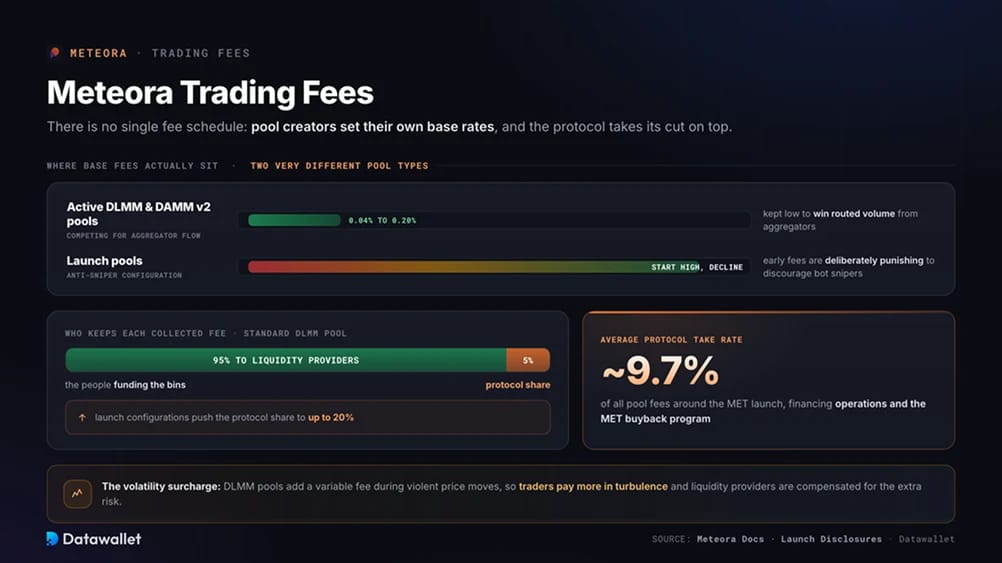
MET Tokenomics & Supply
MET is Meteora’s native token. It launched on October 23, 2025, with a fixed supply of 1 billion tokens and one of the highest initial floats among major Solana protocols. The official tokenomics documentation states that 480 million tokens, equal to 48% of the supply, circulated on the first day.
About one-tenth of the circulating supply was distributed through a Liquidity Distributor as ready-made pool positions rather than standard airdrops. Recipients could begin earning trading fees immediately. The team sold none of its own tokens during the event.
Allocation
All community allocations unlocked at launch. The two internal allocations follow much longer schedules. Both the team supply and Meteora Reserve have a one-month cliff followed by 72 months of linear vesting, ending in October 2031.
The 1 billion MET supply divides as follows:
- Meteora Reserve (34%): The protocol’s long-term budget for growth and incentives. It was fully locked at launch and vests linearly over six years.
- Team (18%): Contributor tokens follow the same one-month cliff and six-year linear schedule, releasing approximately 2.5 million MET each month.
- Mercurial holders and reserve (20%): Former MER holders received a 15% airdrop, while another 5% went to a reserve. The allocation recognized the community affected by FTX’s collapse.
- LP Stimulus Plan (15%): Liquidity providers who accumulated points during the pre-launch seasons received rewards without vesting.
- Ecosystem and partners (13%): The allocation covers a launch-event reserve (3%), exchange and market-maker supply (3%), Jupiter stakers (3%), launchpad partners (3%), and M3M3 participants (2%).
- Offchain contributors (2%): Tokens allocated to community members and moderators who supported Meteora before MET existed.
Utility
MET’s main uses are staking and revenue capture rather than governance voting. Through the Referral Staking Program, stakers can receive a share of eligible DLMM protocol fees. Solana Compass reported that more than 69 million MET had been staked within two weeks of launch.
The buyback program connects MET directly to protocol revenue. Meteora used $10 million of USDC to repurchase 2.3% of the supply during the final quarter of its launch year. By the following quarterly report, cumulative spending had reached $13.7 million and covered 3.97% of the total supply.
Comet Points provide a separate consumable benefit. Users earn them by staking MET and interacting with Meteora products, then redeem the points for airdrop access, presale eligibility, an off-chain rewards store, or liquidity-provider coaching.
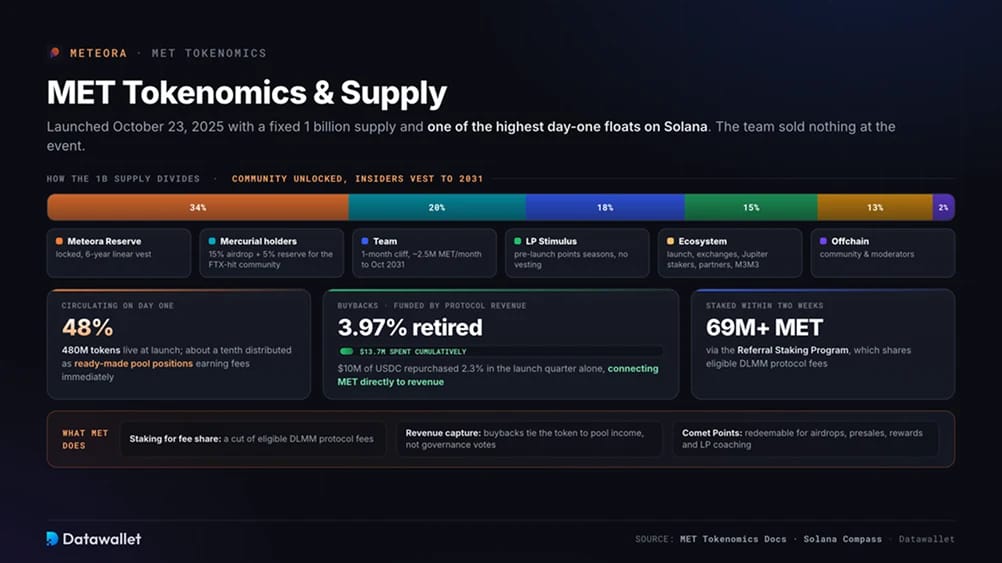
Meteora Statistics & Trends
Meteora has contracted from its memecoin-mania peak but continues to generate substantial revenue from an established niche. The figures below come from DefiLlama and Meteora’s Q1 2026 Token Holders’ Report.
The key metrics to know are these:
- Total value locked: Meteora pools currently hold roughly $270 million, compared with about $1.5 billion during the TRUMP token frenzy in January 2025. The token launched through its pools, according to DefiLlama’s tracker.
- Cumulative activity: Lifetime trading volume exceeds $200 billion. The pools have generated more than $1.3 billion in swap fees, of which approximately $62 million was retained as protocol revenue.
- Quarterly performance: The first-quarter report recorded $19.5 billion in volume, $105.9 million in pool fees, and $11.4 million in revenue. Each figure fell sharply from the launch quarter as memecoin trading cooled.
- Treasury position: Meteora ended the quarter with $32.8 million in treasury assets and monthly operating costs of $1.4 million. This provides more than two years of runway without additional revenue.
- Product mix: DLMM pools account for 86% of volume and 54% of fees. Fees from DAMM and bonding-curve products increased 18% quarter on quarter as launchpad activity moved toward newer products.
- MET market data: MET trades below $0.20 and has a circulating value near $100 million. It sits about 70% below its launch-day peak of $0.69, while team and reserve unlocks add roughly 7.3 million tokens to circulation each month.
The main trend is competition among launchpads. Solana token creation has shifted away from Pump.fun’s closed system toward configurable infrastructure, with Meteora’s bonding curve becoming the default backend for competing platforms. Its fee base consequently moves with whichever launchpads attract users. Our TVL tracker compares Meteora’s share of Solana deposits.
Is Meteora Safe?
Meteora’s contracts are open source and non-custodial. Users retain their private keys, and the state of each pool can be verified onchain. Every core program, including the DLMM, bonding curve, and vaults, has published third-party audit reports. The team also maintains an ongoing bug bounty.
Audits lower risk but cannot eliminate it. Meteora has suffered operational losses despite its audited contracts. In January this year, the team lost $1.5 million through a social-engineering scam involving a fake over-the-counter transaction during its buyback operations. The incident showed how operational failures can bypass even well-audited smart contracts.
Risks
Most user risk comes from how Meteora’s pools are used rather than the underlying code. Launch pools carry the greatest exposure.
Weigh these risks before depositing:
- Impermanent loss: Concentrated positions widen the potential gap between holding tokens and supplying liquidity. A sustained one-sided move can leave the provider holding mostly the weaker asset.
- Launch-pool volatility: Tokens traded through bonding curves and launch pools often decline by 90% or more. High advertised fee yields can therefore obscure the possibility of near-total capital loss.
- Sniping and manipulation: Anti-bot mechanisms limit but cannot fully prevent coordinated launch buying. Our guide to Solana bundle risks explains the problem in more detail.
- Unlock pressure: Team and reserve vesting will add about 7.3 million MET to circulation each month through 2031. Buybacks may not offset the new supply.
- Litigation overhang: US class actions concerning the M3M3 and LIBRA launches name Meteora and its former CEO. Their outcomes remain unresolved.
- Smart contract exposure: Meteora relies on several interacting programs, creating more opportunities for bugs than a single-contract exchange despite the audits.
The LIBRA Controversy
Meteora faced its most serious controversy in February 2025. The LIBRA memecoin, promoted by Argentine President Javier Milei, collapsed after launching through Meteora’s pools. Claims that insiders extracted more than $100 million led to a class action naming Meteora and Kelsier Ventures. A related lawsuit concerns the earlier M3M3 launch.
Co-founder Ben Chow resigned within days. He denied financial misconduct but acknowledged poor judgment in his dealings with the token’s facilitators. Meteora remained permissionless throughout the episode, and no user funds were exploited. Even so, the fallout changed its leadership and prompted the team to publish the detailed transparency reports it issues today.
Meteora Founders and Leadership
Meteora emerged from Mercurial Finance, which Ben Chow co-founded with the pseudonymous developer Meow, who later created Jupiter. After the rebrand, Chow managed Meteora’s daily operations while Meow concentrated on Jupiter. The two protocols have since operated through separate teams.
Fellow co-founder Zhen Hoe Yong became project lead after Chow’s resignation, with co-lead Soju joining him for the token launch. Yong had worked on the protocol since its Mercurial period. Jupiter’s leadership publicly supported his appointment as the operator best positioned to restore trust.
Extensive financial disclosure has become a defining feature of the current team. Its quarterly token holder reports cover revenue, spending, treasury balances, and operational losses. This level of detail is uncommon among DeFi projects and responds directly to the trust problems created by LIBRA.
Meteora vs Other Solana DEXs
Meteora competes with Raydium, Orca, and the Pump.fun ecosystem for Solana liquidity, although each platform serves a different role. Meteora focuses on configurability for launchpads and active liquidity providers. Its competitors place greater emphasis on simple interfaces, retail distribution, or launch volume retained within their own systems.
Raydium remains the volume leader among traditional Solana pools and offers its own launch products. Its standard pools use fixed fees rather than rates adjusted for volatility. Orca serves retail providers through its concentrated Whirlpool design, while Pump.fun keeps launches within a closed system before moving them to PumpSwap.
A growing share of Meteora’s revenue comes from external platforms built on its pools. This makes it less reliant on its own front end than any competing decentralized exchange.
Final Thoughts
Meteora recovered from a near-collapse to become one of Solana’s most durable infrastructure businesses. The protocol survived FTX, a founder scandal, and a severe memecoin downturn while generating more than $1.3 billion in lifetime fees. Its pool designs have continued to attract genuine use.
MET changed how the market measures that success. Revenue-funded buybacks connect the token to protocol income, while insider allocations vest over six years. Quarterly reports also disclose financial losses as openly as positive results.
Legal and competitive risks remain. The unresolved class actions create headline exposure, launchpads can change providers quickly, and token unlocks continue through 2031. Anyone using Meteora’s pools or considering MET should account for those pressures when sizing a position.