




Which Countries Does Hyperliquid Restrict?
Hyperliquid restricts users in the United States, Ontario in Canada, and any territory subject to applicable sanctions or export-control laws. Section 1.5 of its Terms of Use, updated June 15, 2026, defines these users as Restricted Persons and bars them from the Interface.
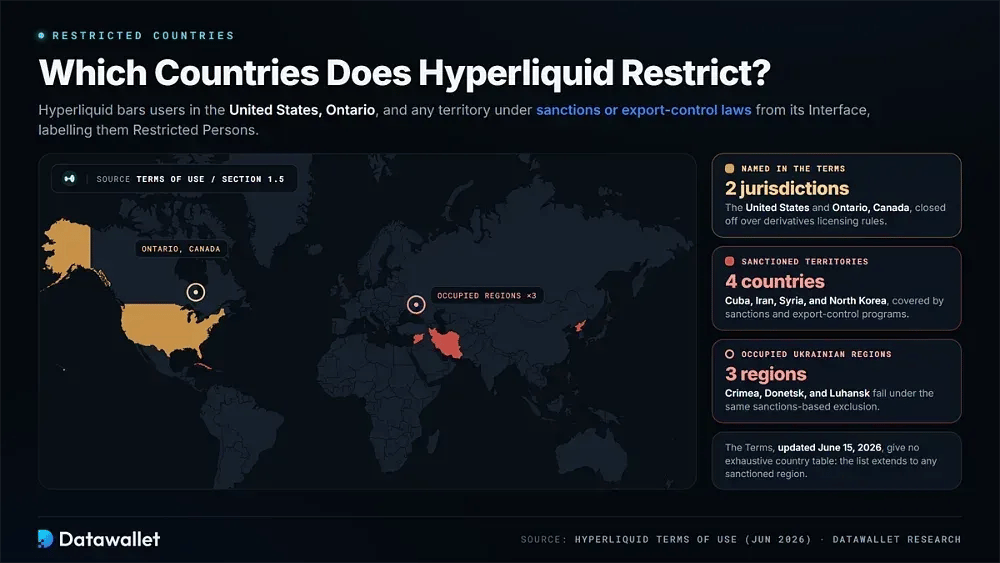
Hyperliquid Restricted Countries List in 2026
The Terms do not provide an exhaustive country-by-country table. Instead, Hyperliquid identifies certain jurisdictions directly and extends its restrictions to regions covered by sanctions or export-control programs.
How Hyperliquid Determines Eligibility
Hyperliquid treats eligibility as a status question, not simply an IP check. Its Terms cover where a user resides or is located, where an entity is incorporated or registered, and, for Restricted Territories, citizenship. Local law still matters because users must also determine whether leveraged derivatives are permitted where they trade.
Why Does Hyperliquid Restrict These Countries?
The restrictions limit Hyperliquid's exposure to sanctions enforcement, derivatives licensing requirements, securities oversight, and AML obligations. Its Interface gives users access to leveraged perpetual futures, which carry greater legal exposure in heavily regulated markets than ordinary spot trading.
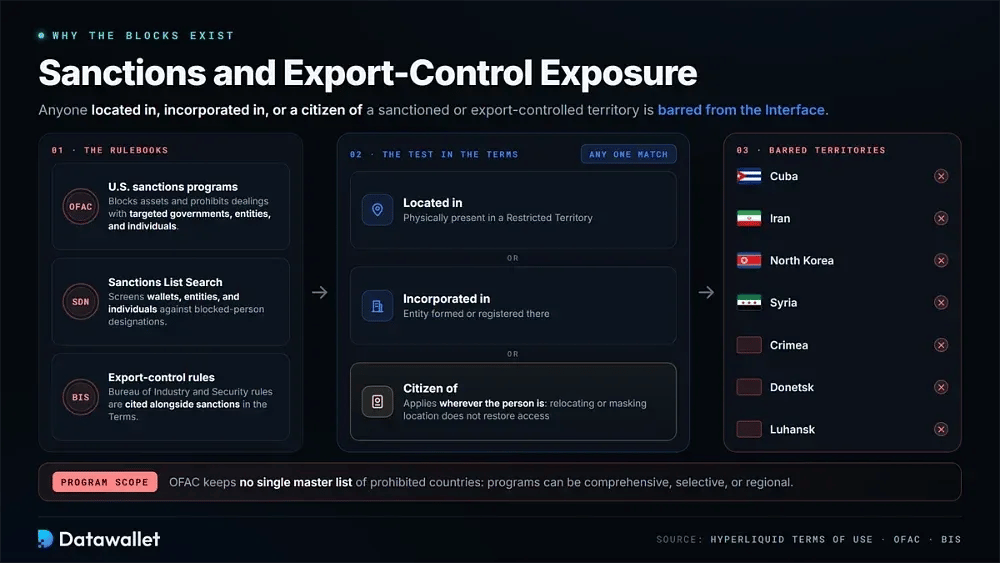
1. Sanctions and Export-Control Exposure
Under Hyperliquid's Terms, anyone located in, incorporated in, or holding citizenship of a sanctioned or export-controlled territory is barred. That provision accounts for the exclusion of Cuba, Iran, North Korea, Syria, and occupied Ukrainian regions.
The main sanctions-driven factors behind these restrictions include:
- OFAC: The Office of Foreign Assets Control administers U.S. sanctions programs that block assets and prohibit dealings with targeted governments, entities, and individuals for national-security and foreign-policy purposes.
- SDN Screening: Platforms can use OFAC's Sanctions List Search to check wallets, entities, and individuals against blocked-person designations. Crypto interfaces rely on this screening step to avoid serving sanctioned counterparties.
- Program Scope: OFAC clarifies that there is no single master list of prohibited countries. Restrictions instead follow individual sanctions programs, which may be comprehensive, selective, or targeted at particular regions.
- Export Rules: The Bureau of Industry and Security enforces U.S. export-control regulations. Hyperliquid's Terms refer to those rules alongside sanctions when defining territories its Interface will not serve.
- Citizenship Test: Citizens of Restricted Territories remain subject to the restrictions regardless of where they are physically located, preventing relocation or location masking from restoring Interface access.
- Interface Model: Hyperliquid Corp. says it operates the website front end rather than the decentralized blockchain itself. Jurisdictional restrictions therefore apply specifically at the Interface layer.
2. Derivatives Licensing and Local Regulation
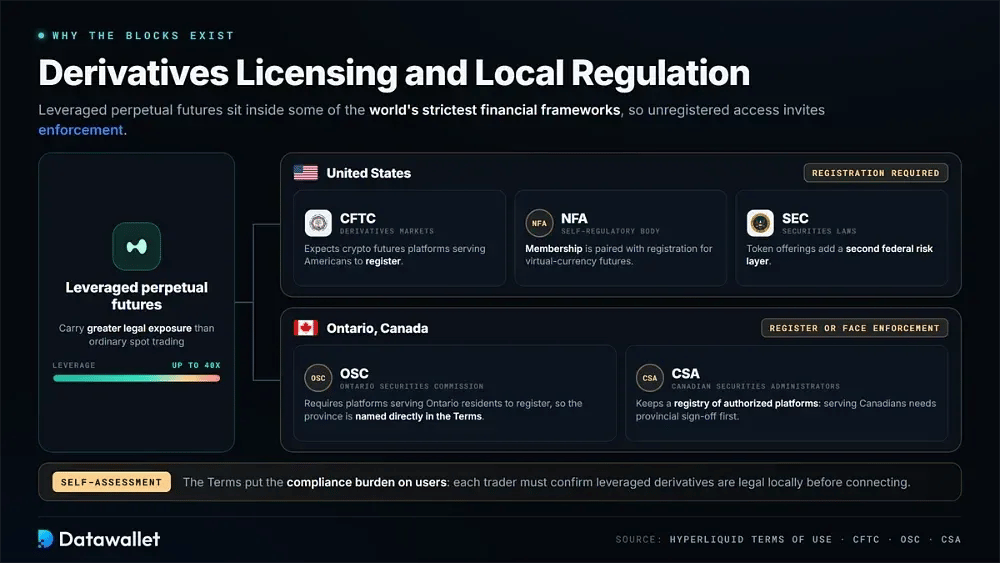
Leveraged perpetual futures fall within some of the world's strictest financial regulatory frameworks. In major Western markets, making those products available without registration can lead to licensing, consumer-protection, and enforcement consequences.
Key regulatory drivers behind the US and Ontario blocks include:
- CFTC: The Commodity Futures Trading Commission regulates U.S. derivatives markets and expects platforms facilitating crypto futures for American users to register and comply with its customer-protection framework.
- NFA: The National Futures Association is the self-regulatory organization for U.S. derivatives intermediaries. CFTC guidance pairs NFA membership with registration for virtual-currency futures activity.
- SEC: The Securities and Exchange Commission oversees token offerings and trading venues that implicate securities laws, creating an additional federal risk layer for unregistered platforms serving U.S. users.
- OSC: The Ontario Securities Commission requires crypto trading platforms serving Ontario residents to register or face enforcement. Ontario is therefore identified directly in Hyperliquid's Terms.
- CSA: The Canadian Securities Administrators maintain a registry of platforms authorized to serve Canadians, reinforcing that Canada-facing crypto services generally require prior authorization from provincial regulators.
- Self-Assessment: Hyperliquid's Terms place the compliance burden on users. Each trader must determine whether leveraged and derivative trading is legal in their jurisdiction before connecting.
How Does Hyperliquid Enforce Its Restrictions?
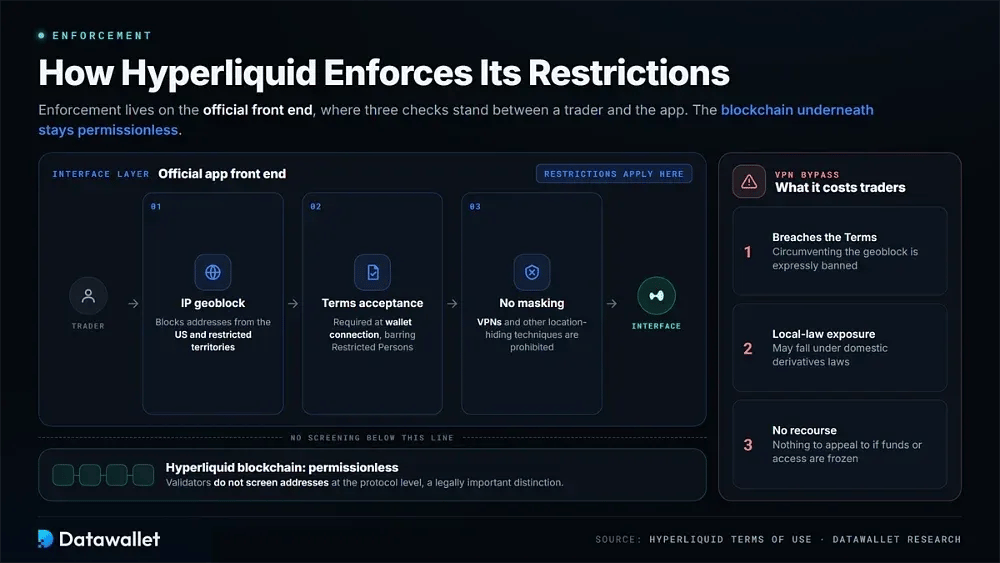
Enforcement happens mainly through Hyperliquid's front end. The official app geoblocks IP addresses from the United States and other restricted territories. Wallet connections also require users to accept Terms that prohibit Restricted Persons from accessing the Interface, using VPNs to circumvent restrictions, or applying other techniques to conceal their true location.
The blockchain underneath remains permissionless, so validators do not screen addresses at the protocol level. Legally, that distinction is important. Using a VPN to bypass the geoblock breaches the Terms, may expose traders to local derivatives laws, and provides no recourse if funds or access are later frozen.
Hyperliquid Supported Countries
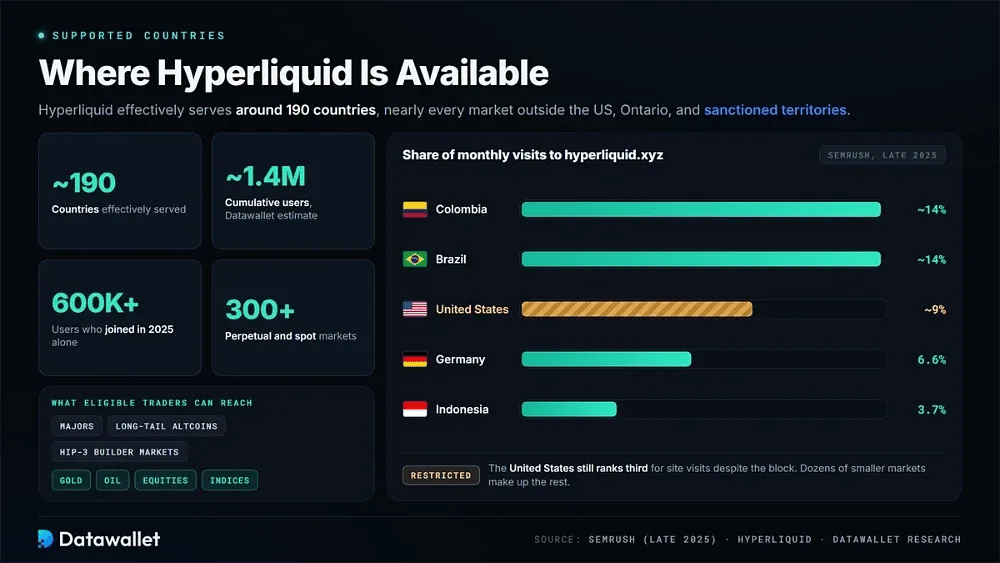
Hyperliquid effectively serves around 190 countries, encompassing nearly every market outside the United States, Ontario, and sanctioned territories. Datawallet's Hyperliquid statistics estimate roughly 1.4 million cumulative users after more than 600,000 joined in 2025 alone, reflecting continued global demand for wallet-based derivatives.
More than 300 perpetual and spot markets are available to supported traders, according to Hyperliquid's own app listing. These include majors, long-tail altcoins, and HIP-3 builder markets tied to gold, oil, equities, and indices. The selection keeps expanding as additional perpetuals, spot pairs, and builder-deployed venues launch.
Late-2025 Semrush traffic data shows Colombia and Brazil each accounting for roughly 14% of monthly visits to hyperliquid.xyz. The United States followed at about 9%, with Germany at 6.6% and Indonesia at 3.7%. Dozens of smaller markets made up the remaining share.
What Eligible Traders Can Access
Eligible traders use a non-custodial wallet rather than a traditional exchange account. Once connected, they can reach more than 300 perpetual and spot markets, including HIP-3 builder markets, while remaining responsible for local-law compliance. Access expands as new perpetuals, spot pairs, and builder-deployed venues are added.
Is Hyperliquid Available in the US?
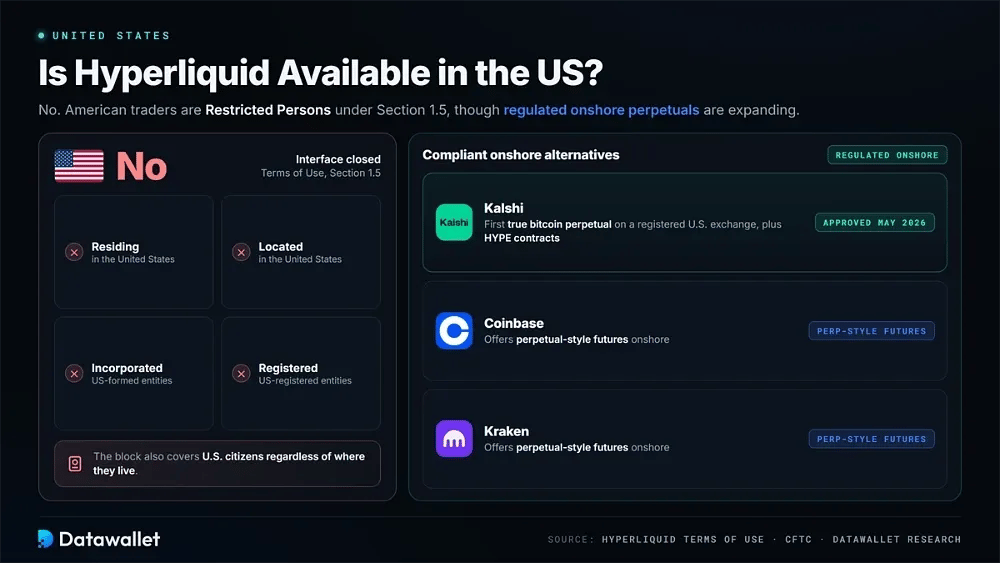
No. Hyperliquid's Interface remains closed to anyone residing, located, incorporated, or registered in the United States. Its Terms also apply the restriction to U.S. citizens regardless of where they live. Under Section 1.5, American traders are Restricted Persons and cannot use the official front end.
Regulated alternatives are expanding, however. The CFTC approved the first true bitcoin perpetual on a registered U.S. exchange in May 2026. Coinbase and Kraken now offer perpetual-style futures onshore, while Kalshi lists HYPE contracts, giving Americans compliant exposure without using Hyperliquid's blocked Interface.
Will Hyperliquid Come to the United States?
A central question surrounding Hyperliquid's 2026 country list is whether the United States will eventually be removed. Washington has moved from treating offshore perpetuals primarily as an enforcement target toward actively exploring their onshoring, with Hyperliquid mentioned at the highest political level.
The White House and CFTC Push
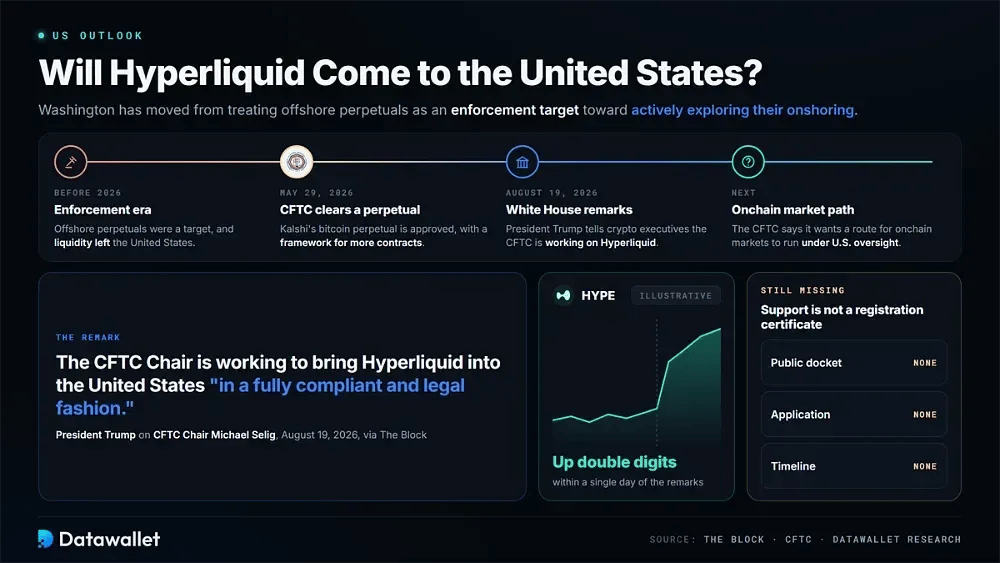
On August 19, 2026, President Trump told crypto executives that CFTC Chair Michael Selig was working to bring Hyperliquid into the United States "in a fully compliant and legal fashion." The remarks were reported by The Block and sent HYPE up double digits within a single day.
Selig has described onshoring as a way to recapture liquidity that left during the enforcement era. On May 29, 2026, the CFTC cleared Kalshi's bitcoin perpetual and published a framework for reviewing additional contracts. It has also said it wants a path for onchain markets such as Hyperliquid to operate under U.S. oversight.
What Still Stands in the Way
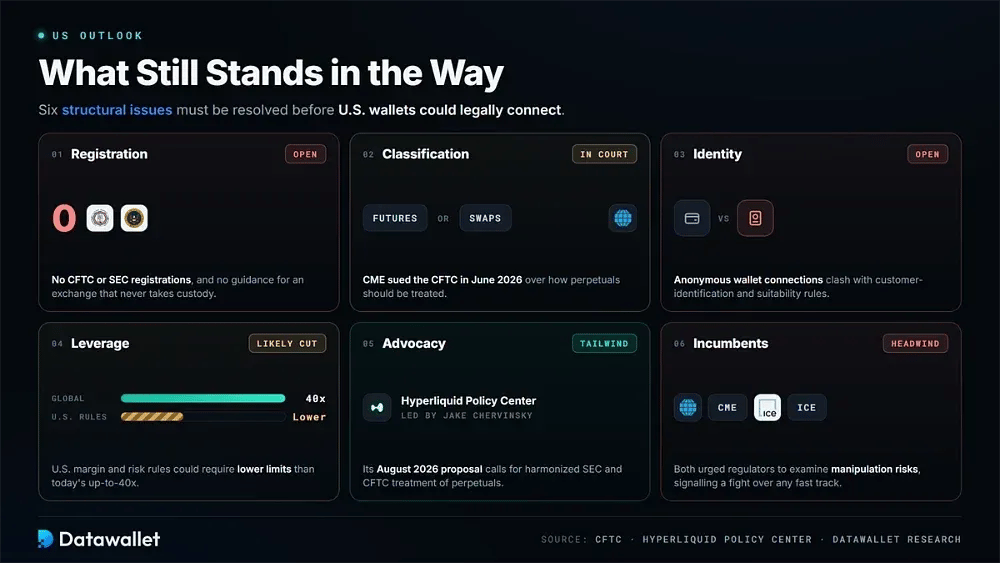
Political support does not amount to a registration certificate. No public docket, application, or timeline for Hyperliquid has been announced, and several structural issues would need to be resolved before U.S. wallets could legally connect.
The main open issues shaping a potential U.S. launch include:
- Registration: Hyperliquid has no CFTC or SEC registrations. Regulators have also not explained how conventional exchange requirements would apply to a venue that never takes custody of user funds.
- Classification: CME sued the CFTC in June 2026 over whether perpetuals should be treated as futures or swaps. The outcome affects how onchain contracts can be listed.
- Identity: Customer-identification and suitability requirements remain difficult to reconcile with anonymous wallet connections because Hyperliquid's core design intentionally avoids the account onboarding used by regulated venues.
- Leverage: U.S. margin and risk rules could require lower leverage limits than the up-to-40x currently available to international Hyperliquid traders.
- Advocacy: In August 2026, the Hyperliquid Policy Center, led by Jake Chervinsky, submitted a proposal calling for harmonized SEC and CFTC treatment of perpetual contracts across markets.
- Incumbents: CME and ICE have urged regulators to examine Hyperliquid's manipulation risks, indicating that established exchanges will challenge any fast-tracked route into U.S. derivatives markets.
Does Hyperliquid Require KYC?
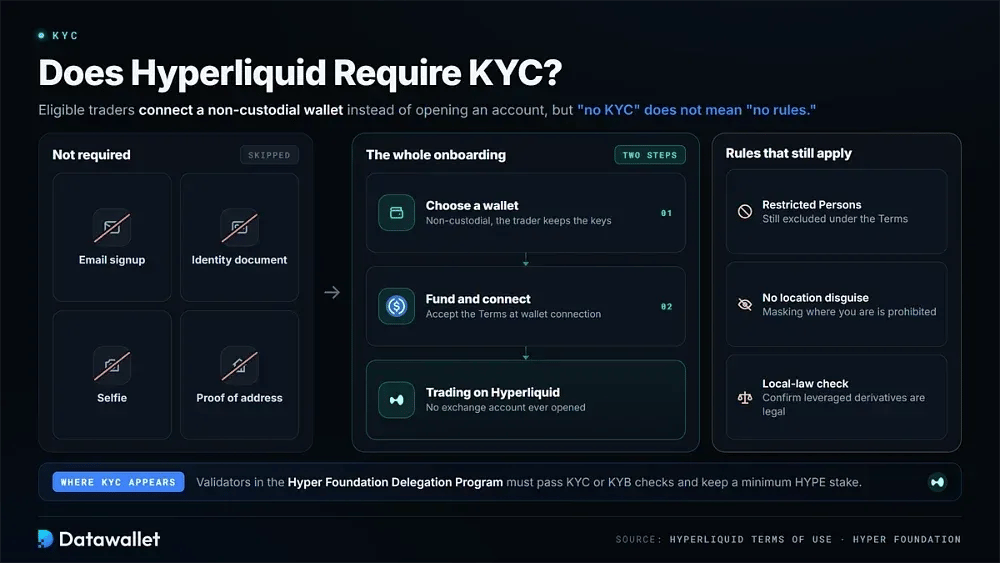
Hyperliquid does not use traditional KYC for eligible traders. Instead of opening an exchange account, users connect a non-custodial wallet. There is no email signup, identity document, selfie, or proof-of-address requirement. Choosing one of the best Hyperliquid wallets and funding it completes the onboarding process.
"No KYC" does not mean "no rules." Restricted Persons are still excluded under the Terms, disguising a user's location is prohibited, and each trader is responsible for confirming that leveraged derivatives are legal where they live. That obligation matters particularly in jurisdictions with strict rules for retail derivatives.
Identity checks do appear elsewhere in the ecosystem. Validators applying to the Hyper Foundation Delegation Program must complete KYC or KYB checks, maintain a minimum HYPE stake, operate high-uptime infrastructure, and comply with jurisdictional restrictions. Verification therefore appears where Hyperliquid intersects with formal legal obligations.
Hyperliquid Licenses and Regulation
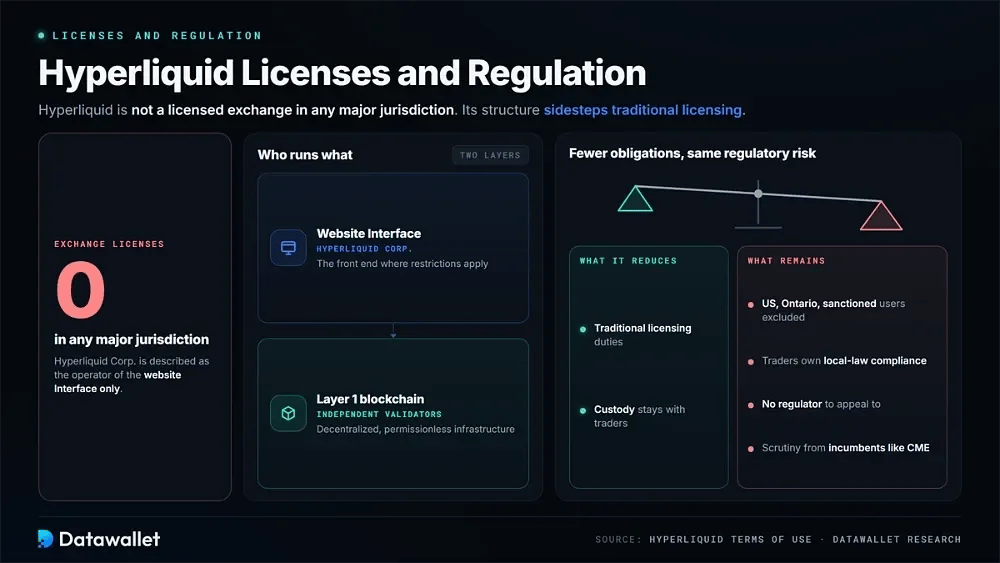
Hyperliquid is not a licensed exchange in any major jurisdiction. Its Terms describe Hyperliquid Corp. as the operator of the website Interface only. Beneath that front end, the Layer 1 blockchain functions as decentralized, permissionless infrastructure executed by independent validators. This structure sidesteps traditional licensing but provides no regulator to appeal to.
Decentralization reduces some obligations without removing regulatory risk. Users in the United States, Ontario, and sanctioned jurisdictions remain excluded, while the Terms make individual traders responsible for complying with local law. Pressure from incumbents such as CME also shows that decentralization arguments will continue facing scrutiny as perpetuals move closer to mainstream oversight.
Was Hyperliquid Hacked?
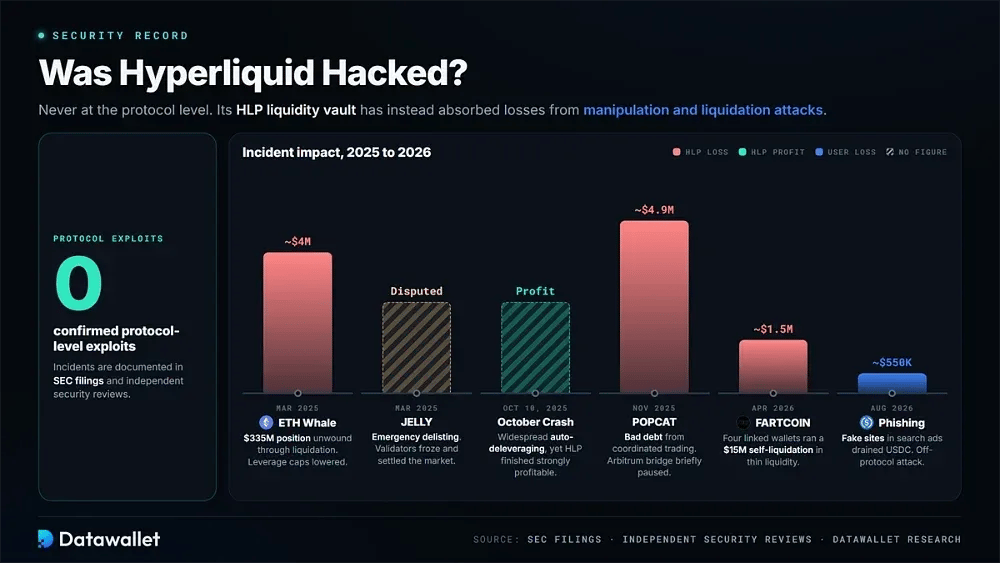
Hyperliquid has never experienced a confirmed protocol-level exploit. Its HLP liquidity vault, however, has taken repeated losses from market manipulation and liquidation attacks. Those incidents are documented in SEC filings and independent security reviews rather than social-media claims.
Notable Hyperliquid market and security incidents so far include:
- ETH Whale: In March 2025, a $335 million leveraged ETH position was strategically unwound through liquidation. HLP lost roughly $4 million, after which Hyperliquid lowered leverage caps.
- JELLY: Later that month, manipulated JELLYJELLY exposure led to an emergency delisting. Estimates of the losses varied widely, while validators intervened to freeze and settle the market by decree.
- POPCAT: Coordinated POPCAT trading in November 2025 left HLP with about $4.9 million in bad debt. Hyperliquid also briefly paused Arbitrum bridge activity during its incident response.
- October Crash: The October 10, 2025 crash caused widespread auto-deleveraging across the platform. HLP nevertheless finished strongly profitable, illustrating how the vault monetizes extreme liquidation cascades.
- FARTCOIN: In April 2026, four linked wallets orchestrated a $15 million self-liquidation in thin FARTCOIN liquidity, shifting roughly $1.5 million in losses onto the vault.
- Phishing: Fake Hyperliquid websites promoted through search ads drained around $550,000 in USDC in August 2026. This was an off-protocol attack against users rather than the platform's infrastructure.
About Hyperliquid
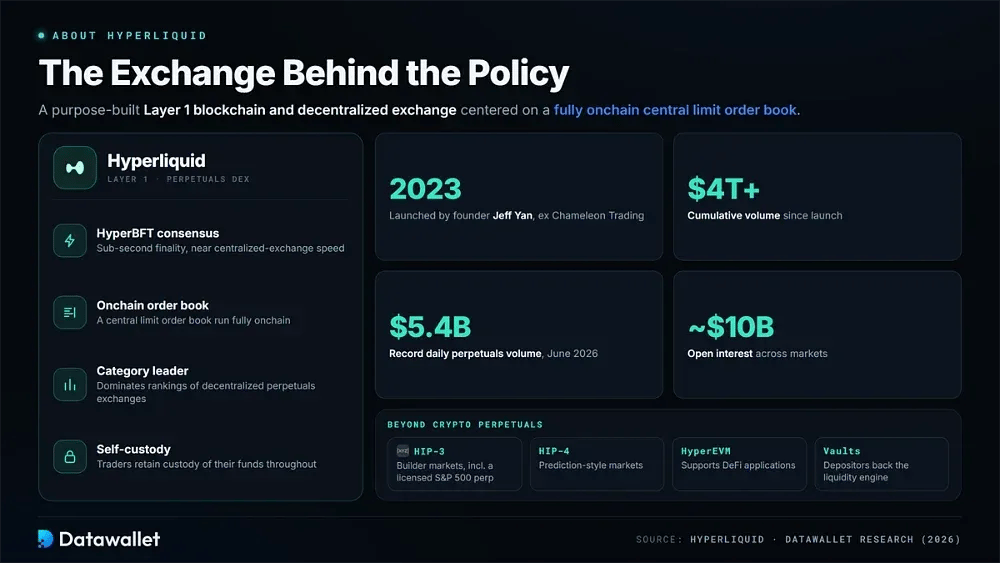
Hyperliquid is a purpose-built Layer 1 blockchain and decentralized exchange centered on a fully onchain central limit order book. HyperBFT consensus provides sub-second finality, allowing the platform to approach centralized-exchange responsiveness while traders retain custody. That model has helped it dominate rankings of decentralized perpetuals exchanges.
Founder Jeff Yan, formerly of high-frequency firm Chameleon Trading, launched the project in 2023 as FTX's collapse drove traders toward self-custody. Since then, cumulative volume has exceeded $4 trillion. Daily perpetuals volume reached a record $5.4 billion in June 2026, while open interest has risen to roughly $10 billion.
The ecosystem now extends far beyond crypto perpetuals. HIP-3 allows builders to deploy their own markets, and Trade[XYZ] holds an official S&P Dow Jones license for its S&P 500 perpetual. HIP-4 adds prediction-style markets, HyperEVM supports DeFi applications, and vaults allow depositors to back the platform's liquidity engine.
Final Thoughts
Hyperliquid's access rules can be stated simply but are easy to misunderstand. The platform serves roughly 190 countries while excluding the United States, Ontario, and sanctioned territories. Anyone considering Hyperliquid should verify their eligibility, understand the derivatives laws that apply locally, and view VPN workarounds as a breach of the Terms rather than a loophole.
Eligible traders can choose a compatible wallet, bridge funds to Hyperliquid, check the fee schedule, and begin with smaller positions before moving into higher leverage, vaults, or builder markets. The CFTC's onshoring efforts are also worth following because the restricted-country list itself may be the next thing to change.