


Can I Add USDT to MetaMask?
Yes. MetaMask displays USDT on every Ethereum-compatible (EVM) network it connects to, and on Solana as well since the wallet shifted to multichain accounts in October 2025. A single account now pairs an Ethereum-style address with a Solana address, so one import process covers both.
The catch is that USDT is network-specific. Tether deploys a separate contract on each chain it supports, and MetaMask only shows a balance when the wallet is set to the chain your tokens were sent on. If your USDT arrived on Arbitrum while MetaMask is displaying Ethereum, the balance stays invisible until you switch networks, even though the funds never moved.
Two major USDT networks sit outside MetaMask. Tron, which carries the largest share of all USDT in circulation, and TON both require dedicated wallets, though MetaMask has named Tron on its expansion roadmap. We cover the workaround in our guide to managing TRC-20 USDT alongside MetaMask.
How to Add USDT to MetaMask
Importing USDT takes under two minutes. Always copy the contract address from Tether's official list or a chain explorer, never from a message, a Telegram group, or an unfamiliar website.
Follow these steps to import USDT safely:
- Select the correct network: Open MetaMask and switch to the chain holding your USDT, whether that is Ethereum, Arbitrum, Solana, or another network.
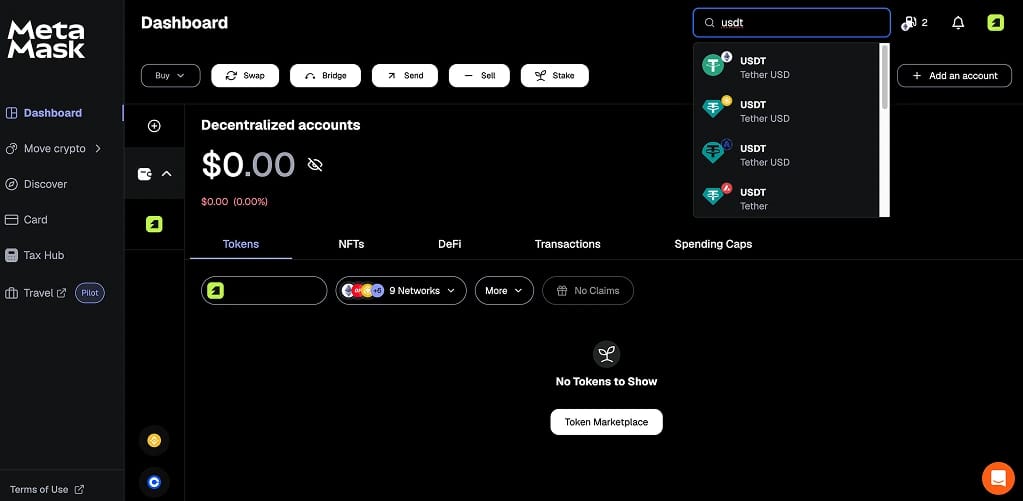
- Copy the verified contract address: Head to Tether's supported protocols page or the table below, find your network, and copy the address exactly as published.
- Open the import screen: In the Tokens tab, scroll down, tap Import Tokens, and choose the Custom Token option if the search view appears first.
- Paste and check the details: Enter the contract address and confirm the symbol reads USDT or USD₮ and the decimals show 6, or 18 if you are on BNB Chain.
- Confirm the import: Review the token summary, approve the addition, and check that your balance matches what the block explorer shows for your wallet address.
Adding USDT With MetaMask's Built-In Search
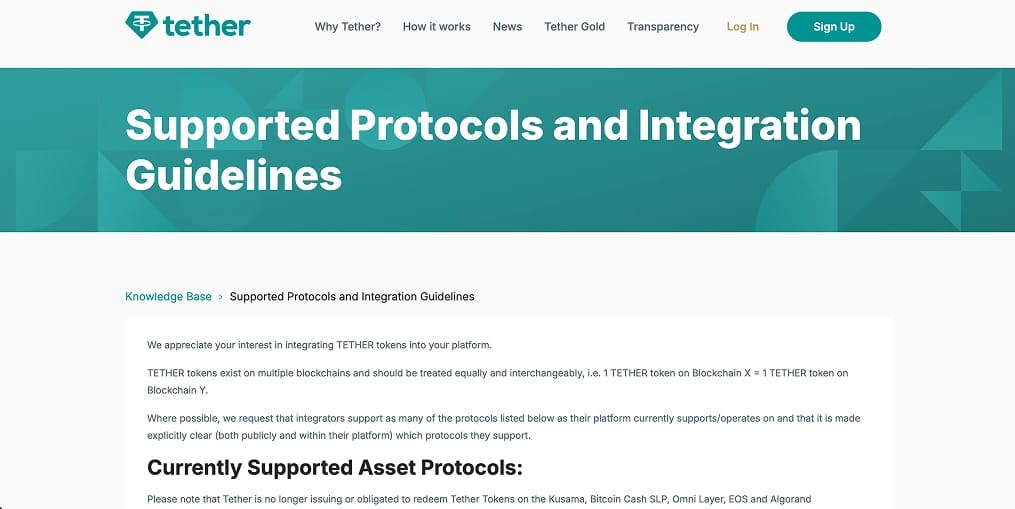
MetaMask also maintains its own verified token lists, which removes the copy-and-paste step on major networks like Ethereum and its Layer 2s.
Use the built-in search in three steps:
- Open Import Tokens: From the Tokens tab in MetaMask Portfolio, scroll to the bottom and select Import Tokens to bring up the search field.
- Search for USDT: Type the ticker and let MetaMask surface the verified Tether listing for whichever network is currently active.
- Verify and add: Confirm the logo, symbol, and network match before approving, since lookalike tokens occasionally appear in search results on smaller chains.
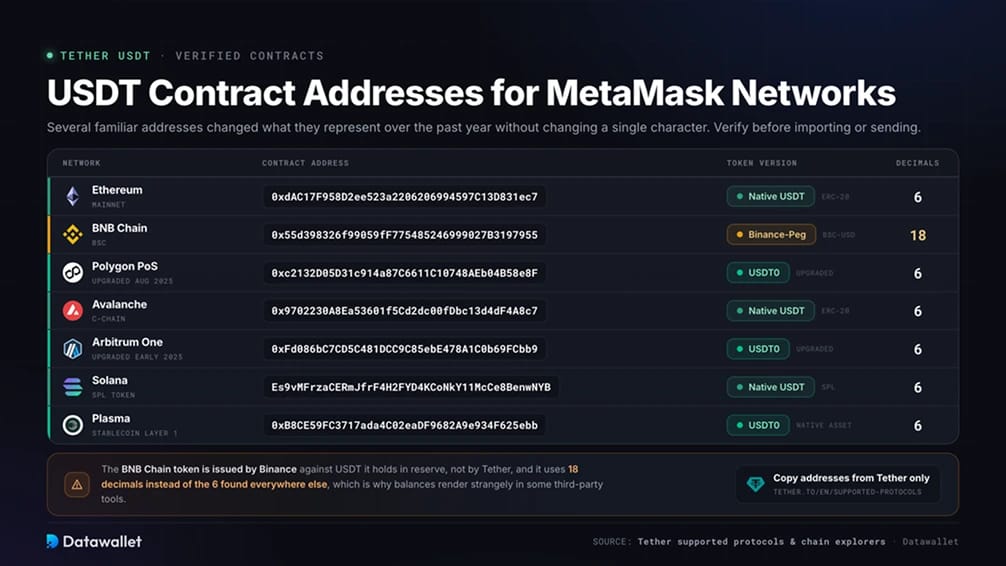
USDT Contract Addresses for MetaMask Networks
Several familiar contract addresses changed what they represent over the past year without changing a single character. Verify against this table or Tether's official list before importing or sending anything.
The BNB Chain token is issued by Binance against USDT it holds in reserve rather than by Tether itself, and it uses 18 decimals instead of the 6 found everywhere else, which is why balances sometimes render strangely in third-party tools.
Why MetaMask Shows USDT0 Instead of USDT
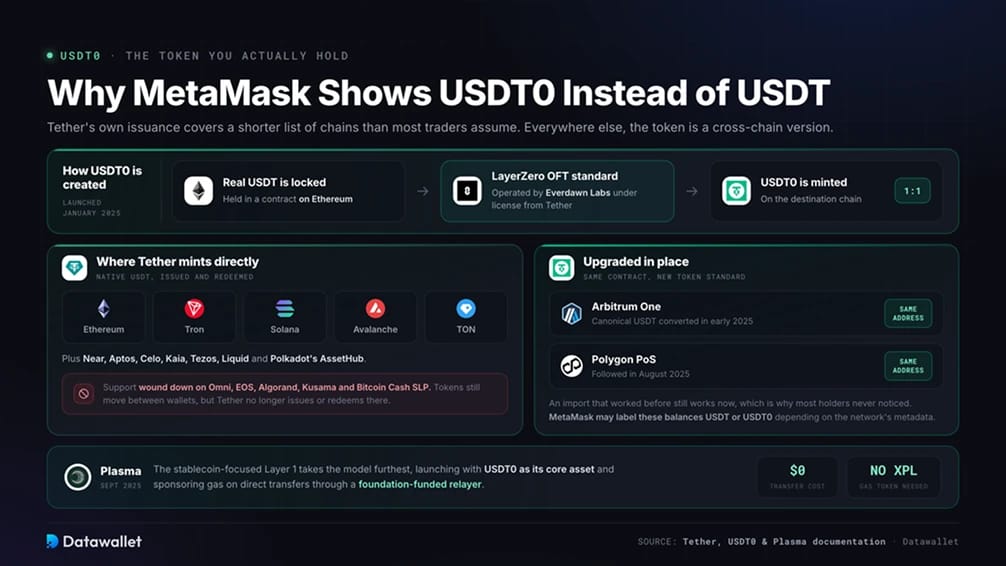
Tether's own issuance now covers a shorter list of chains than many traders assume. The company mints USDT directly on Ethereum, Tron, Solana, Avalanche, TON, Near, Aptos, Celo, Kaia, Tezos, Liquid, and Polkadot's AssetHub, and it has wound down official support for Omni, EOS, Algorand, Kusama, and Bitcoin Cash SLP. Tokens on those legacy chains still move between wallets, but Tether no longer issues or redeems there.
Everywhere else, the token you hold is usually USDT0. Launched in January 2025, USDT0 is a cross-chain version of Tether built on LayerZero's Omnichain Fungible Token (OFT) standard and operated by Everdawn Labs under license from Tether. Real USDT sits locked in a contract on Ethereum, and an equal amount of USDT0 is minted on the destination chain, a structure we break down in our USDT vs USDT0 comparison.
The upgrades happened in place, which is why most holders never noticed. Arbitrum's canonical USDT contract converted to USDT0 in early 2025 and Polygon's followed in August of that year, both keeping their original addresses, so an import that worked before still works now even though the token standard has changed. MetaMask may label these balances USDT or USD₮0 depending on the network's metadata.
Plasma takes the model furthest. The stablecoin-focused Layer 1 launched in September 2025 with USDT0 as its core asset and sponsors gas on direct transfers through a foundation-funded relayer, meaning basic USDT payments cost nothing and require no XPL. Our guide to adding Plasma to MetaMask covers the network setup.
Troubleshooting a Missing USDT Balance
A missing USDT balance nearly always has a quick fix.
- Wrong network selected: Check which chain the sender used by looking up your wallet address on that chain's block explorer, then switch MetaMask to match. Tokens never display across networks.
- Fake or spoofed contract: Scammers deploy tokens named USDT with airdropped balances to bait approvals. Hide anything you did not import deliberately, never interact with it, and only trust addresses from Tether's official list or a major explorer's verified badge.
- Balance not updating: A congested or failing RPC endpoint, the server connection MetaMask uses to read the blockchain, stops token data syncing. Restart the app first, and if the problem persists, swap the network's RPC URL for an alternative from ChainList or a provider like Infura or Alchemy.
- Blank symbol or decimals: When metadata fails to auto-populate, type the symbol as USDT and set decimals to 6 manually, or 18 on BNB Chain, then re-import if the fields still refuse to save.
If you previously held USDT.e on Avalanche, treat it as a separate, bridged asset rather than a duplicate, and swap it for the native version listed above.
Is It Safe to Hold USDT in MetaMask?
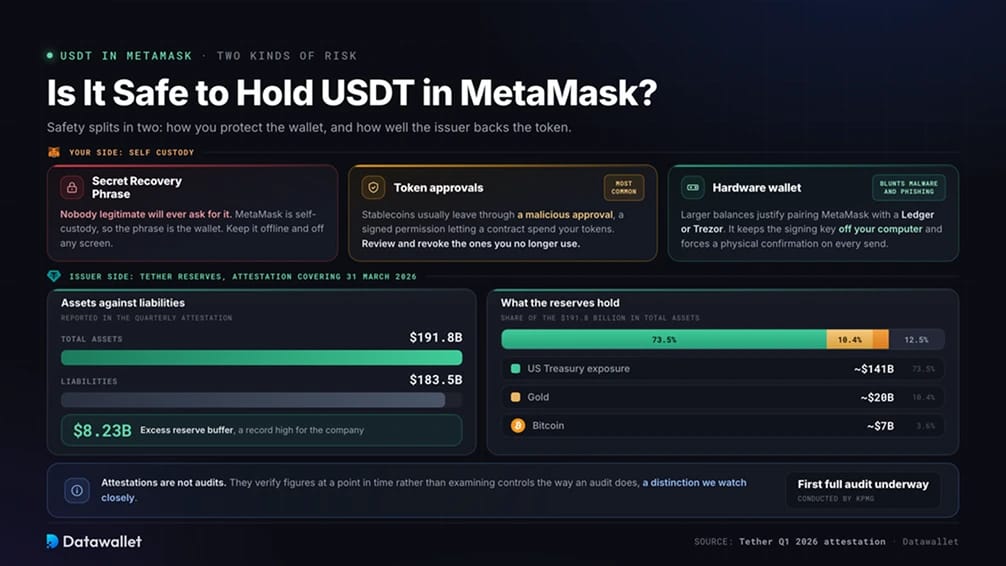
MetaMask is a self-custody wallet, so the safety of your USDT rests on how you protect the Secret Recovery Phrase and what you sign. Nobody legitimate will ever ask for that phrase. Stablecoins most often leave a wallet through a malicious token approval, a signed permission that lets a smart contract spend your tokens, rather than through a stolen phrase. Periodically review and revoke token approvals you no longer use.
Larger balances justify pairing MetaMask with a hardware wallet. A Ledger or Trezor keeps the signing key off your computer and forces a physical confirmation for every outgoing transaction, which blunts both malware and phishing pages built to imitate MetaMask.
On the issuer side, Tether's attestation covering March 31, 2026 reported roughly $191.8 billion in total assets against $183.5 billion in liabilities, leaving a record $8.23 billion excess reserve buffer.
Around $141 billion of the reserves sit in US Treasury exposure alongside about $20 billion in gold and $7 billion in Bitcoin, and the company confirmed its first full audit, conducted by KPMG, is underway. Attestations verify figures at a point in time rather than examining controls the way an audit does, a distinction we watch closely.
About Tether USDT
Tether (USDT) is a US dollar stablecoin that launched in 2014 and grew into the most traded asset in crypto, functioning as the default settlement currency across exchanges, DeFi, and cross-border payments. Circulation sits near all-time highs, and we track the supply, chain distribution, and holder data in our Tether statistics report.
The token holds its dollar peg through reserves managed by Tether, dominated by short-dated US Treasuries and disclosed through quarterly attestations from BDO. Where competitors concentrate on a handful of chains, Tether has spread across more networks than any rival, which is why knowing your token version before importing it into MetaMask is now basic stablecoin hygiene.
Final Thoughts
Adding USDT to MetaMask succeeds or fails on the network you select and the contract address you import.
Import only from Tether's official list or the verified table above, confirm the decimals match your chain, and remember that Arbitrum, Polygon, and Plasma balances are USDT0 rather than Tether-issued USDT, a difference that matters when bridging or redeeming.
Keep your Secret Recovery Phrase offline, audit token approvals occasionally, and consider a hardware wallet once your stablecoin balance grows beyond what you would carry in cash.