







Can I Buy USDT in the UAE?
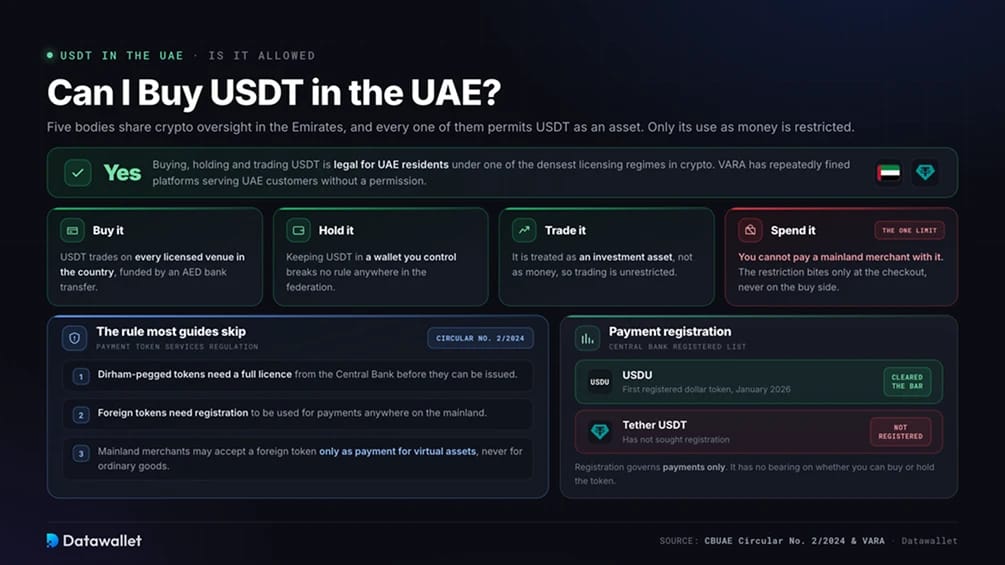
Yes. Buying, holding, and trading USDT is legal for UAE residents under one of the densest licensing regimes in crypto. VARA licenses virtual asset firms in Dubai, the FSRA covers Abu Dhabi's ADGM free zone, the Securities and Commodities Authority takes the rest of the federation, and the Central Bank regulates stablecoins used for payments. VARA has repeatedly fined platforms serving UAE customers without a permission.
Most guides skip the Payment Token Services Regulation. Under Central Bank Circular No. 2/2024, dirham-pegged tokens need a full licence, foreign ones need registration, and merchants on the mainland can only accept a foreign token as payment for virtual assets, never for ordinary goods. The first registered dollar token, USDU, cleared that bar this January, while Tether has not sought registration.
None of that touches the buy side. USDT trades on every licensed venue in the country as an investment asset, and holding it in your own wallet breaks no rule. The restriction bites only if you try to pay for dinner with it.
How to Buy Tether (USDT) in the UAE
The setup we recommend is a verified Rain account funded by AED transfer from a UAE bank account matching your registered name exactly. Send dirhams rather than letting your bank convert, since Rain credits whatever amount arrives. Transfers clear within one business day once your bank details are linked, though a first deposit can take up to four.
Steps to buy USDT on Rain in the UAE:
- Create and verify your account: Sign up at Rain and complete KYC with your Emirates ID, or a passport plus residence visa for expats, and a liveness selfie. Our verification cleared within a day.
- Link your bank and request a deposit: Add your personal UAE bank account, enter the amount, and Rain generates beneficiary details with a reference. Send the transfer from your banking app, then tap the confirmation button so Rain can match the payment.
- Wait for the dirhams to land: Deposits carry no Rain fee and post within one business day for an established account. Keep the transfer receipt, since Rain matches incoming payments manually rather than pulling funds.
- Buy USDT against AED: Select Tether in the app and trade it directly from your dirham balance. Rain quotes a single all-in price, so compare the displayed rate against the 3.6725 peg to see the spread you are paying before confirming.
- Withdraw to self-custody: Move anything you plan to hold long term into a USDT wallet you control. Tron (TRC-20) suits remittances and cheap transfers, while Ethereum (ERC-20) fits DeFi at a higher gas cost.
AED to USDT Fees
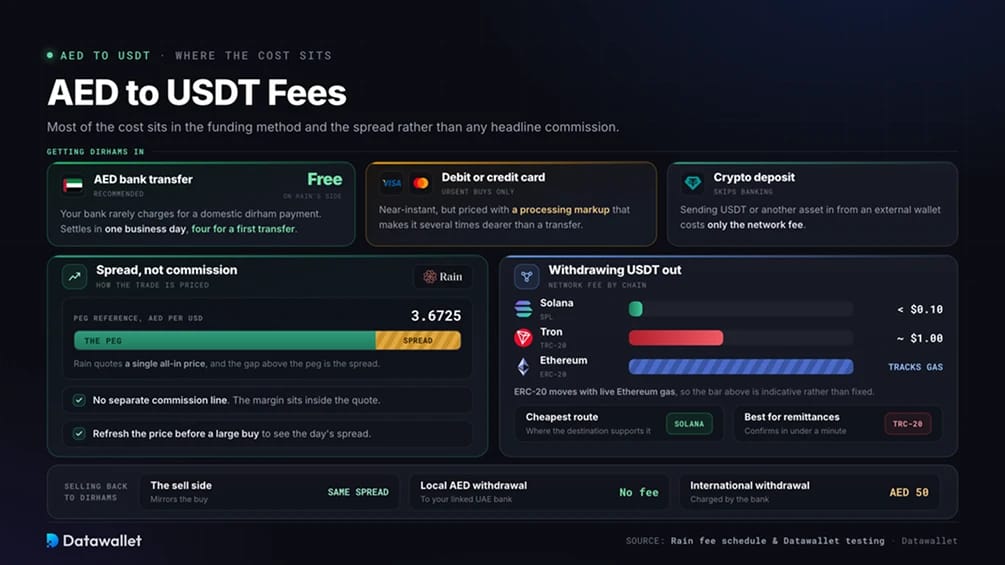
Most of the cost sits in the funding method and the spread rather than any headline commission.
Deposits
- AED bank transfer (recommended): Free on Rain's side, with your own bank rarely charging for a domestic dirham payment. Settlement takes one business day, longer for a first transfer.
- Debit or credit card: Near-instant but priced with a processing markup that makes it several times dearer than a transfer. We keep cards for small, urgent buys only.
- Crypto deposit: Sending USDT or another asset in from an external wallet skips banking and costs only the network fee.
Trading and withdrawals
- Spread pricing: Rain builds its margin into the quoted buy and sell price instead of charging a separate commission. During our testing the quote sat within a narrow band of the peg, and refreshing the price before a large buy shows where the spread sits that day.
- USDT network fees: A TRC-20 withdrawal costs about a dollar and confirms in under a minute. ERC-20 tracks Ethereum gas, and Solana lands below ten cents where the destination supports it.
- Selling back to AED: The sell side mirrors the buy at the same spread, and a local dirham withdrawal to your linked bank carries no Rain charge. International withdrawals attract an AED 50 bank fee.
Fee structures across the global venues are compared in our best USDT exchanges roundup.
Best USDT Exchanges in the UAE
The ranking weighs AED funding access, UAE licensing, fees, and USDT depth. Every platform below holds a UAE permission, the first filter we apply. The wider market is covered in our best crypto exchanges in the UAE guide.
Rain leads for the cleanest dirham path into USDT under a Gulf licence. OKX and Binance suit active traders who want order books and lower percentage fees once funded, Bybit brings the deepest Tether markets under a federal SCA permission, and BitOasis remains the familiar local brand for simple buys.
Regulatory Status of USDT in the UAE
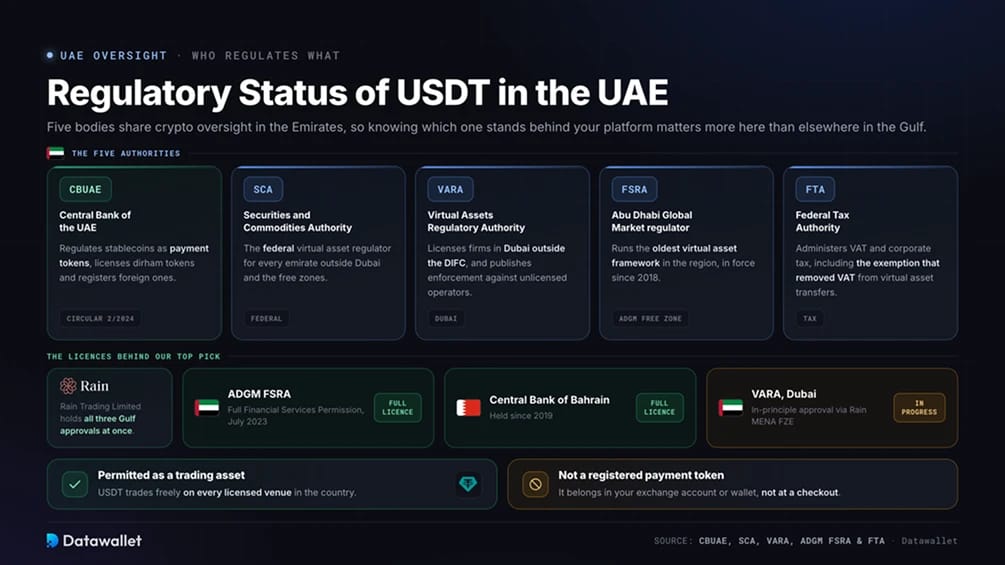
Five bodies share crypto oversight in the Emirates, so knowing which one stands behind your platform matters more here than elsewhere in the Gulf.
Rain Trading Limited received its full ADGM FSRA permission in July 2023, the authorisation that lets it hold client assets in custody and accept dirham deposits from UAE customers. Its in-principle approval from VARA arrived this May through Rain MENA FZE, which will add Dubai exchange and broker-dealer permissions once the conditions are met. Alongside the Central Bank of Bahrain licence it has held since 2019, no other platform carries all three Gulf approvals at once.
USDT itself is fully permitted as a trading asset on licensed venues. As a payment instrument it sits outside the Central Bank's registered list, so it belongs in your exchange account or wallet rather than at a checkout.
Tax Implications of USDT in the UAE
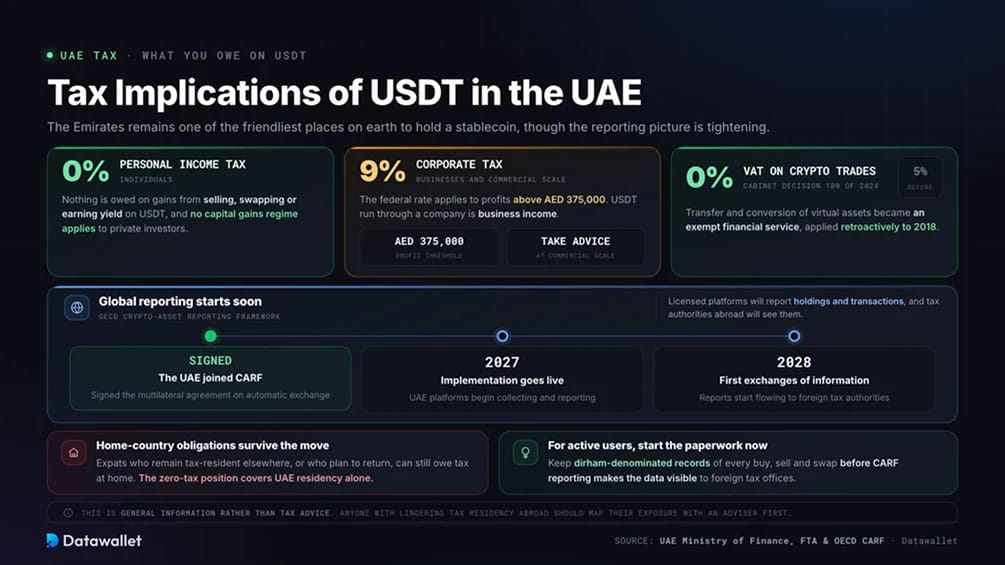
The Emirates remains one of the friendliest places on earth to hold a stablecoin, though the reporting picture is tightening.
- No personal income tax exists: Individuals pay nothing on gains from selling, swapping, or earning yield on USDT, and no capital gains regime applies to private investors.
- Corporate tax can reach trading businesses: The 9% federal rate applies to business profits above AED 375,000, so anyone running USDT activity through a company or at commercial scale should treat gains as business income and take advice.
- VAT no longer touches crypto trades: Cabinet Decision No. 100 of 2024 made the transfer and conversion of virtual assets an exempt financial service, applied retroactively to the start of 2018, so the 5% levy is off every USDT purchase and sale.
- Global reporting starts soon: The UAE signed the OECD's Crypto-Asset Reporting Framework. Implementation goes live in 2027 and the first exchanges of information follow in 2028. Licensed platforms will report holdings and transactions, and tax authorities abroad will see them.
- Home-country obligations survive the move: Expats who remain tax-resident elsewhere, or who plan to return, can still owe tax at home on gains made in Dubai. The zero-tax position covers UAE residency alone.
💡 For active users: keep dirham-denominated records of every buy, sell, and swap now, before CARF reporting makes the data visible to foreign tax offices. Anyone with lingering tax residency abroad should map their exposure with an adviser first. This is general information rather than tax advice.
Why UAE Residents Hold USDT
The dirham has been fixed at 3.6725 to the US dollar for decades, so nobody here buys Tether to escape a falling currency. Demand is driven by access instead.
- Remittances at expat scale: Foreign workers make up nearly nine in ten residents, and migrant remittance outflows reached $38.5 billion in a single recent year, mostly toward India, Pakistan, and the Philippines. A TRC-20 transfer settling in minutes for about a dollar undercuts an exchange house on both speed and cost, and for monthly senders the difference adds up fast.
- The entry ticket to global markets: Nearly every pair on international exchanges quotes against Tether, which circulates at the scale covered in our USDT statistics page. A dirham balance converts to trading capital in one step, without opening a USD bank account.
- Settlement that ignores banking hours: Bank transfers respect business days and cut-off times. A funded USDT balance moves at midnight on a Friday for a dollar, which is why active traders here fund once and stay in stablecoins between positions.
- Yield on idle dollars: Earn products on USDT quote mid-single-digit rates on flexible terms, above what an AED deposit account pays. The income is real but so is the platform risk, and the structures are compared in our USDT yield opportunities guide.
The same access logic repeats across the region, and readers elsewhere in the Gulf can find the local equivalents in our guides to buying USDT in Saudi Arabia and Qatar.
Final Thoughts
Rain settles the question for most UAE buyers. A full ADGM FSRA permission, a Central Bank of Bahrain licence, a VARA approval in progress, free dirham deposits, and direct AED-to-USDT pricing add up to a package no offshore venue matches. Traders who outgrow spread pricing can graduate to OKX or Bybit for order books, and our Rain review covers the platform in full depth.
One caveat. Rain lost roughly $16 million to North Korea's Lazarus Group in April 2024, covered the loss from company funds, and protected every customer balance, though the disclosure only surfaced through an outside investigator. Treat any exchange as a trading venue rather than a vault.
Keep working capital on the platform, move the rest to self-custody, and remember that in the UAE your USDT is an investment you hold rather than money you spend.
.webp)