







Compare Top UAE Crypto Exchanges
1. Rain
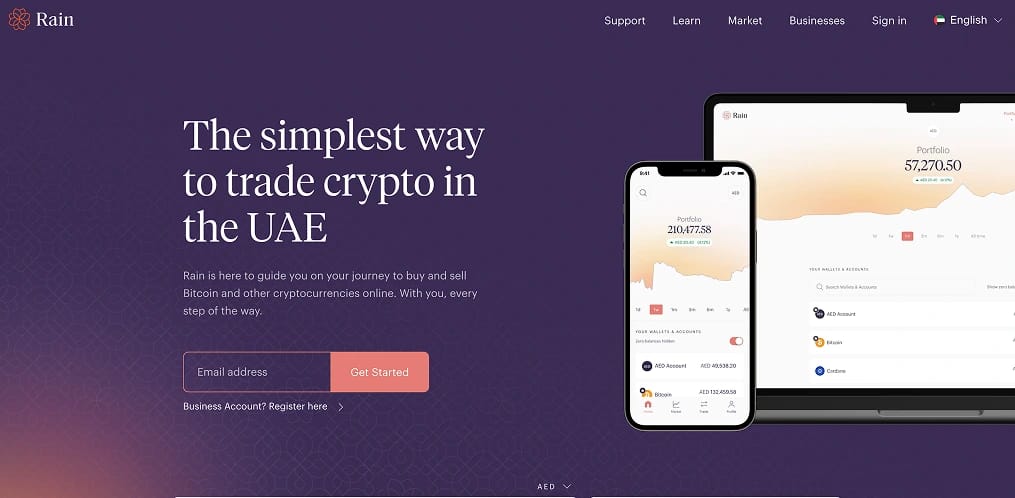
Rain is the platform we point most UAE residents to first, built for this market rather than adapted to it. It became the first licensed crypto-asset service provider in the Middle East through the Central Bank of Bahrain in 2019, and its UAE arm, Rain Trading Limited, holds a Financial Services Permission from Abu Dhabi's FSRA for brokerage and custody with a direct AED on-ramp. A VARA in-principle approval will add a full Dubai licence once final conditions are met.
The AED rails are why it leads. A May 2026 banking agreement with Standard Chartered added segregated client-money accounts and settlement in AED, BHD, and USD, and our test transfer from an Emirates NBD account cleared without the hold-and-call routine that trips up offshore deposits. On cost, the one-tap screen carries a spread near 2%, while Rain Pro charges a flat 0.10% maker and 0.25% taker, so trade on the order book. Its roughly 70 assets suit a saver or majors buyer more than an altcoin hunter.
The security record is not spotless. In April 2024 the North Korean Lazarus Group socially engineered an employee and extracted wallet keys, costing Rain about 15 million dollars, which it covered from its own funds with no hit to customer balances, though disclosure was slow. It keeps more than 98% of assets in multi-signature cold storage and counts Coinbase Ventures and Paradigm among its backers. Our full Rain review covers the platform.
Pros
- FSRA and Central Bank of Bahrain licences, purpose-built for GCC users with native AED support.
- Standard Chartered segregated client-money accounts, among the strongest custody setups regionally.
- Rain Pro fees of 0.10% maker and 0.25% taker, among the lowest here.
- Fast Arabic and English support, verification usually inside a day.
Cons
- The simple buy screen carries a spread near 2% plus a funding fee, far above Rain Pro.
- Around 70 supported coins, the narrowest selection here.
- A 2024 breach saw client-covered losses, and the slow initial disclosure was a poor look.
2. Binance
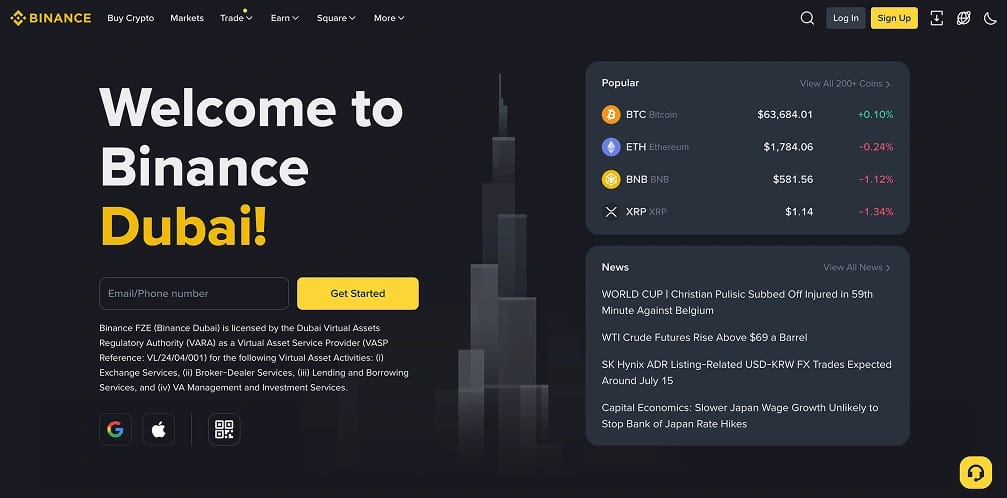
Binance is where liquidity and asset choice tip toward the global players. Its local entity, Binance FZE, holds a full VARA licence granted in 2024, the second global exchange to reach that stage after OKX, and added a full ADGM licence that went live in January 2026 under its Nest brand. With its regional headquarters in Dubai and both major UAE regulators covered, it is as locally anchored as a global venue gets.
The trading case is hard to argue with. Spot fees sit at 0.10%, dropping to 0.075% paid in BNB, across more than 500 assets, the widest range any UAE-licensed platform offers. AED deposits arrive by bank transfer, card, or the P2P desk, a useful fallback when a bank stalls a transfer, and Binance Earn and staking round out the range. Depth on BTC and ETH pairs is the best a UAE user can reach, so large orders fill with minimal slippage.
It sits second rather than first on history and fit. Binance's global entity settled with the US Department of Justice for 4.3 billion dollars in 2023, and the sheer size of the menu can overwhelm someone who just wants to buy Bitcoin monthly. As a trading venue and portfolio home it excels, and our Binance review tracks its compliance rebuild.
Pros
- Full VARA and ADGM licences, the strongest dual-regulator position of any global exchange in the UAE.
- Deepest liquidity and widest asset range here at 500-plus coins, with 0.10% fees or 0.075% in BNB.
- AED bank, card, and P2P funding, plus Earn, staking, and derivatives.
Cons
- The 2023 US Department of Justice settlement still weighs on the global track record.
- The product menu is dense and can overwhelm first-time buyers.
- Simple-buy conversions carry wider costs than the spot order book.
3. OKX
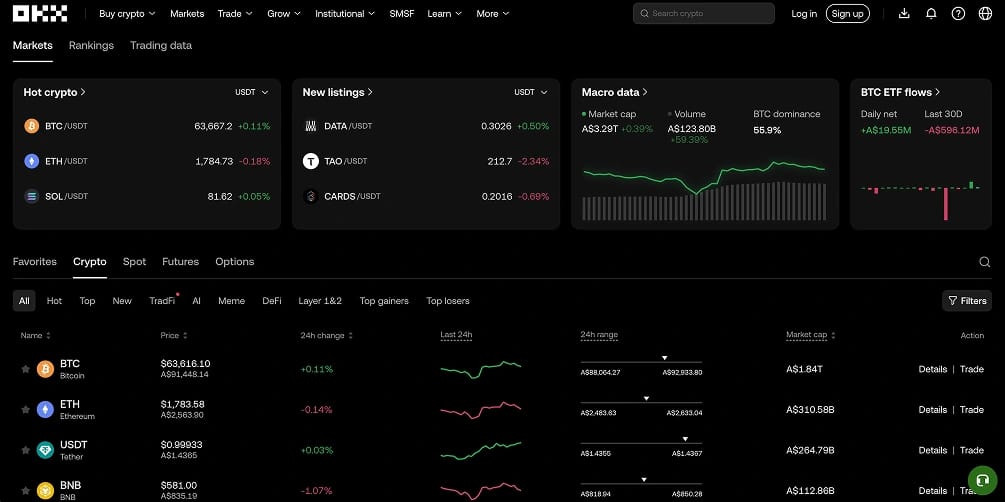
OKX earns third on price and on being the pathfinder here. Its local arm, OKX Middle East Fintech FZE, was the first global exchange to receive a full VARA licence in January 2024, covering spot, derivatives, and custody. Spot fees of 0.08% maker and 0.10% taker are the lowest of any major exchange serving UAE retail, and AED bank transfers carry no OKX fee, with BTC/AED pairs trading directly.
OKX pulls ahead of simpler platforms with its built-in Web3 wallet, which spans dozens of chains with a DEX aggregator and lets a user step from regulated spot trading into DeFi in one app. The OKX wallet removes the juggle of a browser extension, and the virtual OKX Card converts stablecoins to AED at the till. Monthly Merkle-tree proof-of-reserves disclosures have run since late 2022.
The trade-offs are familiar for a global venue. Support can slow during compliance reviews, AED books run thinner than global USDT pairs outside regional hours, and the advanced interface asks more of a beginner than Rain does. Our OKX review goes deeper.
Pros
- First platform to hold a full VARA licence, with a long track record in Dubai.
- Lowest fees here at 0.08% maker and 0.10% taker, with free AED bank transfers.
- Web3 wallet and OKX Card built into the same app as the regulated exchange.
Cons
- AED books thin out against global pairs during off-peak hours.
- Support response times lag the local desks on verification issues.
- The advanced interface is heavier than a first-time buyer needs.
4. Bybit
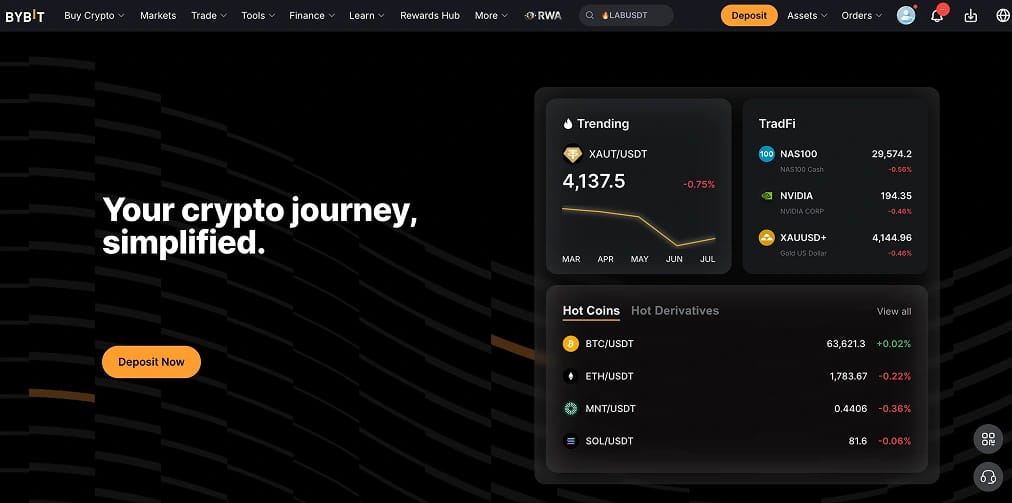
Bybit is the pick for anyone living outside Dubai. In October 2025 it became the first exchange to secure a full licence from the federal regulator, now the CMA, covering the UAE mainland and every emirate beyond Dubai and the free zones. No VARA-only platform can match that, and it matters for residents in Sharjah, Ajman, or Ras Al Khaimah, where VARA coverage technically stops short.
The AED rails followed the licence. Bybit launched local bank deposits and withdrawals through Mercuryo in January 2026, with BTC/AED and ETH/AED spot pairs arriving in March, alongside a P2P desk for dirham funding. Spot fees sit at 0.10%, and the 0.02% maker fee on futures is class-leading for anyone moving from spot into derivatives, a market we cover in our best crypto futures exchanges guide. More than 500 assets trade here.
Two caveats belong on the record. Bybit's Dubai VARA licence is still provisional, so residents inside Dubai city may find AED bank rails restricted until it converts, with P2P as the fallback meanwhile. And in February 2025 Bybit suffered the largest exchange breach on record, a 1.5 billion dollar theft of Ethereum during a cold-to-hot transfer, again linked to Lazarus. Bybit covered every customer and stayed solvent, but the scale keeps it in the amber tier.
Pros
- First and only exchange with a full federal CMA licence, covering mainland UAE beyond Dubai.
- Direct AED bank deposits via Mercuryo with BTC/AED and ETH/AED pairs, plus P2P.
- Class-leading 0.02% maker fee on futures and a 500-plus asset range.
Cons
- The Dubai VARA licence is provisional, so AED bank rails can be limited for Dubai-city residents.
- The February 2025 breach was the largest in exchange history, though fully reimbursed.
- Expat AED withdrawals require exact name matching, a common friction with Arabic transliterations.
5. Coinbase
Coinbase earns its place on pedigree rather than local AED convenience. It is the largest publicly traded crypto exchange, listed on the Nasdaq under US public-company disclosure, and in October 2025 it opened Coinbase International Exchange in Dubai under a VARA licence, adding to the advisory and asset-management permissions its MENA arm already held. Few names a UAE user can reach are as transparently regulated.
The catch is who it serves. The Dubai licence covers qualifying institutional and professional clients on spot and derivatives, and the standard retail app is not offered onshore, so an ordinary resident cannot fund by AED bank transfer today. UAE users reach Coinbase through a crypto transfer or an overseas account rather than a local dirham deposit, which puts it in the same hold-and-trade bracket as Kraken for now.
Coinbase holds customer assets 1:1, has never lost client funds to a hack, and its Advanced platform lists more than 240 assets with maker-taker fees from 0.60% and 1.20% that fall with volume. The simple buy screen is far pricier, with an embedded spread that can push a small card purchase toward 4%, so use Advanced from the start. Our Coinbase review covers the platform in full.
Pros
- Nasdaq-listed public company held to US disclosure standards, with assets kept 1:1, one of the most transparent operators here.
- VARA licence in Dubai plus advisory and asset-management permissions, a strong institutional footprint.
- Advanced trading platform with 240-plus assets and volume-based fees that fall steadily.
Cons
- No direct AED bank funding for retail residents, and the standard consumer app is not offered onshore.
- Dubai access is aimed at institutional and professional clients rather than everyday retail users.
- A May 2025 insider data breach exposed personal data for roughly 69,000 customers, though no funds or keys were taken.
6. Kraken
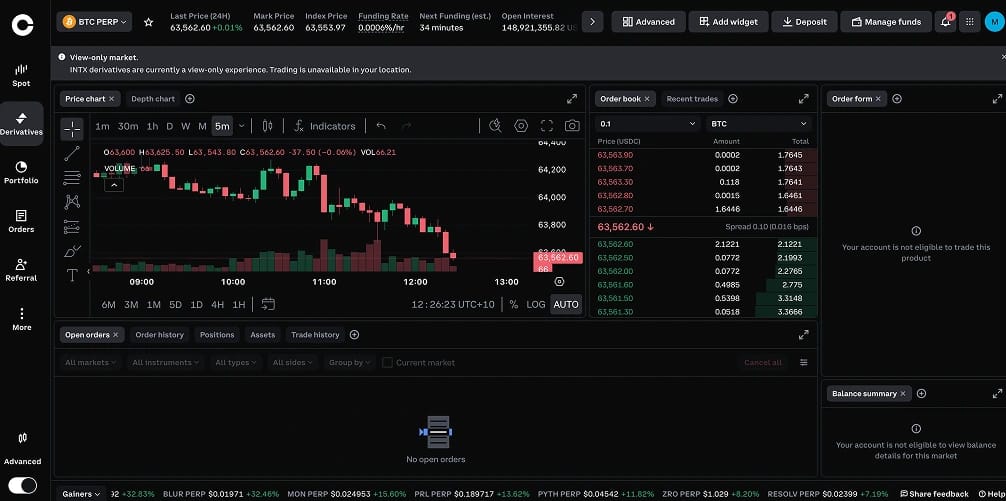
Kraken makes the list on a security record few can rival, with the caveat that its onshore AED rails are still arriving. It has published proof-of-reserves attestations since 2014 and never lost customer funds to a breach, and its parent Payward holds preliminary VARA approval for a Dubai broker-dealer, investment, and management licence. That entity will bring direct AED funding, but as of writing it is not yet live for dirham deposits.
For now, UAE users treat Kraken as a custody-grade home for a portfolio funded by crypto transfer or an international account rather than a local AED on-ramp. Around 600 assets trade on deep books, Kraken Pro charges from 0.25% maker and 0.40% taker, and staking covers the majors. Once the Dubai entity switches on, its ranking here will climb.
Kraken is a place to hold and trade rather than the fastest way to move AED today. If direct dirham funding is your priority now, Rain, Binance, or OKX serve you better, and our Kraken review weighs the full platform.
Pros
- Proof-of-reserves history back to 2014 and no customer funds ever lost to a breach.
- Preliminary VARA approval for an onshore Dubai entity that will add direct AED funding.
- Around 600 assets on deep books with Kraken Pro fees from 0.25%.
Cons
- Direct AED bank funding is not yet live for UAE residents.
- The onshore Dubai licence remains at the preliminary stage.
- Simple-buy pricing is expensive next to the Pro order book.
How to Choose a Crypto Exchange in the UAE
Picking an exchange in the UAE is less about finding a legal option and more about matching the licence to where you live and bank, then pricing the full trade rather than the headline fee.
- Match the licence to your emirate: A VARA licence covers Dubai, an ADGM FSRA permission covers Abu Dhabi, and Bybit's federal CMA licence reaches the wider mainland. Confirm your platform on VARA's public register or the relevant regulator before funding, and treat any exchange without a UAE or GCC licence as off-limits.
- Test the AED rails with a small transfer: Send a few hundred dirhams first from your own bank. Emirates NBD, Mashreq, ADCB, Wio, and Zand are among the more crypto-friendly banks, and most licensed exchanges clear a transfer within minutes once your name matches the account exactly.
- Line up your name before you verify: The most common stall for expats is a mismatch between the English transliteration on a UAE bank account and the spelling on a passport or Emirates ID. Fix that first, since AED withdrawals often require an exact match.
- Price the whole trade, spread included: A 0.10% headline fee means little if the one-tap screen carries a 2% spread. Order books on Rain Pro, OKX, and Binance show true market pricing, while simple-buy screens embed the spread. Run a small buy and immediate sell and measure the round-trip cost.
- Check the coin can be traded onshore: Under the federal framework, an asset must sit on an approved list to trade in the UAE, and privacy coins such as Monero and Zcash are now prohibited. Confirm the token you want is listed before committing funds.
Crypto and Bitcoin Regulation in the UAE
Crypto is legal in the UAE, which runs one of the most developed licensing regimes anywhere. Five bodies share the map, and knowing which governs your platform is the whole game.
- VARA, the Dubai regulator: The Virtual Assets Regulatory Authority was established under Dubai Law No. 4 of 2022 as the world's first dedicated virtual assets regulator. It licenses exchanges, custodians, and broker-dealers across Dubai's mainland and free zones outside the DIFC, has licensed institutional entrants such as Coinbase's international exchange, and enforces hard, ordering KuCoin to cease all Dubai activity in March 2026 for operating without a licence.
- The CMA, the new federal authority: On 1 January 2026, Federal Decree-Laws 32 and 33 of 2025 reconstituted the Securities and Commodities Authority as the Capital Market Authority, brought virtual assets into federal capital-markets law as a financial product, and gave the regulator extraterritorial reach and penalties up to 250 million dirhams. Trading a coin onshore now requires it to be on an approved federal list.
- ADGM and the FSRA, the Abu Dhabi framework: The Financial Services Regulatory Authority in Abu Dhabi Global Market built one of the region's first virtual asset frameworks in 2018 under English common law. Rain and Binance both hold FSRA permissions, and the regime is favoured for institutional-grade custody.
- The DFSA in the DIFC. The Dubai International Financial Centre runs its own regulator, the Dubai Financial Services Authority, separate from VARA, with its own token-listing and custody rules.
- The Central Bank on stablecoins: The CBUAE's Payment Token Services Regulation governs AED-pegged and approved stablecoins for payments. Regulated dirham tokens such as AE Coin and Zand AED now exist, and Circle secured an ADGM permission for USDC, moving stablecoins into supervised financial plumbing.
For a user, nothing worth doing is banned. The platforms most likely to still be serving you in 2028 are already licensed, reporting to their regulator, and listing only approved assets.
.webp)
How Does the UAE Tax Crypto?
The UAE is one of the most tax-efficient places on earth to hold crypto as an individual, and the picture is clear.
- No personal income or capital gains tax: An individual buying, holding, trading, or staking crypto for personal investment pays no income tax and no capital gains tax on the proceeds. There is no personal crypto tax return to file.
- Crypto transfers are VAT-exempt: Cabinet Decision No. 100 of 2024 exempted the transfer and conversion of virtual assets from the 5% VAT, treating them like financial services. The exemption took effect on 15 November 2024 and applies retroactively to 1 January 2018.
- Businesses face the 9% corporate tax: Companies whose profits exceed 375,000 dirhams a year pay the 9% corporate tax introduced in 2023, though qualifying free-zone entities can reach 0%. Mining is a taxable business activity and does not benefit from the VAT exemption.
- High-volume trading can be reclassified: There is no bright line, but frequent, systematic, high-volume trading with professional tooling can be treated as a business, which changes the tax treatment. If your activity looks commercial, take advice.
- International reporting arrives in 2027: The UAE has signed up to the OECD's Crypto-Asset Reporting Framework, with implementation from 2027 and the first automatic exchange of account data with other tax authorities in 2028. Offshore holdings will get harder to keep off the radar.
None of this is tax advice, and edge cases deserve a UAE adviser. For stablecoins, our guide to buying USDT in the UAE covers the practical steps.
.webp)
Cryptocurrency Adoption in the UAE
The UAE punches far above its population in crypto, driven by wealth and regulation rather than economic stress.
- A top-five global market. The Henley Crypto Adoption Index 2025 ranked the UAE fifth in the world overall, second only to the United States for public adoption, and first for attracting crypto wealth. Chainalysis put UAE crypto inflows at roughly 56 billion dollars across 2024 to 2025, the second-largest MENA market after Türkiye.
- A magnet for crypto businesses. More than 700 blockchain and Web3 companies now operate in Dubai, drawn by the licensing clarity and zero personal-tax regime.
- Payments are moving from pilot to practice. Regulated dirham stablecoins have gone live, AE Coin is accepted at hundreds of ADNOC fuel stations, and merchants from Carrefour to Dubai Duty Free are testing crypto payments, a shift Chainalysis linked to growth in smaller merchant-sized transfers even as headline volume concentrated among institutions.
- A digital dirham on the way. The Central Bank is piloting a Digital Dirham CBDC, a state-issued complement to the stablecoins already circulating.
Global comparisons sit on our crypto adoption statistics page. What stands out is a market where clear rules and no personal tax turned early enthusiasm into durable, institution-grade demand.
.webp)
How to Buy Bitcoin in the UAE
Buying Bitcoin in the UAE takes about fifteen minutes with your Emirates ID handy, and the cheapest path pairs a free AED bank transfer with a limit order.
- Pick a licensed platform that fits you: Rain for AED-native simplicity, Binance or OKX for low fees and depth, Bybit if you live outside Dubai. Confirm the licence on the regulator's register before signing up.
- Complete verification: Upload your Emirates ID and residency visa, add a selfie, and enter your name exactly as it appears on your bank account. Most platforms clear this inside a day.
- Fund with AED by bank transfer: Send from a crypto-friendly bank such as Emirates NBD, Mashreq, or ADCB. Expect a hold on the first transfer to a new payee, then near-instant clearing. Skip card deposits, which cost most.
- Buy with a limit order on an order book:" On Rain Pro, OKX, or Binance, a limit order on BTC/AED avoids the one-tap spread and saves 1% to 2% versus the simple buy screen.
- Decide on custody:" Active traders can leave coins on a licensed exchange. Long-term holders should withdraw to self-custody. Our best crypto wallets guide compares hardware and software options.
Selling reverses the path, with AED withdrawals landing in a matched UAE bank account.
Final Thoughts
Rain leads for most UAE residents on native AED rails, regional licensing, and Standard Chartered custody. Binance and OKX win on liquidity, range, and cost, Bybit suits anyone banking outside Dubai on its federal CMA licence, Coinbase brings Nasdaq-listed assurance for those who can fund it without local AED, and Kraken pairs an unmatched security record with AED funding still to come.
The structural shift matters more. The CMA put virtual assets inside federal capital-markets law with an approved-token list and stiffer penalties, so which regulator backs an exchange now says more about its future than any marketing page. Whichever you pick, run a small amount through first. Fund by bank transfer, buy with a limit order, sell, and withdraw. The all-in cost and transit time tell you more than any review can.
Our Methodology
We scored each platform across six criteria after opening accounts, completing KYC with UAE documents, funding by AED bank transfer and card, trading on live books, and withdrawing dirhams to a UAE account.
- Trust Score: Our proprietary rating out of 5, weighting regulatory standing with VARA, the CMA, the FSRA, and the CBUAE, custody and reserve transparency, security history, longevity, and audits.
- AED Funding Methods: Confirmed bank transfer, card, Apple Pay, and P2P support, measuring settlement speed, first-transfer holds, and withdrawal times.
- Regulatory Standing: Verified each licence against the public register, its scope, enforcement history, and readiness for the federal token-list and reporting rules.
- Security Track Record: Reviewed breach history and handling, custody and cold-storage arrangements, proof-of-reserves cadence, and certifications such as ISO 27001 and SOC 2.
- Assets and Liquidity: Placed market and limit orders on BTC/AED, ETH/AED, and a mid-cap pair on each venue, measuring spread, depth, and fill quality.
- Fee Structure: Compared maker and taker fees, simple-buy spreads, deposit and withdrawal costs, and the all-in cost of a round trip in dirhams.
We excluded platforms without a UAE or GCC licence or with unresolved compliance failures, and flag where a licensed name's AED rails are institutional or still rolling out. Testing ran across the first half of 2026, with statuses rechecked after the CMA framework took effect.
%20(1)%20(1).webp)