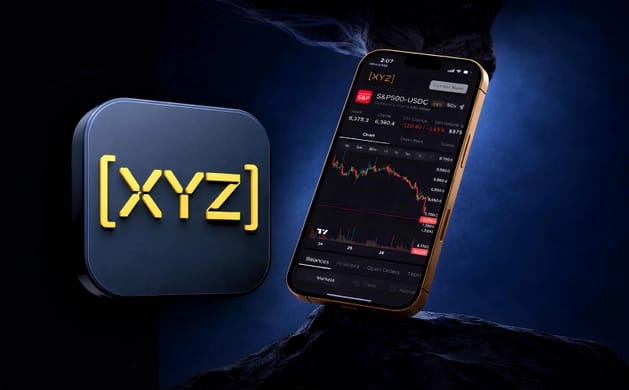

What is TradeXYZ?
TradeXYZ is a perpetual futures interface built atop Hyperliquid for traditional assets, giving traders onchain access to equities, equity indices, commodities, and other synthetic exposures through decentralized order books, validator-secured execution, and automated settlement.
Its utility comes from Hyperliquid Improvement Proposal 3 (HIP-3), which lets independent builders deploy and operate their own perpetual DEXs. Within that framework, XYZ defines listings, oracle sources, leverage parameters, and market operations, while TradeXYZ is the user interface.
Founded in 2024, TradeXYZ launched alongside Hyperliquid’s HIP-3 rollout in October 2025 as the network’s first deployment. On March 18, 2026, the protocol obtained an official S&P 500 license, enabling the first institutional-grade, 24/7 perpetual market for the benchmark index.
According to DefiLlama data, the protocol generates $87.19 million in annualized fees and $43.59 million in annualized revenue. Current activity reflects $53.24 billion in 30-day perpetual volume alongside $1.54 billion in open interest across its decentralized order books.
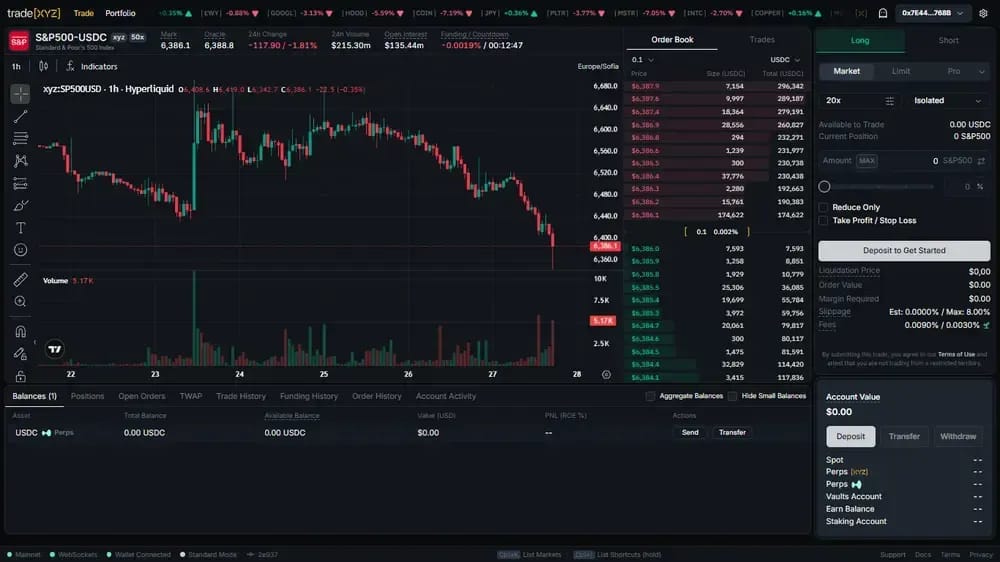
How Does TradeXYZ Work?
TradeXYZ uses Hyperliquid's HIP-3 architecture, where XYZ controls market-specific pricing and parameters while HyperCore powers execution, funding, liquidations, margining, and settlement onchain.
Here’s the core mechanics behind the system:
- HIP-3 Structure: TradeXYZ is a builder-deployed perpetual DEX on Hyperliquid, where XYZ defines listings, oracle sources, leverage limits, and contract parameters.
- Execution Layer: Matching, order types, funding, liquidations, and auto-deleveraging are handled by HyperCore, giving XYZ markets native onchain trading infrastructure.
- Contract Design: XYZ perpetuals are linear contracts margined and settled in USDC, while the oracle remains USD-denominated with no USDC/USD conversion applied.
- Exposure Model: That setup creates quanto-style exposure, meaning traders take USD-based market risk while profit and loss is cash-settled in USDC.
- Custom Pricing Stack: Three components are bespoke to XYZ markets: the oracle price, mark price, and external price, which together drive pricing and risk controls.
- Relayer Network: A distributed relayer system computes those values and broadcasts updates to HyperCore roughly every 3 seconds, keeping market data responsive.
- Oracle Logic: When underlying markets are open, the oracle uses external fair-value pricing; when closed, it switches to a continuous-time EMA model.
- Oracle Parameters: The internal oracle uses a 1-hour time constant, with effective elapsed time capped at 0.1 x tau, limiting each update shift to about 9.5%.
- Mark Price Model: The mark price is the median of three components, including oracle price, oracle-plus-basis smoothing, and live order book trade signals.
- Risk Controls: Mark and oracle updates are clamped within ±50 basis points, while discovery bounds tie off-session price movement to 1 / max leverage.
TradeXYZ Supported Assets
TradeXYZ supports multi-asset perpetuals across indices, stocks, commodities, FX, and regional equity products, with each category using tailored pricing windows, leverage caps, and discovery-bound parameters.
Here is a summarized information table of active XYZ contracts:
How to Trade Perpetuals on TradeXYZ
Trading perpetuals on TradeXYZ starts with the app interface, then moves through market selection, collateral setup, order configuration, execution, and active position monitoring.
Here’s the basic trading flow, step by step.
- Visit App: Visit the TradeXYZ app and load the trading terminal.
- Connect: Connect your crypto wallet to access trading balances and markets.
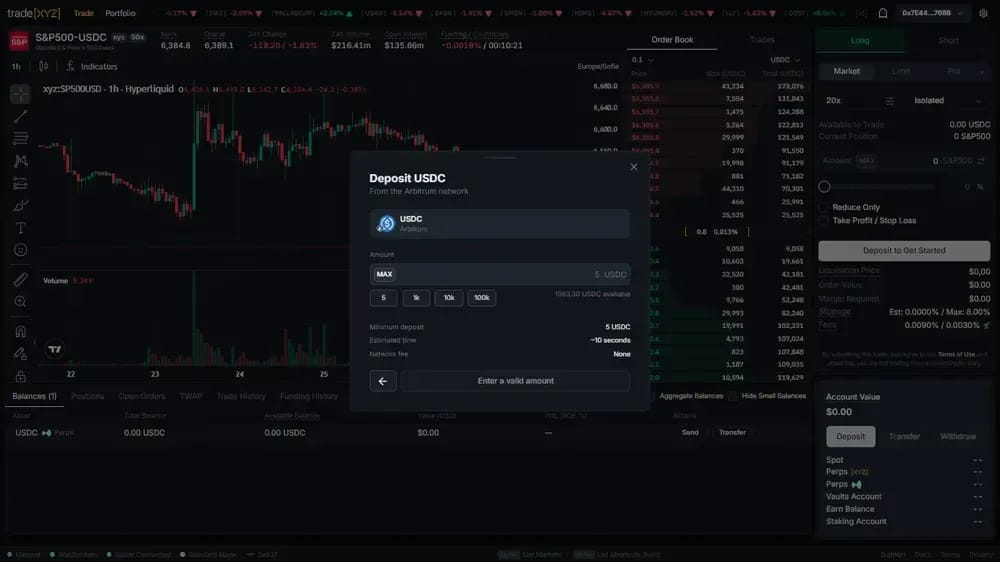
- Fund: Transfer USDC collateral using the bottom-right account module.
- Select: Choose the perp market you want to trade.
- Configure: Pick order type, enter price if needed, then set size.
- Leverage: Adjust leverage, noting required initial margin before submitting.
- Review: Check liquidation price, order value, fees, and slippage estimates.
- Execute: Place the order; market fills instantly, limits rest open.
- Monitor: Track filled positions in Positions, or pending orders in Open Orders.
- Manage: Watch margin and hourly funding, then reduce, close, or adjust.
TradeXYZ Fees
TradeXYZ fees combine HIP-3 trading charges, tiered maker-taker schedules, growth-mode discounts, staking reductions, and hourly peer-to-peer funding payments across perpetual markets.
Trading Fees
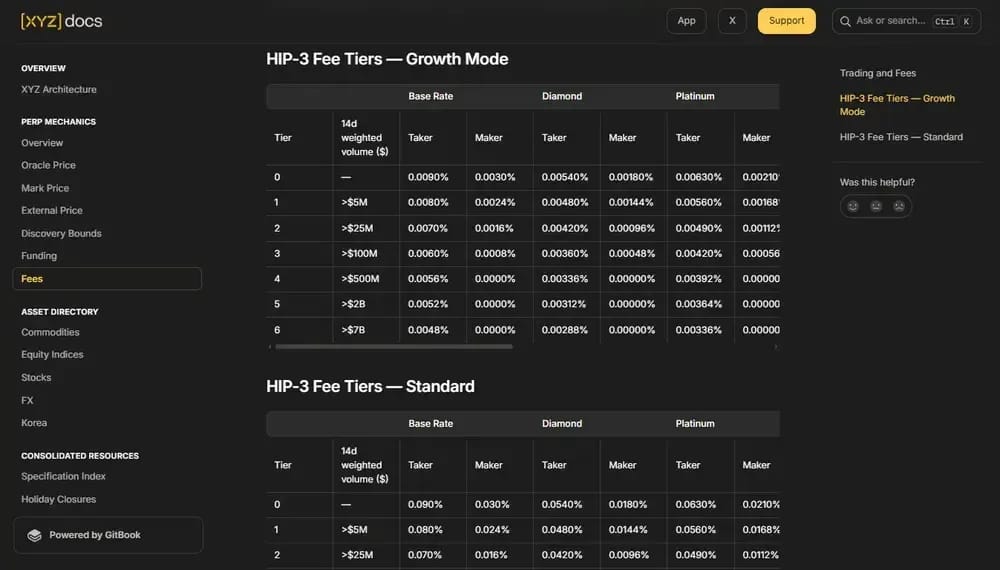
TradeXYZ uses HIP-3 fee schedules, where standard fees on builder-deployed assets are currently 2x higher than the usual fees on validator-operated Hyperliquid perp markets. Of those collected trading fees, 50% goes to Hyperliquid and 50% goes to TradeXYZ.
Fee tiers are based on rolling 14-day weighted volume and are reassessed daily in UTC. One tier applies across all perps, HIP-3 perps, and spot markets, while maker rebates are paid continuously per trade and Hyperliquid staking discounts can further reduce costs.
Standard Fee Tiers
- Base Rate: Standard HIP-3 fees start at 0.090% taker and 0.030% maker at Tier 0.
- Tier 1: Traders above $5 million in 14-day weighted volume pay 0.080% taker and 0.024% maker.
- Tier 2: Above $25 million, standard fees fall to 0.070% taker and 0.016% maker.
- Tier 3: Above $100 million, fees decline to 0.060% taker and 0.008% maker.
- Tier 4: Above $500 million, fees reach 0.056% taker and 0.000% maker.
- Tier 5: Above $2 billion, standard pricing moves to 0.052% taker and 0.000% maker.
- Tier 6: Above $7 billion, the lowest standard base rate is 0.048% taker and 0.000% maker.
Growth Mode Fees
Growth mode can be enabled on selected assets, cutting all-in fees by at least 90% relative to the standard rate. However, rebates and volume-contribution credits are also reduced by at least 90%, so the lower headline fee comes with proportionally smaller incentives.
Under the growth-mode base schedule, Tier 0 fees drop to 0.0090% taker and 0.0030% maker, while the lowest Tier 6 base rate falls to 0.0048% taker and 0.0000% maker. This mode is designed to improve accessibility on selected markets without fully preserving the standard rebate structure.
Growth Mode Restrictions
- Crypto Perps: Perpetuals on crypto assets against any collateral are not eligible.
- Crypto Baskets: Crypto indexes, ETFs, and other crypto-asset baskets are excluded.
- Math Combinations: Perps based on mathematical combinations involving crypto, such as BTC + X, cannot use growth mode.
- Crypto Wrappers: Vehicles or wrappers holding primarily crypto assets, such as MSTR, are not eligible.
- Gold Products: Gold-tracking perps are excluded because PAXG-USDC already tracks gold price.
Maker Rebates and Discounts
- Unified Tiering: The same fee tier applies across spot, standard perps, and HIP-3 perps.
- Continuous Rebates: Maker rebates are credited continuously on each executed trade.
- Staking Benefit: Hyperliquid staking discounts still apply on top of the tier structure.
- Cost Advantage: Higher-volume traders can reduce taker costs materially while reaching zero maker fees from Tier 4 onward on the base schedule.
Funding Rates
Funding rates on TradeXYZ are not a platform fee but a peer-to-peer transfer between longs and shorts, designed to keep the perp price aligned with the oracle price. If the contract trades above oracle, longs pay shorts; if it trades below oracle, shorts pay longs.
Funding is charged hourly and follows the formula F = 0.5 [P + clamp(r - P, -0.0005, 0.0005)], where P is the premium index and r is the interest rate.
Payments are calculated as position size × oracle price × funding rate, use the oracle price rather than mark price, and are capped at ±4% per hour. TradeXYZ also applies a 0.5x multiplier to Hyperliquid’s baseline funding formula, reducing baseline funding from roughly 11% annualized to about 5.5% annualized.
What is TradeXYZ’s Ghost Mode?
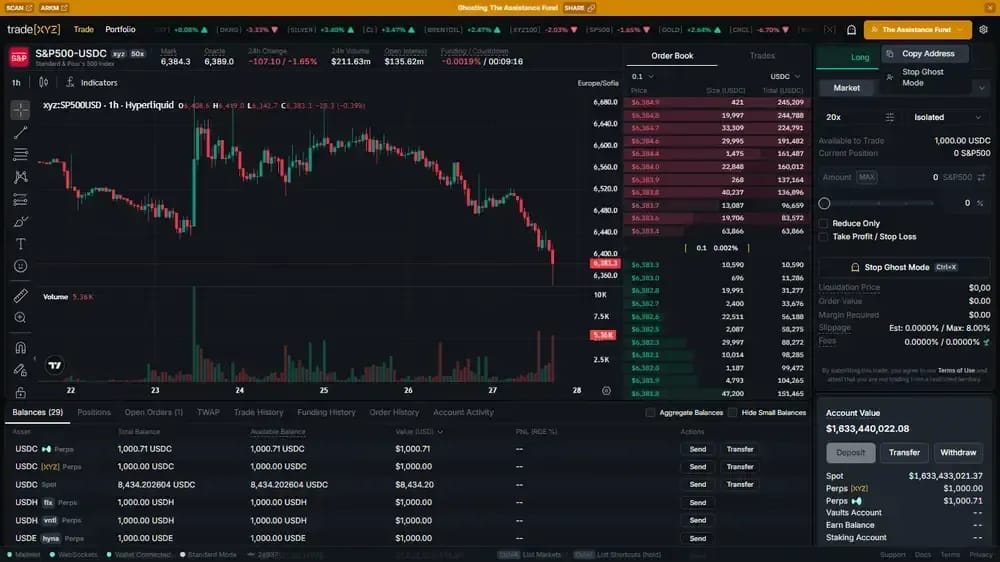
TradeXYZ’s Ghost Mode is a wallet-spectating feature that uses Hyperliquid’s transparent, onchain architecture to let users observe another public wallet’s trading activity in near real time. Instead of copying trades automatically, it functions as a live market observation tool.
Users can enter Ghost Mode from the upper-right icon or the Connect Wallet menu, then paste a public Hyperliquid address or choose one from a leaderboard or example list. Once activated, the interface updates to show that wallet’s positions, orders, and fills as they appear onchain.
The feature is mainly designed for learning how active traders manage entries, exits, stops, and position scaling, but it comes with important cautions.
Activity can appear with a slight delay of a few seconds, only public blockchain data is shown, and users are encouraged to observe ethically rather than harass, dox, or blindly mirror another trader’s strategy.
Does TradeXYZ Have a Token?
TradeXYZ does not currently have a separate public token documented in its official materials. The protocol is presented as a Hyperliquid HIP-3 deployment named xyz, with docs describing the DEX, deployer, oracle updater, and market architecture, but not any native TradeXYZ token.
That means users interact with TradeXYZ primarily through USDC-margined perpetual markets and the wider Hyperliquid infrastructure, rather than through a platform token. Its fee docs also describe revenue sharing and trading tiers, but again do not mention a standalone TradeXYZ token.
Risks of TradeXYZ
TradeXYZ carries the usual perpetual futures risks, plus additional HIP-3, oracle, and off-hours market structure considerations tied to builder-operated listings on Hyperliquid.
Here are the main risks traders should evaluate:
- Liquidation Risk: Leveraged positions can be liquidated quickly when price moves against you, especially if margin is thin or volatility spikes suddenly.
- Funding Costs: Funding is charged every hour, so extended positions can accumulate meaningful costs or negative carry during persistent premium or discount conditions.
- Oracle Dependence: XYZ markets rely on relayer-published oracle, mark, and external prices, creating risk if pricing inputs degrade, lag, or misbehave.
- Smart Contract Risk: Onchain trading infrastructure can still contain smart contract bugs, logic flaws, or integration vulnerabilities that affect execution, settlement, or user funds.
- Builder Risk: Because TradeXYZ runs as a HIP-3 deployment, the builder is responsible for market definition, oracle operation, leverage settings, and settlement.
- Slashing Exposure: HIP-3 deployers can be slashed by validator vote for irregular inputs, downtime, degradation, or harmful market operation affecting protocol integrity.
- Off-Hours Pricing: Many XYZ markets continue price discovery when underlying venues are closed, which can increase uncertainty around fair value and reopening gaps.
- Bounded Discovery: Discovery bounds can limit off-session movement, reducing liquidation risk but also constraining price formation until external markets resume.
- Liquidity Risk: Thin order books can increase slippage, widen spreads, and make market orders more expensive, particularly in smaller or specialty listings.
- ADL Risk: Auto-deleveraging is a last-resort mechanism in perp venues, meaning profitable traders can still be affected during stressed liquidation events.
Final Thoughts
TradeXYZ is one of the more distinctive HIP-3 deployments on Hyperliquid, extending perpetual trading beyond crypto into equities, indices, commodities, FX, oil perpetuals, and regional equity exposures through a unified onchain framework.
Its appeal comes from broad market access and continuous price discovery, but those advantages also introduce leverage, oracle, liquidity, and off-hours pricing risks that make disciplined risk management essential for traders.