


.svg)
What is World Liberty Financial?
World Liberty Financial is a Trump-branded crypto and decentralized finance project launched in 2024 to connect digital assets with mainstream financial services. It presents itself as a DeFi ecosystem, with products tied to borrowing, lending, governance, and the USD1 stablecoin, rather than a single standalone cryptocurrency.
The venture is closely linked to Donald Trump and his family. Donald Trump has been described as the project’s “chief crypto advocate,” while Donald Trump Jr. and Eric Trump have promoted the business publicly. Barron Trump has also been listed in project materials as a DeFi-focused figure.
World Liberty Financial’s broader founding group includes crypto entrepreneurs and Trump business allies, including Zachary Folkman, Chase Herro, Steve Witkoff, and members of the Witkoff family. This mix of political branding, real-estate connections, and crypto operators helped the project attract attention far beyond typical DeFi launches.
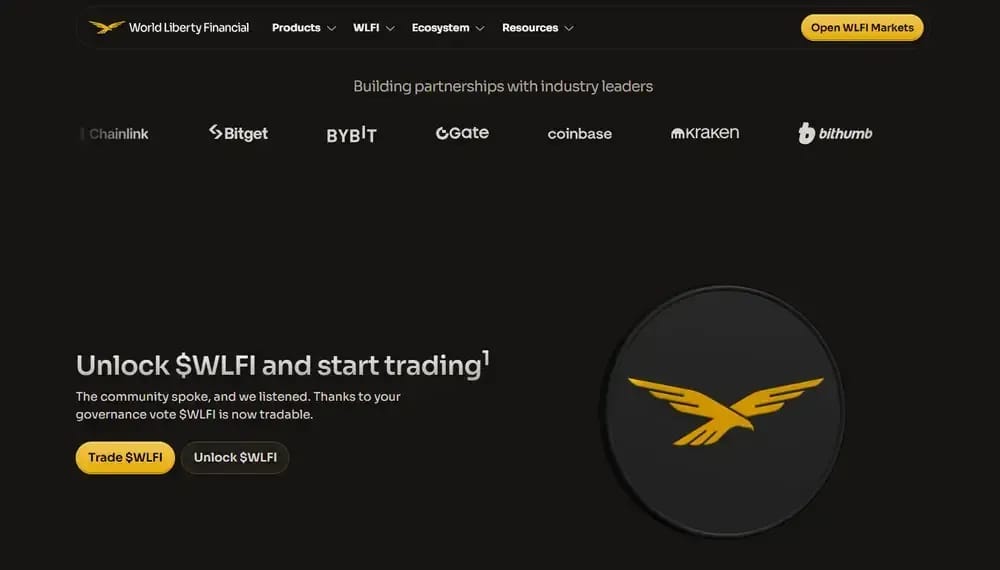
At a high level, World Liberty Financial aims to build a crypto-based financial platform around WLFI, its governance token, and USD1, its dollar-pegged stablecoin. Its pitch is that users and partners can access blockchain-based finance while token holders participate in some governance decisions through proposals and voting.
How Does World Libery Work?
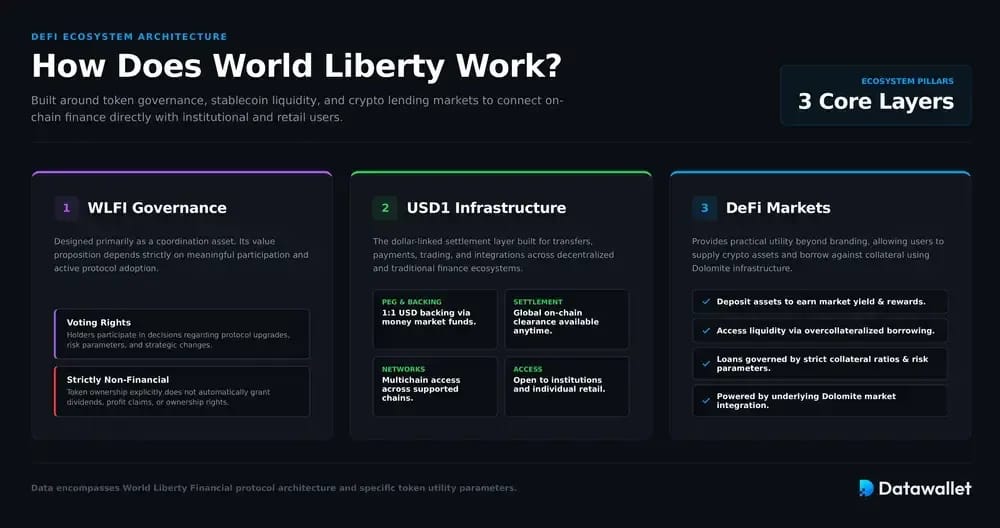
World Liberty Financial works as a DeFi ecosystem built around token governance, stablecoin liquidity, and crypto lending markets, aiming to connect on-chain finance with institutional and retail users.
1. WLFI Governance Layer
The WLFI token is designed primarily as a governance asset, giving holders the ability to participate in decisions about the World Liberty Financial protocol. According to project materials, this can include voting on upgrades, risk parameters, and strategic changes, but token ownership does not automatically grant dividends, profit claims, or ownership rights.
This means WLFI functions more like a voting and coordination token than a cash-flow instrument. Its value proposition depends heavily on whether the protocol gains adoption, whether governance participation is meaningful, and whether future proposals expand or limit what token holders can actually influence.
2. USD1 Stablecoin Infrastructure
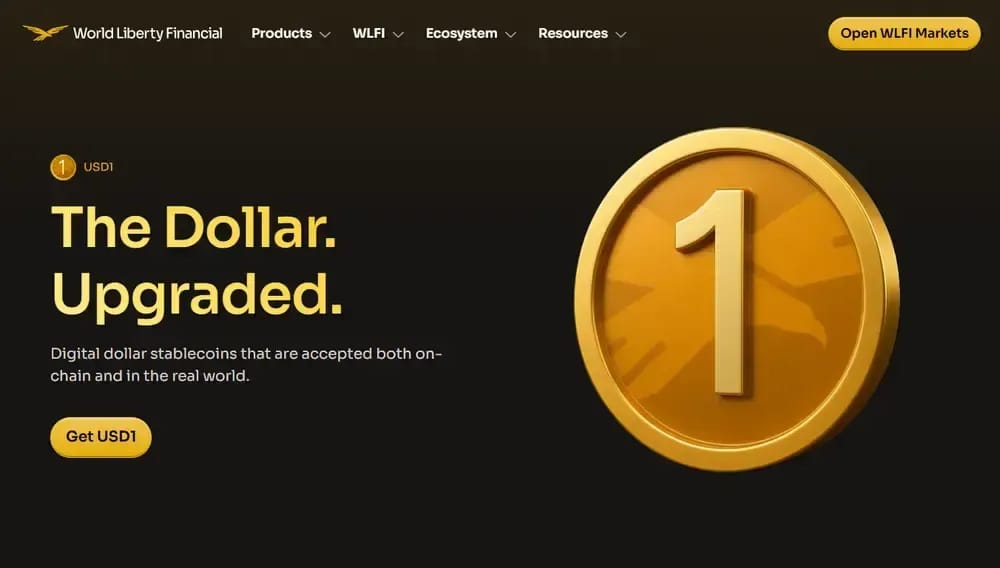
USD1 is the project’s dollar-linked settlement layer, designed for transfers, payments, trading, lending, and integrations across DeFi and traditional finance.
Key features that define USD1’s role include:
- Peg: Redeemable 1:1 for U.S. dollars.
- Backing: Supported by dollars and U.S. government money market funds.
- Settlement: Enables on-chain transfers that can clear globally, anytime.
- Access: Available to institutions, individuals, developers, and DeFi users.
- Networks: Built for multichain use across supported blockchain ecosystems.
- Use cases: Payments, lending, borrowing, trading, and digital asset settlement.
3. WLFI Markets and DeFi Services
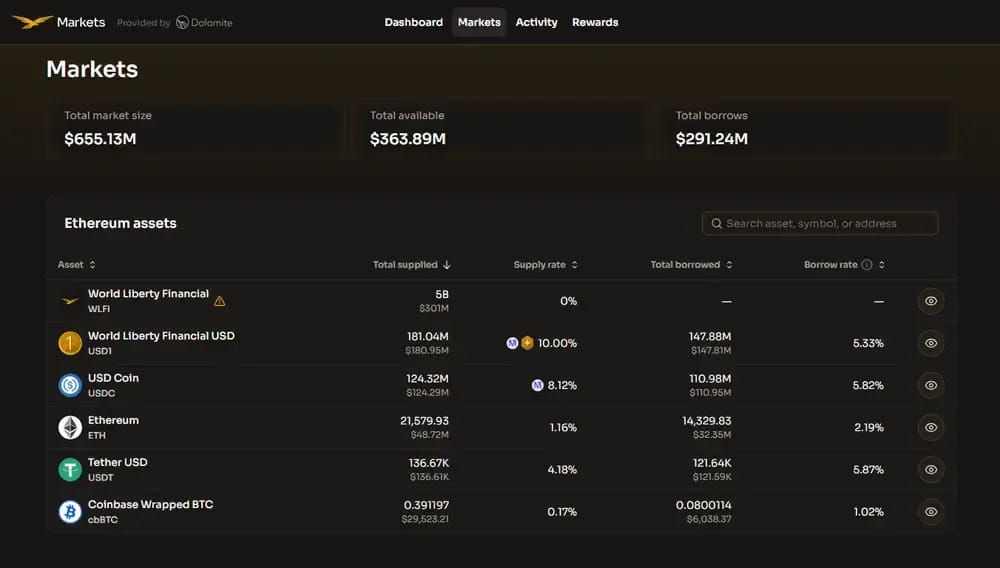
World Liberty also promotes WLFI Markets, where users can supply crypto assets, borrow against collateral, and interact with lending infrastructure provided through Dolomite.
The market layer is important because it gives the project practical utility beyond branding:
- Supplying: Users deposit supported crypto assets into lending markets.
- Borrowing: Borrowers access liquidity by posting eligible collateral.
- Collateral: Loan activity depends on collateral ratios and asset risk.
- Rewards: Suppliers may earn protocol-based incentives or market yield.
- Gas: Users still pay blockchain transaction fees when interacting on-chain.
- Integration: Dolomite provides the underlying market infrastructure.
- Utility: Markets help connect WLFI governance with actual DeFi usage.
World Liberty Financial Funding
World Liberty Financial has raised about $715 million through WLFI-related fundraising rounds, according to ICO tracking data. The largest confirmed portion came from two public token sales: an initial $300 million sale, followed by a $250 million sale of 5 billion WLFI tokens at $0.05 each.
The remaining funding includes major investor purchases and later rounds, such as Justin Sun’s reported $75 million WLFI buy and Aqua 1 Foundation’s $100 million investment. ICO trackers also list a $25 million April 2025 round and smaller January funding, bringing the tracked total to roughly $715 million.
The WLFI Token
WLFI is World Liberty Financial’s governance token, built to coordinate protocol decisions, support ecosystem participation, and trade across supported venues after transferability was enabled.
1. WLFI Tokenomics
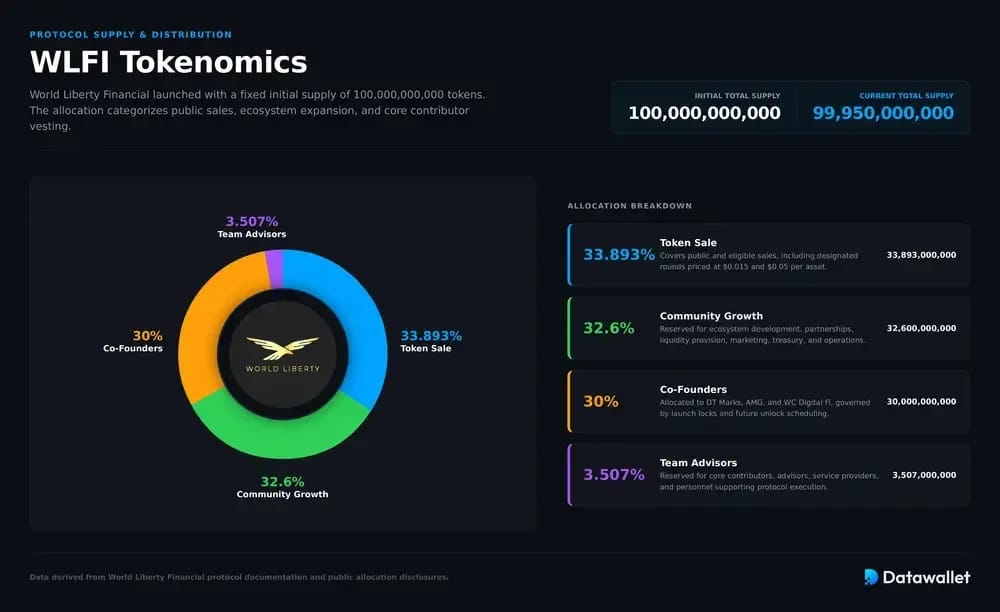
WLFI launched with a fixed initial supply of 100 billion tokens, with the current total supply slightly lower at about 99.95 billion WLFI.
The main WLFI allocation categories are:
- Token Sale: 33.893% equals 33.893 billion WLFI, covering public and other eligible sales, including rounds priced at $0.015 and $0.05 per token.
- Community Growth: 32.6% equals 32.6 billion WLFI, reserved for ecosystem development, partnerships, liquidity provision, marketing, treasury reserves, and future protocol operations.
- Co-Founders: 30% equals 30 billion WLFI, allocated to DT Marks, AMG, and WC Digital Fi, with launch locks and future unlock scheduling.
- Team Advisors: 3.507% equals 3.507 billion WLFI, reserved for core contributors, advisors, service providers, and personnel supporting protocol development and operations.
2. WLFI Utility
WLFI’s core utility is governance. The token lets holders propose, discuss, and vote on matters affecting the World Liberty Financial Protocol, including ecosystem direction and operational changes. Official docs state that WLFI is not intended for use outside governance.
Governance is not unlimited control. Proposals go through discussion, screening, and Snapshot voting, while implementation may depend on technical, legal, security, and operational review. Voting power is also capped at 5% of total supply per holder.
3. WLFI Price Performance
WLFI began trading publicly after earlier restrictions were loosened, turning a previously governance-focused token into a liquid market asset. CoinGecko recently listed WLFI near $0.0597, with roughly 32 billion tokens circulating and market capitalization around $1.9 billion.
Performance has been volatile. CoinGecko shows WLFI down sharply from its $0.3313 all-time high, while recent seven-day performance also lagged the broader crypto market. CoinMarketCap similarly reported a live price near $0.06 and max supply of 100 billion tokens.
World Liberty Financial’s Crypto Holdings
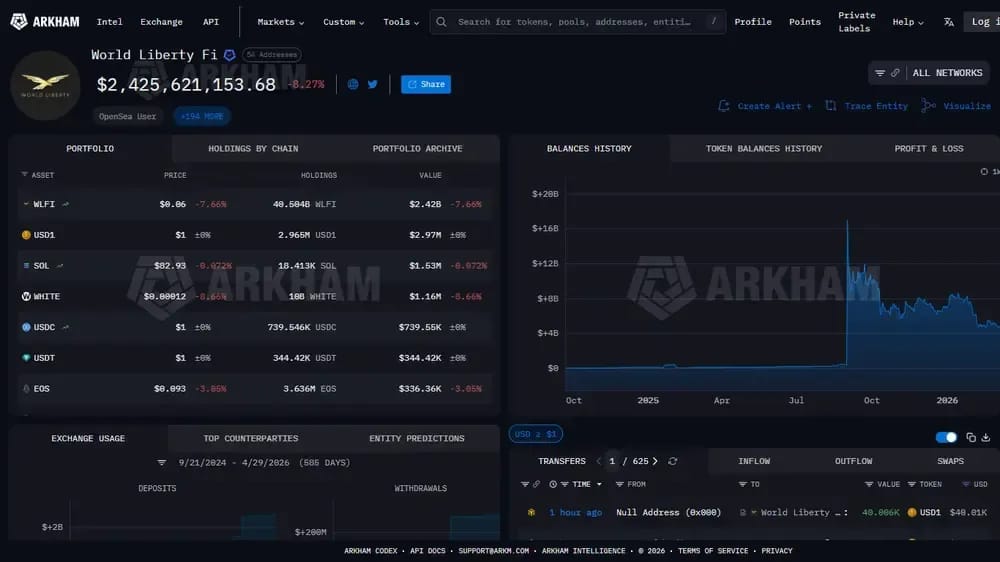
Arkham’s labeled World Liberty Financial portfolio shows holdings led by WLFI, with smaller positions across USD1, SOL, stablecoins, and other ecosystem tokens.
Key holdings shown in the Arkham portfolio snapshot include:
- WLFI: 40.594 billion WLFI worth about $2.42 billion, making the native governance token the overwhelming majority of the tracked portfolio.
- USD1: 2.965 million USD1 worth about $2.97 million, reflecting exposure to World Liberty’s own dollar-pegged stablecoin.
- SOL: 18,413 SOL worth about $1.53 million, giving the portfolio meaningful exposure to the Solana ecosystem.
- WHITE: 10 billion WHITE tokens worth about $1.16 million, a smaller but still seven-figure altcoin position.
- USDC: 739,546 USDC worth about $739,550, providing liquid dollar-denominated reserves for transfers, liquidity, or treasury management.
- USDT: 344,420 USDT worth about $344,420, adding another liquid stablecoin position alongside USD1 and USDC.
- EOS: 3.636 million EOS worth about $336,470, representing a smaller legacy layer-1 allocation in the tracked wallet set.
- Other Assets: Arkham research has also linked WLFI wallets to ETH, WBTC, stETH, TRX, MOVE, ONDO, AAVE, LINK, and ENA activity.
How to Buy WLFI Token
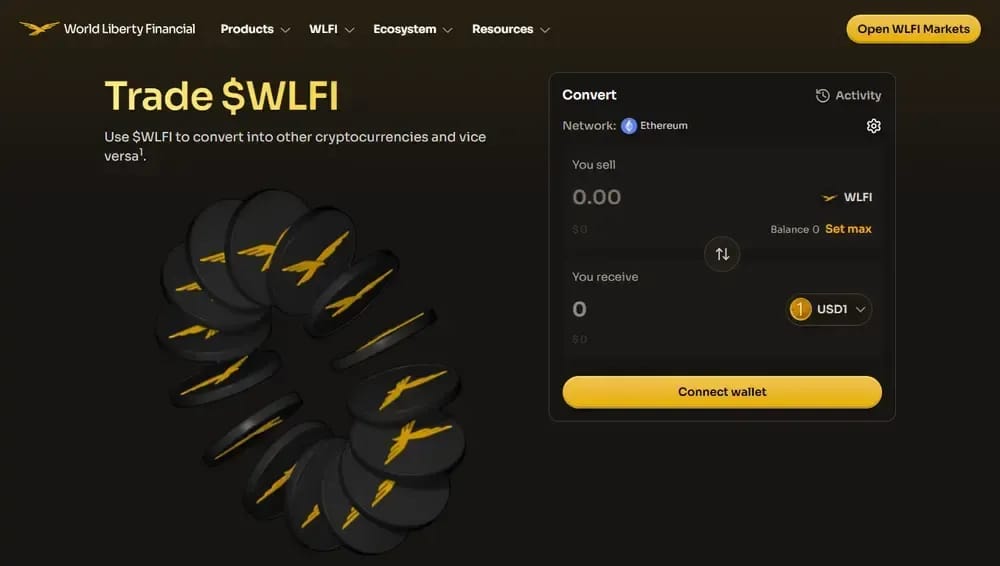
WLFI can be bought directly via the official interface using a crypto wallet or through centralized exchanges, decentralized exchanges, or derivatives platforms, depending on whether the user wants spot exposure, self-custody, or leveraged trading access.
For DeFi users, World Liberty Financial points users toward Uniswap, while noting that Uniswap is not controlled by the project. Buyers typically need a compatible wallet, ETH for gas, and the correct WLFI contract to avoid scam tokens. DEX purchases may involve slippage, liquidity limits, and self-custody risk.
For centralized exchanges, WLFI trades on venues including Binance, OKX, Bybit, Gate, and MEXC, often against USDT. CoinGecko lists OKX, Bybit, and Gate among popular WLFI markets, while Binance and Bybit show live WLFI/USDT spot pages. Perpetual markets may also be available for traders seeking leveraged exposure.
Is World Liberty Financial Legit?
World Liberty Financial is a real, active crypto venture with public token documentation, exchange listings, Arkham-labeled wallets, and reported fundraising. However, “legit” does not mean low-risk: Reuters has reported insider-favorable governance, Trump-family revenue rights, and heavy political-conflict scrutiny around the project.
It also sits within a broader Trump-family crypto push that includes WLFI, USD1, the official $TRUMP meme coin, Melania’s $MELANIA meme coin, Trump Digital Trading Card NFTs, and American Bitcoin, the mining company backed by Eric Trump and Donald Trump Jr.
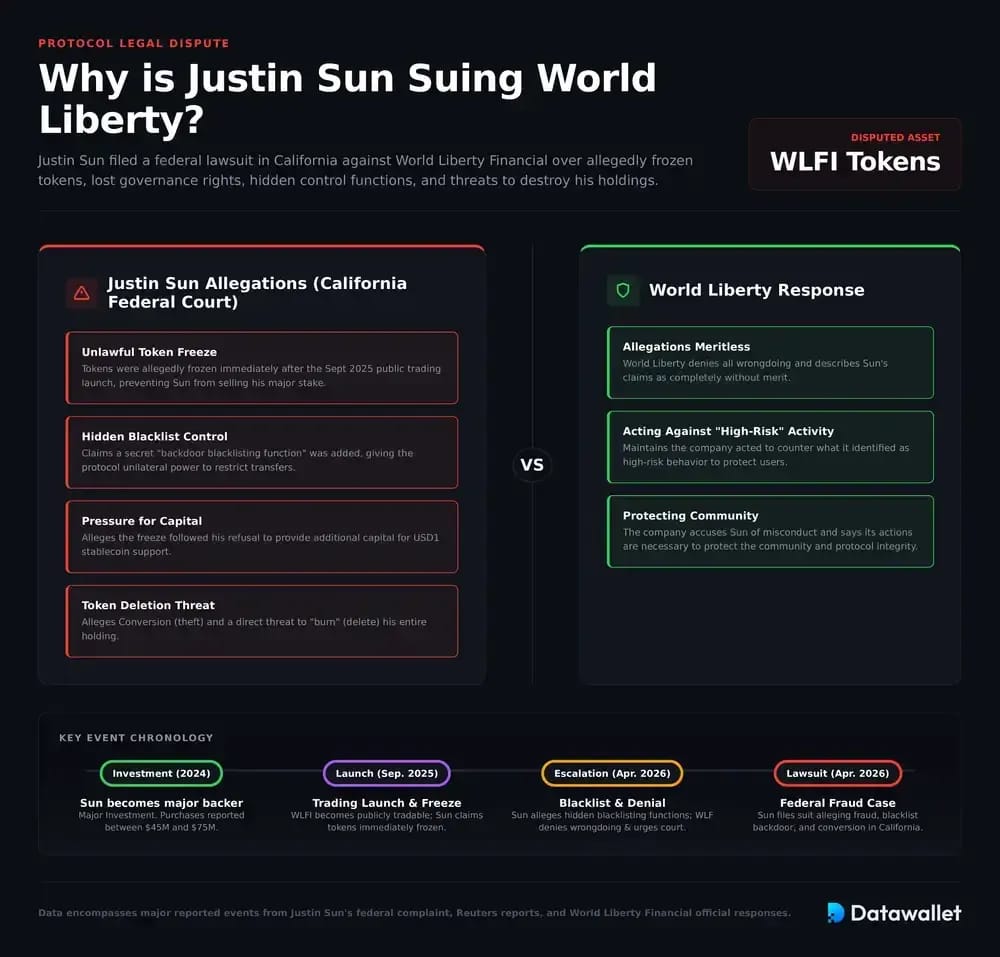
Why is Justin Sun Sueing World Liberty?
Justin Sun is suing World Liberty Financial over allegedly frozen WLFI tokens, lost governance rights, hidden blacklist controls, and threats to burn his holdings.
The dispute developed through several key events:
- Investment (2024): Sun says he bought $45 million of WLFI, while Reuters previously reported at least $75 million in purchases, making him a major backer.
- Trading Launch (Sep. 2025): WLFI became publicly tradable, but Sun claimed his tokens were “unreasonably frozen,” preventing him from selling after the token’s market debut.
- Blacklist Claims (Apr. 2026): Sun alleged World Liberty secretly added a “backdoor blacklisting function,” giving the project unilateral power to freeze or restrict token transfers.
- Escalation (Apr. 2026): World Liberty denied wrongdoing, urged Sun to take the dispute to court, and said it acted against high-risk activity.
- Lawsuit (Apr. 2026): Sun filed in California federal court, alleging fraud, breach of contract, conversion, unlawful freezing, and threatened deletion of his WLFI tokens.
- Pressure Allegation (Apr. 2026): The complaint claims World Liberty froze his tokens after he refused to provide additional capital for USD1 stablecoin-related support.
- World Liberty Response (Apr. 2026): World Liberty called Sun’s allegations meritless, accusing him of misconduct and saying the company acted to protect users and the community.
World Liberty Financial Risks
World Liberty Financial carries risks beyond normal crypto volatility, including governance concentration, regulatory scrutiny, stablecoin exposure, liquidity limits, and political-conflict concerns.
Key risks investors should understand include:
- Volatility: WLFI has traded far below its peak, making short-term holders exposed to sharp drawdowns, thin liquidity, and sentiment-driven price swings.
- Liquidity Limits: World Liberty disclosures warn that restricted transferability may reduce secondary-market liquidity, increasing volatility if many holders try to exit simultaneously.
- Governance Limits: WLFI only provides governance rights over certain protocol matters, not ownership or governance rights in World Liberty Financial LLC or affiliates.
- Smart Contracts: WLFI and USD1 rely on smart contracts that may contain bugs, hidden vulnerabilities, upgrade risks, or exploitable code despite audits and security reviews.
- Insider Control: Large allocations to founders, insiders, and early buyers may weaken community influence, especially if voting power remains concentrated despite nominal governance protections.
- Blacklist Risk: Justin Sun has alleged World Liberty installed tools to freeze token transfers, highlighting concerns around unilateral restrictions and token-holder property rights.
- Legal Disputes: Sun’s lawsuit alleges fraud, breach of contract, conversion, and threatened deletion of WLFI tokens, creating uncertainty for reputation and token governance.
- Regulatory Risk: WLFI and USD1 operate in areas regulators closely monitor, including token sales, stablecoins, disclosures, conflicts of interest, and exchange-market activity.
- Stablecoin Risk: USD1 depends on reserve quality, redemption confidence, and market trust; even temporary depegs can damage confidence in the broader ecosystem.
- Political Risk: Reuters and ethics experts have scrutinized the overlap between Trump-family crypto ventures, political power, and private financial upside.
- Counterparty Risk: Reported partnerships and exchange dependencies can create exposure to outside firms, compliance issues, reputational problems, or unexpected operational disruptions.
Final Thoughts
World Liberty Financial is one of the most visible politically linked crypto projects, combining WLFI governance, USD1 stablecoin infrastructure, DeFi markets, and Trump-family branding into a high-profile but controversial ecosystem.
Its scale, exchange access, and fundraising make it hard to dismiss, but investors should weigh token concentration, legal disputes, smart contract risks, regulatory scrutiny, and political conflicts before treating WLFI as a long-term bet.