






What Is the TRUMP Meme Coin?
Official Trump ($TRUMP) is a Solana memecoin launched on 17 January 2025, three days before Donald Trump's second inauguration, and promoted from his own X and Truth Social accounts. It was the first cryptocurrency issued under the brand of a sitting US president, and briefly one of the largest memecoins in existence.
The token is issued by Fight Fight Fight LLC, run by long-time Trump associate Bill Zanker, alongside CIC Digital LLC, an affiliate of the Trump Organization. Those entities control 80% of the 1 billion token supply and collect a fee on trading activity. Trump's stake sits in a family trust, and the project's own disclosures describe the coin as a collectible expression of support rather than an investment.
As of June 2026, $TRUMP trades around $1.65 with a circulating market cap near $390 million, down roughly 98% from its all-time high. We treat it as a case study in how political branding, insider-heavy tokenomics, and access-based marketing interact, since that combination has defined every phase of its short history.
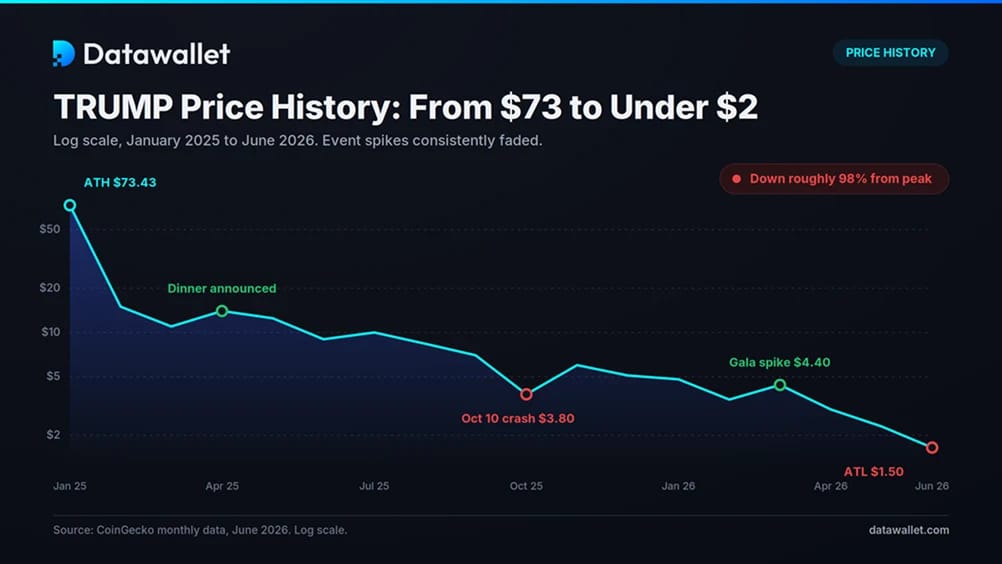
TRUMP Price History: From $73 to Under $2
$TRUMP went vertical at launch, reaching an all-time high of $73.43 on 19 January 2025 with a fully diluted valuation above $70 billion. The frenzy pushed Solana DEX volumes to record levels, and the MELANIA token launched into the same window, pulling liquidity from $TRUMP almost immediately. Within two weeks the price had fallen below $20.
The decline since then has been punctuated by event-driven spikes that consistently faded. The May 2025 holder dinner announcement roughly doubled the price before retracing. The October 2025 crypto crash dragged it to then-lows near $3.80, and by 12 March 2026 it had slid to $2.73. The Mar-a-Lago gala announcement that same day lifted it about 60% to $4.40, and the rally again unwound within weeks.
The token printed a fresh all-time low of $1.50 in June 2026. A $10,000 purchase at the peak is worth a few hundred dollars today, which has made the coin a reference point in debates about retail harm in memecoin markets.
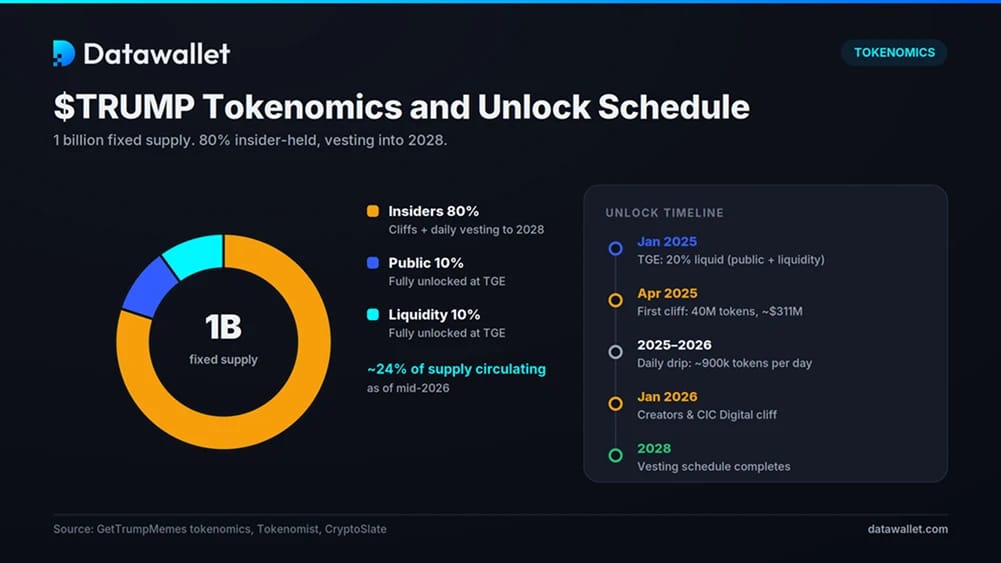
$TRUMP Tokenomics and Unlock Schedule
$TRUMP has a fixed supply of 1 billion tokens. Only 20% was liquid at launch, split between a public sale and exchange liquidity, with the remaining 80% assigned to Creators and CIC Digital allocations under cliffs and vesting that stretch into 2028.
Allocation and Unlock Structure
- Insiders (80%): Held by CIC Digital and Fight Fight Fight entities, released through staged cliffs followed by daily linear vesting.
- Public distribution (10%): Fully unlocked at the token generation event in January 2025.
- Liquidity (10%): Fully unlocked at launch to seed exchange and DEX markets.
The first insider cliff hit on 19 April 2025, releasing 40 million tokens worth about $311 million at the time, followed by a continuous daily drip. A further Creators and CIC Digital cliff landed on 18 January 2026, and by mid-2026 roughly 24% of total supply was circulating, with around 900,000 tokens still unlocking each day according to Tokenomist data.
This structure matters more than any chart pattern. Each unlocked tranche is held by entities with a near-zero cost basis, so the market prices in persistent sell pressure whether or not insiders actually sell. With the schedule running into 2028, the overhang is permanent rather than temporary.
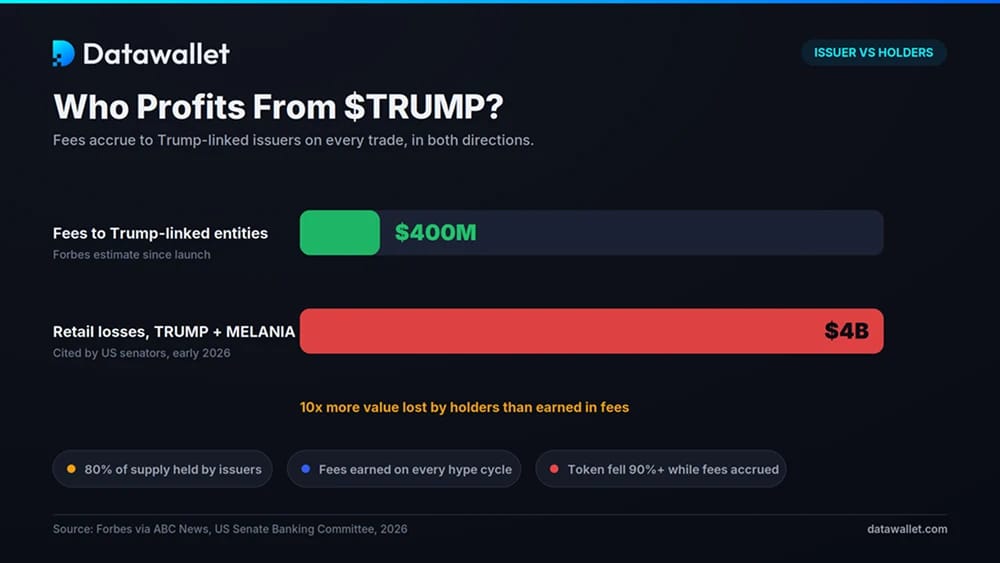
Who Profits From $TRUMP?
The economics of $TRUMP favour its issuers. Trading generates fees for the Trump-linked entities behind the token, and Forbes estimates those fees have produced close to $400 million for the president and his partners since launch, earned while the token itself fell more than 90%.
Holders have fared very differently. Analyses cited by US senators put combined retail losses across the TRUMP and MELANIA tokens at around $4 billion by early 2026, concentrated among buyers who entered during the launch spike and later event-driven rallies.
We think this asymmetry is the single most important fact about $TRUMP. The issuer earns on volume in both directions, so every hype cycle pays the team even when it destroys value for the buyers it attracts. That is not unique to this token, but no other memecoin has run the model at this scale with a head of state attached.
Holder Events: Dinners, Galas and Reward Points
With no on-chain utility, the project's main demand lever has been access to Trump himself. In May 2025, the top 220 holders attended a black-tie dinner at Trump National Golf Club in Virginia, qualifying through a public leaderboard that required roughly $148 million in combined token purchases. Justin Sun attended as the largest holder, and Trump spoke briefly and handed out watches to top participants.
The sequel arrived on 25 April 2026 at Mar-a-Lago, billed as the most exclusive crypto and business conference in the world. Entry was limited to the top 297 holders on a time-weighted leaderboard, with the top 29 receiving a VIP reception with Trump. Speakers included Cathie Wood, Tony Robbins, Mike Tyson, Tether's Paolo Ardoino, and Anthony Pompliano, and attendees received branded watches and trading cards.
The pattern around both events has been identical: an announcement-driven spike as whales accumulate to climb the leaderboard, then a fade once the snapshot passes. A teased Coin Club membership programme suggests more access campaigns are coming, but neither event produced a lasting recovery.
Revival Attempts: Tron, ETFs and a Token Treasury
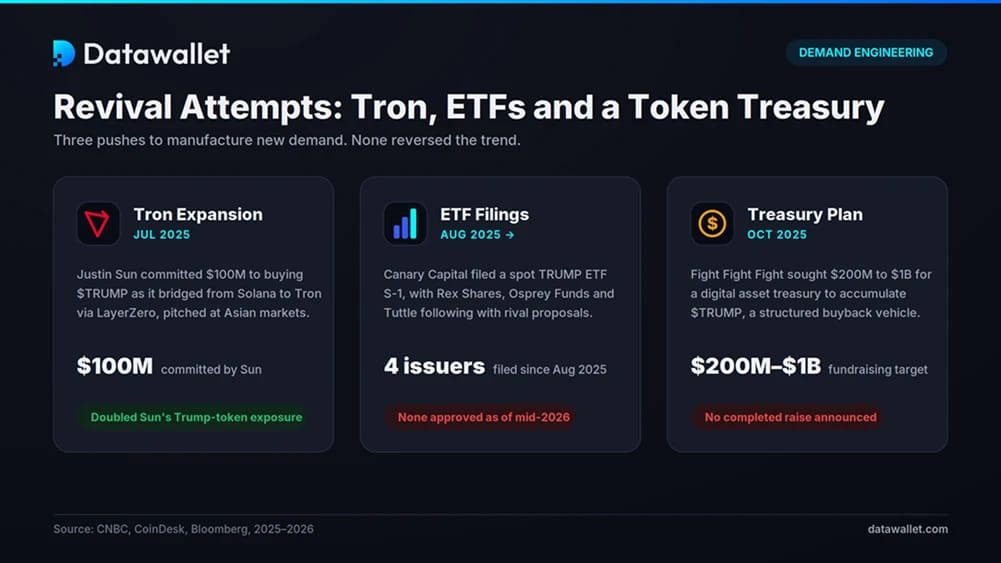
The team and its allies have made repeated attempts to engineer new demand. In July 2025, Justin Sun committed $100 million to buying $TRUMP as the token expanded from Solana to Tron via a LayerZero bridge, pitched as a distribution push into Asian markets. The purchase doubled Sun's known exposure to Trump-linked tokens but did not arrest the downtrend.
Traditional finance wrappers followed. Canary Capital filed an S-1 for a spot TRUMP ETF in August 2025, with Rex Shares, Osprey Funds, and Tuttle submitting competing proposals. None had been approved as of mid-2026, with analysts citing the absence of a regulated futures market and the token's volatility.
The most ambitious plan surfaced in October 2025, when Bloomberg reported that Fight Fight Fight was seeking $200 million to $1 billion to build a digital asset treasury company that would accumulate $TRUMP, effectively a structured buyback vehicle. No completed raise has been announced since. An earlier plan for a Trump-branded wallet collapsed in mid-2025 after a public dispute with World Liberty Financial, the Trump family's separate DeFi venture, underscoring how fragmented the wider Trump crypto ecosystem has become.
Regulation and Conflict-of-Interest Scrutiny
$TRUMP occupies an unusual regulatory position. In February 2025, the SEC's Division of Corporation Finance issued a staff statement concluding that typical memecoins are not securities, which removed the most direct federal oversight path just weeks after the token launched. The GENIUS Act, signed in July 2025, regulates stablecoins and leaves memecoins untouched.
The political response has focused on the president's personal stake. House Democrats introduced the MEME Act in February 2025, which would bar senior federal officials and their families from issuing or promoting digital assets, though it has not advanced. In April 2026, Senators Warren, Schiff, and Blumenthal opened an inquiry into the Mar-a-Lago gala, demanding records from Fight Fight Fight on Trump's role in planning and profiting from the event.
The White House maintains there is no conflict of interest because Trump's assets sit in a family-managed trust. The practical consequence for holders is that $TRUMP carries political and legislative risk no other major crypto asset has, and that risk cuts in both directions depending on who controls Washington.
How to Buy $TRUMP
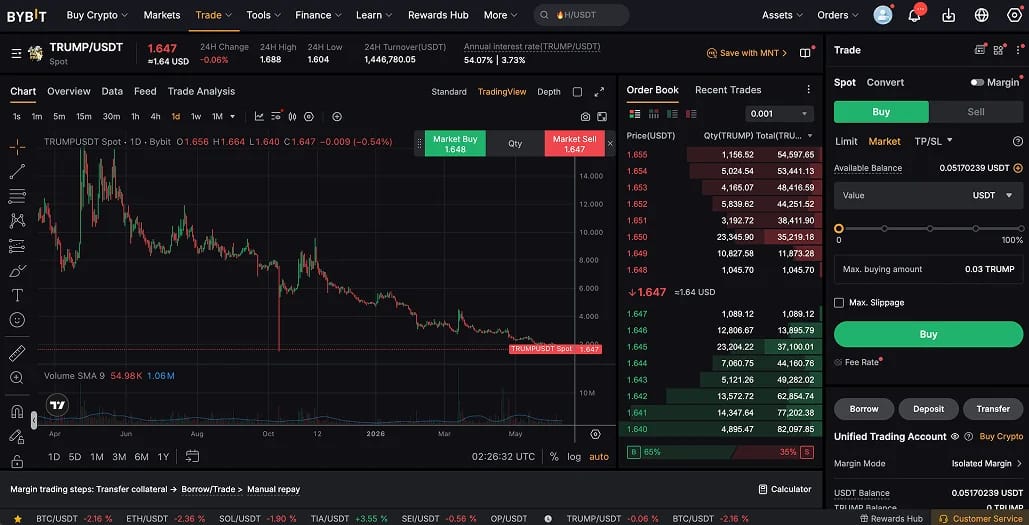
$TRUMP trades on most major exchanges, including Bybit, Coinbase, Binance, and Robinhood, alongside Solana DEXs such as Raydium and Jupiter. We use Bybit for memecoin spot trading thanks to its deep $TRUMP liquidity, 0.1% spot fees, and broad fiat support, and our full Bybit review covers how it performed in our testing.
Steps to Buy $TRUMP on Bybit
- Create an account: Sign up on Bybit and complete identity verification.
- Deposit funds: Add fiat via bank transfer or card, or deposit crypto from an external wallet.
- Find the pair: Search for TRUMP/USDT in the spot market.
- Place the order: Set your amount, review the price, and confirm the trade.
If you prefer self-custody, you can swap into $TRUMP on Solana DEXs through a wallet such as Phantom.
TRUMP Token Risks
The risk profile of $TRUMP has hardened since launch. The token sits near all-time lows with thinning liquidity, and the drivers that once produced violent rallies now generate progressively weaker bounces.
Key Risks to Weigh
- Insider supply overhang: Daily unlocks from the 80% insider allocation continue into 2028, against a shrinking pool of new buyers.
- Event dependency: Price action tracks access campaigns and Trump-related headlines, including health rumours, rather than anything fundamental.
- Key-person risk: The token's premise expires with Trump's political relevance, and his second term ends in January 2029.
- Realised drawdown: A 98% fall from the high is the recorded outcome to date, not a hypothetical scenario.
We would treat any allocation here as speculation on political news cycles, sized so a total loss is acceptable. For broader exposure to the sector, our ranking of the best meme coins covers tokens with stronger liquidity and distribution.
Final Thoughts
$TRUMP set the template for political memecoins and then demonstrated why the model concentrates gains with issuers and losses with buyers. Fee revenue near $400 million against roughly $4 billion in retail losses is the defining ledger of its first eighteen months.
The token will likely keep producing tradeable spikes for as long as Trump headlines move markets and the team runs access campaigns. As a hold, the structure works against you: a multi-year insider unlock, no utility, and demand that decays between events. We see no reason that changes before vesting completes in 2028.
.webp)