


Who is Sam Bankman-Fried?
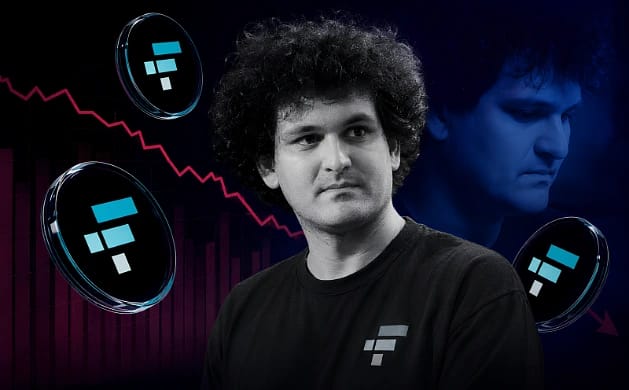
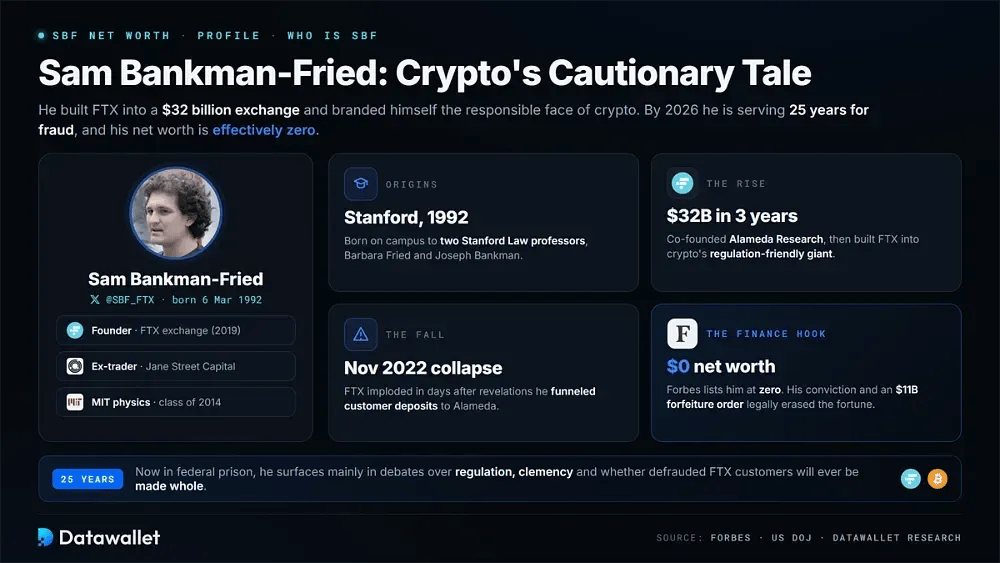
Sam Bankman-Fried, widely known by his initials SBF, is an American entrepreneur and former billionaire who founded the cryptocurrency exchange FTX and the trading firm Alameda Research. Once celebrated as a wunderkind of the industry, his reputation collapsed after revelations of large-scale financial misconduct in late 2022.
Educated at MIT and shaped by the effective altruism movement, he built FTX into a $32 billion exchange in just a few years while cultivating an image as the responsible, regulation-friendly face of crypto that set him apart from the industry's wilder actors.
By 2026, his story functions as the industry's defining cautionary tale. He is now serving a 25-year sentence, his companies are being unwound in bankruptcy court, and his name surfaces mainly in debates over crypto regulation, clemency, and whether defrauded FTX customers will ever be made whole.
What still draws scrutiny is the gap between the fortune he claimed to be giving away and where the money actually went. The billions he moved through Alameda funded venture bets, real estate, and political donations, spending that turned his altruistic branding into a central irony of the case.
Sam Bankman-Fried's Background
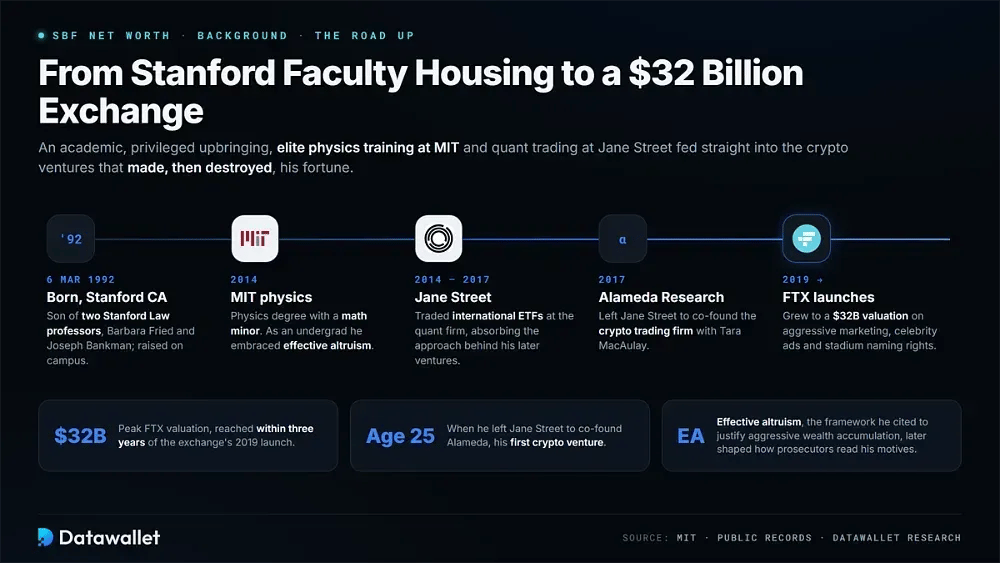
Bankman-Fried's path runs from an academic, privileged California upbringing through elite physics training at MIT and quantitative trading at Jane Street, into the crypto ventures that made and then destroyed his fortune.
Early Life and Education
Born on March 6, 1992, in Stanford, California, SBF is the son of two Stanford Law School professors, Barbara Fried and Joseph Bankman. He attended the Massachusetts Institute of Technology, graduating in 2014 with a degree in physics and a minor in mathematics.
While at MIT, he embraced effective altruism, a philosophy that uses evidence and reason to maximize one's positive impact. That framework, which he cited to justify aggressive wealth accumulation, later became central to how prosecutors and the public interpreted his motives and spending.
Professional Career
After college, Sam joined Jane Street Capital, a global proprietary trading firm, where he traded international exchange-traded funds and absorbed the quantitative approach that shaped his later ventures. He left in 2017 to co-found Alameda Research with Tara MacAulay.
Two years later, in 2019, he launched FTX, a cryptocurrency exchange that grew rapidly to a $32 billion peak valuation. FTX became known for aggressive marketing, celebrity endorsements, and stadium naming rights, positioning SBF as the acceptable, regulation-friendly face of crypto.
The FTX Collapse
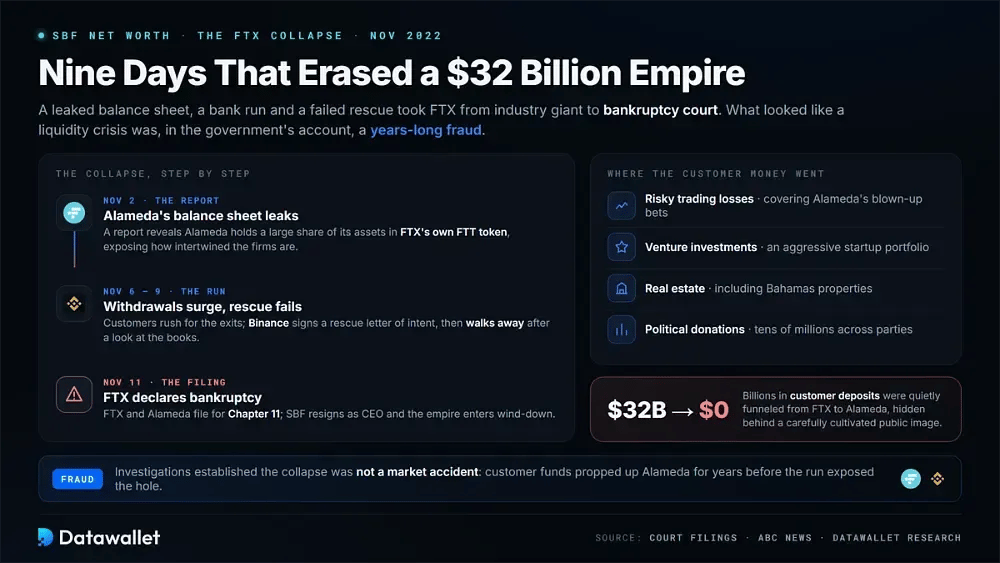
In November 2022, a report revealed that Alameda held a large share of its assets in FTX's own FTT token, raising alarm about how intertwined the two firms were. A wave of customer withdrawals and a failed rescue by Binance triggered FTX's bankruptcy filing on November 11, 2022.
Investigations quickly established that SBF had funneled billions in customer deposits from FTX to Alameda, covering risky trading losses, venture bets, real estate, and political donations. What looked like a liquidity crisis was, in the government's account, a years-long fraud hidden behind a carefully cultivated public image.
Sam Bankman-Fried's Net Worth in 2026
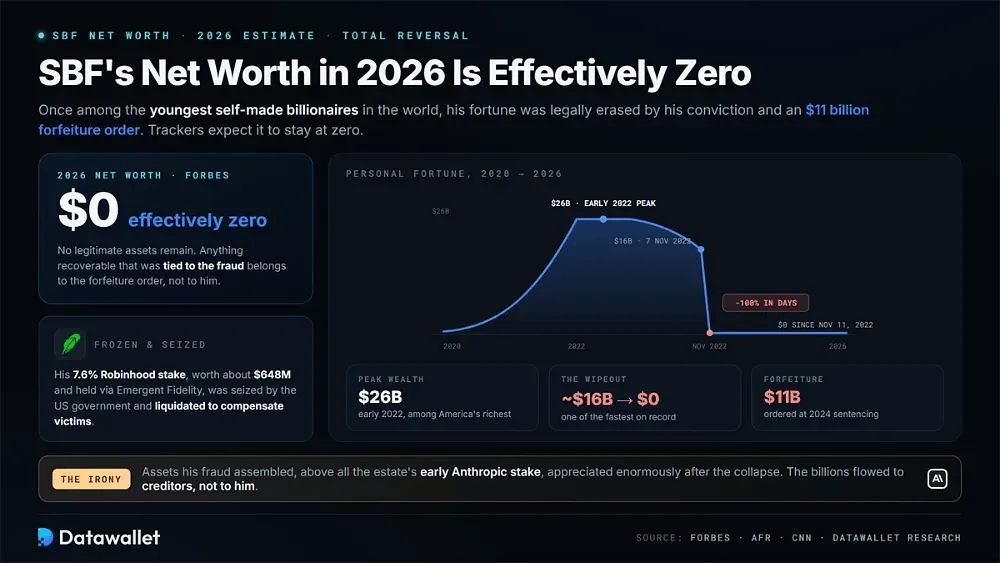
Sam Bankman-Fried's net worth in 2026 is effectively zero, according to Forbes, a total reversal from the fortune that once made him one of the youngest self-made billionaires in the world. His wealth was legally erased by his conviction and an $11 billion forfeiture order.
The collapse of his fortune breaks down across a few key stages:
- Peak wealth: In early 2022, his stakes in FTX and Alameda gave him a personal fortune around $26 billion, briefly ranking him among America's richest people.
- Single-day wipeout: As FTX imploded in November 2022, his net worth fell from roughly $16 billion to effectively nothing, one of the fastest destructions of personal wealth on record.
- Forfeiture order: His 2024 sentencing required him to forfeit about $11 billion, formally stripping any recoverable assets tied to the fraud.
- Frozen assets: Holdings like his Robinhood stake were seized by the government and liquidated to help compensate victims rather than benefit him.
- Current status: With no legitimate assets and a long prison term, trackers now list his net worth at zero, where it is expected to remain for the foreseeable future.
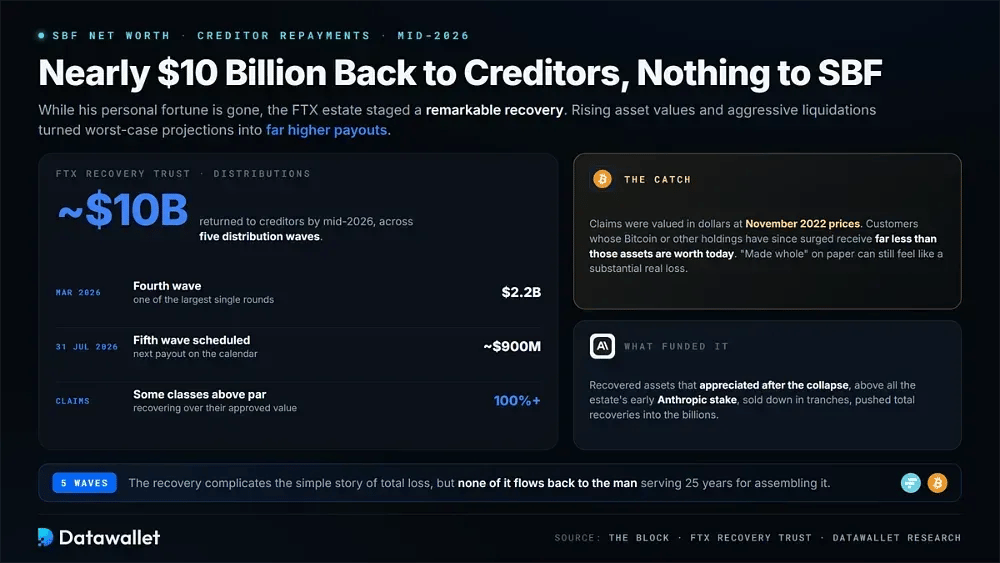
The irony threaded through the bankruptcy is stark. Many assets the estate recovered, most notably its early stake in AI developer Anthropic, appreciated enormously after the collapse, meaning the fraud's wreckage generated billions in value that flowed to creditors instead of the man who assembled it.
SBF's Investment Portfolio
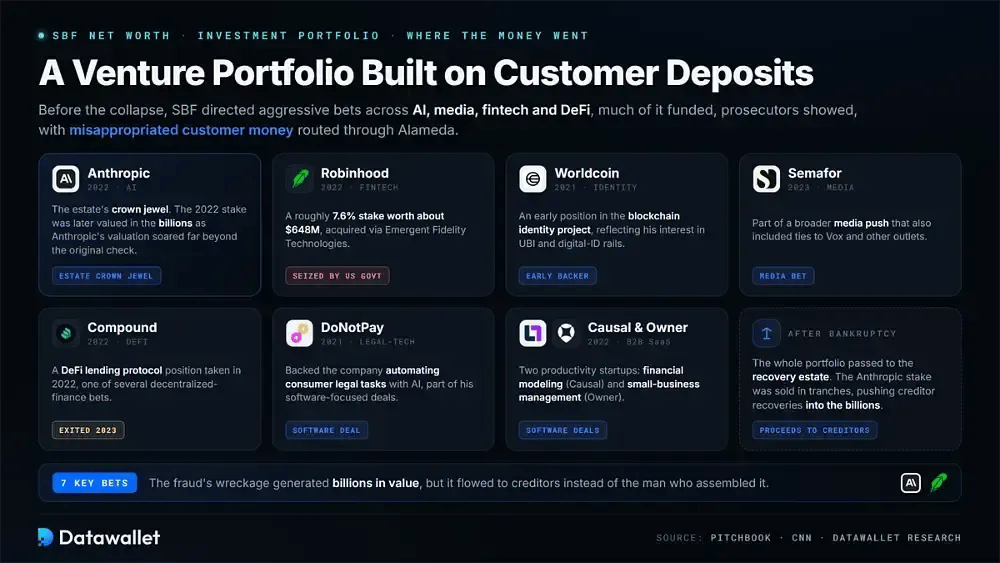
Before his downfall, Sam Bankman-Fried directed an aggressive venture portfolio spanning AI, media, fintech, and DeFi, much of it funded with what prosecutors later showed were misappropriated customer deposits routed through Alameda Research.
His most notable investments included:
- Anthropic: A 2022 stake in the AI firm that became the estate's crown jewel, later valued in the billions as Anthropic's valuation soared far beyond the original check.
- Robinhood: A roughly 7.6% stake worth about $648 million, acquired via Emergent Fidelity Technologies and later seized by US authorities.
- Worldcoin: An early 2021 position in the blockchain identity project, reflecting his interest in universal basic income and digital-ID infrastructure.
- Semafor: A 2023 investment in the news startup, part of a broader push into media that also included ties to Vox and other outlets.
- Compound: A DeFi lending protocol position taken in 2022 and exited in 2023, one of several decentralized-finance bets across the portfolio.
- DoNotPay: A legal-tech company automating consumer legal tasks with AI, backed in 2021 as part of his software-focused deals.
- Causal and Owner: Two business-productivity software startups backed in 2022, aimed at financial modeling and small-business management respectively.
Following FTX's bankruptcy, this portfolio passed into the hands of the recovery estate. The Anthropic stake in particular has been sold down in tranches, with proceeds helping push total creditor recoveries into the billions.
Sam Bankman-Fried's Donations
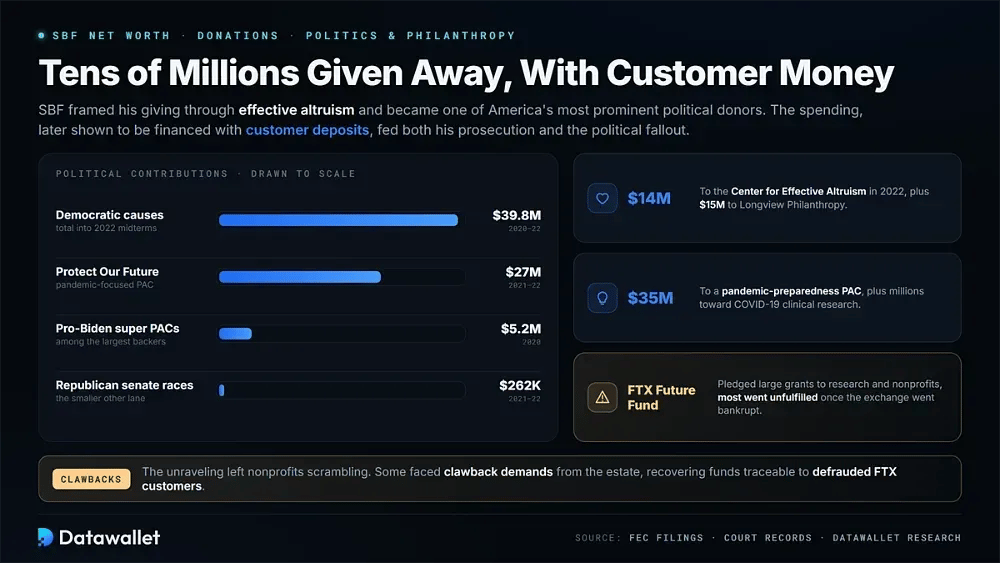
SBF was once one of the most prominent political donors in the United States, framing his giving through effective altruism. The scale of that spending, later shown to be financed with customer money, became a major thread in both his prosecution and the political fallout.
Political Contributions
- 2020 elections: He donated $5.2 million to super PACs supporting Joe Biden, making him one of that campaign's largest individual backers.
- 2021-2022 giving: He contributed roughly $27 million to the Protect Our Future PAC while also directing about $262,200 to Republican senate campaigns.
- Total Democratic support: His contributions to Democratic causes reached nearly $39.8 million heading into the 2022 midterms before FTX collapsed.
Philanthropic Endeavors
- Effective altruism: In 2022 he gave around $14 million to the Center for Effective Altruism and $15 million to Longview Philanthropy.
- FTX Future Fund: This vehicle pledged large grants to research and nonprofits, most of which went unfulfilled once the exchange went bankrupt.
- Pandemic prevention: He backed pandemic-preparedness efforts, including about $35 million to a related PAC and millions toward COVID-19 clinical research.
The unraveling of these pledges left many nonprofits scrambling, and some faced clawback demands from the estate seeking to recover funds ultimately traceable to defrauded FTX customers.
Why Did SBF Go to Jail?
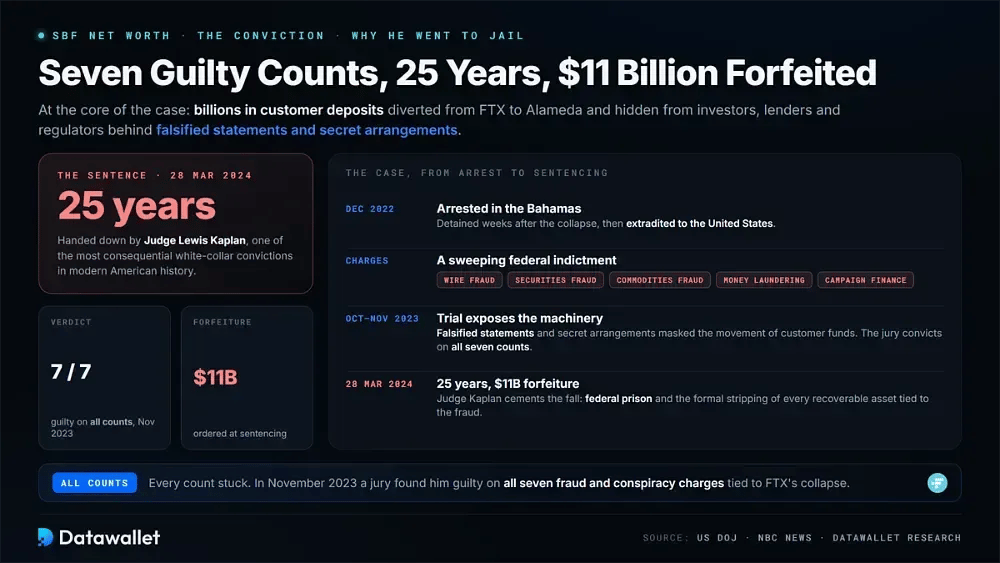
Sam Bankman-Fried was sentenced to prison after being convicted on multiple counts of fraud and conspiracy tied to FTX's collapse. At the core of the case was his diversion of billions in customer deposits to Alameda Research, hidden from investors, lenders, and regulators.
He was arrested in the Bahamas in December 2022 and extradited to the United States, where prosecutors charged him with wire fraud, securities fraud, commodities fraud, money laundering, and campaign-finance violations. His trial exposed falsified statements and secret arrangements designed to mask the movement of funds.
In November 2023, a jury found him guilty on all seven counts. On March 28, 2024, Judge Lewis Kaplan sentenced him to 25 years in federal prison and ordered $11 billion in forfeiture, cementing one of the most consequential white-collar convictions in modern American history.
SBF's Appeal and Pardon Timeline
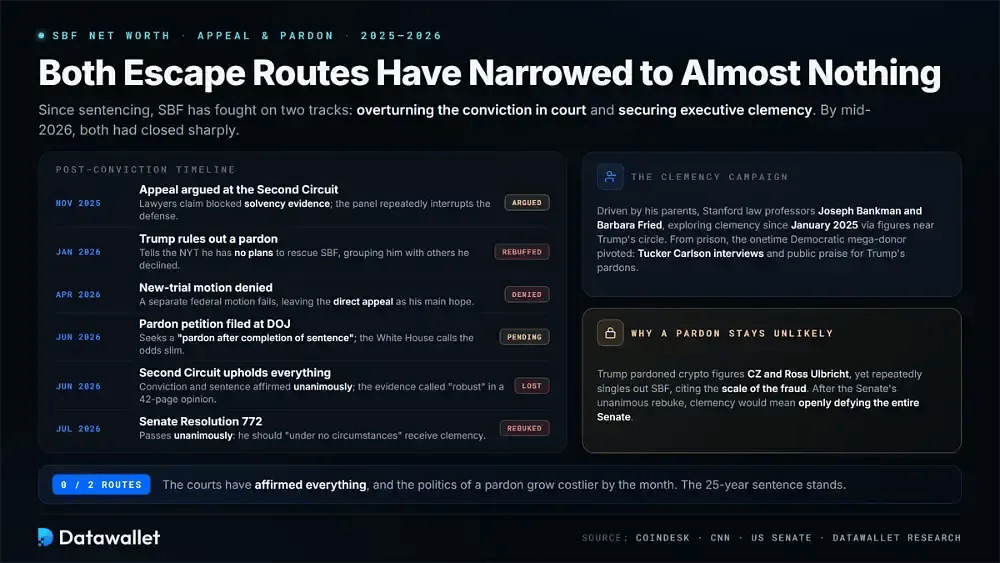
Since his sentencing, Bankman-Fried has pursued two parallel escape routes: overturning his conviction in court and securing executive clemency. By mid-2026, both paths had narrowed sharply, even as his family and allies intensified their public campaign.
The key milestones in his post-conviction fight include:
- Nov 2025 appeal: His lawyers argued before the Second Circuit that Judge Kaplan wrongly blocked evidence FTX was solvent, but the panel repeatedly interrupted the defense.
- Jan 2026 rejection: President Trump told the New York Times he had no plans to pardon SBF, grouping him with other high-profile figures he declined to consider.
- Apr 2026 motion denied: A separate federal motion for a new trial was rejected, closing another avenue and leaving the direct appeal as his main hope.
- Jun 2026 appeal loss: The Second Circuit upheld his conviction and sentence, calling the government's evidence "robust" in a unanimous 42-page opinion.
- Jun 2026 pardon filing: Days earlier, he formally filed a DOJ petition for a "pardon after completion of sentence," which the White House said had slim odds.
- Jul 2026 Senate rebuke: The Senate unanimously passed Resolution 772, stating he should "under no circumstances" receive clemency.
The Family's Clemency Campaign
The pardon push has been driven heavily by SBF's parents, Stanford law professors Joseph Bankman and Barbara Fried, who Bloomberg reported began exploring clemency avenues as early as January 2025. Their outreach reportedly included figures connected to Trump's inner circle.
The campaign also featured a notable public pivot for a onetime major Democratic donor. From prison, SBF gave interviews to conservative media, including Tucker Carlson, and publicly praised Trump's pardons of other figures, signaling a clear attempt to realign himself with the administration.
Why a Pardon Remains Unlikely
Despite the effort, the political barriers are steep. Trump has pardoned other crypto figures, including former Binance chief CZ and Silk Road's Ross Ulbricht, yet has repeatedly singled out SBF as someone he will not help, citing the scale of the fraud.
The bipartisan Senate resolution, led by Cynthia Lummis and Ruben Gallego, added rare political consensus against clemency. While it carries no legal force, granting SBF relief would now mean openly defying the entire Senate, a cost that makes an already unlikely pardon even harder to justify.
Where Do FTX Creditor Repayments Stand?
While SBF's personal fortune is gone, the FTX estate has staged a remarkable recovery for creditors, an outcome that complicates the simple narrative of total loss. Rising asset values and aggressive liquidations turned early worst-case projections into far higher payouts.
By mid-2026, the FTX Recovery Trust had returned nearly $10 billion to creditors across five distributions, including a $2.2 billion round in March and a roughly $900 million round scheduled for July 31. Some claim classes are recovering more than 100% of their approved value.
There is a big catch, however. Claims were valued in US dollars at November 2022 prices, so customers whose Bitcoin or other holdings have since surged receive far less than those assets are worth today. For many, "made whole" on paper still feels like a substantial real loss.
Final Thoughts
Sam Bankman-Fried's fall from a peak net worth around $26 billion in early 2022 to zero by 2026 remains one of the starkest cautionary tales in financial history, a reminder of how quickly unchecked ambition and misused trust can unravel.
His 2026 losses in court and the Senate suggest the door on early freedom is closing. The appeal is exhausted at the panel level, a pardon faces both presidential and legislative opposition, and his projected release date sits around 2044, when the crypto industry he helped popularize may be unrecognizable.
What endures is the lesson beneath the numbers. For founders and investors alike, SBF's story underscores that transparency, genuine custody of customer funds, and ethical leadership are not optional extras but the foundation on which any lasting financial institution, crypto or otherwise, must be built.