






About Bybit
Ben Zhou co-founded Bybit in 2018 as a perpetuals specialist and remains its CEO. The company relocated its headquarters from Singapore to Dubai in 2022, though derivatives still sit at the heart of the platform. CoinGecko ranks it second among centralized exchanges, with reported open interest exceeding $11 billion.
Bybit has since expanded far beyond leveraged crypto. Its Unified Trading Account brings spot, margin, perpetuals, and options under one collateral pool. Users also get trading bots, copy trading, Earn products, lending and borrowing services, a P2P desk, OTC trading, Bybit Pay, and the Bybit Card.
The company changed considerably during the past 18 months. It covered the largest theft in crypto history without suspending withdrawals, gained licenses across the EEA, the UAE, and India, then expanded into stock, gold, and forex trading.
Bybit Features
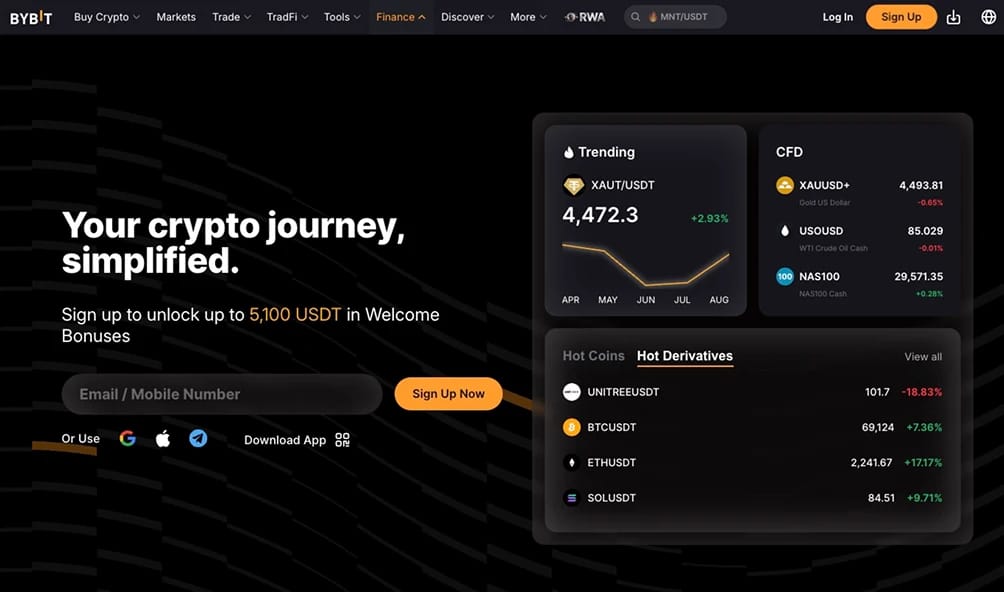
Execution speed shapes much of Bybit’s design. During our tests, major-pair orders filled without meaningful slippage. Margin settings, funding data, and open positions remain one tap apart inside the trading terminal.
Trading Types
The platform accommodates everything from straightforward spot purchases to portfolio-margined options, using a shared collateral pool.
- Spot trading: The main order book carries around 640 pairs. Fiat markets such as BTC/EUR follow a separate, slightly higher fee schedule.
- Margin trading: Users can borrow against their collateral to increase spot exposure. Liquidation begins when the account reaches its maintenance margin threshold.
- Perpetual contracts: Roughly 740 derivatives pairs use USDT, USDC, or coin-margined collateral. Our Bybit Futures review examines leverage tiers, funding mechanics, and contract specifications in detail.
- Expiry futures: Dated contracts are available alongside perpetuals for traders seeking a fixed settlement date.
- Options: European-style, cash-settled calls and puts trade through a USDC desk. Outside Deribit, it is one of the few retail options venues with genuine depth.
- Copy trading and bots: Users can follow vetted lead traders or automate execution with Spot Grid, Futures Grid, and DCA bots.
- Demo mode: The simulated trading environment tracks live prices, allowing users to practice strategies and order types without risking capital.
Earn Options
Bybit Earn ranges from principal-stable savings to structured products whose final payout depends on price direction.
- Easy Earn: Flexible USDT plans listed base rates near 3% APR when we checked, with fixed terms running from 2 to 90 days at higher yields. Promotional tiers advertising 100%+ apply only to the first couple of hundred dollars, so blended returns on larger balances sit far lower.
- On-Chain Earn: Staking routed to underlying protocols paid roughly 3% on ETH and up to about 7.5% on assets such as SOL, from a 0.1 coin minimum, with a protocol service fee of around 1% deducted from rewards. Model any advertised rate through our crypto staking calculator first.
- Launchpool: Staking MNT, USDT, or other supported tokens during a campaign window earns allocations of new listings, with rewards proportional to your share of the pool.
- Dual Asset: A short-dated structure pays an elevated yield, and at expiry you receive whichever of two assets the price outcome dictates. Quoted APRs can run into triple digits precisely because the principal is not protected.
- Crypto Loans: Overcollateralized borrowing releases liquidity from holdings without a sale, on flexible or fixed-rate terms with hourly interest accrual.
- Liquidity Mining: Depositors earn a share of swap fees on pools such as BTC/USDC and ETH/USDT, with advertised APRs reaching roughly 10% to 20% and optional leverage of up to 5x that adds liquidation risk.
Additional Services
- Convert: Instant swaps settle at a quoted rate, while limit mode waits for a selected target price. Costs are built into the spread, making the order book cheaper for larger trades.
- P2P marketplace: Buyers and sellers transact in local currencies using 80+ payment methods. Escrow holds the crypto until payment is confirmed.
- Web3 wallet: The in-app seed-phrase wallet provides self-custody access to on-chain applications without requiring a separate browser extension.
- OTC desk: Large trades settle away from the public order book at quoted prices, reducing the risk of moving the market.
- Bybit Pay: Funds move instantly between Bybit accounts and can be spent at partner merchants. Payments earn the same reward points as the card.
- Islamic Account: A dedicated Shariah-compliant subaccount removes interest entirely and limits trading to around 75 vetted tokens on spot, plus DCA and Spot Grid bots. Certified by CryptoHalal and ZICO Shariah, it inherits your main account's fee tier.
.webp)
Bybit TradFi and RWA Products
Bybit’s biggest product shift this year has been its expansion beyond crypto. The dedicated RWA portal brings together four traditional-asset products, while our Bybit TradFi guide explains how each works.
- TradFi Perpetuals: Launched in April, these USDT-settled contracts track US stocks, ETFs, gold, silver, and crude oil around the clock. Leverage reaches 10x, with margin drawn from the same Unified Trading Account used for crypto positions.
- Bybit TradFi CFDs: This MetaTrader 5 brokerage is operated through Mauritius-licensed Infra Capital. It lists 380+ stock CFDs, along with forex, indices, and commodities. Leverage reaches 500x, and zero-commission campaigns run periodically.
- xStocks: Tokenized shares in companies such as Tesla and Nvidia trade on Bybit Spot. They provide unleveraged exposure backed by custodied shares. Competing platforms appear in our ranking of the best tokenized stock trading exchanges.
- Tokenized gold: XAUT and PAXG are available on Spot. A yield product introduced in March also pays interest on XAUT holdings without removing their gold price exposure.
These products do not provide share ownership, dividends, or voting rights. Leveraged versions also carry liquidation risk when the underlying market is closed, and liquidity becomes thinner.
.webp)
What is Mantle (MNT)?
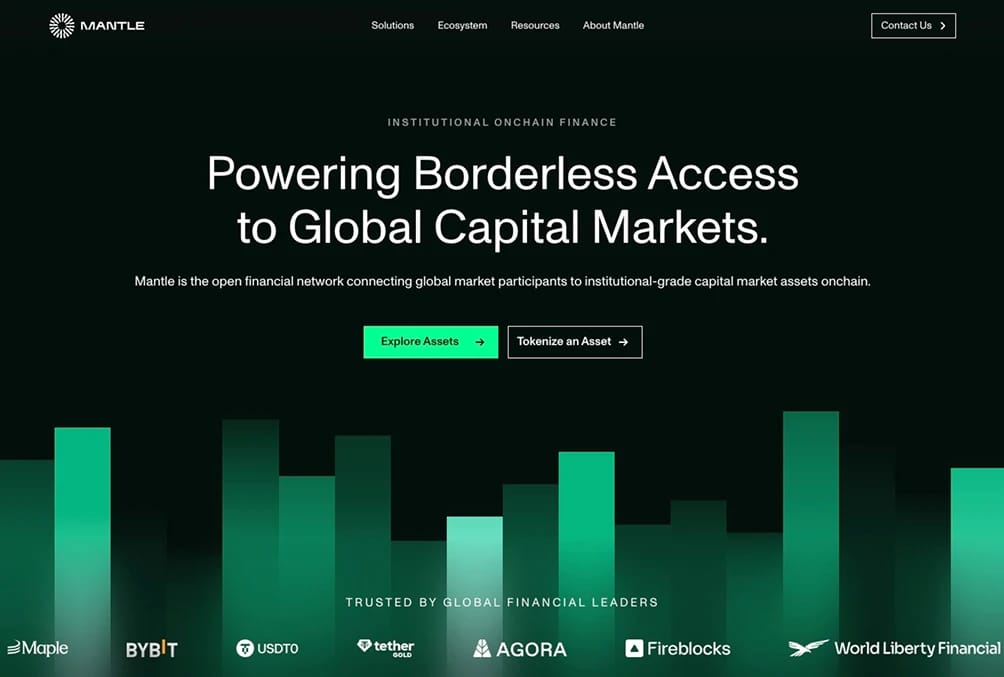
Mantle (MNT) is closely integrated with Bybit and powers several of the exchange’s discounts. The project started as BitDAO, a treasury DAO launched in 2021 with backing from Bybit, Pantera, and Dragonfly. In May 2023, a governance vote renamed the project Mantle and converted BIT into MNT at a 1:1 ratio.
Today, Mantle operates an Ethereum Layer 2 and appears among our picks for the best Layer 2 cryptos. MNT is used for gas payments and governance. The wider ecosystem includes the mETH liquid staking protocol, FBTC wrapped Bitcoin, and the MI4 institutional index fund, supported by a community treasury worth roughly $1.9 billion.
A joint roadmap announced in 2025 strengthened the relationship with Bybit. Two Bybit executives became strategic advisors to Mantle, while MNT gained a larger role across the exchange. It now has four main uses:
- Fee discounts: Paying spot trading fees in MNT reduces the charge by 25%, on top of any applicable VIP rate.
- Cheaper VIP access: MNT receives preferential treatment when Bybit calculates VIP thresholds. A holder can reach VIP 1 with about one-third less capital than would be required using mixed assets.
- Launchpool and Earn: MNT regularly appears as a staking asset for new token distributions and has dedicated Earn products.
- Card and Pay: Users can receive cashback in MNT or spend the token through Bybit Pay and the Bybit Card.
Both sides benefit from the relationship. Bybit users receive measurable savings from MNT, while Mantle gains access to the exchange’s order books and 80 million accounts, giving it distribution unmatched by rival Layer 2 projects. These benefits do not remove market risk. MNT remains a volatile altcoin, and its price can move independently of the discounts available to holders.
Is Bybit Regulated?
Bybit operates through separate regional entities, each subject to different licenses and product restrictions. Although the branding remains consistent, the legal counterparty and available protections depend on the entity used to open the account.
- European Economic Area: Bybit EU GmbH secured CASP authorization under MiCA from Austria’s FMA in May 2025, with permission to passport its services across the EEA. The global platform stopped serving EEA residents when the MiCA transition ended on 1 July, leaving bybit.eu as the only compliant version.
- United Arab Emirates: Bybit became the first exchange awarded a full Virtual Asset Platform Operator license by the Securities and Commodities Authority. The approval covers trading, brokerage, and custody throughout the UAE mainland.
- Kazakhstan and Georgia: An AFSA license authorizes trading and custody in the Astana financial center. In Georgia, Bybit operates under a National Bank registration covering the Caucasus.
- United Kingdom and India: Bybit returned to both countries after earlier departures. Its UK relaunch took place in December 2025 through a partnership with Archax, an FCA-authorized digital securities firm. Indian services resumed after the exchange registered with the Financial Intelligence Unit.
Its withdrawals from other markets are equally important. Bybit is closing Japanese accounts to meet FSA requirements, and Singapore’s MAS placed the exchange on its Investor Alert List in June. The United States, Canada, Hong Kong, and mainland China also remain restricted. Our Bybit restricted countries page tracks all 14 blocked jurisdictions.
.webp)
Bybit Global vs Bybit’s Local Platforms
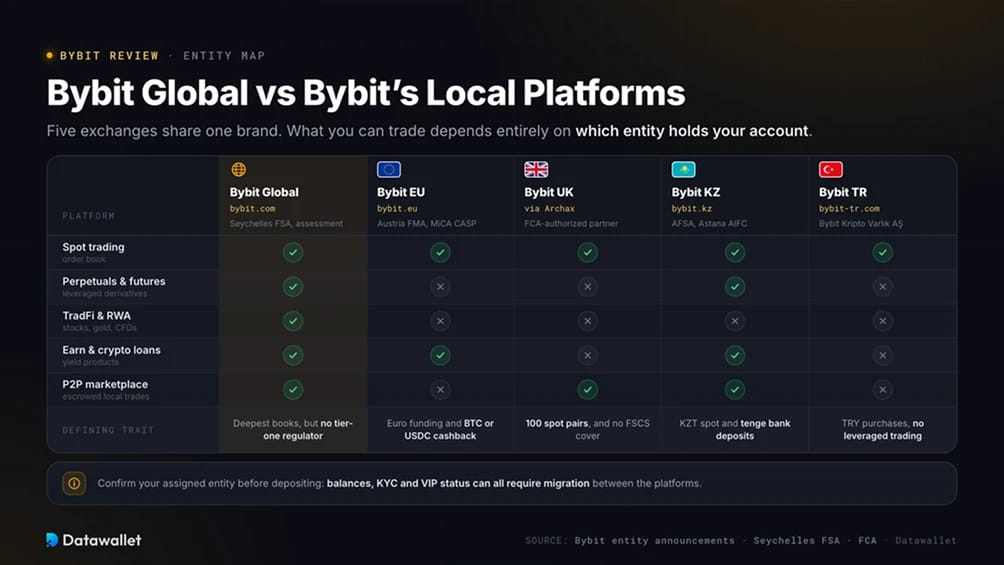
Bybit’s brand covers separate regional exchanges, sometimes with dedicated apps. The regulation section identifies each supervisor and compares the products available to residents.
- Bybit Global (bybit.com): The global platform carries perpetuals, options, TradFi, Earn, P2P, and copy trading. Its operator, Bybit Technology Limited, appears on the Seychelles FSA register with “Assessment” status, leaving the exchange without tier-one supervision.
- Bybit EU (bybit.eu): The Vienna platform covers the EEA, excluding Malta, and requires a separate account with fresh KYC. It provides spot, margin, Earn, euro funding, and card cashback in BTC or USDC. Futures and options remain unavailable while Bybit X’s MiFID II application is pending.
- Bybit UK: The Archax-backed relaunch provides 100 spot pairs and P2P. Retail crypto derivatives remain banned, while the FCA confirms that most crypto services lack FSCS and Financial Ombudsman protection.
- Bybit KZ (bybit.kz): The AFSA-licensed Astana exchange most closely matches Bybit Global, offering spot, derivatives, margin, crypto loans, and Earn. Local services include KZT/USDT spot trading, tenge deposits through Bank CenterCredit, and regulated P2P settlement through Halyk Bank. Support is available in Kazakh and Russian.
- Bybit TR (bybit-tr.com): Bybit TR operates through Bybit Kripto Varlık Alım Satım Platformu AŞ, formerly Narkasa. The platform focuses on spot trading, TRY purchases, and domestic bank transfers. Its user agreement prohibits leveraged trading, excluding the perpetuals, options, and TradFi products available on Bybit Global.
Confirm your assigned entity before depositing. Balances, KYC, and VIP status may require migration between platforms, as EEA customers experienced when Bybit Global began restricting regional access in July.
Is Bybit Safe?
Bybit passed the most severe solvency test faced by any crypto exchange. Its response supports cautious confidence, but we still treat the platform as a trading account rather than a vault and keep only the capital required for open positions.
Hacken has verified Bybit’s monthly Proof of Reserves assessments since June 2024. Every published snapshot, including those during and after the hack, has shown customer liabilities backed above 100% for major assets.
The 2025 Cold Wallet Hack
Attackers stole roughly $1.5 billion in ETH from a Bybit cold wallet on 21 February 2025, making it the largest single crypto theft on record. Forensic work traced the attack to a compromised developer machine at Safe, Bybit’s third-party multisig provider. Injected code displayed a routine transfer to Bybit’s signers while secretly changing control of the wallet.
Withdrawals remained open throughout the crisis. Purchases, loans, and backing from Galaxy Digital, FalconX, and Wintermute replaced the ETH shortfall within 72 hours, and customers did not lose funds. Investigators linked the attack to Lazarus, North Korea’s state-backed hacking group.
Recovery efforts continued into 2026. The LazarusBounty program has paid millions to analysts whose work helped freeze more than $73 million. In August, Bybit sued North Korea, its intelligence bureau, and Lazarus in a US federal court and obtained an injunction freezing identified stolen assets.
Account Safety Measures
For most users, account takeover presents the more immediate threat. We activate each of these controls before depositing:
- Passkeys and 2FA: Device-bound passkeys and authenticator codes protect account access and sensitive actions.
- Fund password: A separate credential must be entered for withdrawals, even if an attacker gains access to the main login.
- Anti-phishing code: A personal phrase appears in every legitimate Bybit email, making forged messages easier to identify.
- Withdrawal address controls: Newly added addresses are temporarily locked, while an allowlist limits transfers to previously approved wallets.
- Device review: Regularly removing outdated devices prevents old sessions from remaining active.
.webp)
Bybit User Reviews
User feedback differs sharply between the trading product and customer support. Ratings for the app are strong, while complaints on Trustpilot often focus on compliance checks and dispute handling.
- Trustpilot: Around 7,100 reviews produce an average score of 3.2/5. Common complaints include accounts frozen during compliance reviews, slow P2P dispute resolution, and scripted support responses.
- Apple App Store: Approximately 46,000 ratings average 4.7/5, with users frequently praising execution speed and the interface.
- Google Play: More than 1.39 million reviews average 4.5/5, and the app has surpassed 10 million installs.
Our experience aligns more closely with the mobile ratings. Orders execute quickly, the terminal is logically organized, and deposits usually arrive within minutes. Trustpilot’s record still warrants caution. Complete verification early and test a small withdrawal before depositing a larger amount, particularly outside licensed regions where no regulator backs disputes with the offshore entity.
Bybit Fee Schedule
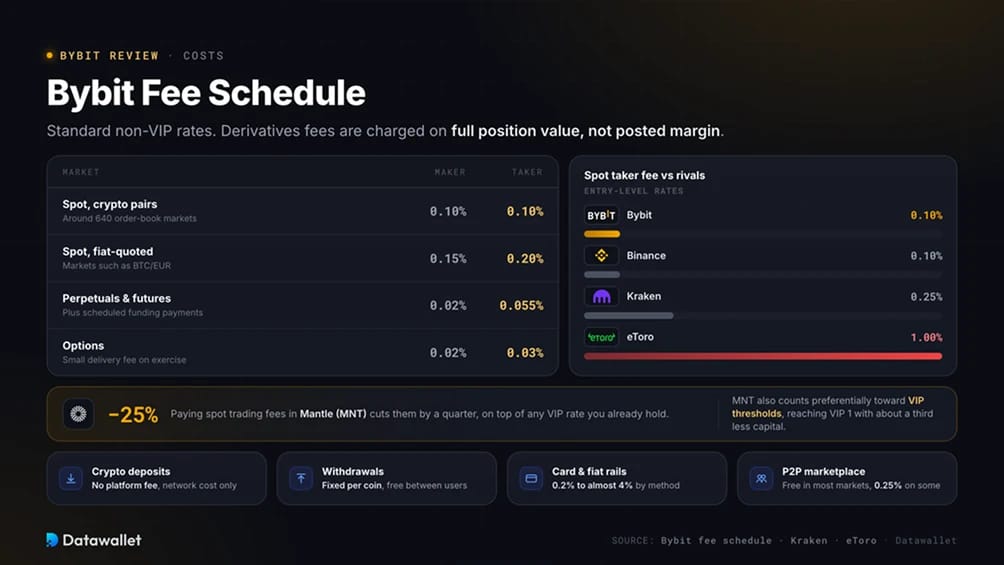
Bybit charges trading fees, funding payments, withdrawal fees, and spreads. The rates below are standard non-VIP prices. Its official fee structure reduces them progressively across the VIP tiers.
Spot and Derivatives Fees
- Spot: Makers and takers pay 0.10% on crypto pairs. Fiat-quoted markets begin at 0.15% maker and 0.20% taker.
- Perpetuals and futures: Fees start at 0.02% for makers and 0.055% for takers, based on the full position value rather than posted margin. Long and short positions exchange scheduled funding payments, which can exceed trading fees when positions remain open for weeks.
- Options: Makers pay 0.02%, and takers pay 0.03%. A small delivery fee applies when contracts are exercised.
- TradFi products: Bybit introduced a reduced fee schedule for TradFi Perpetuals in June. The CFD platform charges spreads or commissions according to the selected account mode.
Paying spot fees in Mantle (MNT) reduces them by 25%. MNT holdings also lower the balance requirements for VIP tiers, as explained in our Bybit VIP levels guide. Whether an order is classified as maker or taker often matters more than the discount.
Deposits, Withdrawals and P2P
- Crypto deposits: Bybit does not charge a deposit fee, though the sending network may impose one.
- Withdrawals: Each coin and network has a fixed fee displayed before confirmation. Transfers between Bybit users are free.
- Fiat rails: Card and payment-provider deposit fees range from about 0.2% to nearly 4%, depending on the method and currency.
- P2P: Most markets carry no platform fee. Selected fiat currencies incur a 0.25% charge on completed orders.
Bybit is among the cheaper large exchanges, especially for derivatives trading. Kraken’s entry-level maker fee is 0.25%, while eToro charges 1% on crypto trades.
What is the Bybit Card?
The Bybit Card is a Mastercard debit card linked to the Funding Account. It spends fiat first, then converts crypto at checkout when the fiat balance is insufficient. EEA applications are processed through Bybit EU, which introduced Bitcoin cashback in January so rewards can accumulate in BTC or USDC.
Cashback ranges from 2% to 10% under a points system tied to spending and VIP status. Tier 2 members and above can also receive 100% rebates for subscriptions such as Netflix, Spotify, ChatGPT, and TradingView.
The main costs to know:
- Crypto conversion: 0.9% when a transaction uses crypto instead of fiat.
- Foreign exchange: 0.5% to 1% above the Mastercard rate, depending on the region.
- Issuance: The virtual card is free. A physical card costs 5 USD or EUR.
- ATM withdrawals: The first 100 USD or EUR withdrawn each month is free, after which a 2% fee applies.
Applicants must complete Identity Verification Level 2. The card is available in the EEA, Australia, Latin America, and parts of Asia Pacific, but not in the US or Canada. New cardholders can combine their application with promotions listed in our Bybit bonus guide.
Final Thoughts
Bybit enters late 2026 as a more institutional exchange than the company we reviewed one year ago. It now holds substantive licenses in the EEA, the UAE, Kazakhstan, and India. Monthly verified reserve reports continue, while its response to the industry’s largest hack demonstrated solvency rather than triggering a collapse.
Regulatory recourse remains the central weakness outside those markets. Complaints about frozen accounts continue, the global entity lacks oversight from a tier-one regulator, and Bybit’s TradFi products add leverage to assets that can gap over weekends.
For eligible traders seeking deep perpetual markets, a developed options desk, and round-the-clock exposure to stocks or gold in one account, Bybit ranks among the most complete platforms available. Our Bybit vs Binance comparison examines how it measures up against its largest competitor.
.webp)