


What is the GENIUS Act?
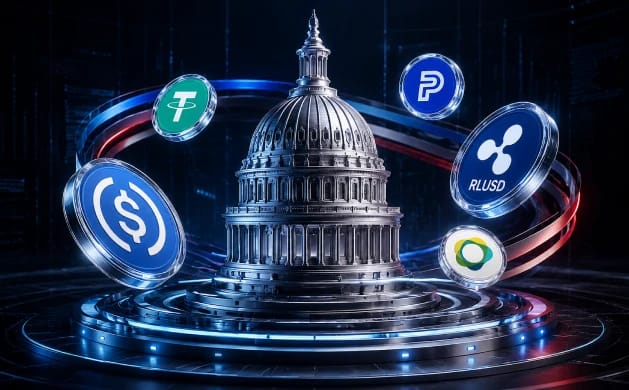
The Guiding and Establishing National Innovation for U.S. Stablecoins Act, better known as the GENIUS Act, establishes who may issue a dollar stablecoin in the United States, what assets must back it, and how holders are protected. Previously, issuers could operate as New York trust companies, offshore entities with Salvadoran licenses, or anonymous DeFi protocols, yet their tokens traded on the same exchanges.
A "payment stablecoin" is defined as a digital asset designed for payment or settlement that the issuer promises to redeem for a fixed amount of money. The definition excludes bank deposits, national currencies, and securities. As a result, the tokenized deposits now being developed by banks fall outside the regime.
Payment stablecoins are also excluded from federal securities and commodities law. This provision ended years of disagreement between the SEC and CFTC over whether a dollar token constituted an investment contract. Banks and payment companies began building stablecoin products within months.
GENIUS Act Timeline
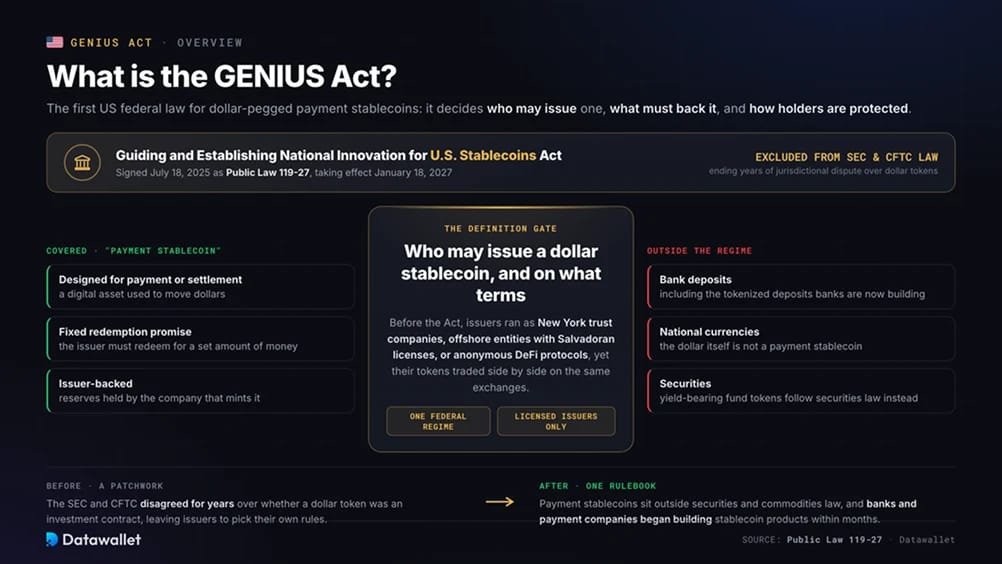
Congress passed the bill in under three months. Implementation has moved more slowly, with the legislative record now extending into a rulemaking calendar that runs through 2028:
- Senate passage (June 17, 2025): The Senate approved the bill 68 to 30 with bipartisan support.
- House passage and signature (July 17 and 18, 2025): The House cleared the Senate text 308 to 122, and the President signed it the next day.
- Treasury advance notice (September 2025): Treasury opened a 58-question consultation covering safe harbors, foreign issuers, and illicit finance.
- First charters (December 2025): The Office of the Comptroller of the Currency (OCC) granted conditional national trust bank charters to Circle, Paxos, Ripple, BitGo, and Fidelity Digital Assets.
- USAT launch (January 27, 2026): Tether launched a separate US token through Anchorage Digital Bank instead of bringing USDT under US rules.
- OCC proposal (February 25, 2026): The 376-page notice addressed licensing, reserves, capital, and the yield ban. It became the template for every other agency.
- FDIC, NCUA, FinCEN and OFAC proposals (April 2026): Agencies proposed prudential rules for bank subsidiaries and the first mandatory sanctions compliance program for any category of US person.
- CLARITY Act markup (May 14, 2026): Senate Banking advanced the market structure bill 15 to 9 after reaching a compromise on stablecoin rewards.
- Circle final approval (July 10, 2026): Circle National Trust received full approval to open.
- Rulemaking deadline missed (July 18, 2026): The one-year statutory deadline passed without final rules or a Federal Reserve proposal.
- Treasury Section 3 proposal (August 17, 2026): Treasury defined what constitutes issuing or selling a stablecoin "in the United States," with comments due October 19.
- Effective date (January 18, 2027): Issuing a payment stablecoin without a license becomes unlawful and subject to criminal penalties.
- Exchange cutoff (July 18, 2028): Exchanges and wallets may no longer offer US persons any stablecoin that was not created by a licensed issuer.
Core Rules of the GENIUS Act
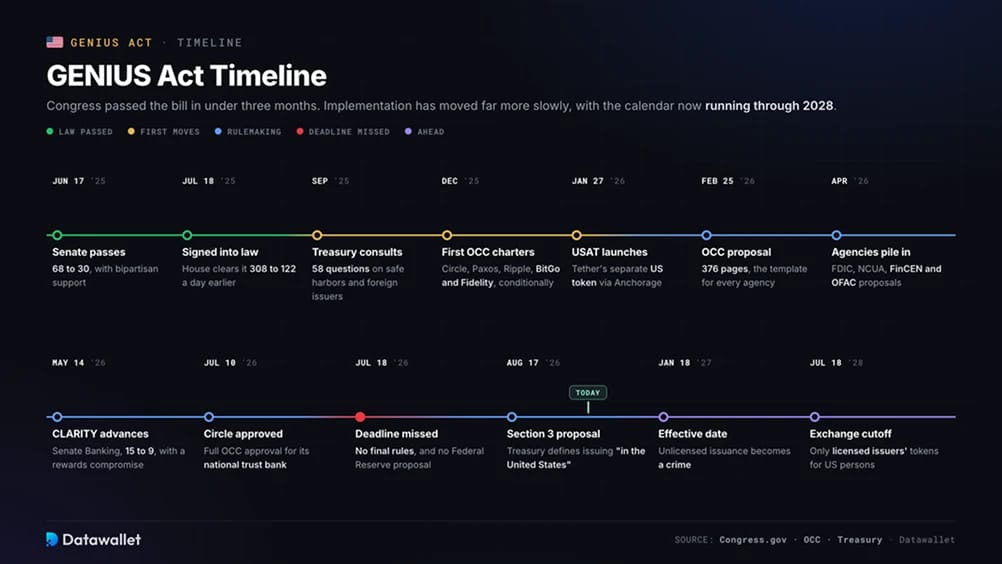
The following requirements apply to every issuer, including bank subsidiaries, OCC-licensed nonbanks, and state-licensed companies.
1. Three Paths to Become a Permitted Issuer
Only a "permitted payment stablecoin issuer" may mint a dollar token for US customers. Subsidiaries of insured banks or credit unions apply to their existing federal regulator. Nonbanks apply to the OCC for a federal license, which is the route Circle, Paxos, and Anchorage are pursuing through national trust bank charters. Alternatively, a company can use a state regime that Treasury has certified as substantially similar to the federal framework.
The state route is limited to issuers with no more than $10 billion in circulation. Once an issuer exceeds that threshold, it must move to OCC supervision within 360 days or stop net new issuance. Treasury published its principles for certifying state regimes in April.
2. One-to-One Reserves in Named Assets
Permitted reserves include US currency, insured bank deposits, Treasury bills maturing within 93 days, overnight repurchase agreements backed by Treasuries, and government money market funds. Gold, Bitcoin, corporate paper, and loans are not eligible.
Issuers cannot pledge or lend the reserves, nor can they mix them with company assets. Reserve composition must be published monthly and examined by a registered accounting firm. The CEO and CFO must certify each report under criminal penalty.
3. No Interest or Yield to Holders
Issuers may not pay holders "any form of interest or yield" solely for holding a token. Congress intended stablecoins to operate as payment instruments, rather than as uninsured savings accounts competing with bank deposits. This restriction has become the law's most contested provision and is discussed below.
4. Holders Come First in Bankruptcy
When an issuer fails, token holders receive first claim on the segregated reserves, which remain outside the bankruptcy estate. Courts are directed to begin distributions within 14 days. Following Terra and FTX, this represents the law's largest single improvement in holder protection.
5. Bank-Level Compliance Obligations
The Bank Secrecy Act classifies permitted issuers as financial institutions. Under the FinCEN and OFAC proposal, they must operate a risk-based anti-money laundering (AML) program, identify customers, report suspicious activity, and appoint a US-based compliance officer.
For the first time, a category of US business would also face a legally mandated sanctions compliance program. Issuers must be capable of freezing, seizing, or burning tokens in response to a lawful order.
Where GENIUS Act Implementation Stands
The July 18, 2026 deadline passed with proposals from every agency except the Federal Reserve, but no final rules. Because the law becomes effective on the earlier of January 18, 2027 or 120 days after the rules are finalized, the missed deadline pushed implementation to its outer limit. The position as of late August is:
The OCC proposal carries the greatest weight because the FDIC and NCUA based their structures on it. New issuers would need to maintain at least $5 million in capital for three years, plus enough liquid assets to cover 12 months of operating expenses. They would also have to diversify reserves under one of two approaches still being considered.
More than 200 questions remain open. The final rule could therefore change the capital requirements, reserve concentration limits, and definition of a related third party.
Under Treasury's August proposal, a token is "issued" when it is first transferred to an outside party. Solicitation and advertising directed at US persons count as an "offer." Exchanges may rely on a foreign issuer's commitment to comply with lawful orders, but only after conducting reasonable due diligence. Transfers between individuals or a person's own accounts are exempt.
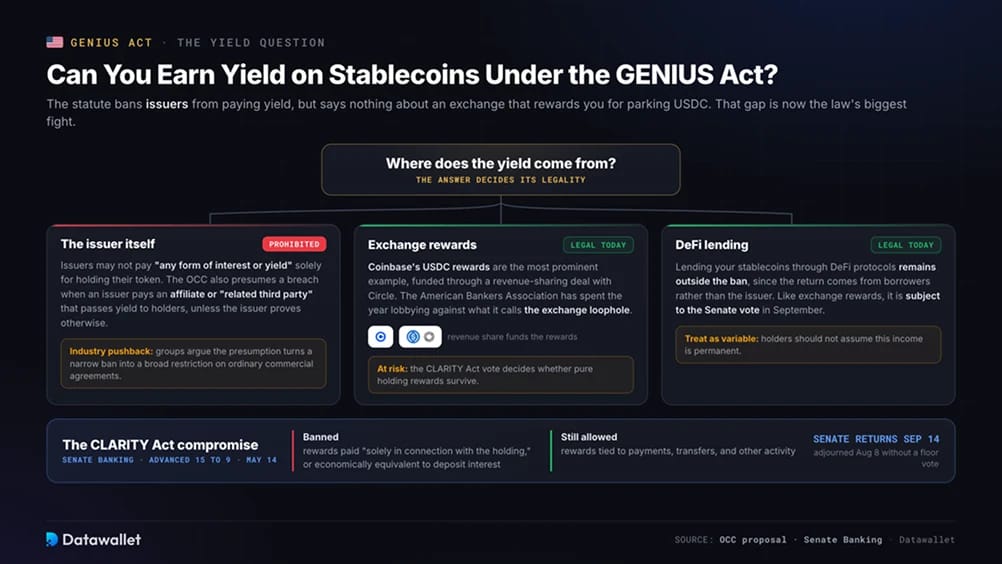
Can You Earn Yield on Stablecoins Under the GENIUS Act?
The statute prohibits issuers from paying yield, but it does not address an exchange that holds a customer's USDC and rewards them for leaving it there. Coinbase's USDC rewards are the most prominent example. The payments are funded through a revenue-sharing arrangement with Circle, prompting the American Bankers Association to spend the year lobbying against what it calls the exchange loophole.
The OCC's February proposal presumes that an issuer breaches the ban when it pays an affiliate or "related third party" that then pays holders, unless the issuer proves otherwise. This definition includes companies paying yield on an issuer's behalf and partners for which the issuer mints branded tokens.
Industry groups argued that the proposal turns a narrow prohibition into a broad restriction on ordinary commercial agreements. The OCC has also reserved the right to review other arrangements individually.
Congress is attempting to resolve the issue through the CLARITY Act. The Senate Banking text released in May prohibits rewards paid "solely in connection with the holding" of a stablecoin or in a form that is "economically or functionally equivalent" to deposit interest. Rewards tied to payments, transfers, and other activity would remain permissible.
The committee advanced that compromise 15 to 9 on May 14. Banking trade groups subsequently asked Chairman Scott and Ranking Member Warren to tighten the language, arguing that yield-bearing balances outside banks would reduce deposits and constrain lending.
The Senate adjourned on August 8 without holding a floor vote and returns on September 14. The final text will determine whether US holders can earn anything on idle dollars. Until then, exchange earn products and DeFi lending remain legal. Our guide to stablecoin interest rates tracks the current position of these products.
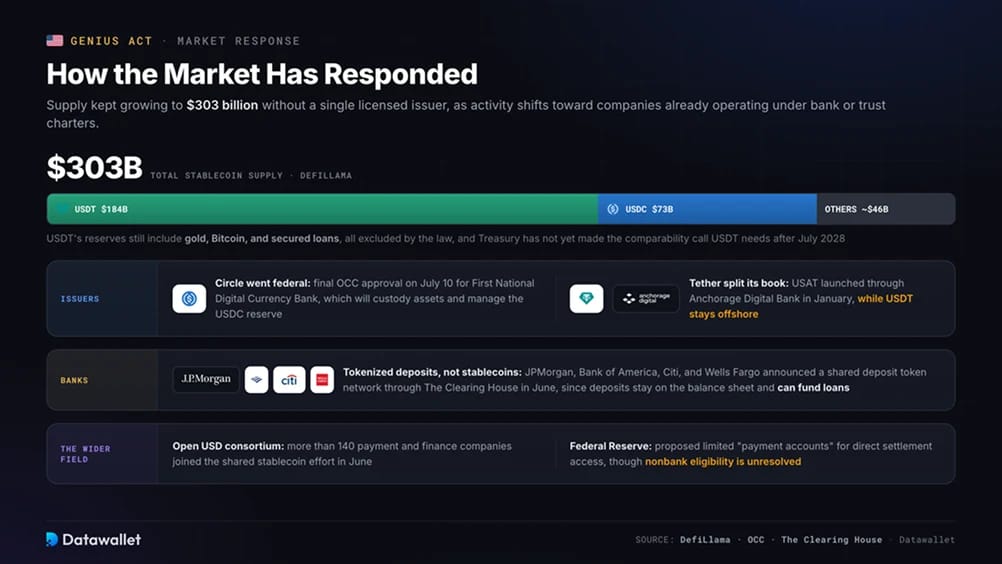
How the Market Has Responded
Stablecoin supply is near $303 billion, according to DefiLlama. USDT accounts for approximately $184 billion, while USDC represents $73 billion. Overall supply has continued growing as activity shifts toward issuers already operating under bank or trust charters. Our stablecoin statistics page tracks the market data.
On July 10, Circle received final OCC approval for First National Digital Currency Bank. The bank will custody digital assets and eventually manage the USDC reserve.
Tether took a different route in January, launching USAT through Anchorage Digital Bank while keeping USDT offshore. USDT's reserves still include gold, Bitcoin, and secured loans, all of which the law excludes. Treasury has not made the comparability determination that USDT needs to remain available on US exchanges after July 2028.
Banks have generally preferred tokenized deposits because they stay on the balance sheet and can fund loans. JPMorgan, Bank of America, Citi, and Wells Fargo announced a shared deposit token network through The Clearing House in June. During the same month, more than 140 payment and finance companies joined the Open USD stablecoin consortium.
The Federal Reserve has proposed limited "payment accounts" that would provide direct settlement access. Whether nonbank issuers would qualify remains unresolved.
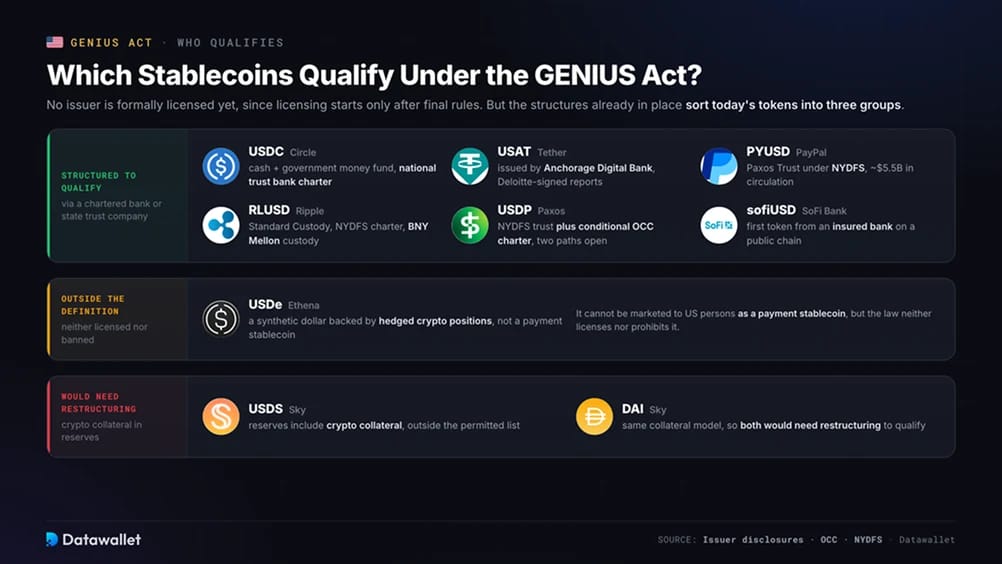
Which Stablecoins Qualify Under the GENIUS Act?
No issuer is formally licensed because licensing begins only after the rules are finalized. However, the following tokens are structured to qualify immediately through a chartered bank or state trust company:
- USDC (Circle): Reserves in cash and a government money market fund, monthly attestations, and a national trust bank charter designed to assume reserve management.
- USAT (Tether): Issued by Anchorage Digital Bank under OCC supervision, with Deloitte-signed reserve reports. It is available on Kraken, OKX, Bybit, and Crypto.com.
- PYUSD (PayPal): Issued by Paxos Trust Company under New York Department of Financial Services (NYDFS) oversight, with roughly $5.5 billion in circulation.
- RLUSD (Ripple): Issued by Standard Custody & Trust Company under an NYDFS charter. BNY Mellon custodies the reserves.
- USDP (Paxos): Paxos holds an NYDFS trust charter and a conditional OCC national trust bank charter, allowing it to choose between the two paths.
- sofiUSD (SoFi Bank): The first token issued by an insured bank on a public chain, launched in December 2025 through the bank subsidiary path.
Ethena's USDe is a synthetic dollar backed by hedged crypto positions. It falls outside the payment stablecoin definition, meaning it is neither licensed nor banned, but cannot be marketed to US persons as a payment stablecoin.
Sky's USDS and DAI use reserves that include crypto collateral, so both would require restructuring to qualify. Our guide to the safest stablecoins compares their backing models.
GENIUS Act vs MiCA
Europe introduced stablecoin regulation two years earlier through the Markets in Crypto-Assets Regulation (MiCA). The two frameworks differ enough that global issuers need separate entities for each market:
MiCA provides no equivalence mechanism. Consequently, USDT was delisted from EU exchanges for retail customers, while Circle's early e-money license allowed USDC to remain available. Our list of MiCA-licensed exchanges shows which platforms qualified.
What the GENIUS Act Means for Exchanges and DeFi
The law classifies exchanges, brokers, and wallet providers as "digital asset service providers." Their obligations begin in two stages.
From January 18, 2027, these providers cannot offer a foreign stablecoin unless the issuer can comply with lawful orders. Beginning July 18, 2028, they may not offer US persons any stablecoin that was not created by a permitted issuer. Treasury's proposal sets penalties of up to $1 million and five years in prison per violation for knowingly breaching the issuance ban.
For US exchanges such as Coinbase and Kraken, compliance primarily requires reviewing token listings. Coinbase had not listed USAT as of this writing, consistent with its USDC revenue-sharing arrangement with Circle. Kraken listed USAT when it launched. Offshore platforms with US subsidiaries must verify each token's issuer status before the 2028 cutoff.
Decentralized protocols receive a narrower exemption. Software developers and node operators are excluded from the service provider definition, so Uniswap's contracts are not considered distributors. The position is less clear for front-end businesses that earn fees by making stablecoins available to US users. The CLARITY Act's DeFi provisions are intended to address that distinction.
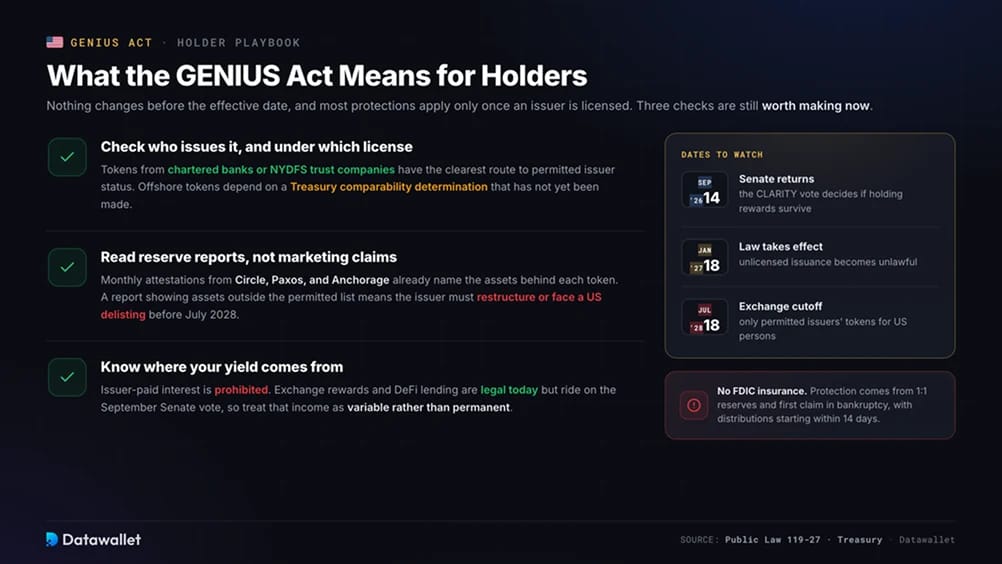
What the GENIUS Act Means for Holders
Holders face no immediate changes before the effective date, and most protections apply only after an issuer becomes licensed. Even so, some preparation is warranted.
First, check who issues the stablecoin and which license it operates under. Tokens issued by chartered banks or NYDFS trust companies have the clearest route to permitted issuer status. Offshore tokens depend on a Treasury comparability determination that has not yet been made.
Reserve reports matter more than marketing claims. Monthly attestations from Circle, Paxos, and Anchorage already identify the assets backing each token. When a report includes assets outside the permitted list, the issuer will likely need to restructure or face a US delisting before July 2028.
It is also important to understand the source of any yield. Issuer-paid interest is prohibited. Exchange rewards and DeFi lending remain legal today, but they are subject to the Senate vote in September. Holders should treat this income as variable rather than permanent.
Final Thoughts
The GENIUS Act has achieved its initial purpose. Circle now has a federal charter, Tether has created a US product, and major banks are developing dollar tokens they would not have considered three years ago. The market exceeded $300 billion without a licensed issuer because the law gave companies a clear picture of what one would require.
Several unresolved decisions will shape the next two years. The OCC's final rule will determine capital and reserve requirements. Treasury's comparability decision will decide whether USDT remains available on US exchanges beyond 2028, while the CLARITY Act vote in September will address whether simply holding a stablecoin can generate rewards.
We expect the final rules to arrive in a cluster over the coming months. In the meantime, holders should favor issuers already operating under bank or trust charters. The regime takes effect on January 18, 2027, before the range of tokens legally available to US customers narrows on July 18, 2028.