For a decade, Washington could not settle which regulator governs crypto. The CLARITY Act was designed to answer that question, and over fourteen months it advanced further than any previous market structure legislation, passing the House with 78 Democratic votes and clearing two Senate committees.
Its progress ended on September 15, 2026, at the Senate's decisive procedural threshold. Cloture failed 49-50. Every Democrat voted no, leaving the most heavily lobbied crypto bill in US history eleven votes short of a debate it never got to have.
Here is what the bill does, why it failed, and what happens now. 👇
What Is the CLARITY Act?
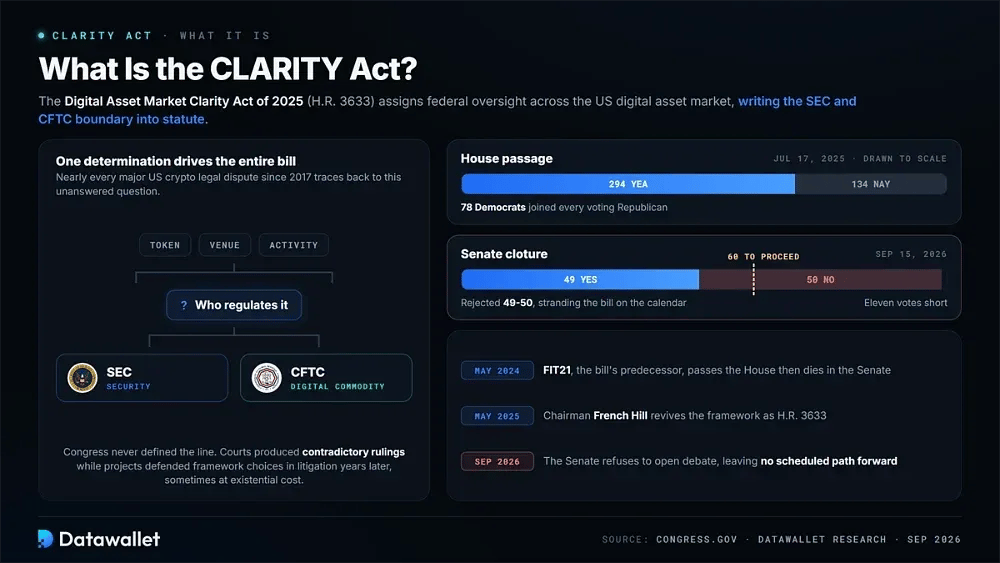
The CLARITY Act, formally the Digital Asset Market Clarity Act of 2025 (H.R. 3633), assigns federal oversight across the US digital asset market. It defines when a token falls under SEC authority as a security and when it qualifies as a digital commodity regulated by the CFTC.
That boundary has driven nearly every major US crypto legal dispute since 2017. Congress never defined it, leaving both agencies to claim overlapping territory. Courts produced contradictory rulings, while projects chose a regulatory framework only to defend that decision in litigation years later, sometimes at existential cost.
The legislation grew out of FIT21, which passed the House in May 2024 and later died in the Senate. House Financial Services Chairman French Hill revived the framework in May 2025. On July 17, 2025, the House passed it 294-134, with 78 Democrats joining every voting Republican.
From there, the fight shifted entirely to the Senate, where 60 votes were required just to begin debate. That test came on September 15, 2026. The chamber rejected it 49-50, stranding the legislation on the calendar without a scheduled path forward.
Why the CLARITY Act Matters
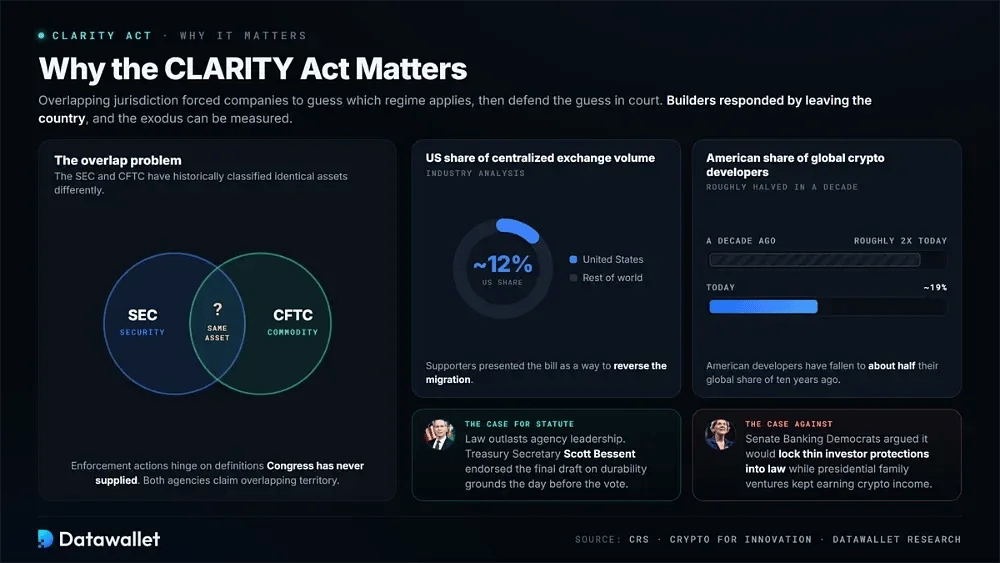
The central problem is overlapping jurisdiction. The SEC and CFTC have historically classified identical assets differently, forcing companies to determine for themselves which regime applies. Enforcement actions can then hinge on definitions that Congress has never supplied. Builders responded by leaving the country.
The economic impact can be measured. Industry analysis places the US share of centralized exchange volume near 12%. American crypto developers have fallen to roughly 19% of the global total, about half their share a decade ago. Supporters presented the bill as a way to reverse that migration.
Putting the framework in statute also gives it durability beyond the officials currently running the agencies. Rules adopted by today's friendly SEC can be reversed by tomorrow's hostile one, which is why the industry pushed for legislation rather than agency guidance. Treasury Secretary Scott Bessent endorsed the final Senate draft on precisely those grounds the day before the vote.
Critics viewed that same permanence as a liability. Senate Banking Democrats argued that the bill would lock thin investor protections into law while the president's family ventures continued earning crypto income that the legislation would not meaningfully restrict. That objection ultimately became decisive on the floor.
How the CLARITY Act Works
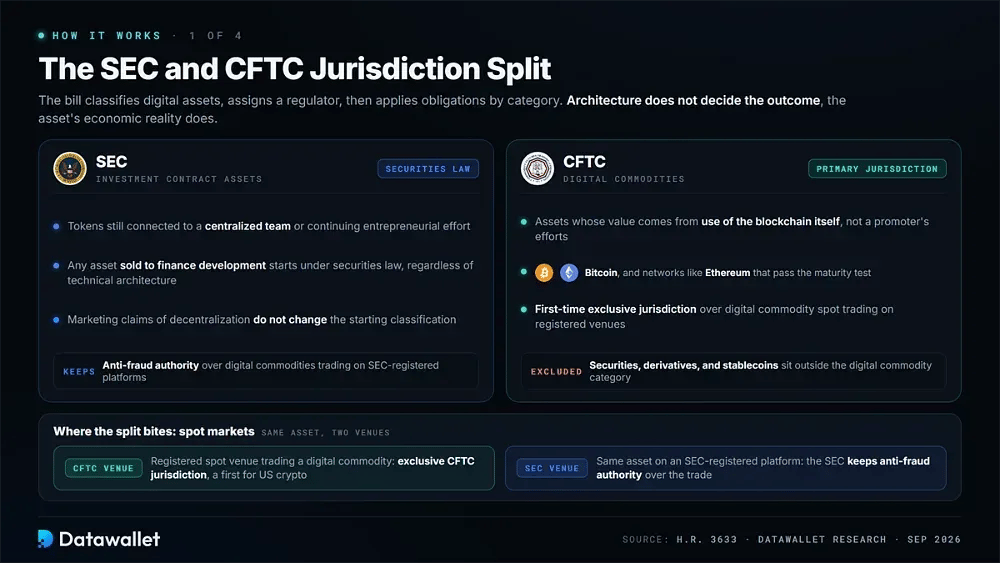
At its core, the bill classifies digital assets, assigns regulatory authority, then applies obligations based on the resulting category. The crucial question is whether a blockchain has become decentralized enough for its token to leave SEC supervision entirely.
1. The SEC and CFTC Jurisdiction Split
The SEC retains authority over investment contract assets. That includes tokens still connected to a centralized team, a capital raise, or continuing entrepreneurial effort. Any asset sold to finance development begins under securities law, regardless of its technical architecture or how its marketing describes decentralization.
Primary jurisdiction over digital commodities goes to the CFTC. These are assets whose value comes from use of the blockchain itself. Securities, derivatives, and stablecoins are excluded from the category, which captures assets such as Bitcoin and, subject to the maturity test below, networks such as Ethereum that have outgrown their founding teams.
The distinction matters most in spot markets. For the first time, the CFTC would receive exclusive jurisdiction over digital commodity spot trading on registered venues. The SEC, however, would keep anti-fraud authority over those same assets when they trade on SEC-registered platforms.
2. The Mature Blockchain Test
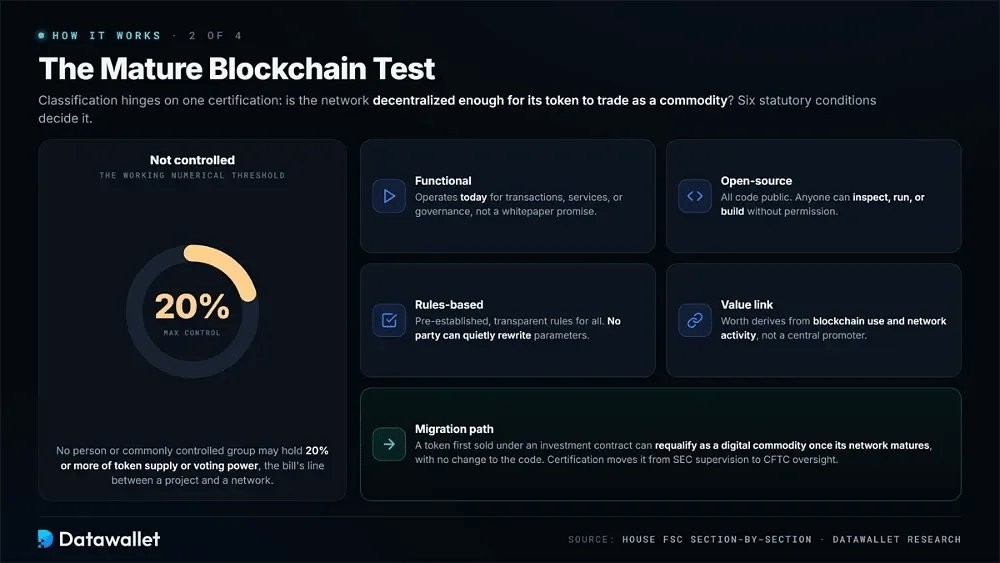
Classification ultimately depends on a certification known as the mature blockchain test. It marks the stage at which a network is sufficiently decentralized for its token to trade as a commodity. The House section-by-section summary sets out the conditions.
A blockchain must satisfy these statutory requirements to qualify as mature:
- Functional: The network must actually operate for transactions, services, or governance today, rather than existing as a whitepaper promise about capabilities that developers intend to ship later.
- Open-source: All underlying code must be public, allowing anyone to inspect, run, or build on the network without seeking permission from an operator who controls access.
- Rules-based: Operations must follow pre-established, transparent rules applied consistently to all participants, not parameters that a single party can quietly rewrite at its own discretion.
- Not controlled: No person or commonly controlled group may hold 20% or more of the token supply or voting power, the bill's working numerical threshold for decentralization.
- Value link: The asset's worth must derive from actual blockchain use and network activity rather than from the ongoing managerial efforts of an identifiable central promoter.
- Migration path: A token first sold under an investment contract can later requalify as a digital commodity once its network matures, without requiring any change to the code.
3. Self-Certification and Registration
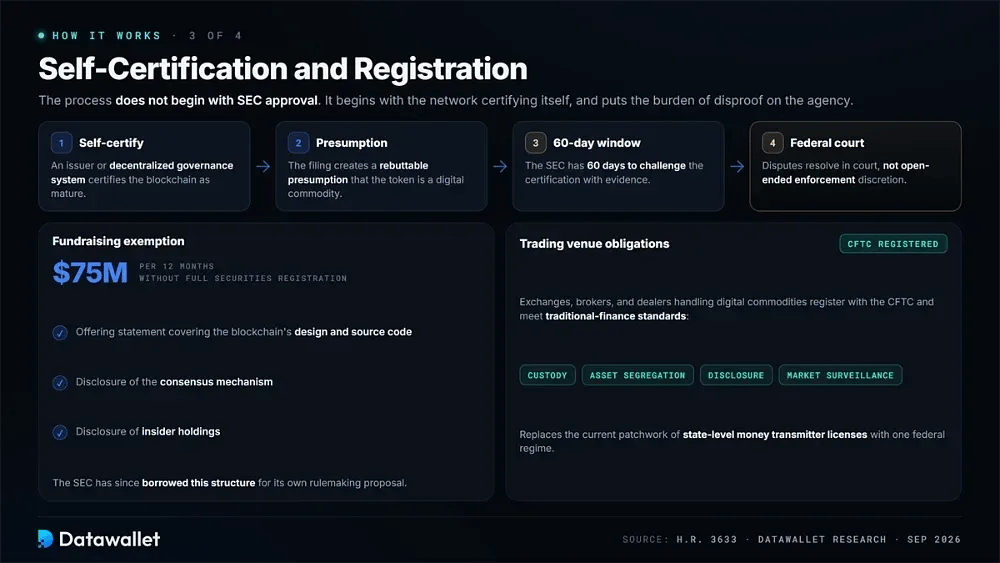
The process does not begin with SEC approval. An issuer or decentralized governance system may self-certify a blockchain as mature, creating a rebuttable presumption. The agency then has 60 days to challenge that certification, with disputes ultimately resolved in federal court instead of through open-ended enforcement discretion.
Fundraising receives a separate exemption. Projects could raise up to $75 million over 12 months without full securities registration, provided they file an offering statement covering the blockchain's design and source code, its consensus mechanism, and insider holdings. The SEC has since borrowed that structure for its own rulemaking proposal.
Trading venues face more conventional requirements. Exchanges, brokers, and dealers handling digital commodities would register with the CFTC. They would also have to meet traditional-finance standards for custody, customer asset segregation, disclosure, and market surveillance, replacing the current patchwork of state-level money transmitter licenses.
4. The DeFi and Developer Carve-Out
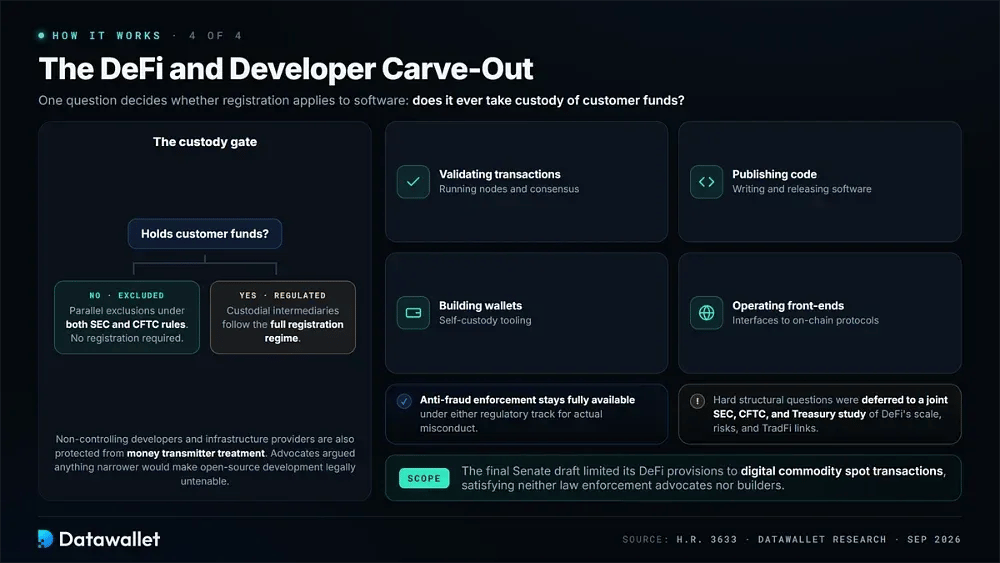
Software that never takes custody of customer funds receives parallel exclusions under both SEC and CFTC rules. Activities such as validating transactions, publishing code, building wallets, and operating front-ends fall outside registration requirements. Anti-fraud enforcement for actual misconduct remains fully available under either regulatory track.
Another provision protects non-controlling developers and infrastructure providers from being treated as money transmitters. Advocates for decentralized exchanges argued during negotiations that narrower protection would make open-source development legally untenable. The final Senate draft limited its DeFi provisions to digital commodity spot transactions.
The legislation also called for a joint SEC, CFTC, and Treasury study of DeFi's scale, risks, and links to traditional markets. Instead of settling the most difficult structural questions in statute, lawmakers deferred them to later rulemaking. The compromise fully satisfied neither law enforcement advocates nor the builders it covered.
CLARITY Act Timeline
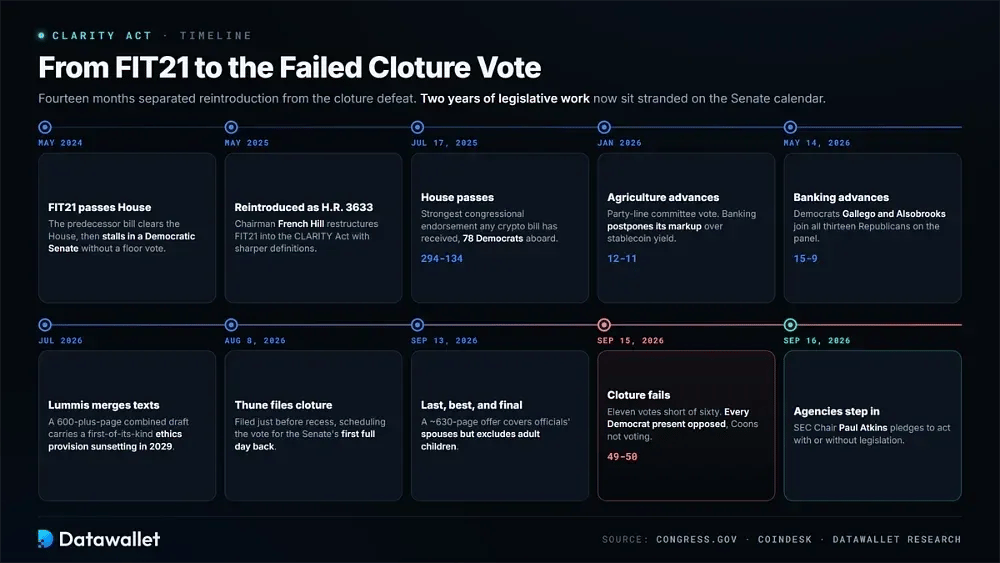
The amount of legislative time consumed at each stage helps explain why the failed vote matters. This record draws on the official legislative actions and contemporaneous reporting across the fourteen months between reintroduction and the cloture defeat.
The bill's path from FIT21 to the failed cloture vote:
- May 2024: Predecessor bill FIT21 passes the House with bipartisan support, then stalls in a Democratic-controlled Senate that never grants it a floor vote.
- May 2025: Chairman French Hill reintroduces the framework as H.R. 3633, restructuring FIT21 into the CLARITY Act with sharper definitions and revised exemptions.
- July 2025: The House passes the bill 294-134 on July 17, with 78 Democrats aboard, the strongest congressional endorsement any crypto legislation has received.
- January 2026: Senate Agriculture advances its companion text on a 12-11 party-line vote while Senate Banking postpones its own markup over stablecoin yield disputes.
- May 2026: Senate Banking advances the bill 15-9 on May 14, with Democrats Ruben Gallego and Angela Alsobrooks joining all thirteen Republicans on the panel.
- July 2026: Senator Cynthia Lummis releases a merged 600-plus-page text combining the Banking and Agriculture drafts, carrying a first-of-its-kind ethics provision that sunsets in 2029.
- August 8, 2026: Majority Leader John Thune files cloture just before recess, scheduling the procedural vote for the Senate's first full day back in September.
- September 13, 2026: Republicans circulate a roughly 630-page final offer with revised ethics restrictions covering officials' spouses but excluding adult children, billed as last, best, and final.
- September 15, 2026: The cloture motion fails 49-50, eleven votes short of sixty, with every Democrat present opposed and Senator Chris Coons not voting.
- September 16, 2026: SEC Chair Paul Atkins pledges the agency will act with or without legislation, shifting the regulatory center of gravity toward agency rulemaking.
Why the CLARITY Act Failed on September 15
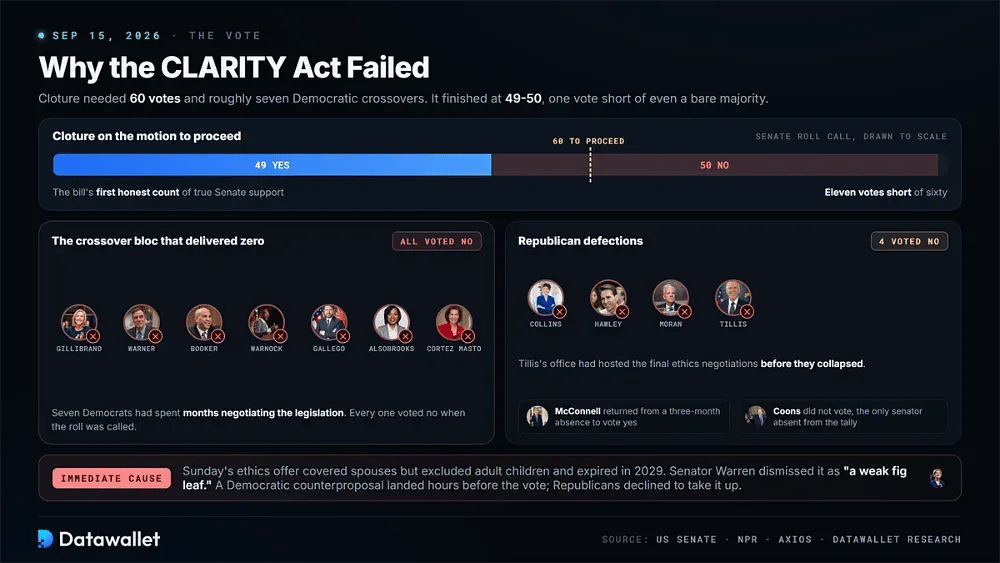
Senate procedure left little room for error. Cloture on the motion to proceed needed 60 votes before debate, amendments, or a final passage vote could begin. Republicans therefore required roughly seven Democratic crossovers. Instead, the tally finished at 49-50, one vote short even of a bare majority.
Democratic support disappeared completely. Senators Gillibrand, Warner, Booker, Warnock, Gallego, Alsobrooks, and Cortez Masto had spent months negotiating the legislation, yet all voted no. A bloc expected to produce seven crossover votes delivered none, giving the bill its first honest count of true Senate support.
Republicans lost votes as well. Four opposed cloture: Susan Collins, Josh Hawley, Jerry Moran, and Thom Tillis. Tillis's office had hosted the final ethics negotiations before they collapsed. Mitch McConnell returned from a three-month absence to vote yes, but those defections eliminated any margin for error.
Ethics was the immediate cause. Sunday's final offer barred officials and their spouses from profiting on digital assets but excluded adult children. Enforcement questions remained unresolved, and the provision expired in January 2029. Senator Elizabeth Warren dismissed it as "a weak fig leaf." Democrats introduced a counterproposal hours before the vote, which Republicans declined to take up.
The Three Disputes That Sank the Bill
The arguments that ultimately killed the legislation did not center on its core jurisdictional framework. Broad support for dividing oversight between the SEC and CFTC lasted through the final stages. Negotiators instead failed to resolve the additional disputes attached to that consensus.
The Ethics Provision
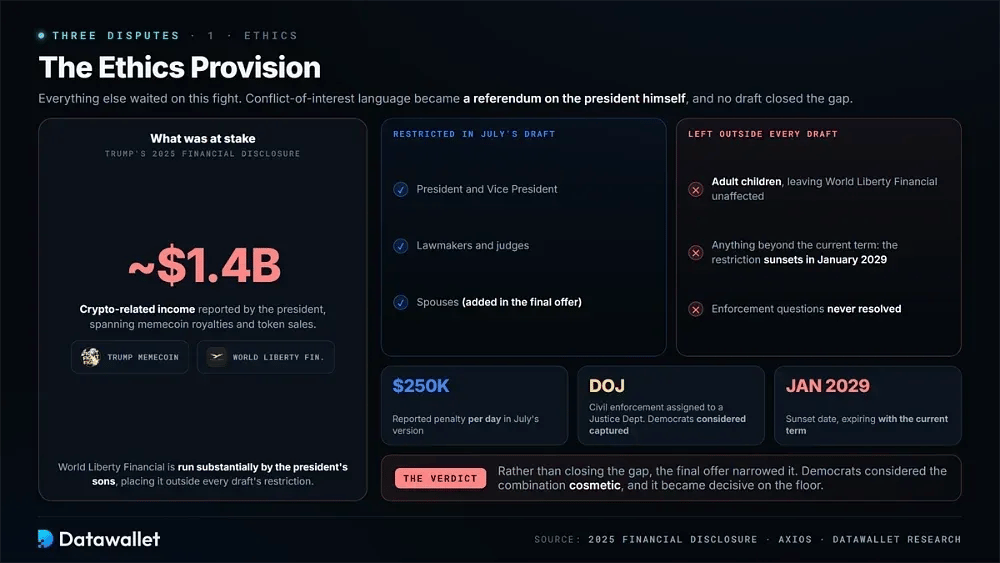
Everything else waited on the ethics fight. Trump's 2025 financial disclosure showed roughly $1.4 billion in crypto-related income, including memecoin royalties and token sales connected to World Liberty Financial. As a result, conflict-of-interest language became a referendum on the president himself.
The boundary shifted with each draft. July's version prohibited the president, vice president, lawmakers, judges, and their spouses from issuing or sponsoring digital assets for compensation. Penalties were reported at up to $250,000 per day. Civil enforcement was then assigned to a Justice Department that Democrats considered captured.
Rather than closing the gap, the final offer narrowed it. Adult children remained outside the restriction, leaving World Liberty Financial, run substantially by the president's sons, unaffected. The January 2029 sunset also meant the constraint would expire with the current term. Democrats considered that combination cosmetic.
Stablecoin Yield
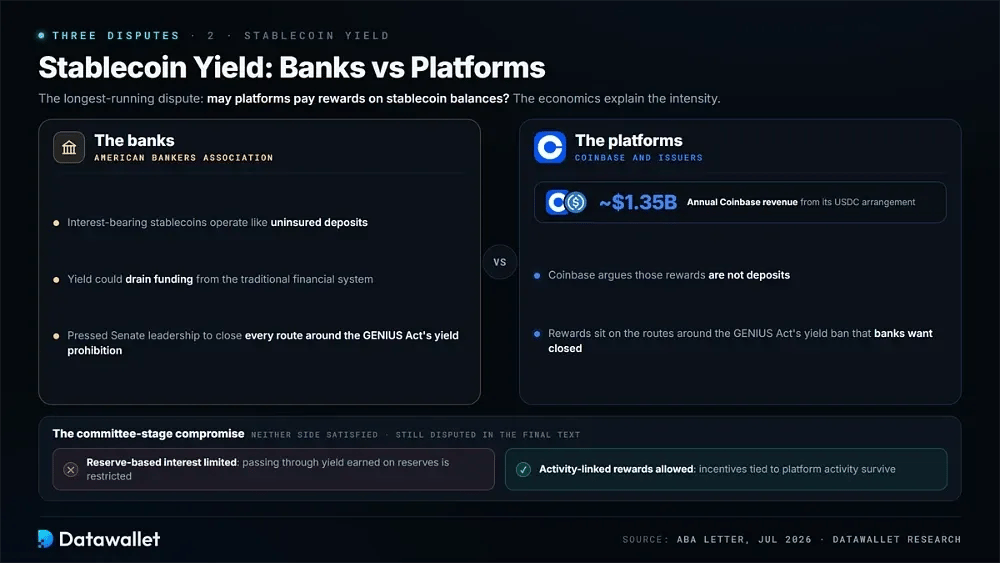
Whether platforms may pay rewards on stablecoin balances became the longest-running dispute. Banks maintained that interest-bearing stablecoins operate like uninsured deposits and could drain funding from the traditional financial system. The American Bankers Association pressed Senate leadership to close every route around the GENIUS Act's yield prohibition.
The size of the economics helps explain the intensity. Coinbase earns roughly $1.35 billion annually through its USDC arrangement and argues that those rewards are not deposits. During the committee stage, negotiators proposed limiting reserve-based interest while allowing activity-linked rewards. Neither side was fully satisfied, and the issue remained disputed in the final text.
DeFi and Illicit Finance
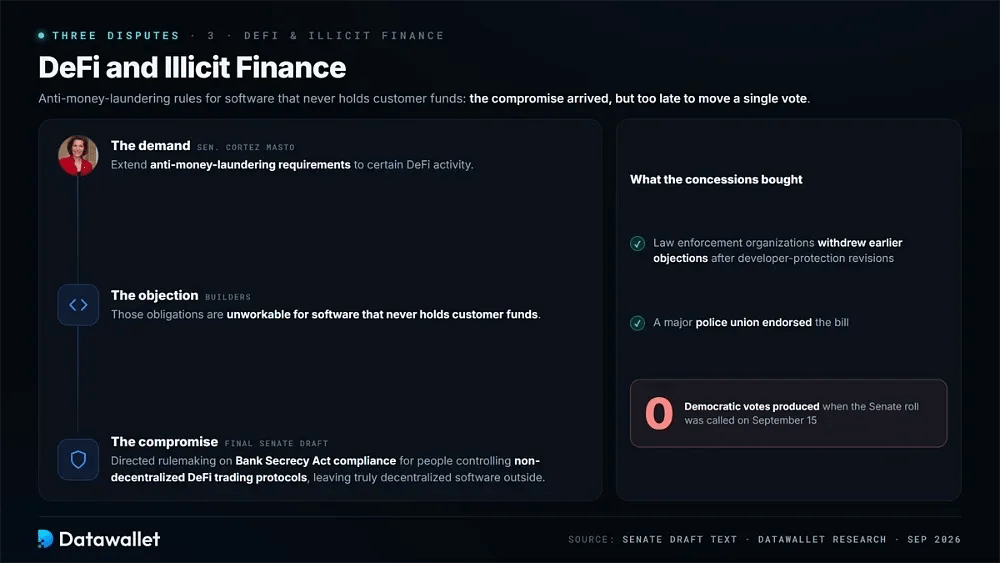
Senator Catherine Cortez Masto sought to extend anti-money-laundering requirements to certain DeFi activity. Builders said those obligations were unworkable for software that never holds customer funds. The final Senate draft attempted a compromise by directing rulemaking on Bank Secrecy Act compliance for people controlling non-decentralized DeFi trading protocols.
That movement came too late to change the vote. Law enforcement organizations withdrew earlier objections after revisions to developer protections, and a major police union endorsed the bill. Even so, the concessions produced no Democratic votes when the Senate roll was called on September 15.
How Markets Reacted to the Failed Vote
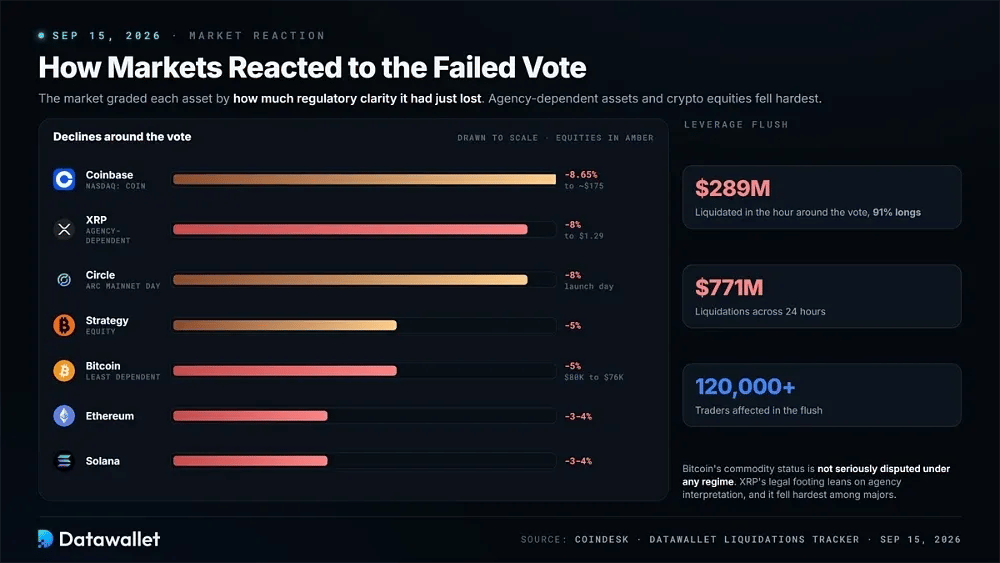
Bitcoin moved from nearly $80,000 overnight to around $76,000 as the vote count arrived, a relatively measured decline for the asset least dependent on the legislation. Altcoins fell more sharply. XRP lost nearly 8% to $1.29, while Ethereum and Solana each declined roughly 3-4%.
Leverage magnified the selloff. Roughly $289 million in positions were liquidated during the hour around the vote, and about 91% were longs. Across 24 hours, liquidations reached $771 million and affected more than 120,000 traders. You can follow flushes like this in real time on Datawallet's crypto liquidations tracker.
Equities absorbed the steepest losses. Coinbase dropped 8.65% to about $175. Circle fell roughly 8% on the same day it launched its Arc mainnet alongside BlackRock and BNY, while Strategy slid 5%. Markets repriced businesses whose models had assumed a statutory framework was close.
The pattern itself was informative. Assets such as XRP, whose legal status relies more heavily on agency interpretation than statute, suffered the largest declines. Bitcoin's commodity classification, by contrast, is not seriously disputed under any regime. In effect, the market graded each asset by how much regulatory clarity it had just lost.
Prediction Market Odds for the CLARITY Act
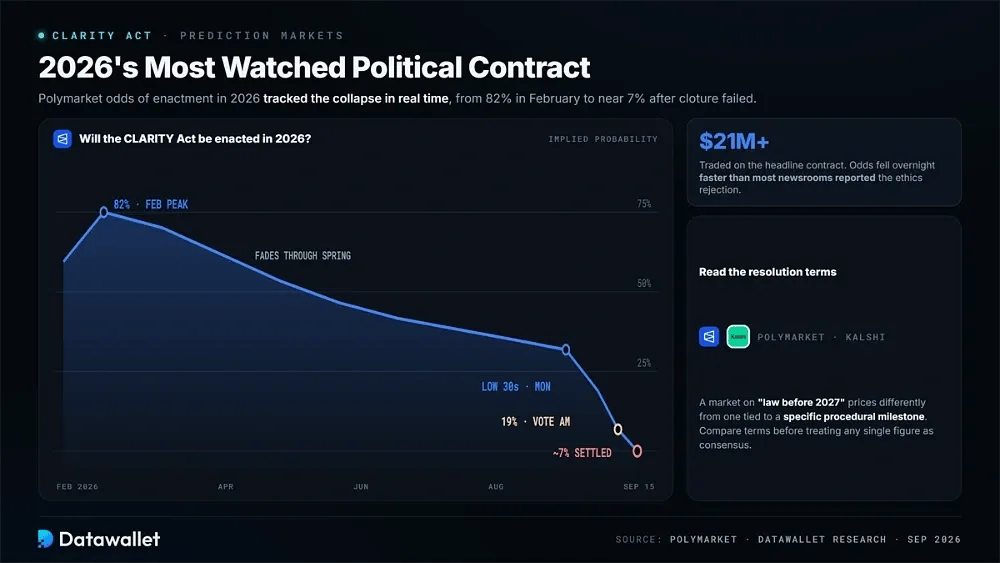
The legislation became 2026's most watched political contract, and the price history closely tracked its collapse. On Polymarket, odds of enactment in 2026 reached 82% in February before fading through spring. They stood at 19% on the morning of the vote and settled near 7% after cloture failed.
Trading volume strengthened the signal. More than $21 million changed hands on the headline contract. Odds fell overnight from the low 30s on Monday into the teens by Tuesday, indicating that traders were processing the Democratic rejection of the final ethics offer faster than most newsrooms reported it.
The structure of each contract still matters when comparing venues. A market asking whether the bill will become law before 2027 will price differently from one tied to a specific procedural milestone. That distinction is visible when comparing Polymarket and Kalshi listings built around the same underlying question. Resolution terms should therefore be read before treating any single figure as consensus.
The SEC and CFTC's Plan B
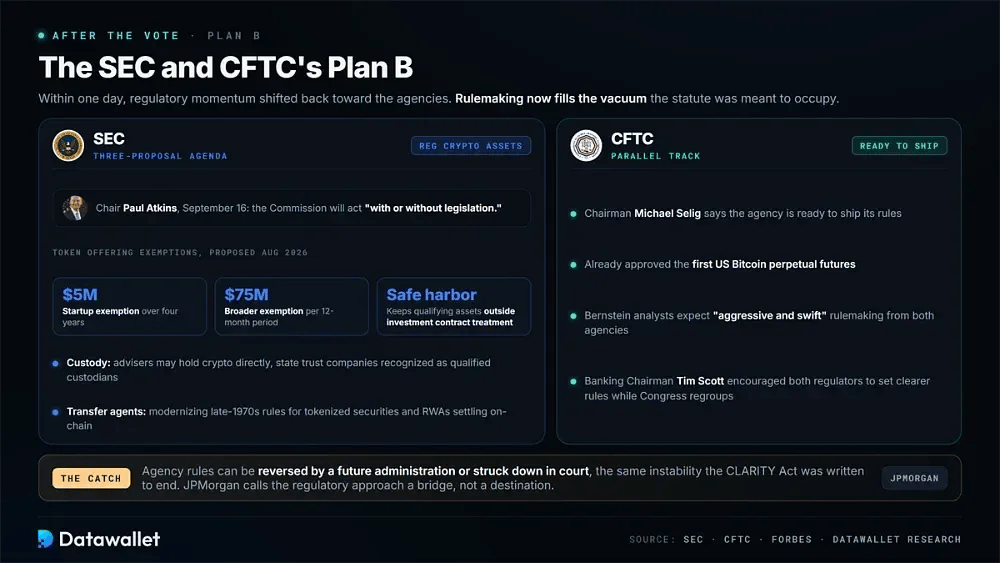
Within one day of the vote, regulatory momentum shifted back toward the agencies. SEC Chair Paul Atkins pledged the Commission would act "with or without legislation." Banking Chairman Tim Scott also encouraged both regulators to establish clearer digital asset rules while Congress regroups.
The SEC already has a vehicle in place. Regulation Crypto Assets, proposed in August, would provide a startup exemption for token offerings of up to $5 million over four years. A broader exemption would allow $75 million per 12-month period, while a conditional safe harbor would keep qualifying assets outside investment contract treatment.
Two additional proposals complete the agenda. One would permit investment advisers to hold crypto directly and recognize state trust companies as qualified custodians. The other would modernize transfer-agent rules dating to the late 1970s for tokenized securities and real-world assets settling on-chain.
The CFTC is advancing its own work at the same time. Chairman Michael Selig said the agency is ready to ship its rules after already approving the first US Bitcoin perpetual futures. With the legislative route blocked for the year, Bernstein analysts now expect "aggressive and swift" rulemaking from both agencies.
Agency action has a familiar weakness. Rules issued under existing authority can be reversed by a future administration or challenged in court. That is the same instability the CLARITY Act was written to end, which is why JPMorgan and others describe the regulatory approach as a bridge rather than a destination.
What Happens Next for the CLARITY Act
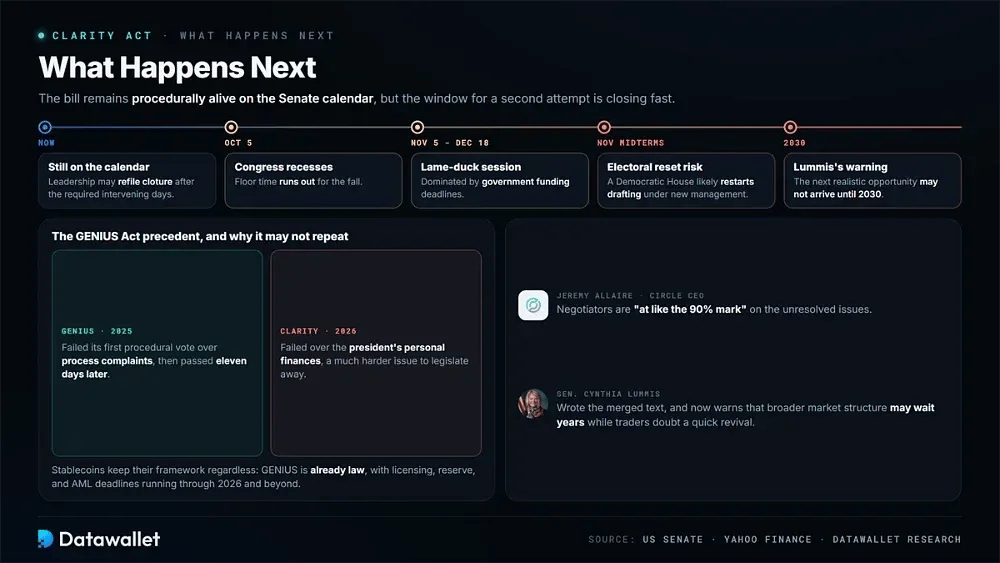
The legislation remains alive procedurally. It is still on the Senate calendar, and leadership may file cloture again after the required intervening days. Supporters repeatedly point to the GENIUS Act, which failed its first procedural vote before passing eleven days later.
Circle CEO Jeremy Allaire says negotiators are "at like the 90% mark" on the unresolved issues. Traders are less convinced that the GENIUS Act precedent will repeat. The difference is structural: GENIUS initially failed over process complaints, whereas CLARITY failed over the president's personal finances, a much harder issue to legislate away.
Time is also running short. Congress recesses on October 5. The lame-duck session from November 5 through December 18 will be dominated by government funding, and if Democrats win control of the House in November's midterms, the framework likely returns to the drafting table under new management and with entirely new demands.
Stablecoin regulation continues regardless of that outcome. The GENIUS Act is already law, and its licensing, reserve, and anti-money-laundering deadlines extend through 2026 and beyond. Payment tokens therefore retain their federal framework while broader market structure waits. Senator Lummis has warned that the next realistic opportunity for the latter may not arrive until 2030.
Risks and Open Questions
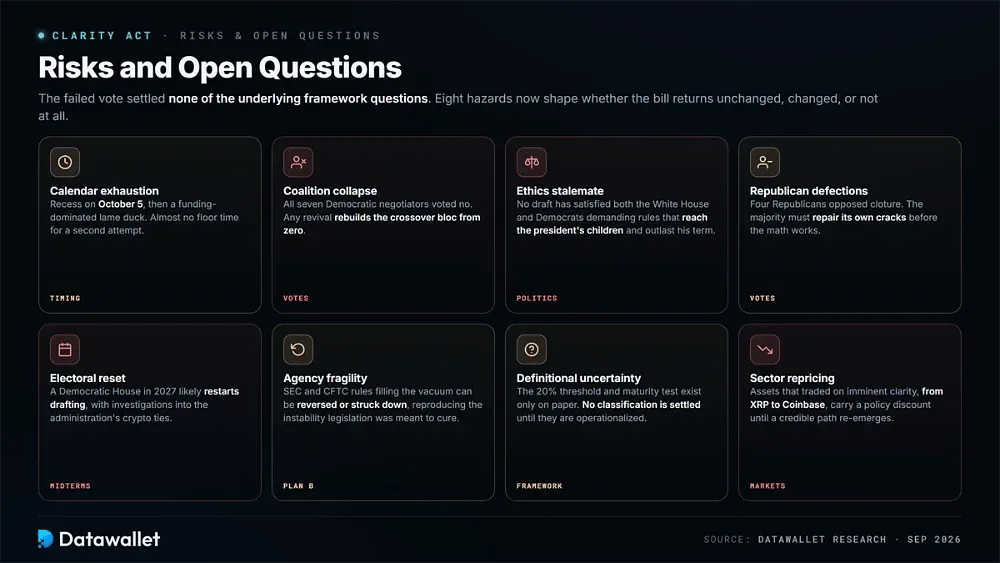
The failed cloture vote settled none of the underlying framework questions, and each group involved now faces a different form of exposure. These hazards will shape whether the CLARITY Act returns unchanged, comes back in a different form, or does not return at all.
The principal risks now facing US crypto market structure:
- Calendar exhaustion: Congress recesses October 5 and the lame-duck session is dominated by funding deadlines, leaving almost no realistic floor time for a second cloture attempt.
- Coalition collapse: All seven Democratic negotiators voted no, meaning any revival must rebuild the crossover bloc from zero rather than converting one or two remaining holdouts.
- Ethics stalemate: No draft has satisfied both a White House protecting family businesses and Democrats demanding restrictions that reach the president's children and outlast his term.
- Republican defections: Four Republicans opposed cloture, so even a perfect Democratic negotiation now requires repairing cracks inside the majority before the math works at all.
- Electoral reset: A Democratic House in 2027 would likely restart drafting entirely, and new majorities are expected to open investigations touching the administration's crypto ties.
- Agency fragility: SEC and CFTC rules now filling the vacuum can be reversed by future administrations or struck down in court, reproducing the instability legislation was meant to cure.
- Definitional uncertainty: The 20% control threshold and maturity test exist only on paper, so no token's classification is settled until an agency or statute finally operationalizes them.
- Sector repricing: Assets and equities that traded on imminent regulatory clarity, from XRP to Coinbase, now carry a policy discount that persists until a credible path re-emerges.
Final Thoughts
No crypto market structure bill has come closer to enactment than the CLARITY Act, yet it still fell eleven votes short. Its core framework: jurisdictional clarity, a maturity test, and defined registration paths, continues to have broad support in both parties. The surrounding politics proved fatal.
September 15 also showed that crypto policy is no longer only about crypto. Token definitions and CFTC funding did not kill the bill. Presidential ethics did, tying its future to the wider political cycle rather than simply to industry lobbying budgets.
Through year-end, watch three signals: whether Thune schedules another cloture attempt before October 5, how far Regulation Crypto Assets progresses at the SEC, and how November's midterms reshape the committees responsible for the next draft. None of this is investment advice.