







Artificial intelligence is creating a huge demand for GPUs, data centers, and compute infrastructure. USD.AI brings this financing need on-chain through a synthetic dollar system connected to AI infrastructure credit.
Instead of treating real-world assets as old collateral to tokenize, USD.AI focuses on future-facing capex demand. Its model links stablecoin holders, DeFi markets, borrowers, and GPU-backed loans.
Here is how USD.AI, CHIP, and InfraFi fit together. 👇
What is USD.AI?
USD.AI is a synthetic dollar and credit protocol built to finance AI infrastructure. Its main purpose is to connect stablecoin depositors with borrowers that need capital for GPU hardware, cloud compute, and AI infrastructure expansion. The protocol describes itself as financing the “physical infrastructure of AI.”
At the center of USD.AI is USDai, a fully backed synthetic dollar designed for liquidity, payments, and DeFi use. Users can mint USDai by depositing stablecoins such as USDC or USDT, and the asset is designed to be redeemable for the underlying stablecoins.
USD.AI also includes sUSDai, a yield-bearing version of USDai. According to the protocol, sUSDai earns from loans backed by AI infrastructure assets, mainly GPU hardware, while idle capital may be held in Treasury Bills as a base yield. The product currently lists about $347 million in deposits.
In simple terms, USD.AI turns AI compute demand into an on-chain credit market. Instead of relying only on crypto-native collateral or token incentives, it links DeFi capital to real-world infrastructure financing. Since launching in 2025, USD.AI says it has executed $225 million in loans and approved over $1.2 billion in facilities.

How Does USD.AI Work?
USD.AI works by turning stablecoin deposits into tokenized credit exposure, then routing selected capital into loans secured by AI infrastructure assets such as GPUs, while keeping USDai liquid for everyday DeFi use.
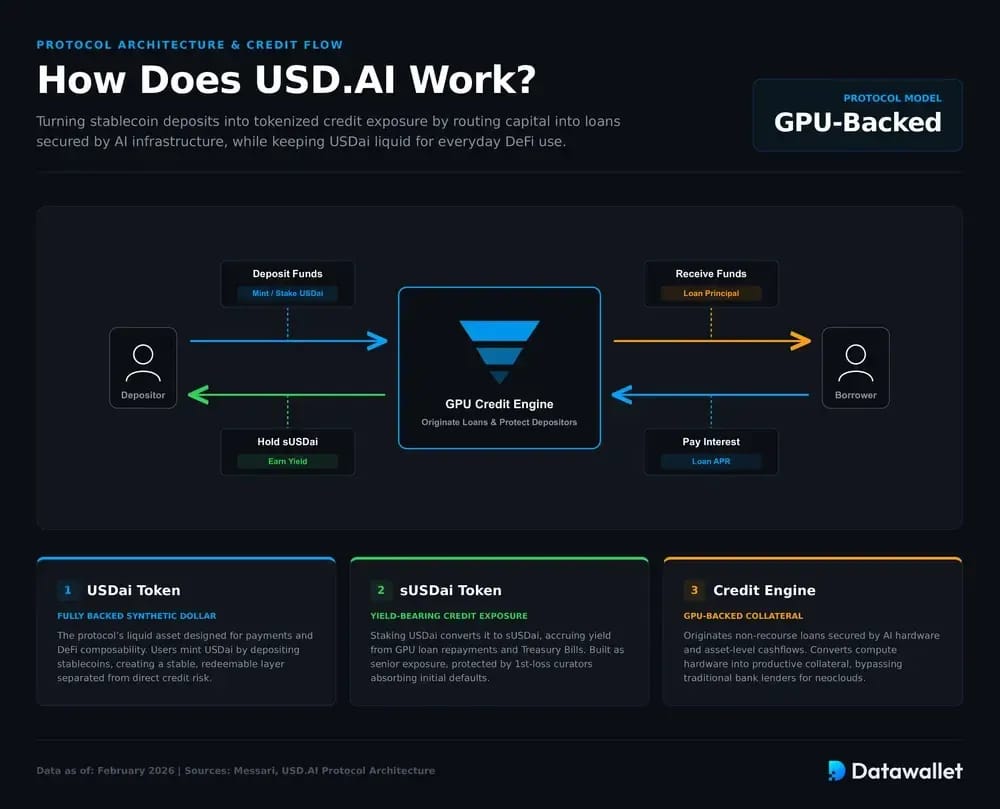
1. USDai (Fully Backed Synthetic Dollar)
USDai is the protocol’s liquid dollar asset. Users deposit supported stablecoins to mint USDai, which is designed for payments, liquidity, secondary markets, and DeFi composability.
Key functions that keep USDai liquid and usable include:
- Minting: Users create USDai by depositing supported stablecoins, giving the protocol base liquidity while issuing a synthetic dollar intended to remain fully backed.
- Redemption: USDai is designed to be redeemable for the underlying stablecoins, helping users move back into conventional stablecoin liquidity when needed.
- Liquidity: The token is built for use across DeFi and secondary markets, so holders can transfer, trade, or deploy it without entering lending positions directly.
- Stability: USDai does not target yield itself; its role is to function as the stable, liquid layer before users choose whether to stake.
- Composability: Because USDai is tokenized, it can integrate with wallets, exchanges, lending markets, and other DeFi applications that support synthetic dollar assets.
- Access: USDai gives users a simpler entry point into the system, separating stablecoin-like utility from the yield and credit risks of sUSDai.

2. sUSDai (Yield-Bearing Credit Exposure)
sUSDai is the yield-bearing version of USDai. Users stake USDai into sUSDai to access returns generated by infrastructure loans and idle-capital management.
The main mechanics behind sUSDai yield are:
- Staking: Users convert USDai into sUSDai, entering the protocol’s yield-bearing layer instead of simply holding the liquid synthetic dollar.
- Yield: Returns primarily come from borrower repayments on loans backed by AI infrastructure assets, especially GPU hardware used by compute operators.
- Treasuries: When capital is not actively deployed into loans, USD.AI says idle funds may earn Treasury Bill yield as a base return.
- Accrual: sUSDai is not treated as a fixed 1:1 mirror of USDai; it is designed to appreciate as yield flows into the vault.
- Seniority: USD.AI describes sUSDai as senior exposure, with first-loss curators absorbing losses before sUSDai holders are affected.
- Risk: Holders are exposed to credit performance, borrower repayment quality, collateral processes, liquidity conditions, and the effectiveness of USD.AI’s risk architecture.

3. GPU-Backed Credit Engine
The credit engine connects DeFi capital with AI infrastructure borrowers. USD.AI originates non-recourse loans secured by GPU infrastructure and asset-level cashflows, allowing neoclouds, data centers, and compute providers to finance hardware without relying only on banks or traditional equipment lenders.
This model treats compute hardware as productive collateral. Loan repayments fund sUSDai yield, while safeguards such as first-loss curators, structured collateral frameworks, amortization schedules, independent appraisals, and oracle-free default processes are designed to protect depositors before losses reach senior capital.

What is InfraFi Market?
InfraFi, short for infrastructure finance is USD.AI’s term for financing the infrastructure-heavy AI economy. The idea is that AI growth requires massive capital expenditure for GPUs, data centers, and compute networks, yet today this financing is still dominated by traditional loans, bonds, and convertible preferred equity.
USD.AI frames InfraFi as a new on-chain credit market for future capex-heavy industries. Instead of tokenizing older assets with existing capital access, it aims to finance productive compute hardware, using crypto-native liquidity, DeFi structuring, and hardware underwriting to support AI infrastructure expansion.
The CHIP Token
CHIP is USD.AI’s governance and utility token, designed to coordinate decisions around GPU-backed lending, protocol risk, staking, fee policy, and long-term development of the USD.AI ecosystem.
Tokenomics
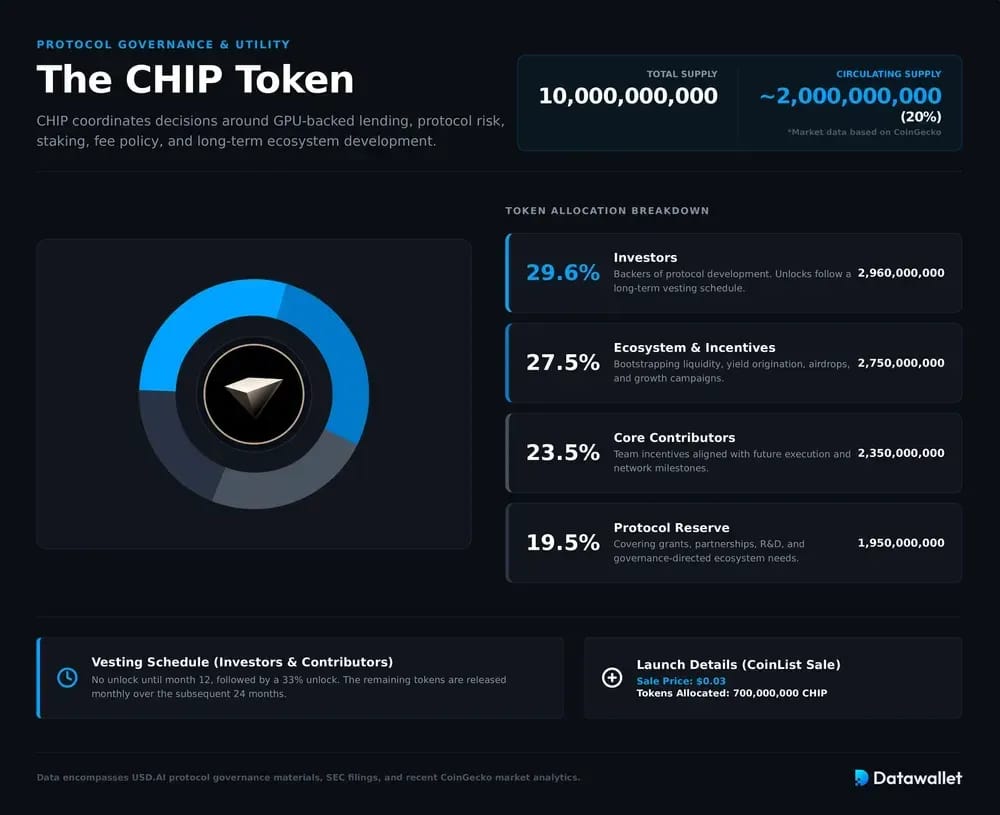
CHIP has a fixed total supply of 10 billion tokens. Around 2 billion CHIP are currently circulating, equal to about 20% of total supply, based on CoinGecko’s latest market data.
The token allocation is structured around ecosystem growth, investors, contributors, reserves, and long-term protocol incentives.
- Supply: CHIP has a total supply of 10 billion tokens, with CoinGecko listing 2 billion tokens as tradable circulating supply in the market.
- Ecosystem: 27.5% is reserved for ecosystem bootstrapping, including liquidity, yield origination, capital formation, future incentives, airdrops, and growth campaigns.
- Investors: 29.6% is allocated to investors that backed the protocol’s development, with unlocks designed around a long-term vesting schedule.
- Contributors: 23.5% is reserved for core contributors, aligning team incentives with future protocol execution rather than immediate post-launch liquidity.
- Reserve: 19.5% is allocated to reserves, generally covering grants, partnerships, research, development, and future governance-directed ecosystem needs.
- Vesting: Investor and contributor allocations reportedly have no unlock before month 12, then 33% unlocks, with the rest released monthly over 24 months.
- Launch: CoinList listed the public sale price at $0.03, with 700 million CHIP allocated to that sale and 10 billion total supply.
Utility
CHIP gives holders governance control over key parts of USD.AI’s credit system. According to USD.AI, holders can vote on risk parameters, curator approvals, fee splits, and treasury allocation, which makes CHIP the coordination layer for how the protocol manages GPU-backed lending.
The token also supports staking through sCHIP, where users can participate in protocol alignment and risk backstopping. USD.AI describes CHIP staking as connected to points and first-loss protection, meaning stakers may help absorb risk before senior capital is affected.
Price Performance
CHIP began trading in a volatile post-launch market. CoinGecko lists CHIP at about $0.0727, with a market cap near $145.4 million, FDV near $727 million, and 24-hour volume around $475 million.
The token has already seen a wide early range. CoinGecko reports an all-time high of $0.1384 on April 23, 2026, and an all-time low of $0.05579 on April 22, 2026, showing sharp launch-week volatility.
USD.AI Ecosystem & Partners
USD.AI’s ecosystem spans networks, wallets, stablecoin infrastructure, DEXs, money markets, custodians, market data, security, hardware, and yield platforms. Listed partners include Arbitrum, LayerZero, Ethereum, Plasma, M0, Coinbase Wallet, Binance Wallet, OKX Wallet, Coin98 Wallet, Uniswap, Curve, Balancer, Fluid, Euler, Morpho, Aave, Pendle, and Gearbox.
The ecosystem also includes institutional and infrastructure-focused partners such as Copper, Fireblocks, Anchorage Digital, Chronicle, Chainlink, Akash Network, Cantina, Spearbit, and Immunefi. Together, these integrations support custody, security, market data, liquidity, lending markets, cross-chain access, and compute-related infrastructure around USDai and sUSDai.

Who Founded USD.AI?
USD.AI is developed by Permian Labs, a company founded in 2021 by David Choi, Conor Moore, and Ivan Sergeev. The project sits at the intersection of DeFi, credit markets, and physical AI infrastructure, with the team focused on GPU-backed lending and synthetic dollar products.
Choi is described as CEO and previously worked in investment banking and co-founded MetaStreet. Moore has experience across Deutsche Bank and Rockpoint Group private equity, while Sergeev brings engineering and hardware systems experience, including FPGA and compute infrastructure work.
Funding
USD.AI announced a $13 million Series A in August 2025 led by Framework Ventures, with participation from Dragonfly, Arbitrum, Big Brain Holdings, CMT Digital, Hermeneutic Investments, FWL Capital, and Flowdesk; other reports also mention Bullish participation and a later undisclosed YZi Labs investment.
USD.AI Risks
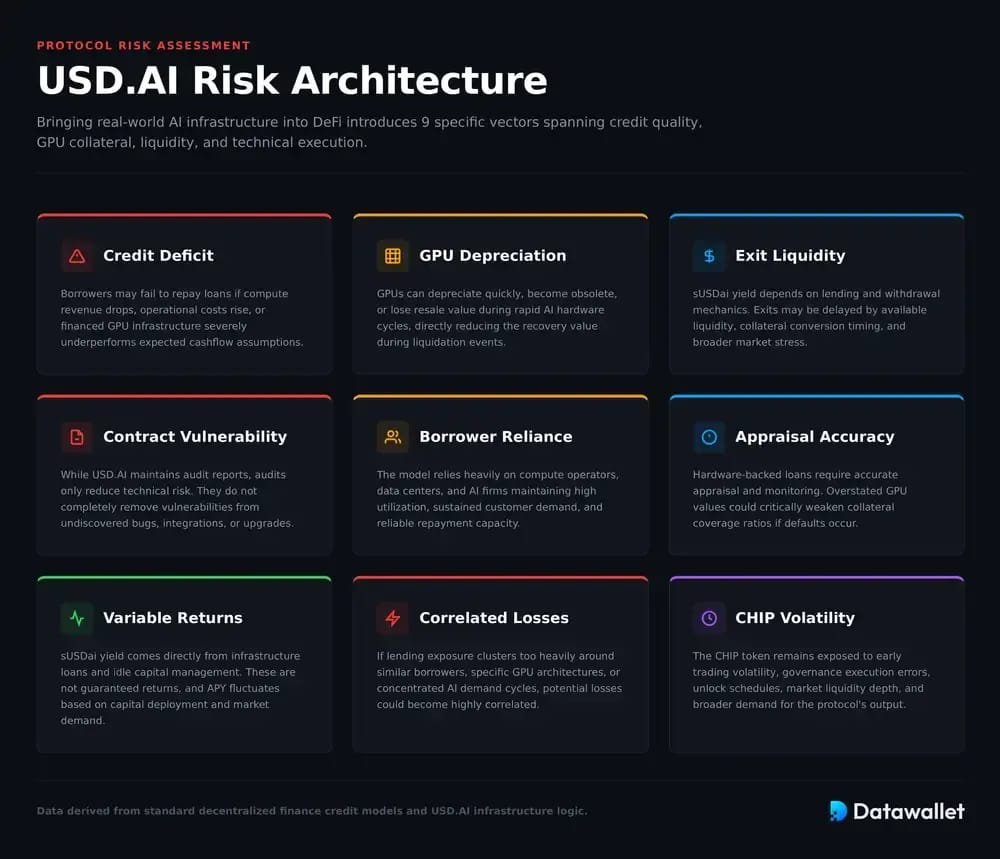
USD.AI brings real-world AI infrastructure into DeFi, but that also creates risks around credit quality, GPU collateral, liquidity, smart contracts, borrower repayment, and market demand for compute-backed yield.
Key risks users should understand include:
- Credit: Borrowers may fail to repay loans if compute revenue drops, costs rise, or financed GPU infrastructure underperforms expected cashflow assumptions.
- Collateral: GPUs can depreciate quickly, become obsolete, or lose resale value during AI hardware cycles, reducing recovery value during defaults.
- Liquidity: sUSDai yield depends on lending and withdrawal mechanics, so exits may be affected by available liquidity, collateral timing, and market stress.
- Smart Contracts: USD.AI has audit reports listed, but audits reduce technical risk rather than removing risks from bugs, integrations, or protocol upgrades.
- Borrowers: The model depends on compute operators, data centers, and AI infrastructure firms maintaining utilization, customer demand, and reliable repayment capacity.
- Valuation: Hardware-backed loans require accurate appraisal and monitoring, because overstated GPU values could weaken collateral coverage during liquidation events.
- Yield: sUSDai yield comes from infrastructure loans and idle capital management, not guaranteed returns, so APY can change with deployment and demand.
- Concentration: If lending exposure clusters around similar borrowers, GPU types, data centers, or AI demand cycles, losses could become correlated.
- Token: CHIP remains exposed to early trading volatility, governance execution, unlock schedules, market liquidity, and broader demand for USD.AI products.
Final Thoughts
USD.AI is trying to turn AI infrastructure demand into a DeFi-native credit market. Its core pitch is simple: stablecoin liquidity can help finance GPUs, while depositors access yield linked to real compute demand.
The project is ambitious because it combines synthetic dollars, private credit, hardware collateral, and AI infrastructure into one system. That makes it more differentiated than many RWA products, but also more complex for users.
For readers, USD.AI is best understood as an infrastructure finance experiment, not just another stablecoin protocol. Its success depends on disciplined underwriting, sustainable borrower demand, risk controls, and adoption across DeFi markets.
.webp)