






Who is Michael Saylor?
Michael Saylor is an American software entrepreneur who turned a mid-sized analytics business into a publicly traded Bitcoin holding company. He was CEO from its founding in 1989 until August 2022. Phong Le then took over daily operations as Saylor became Executive Chairman, focused on Bitcoin acquisitions.
Since 2020, Saylor has built his public profile around the argument that companies should hold their reserves in Bitcoin and raise capital to buy more. He points to cash's declining purchasing power and Bitcoin's fixed supply of 21 million coins. Most Strategy purchases are first announced on his @saylor account on X.
That conviction made him a billionaire twice. SEC filings make his Strategy shareholding relatively straightforward to value. His full personal balance sheet is not public, so his overall net worth remains an estimate.

Michael Saylor's Background
Saylor lost most of his dot-com fortune after an accounting restatement at the software company he had built. He later rebuilt that fortune by shifting the same business into Bitcoin.
Early Life and MIT
Saylor was born in Lincoln, Nebraska, on February 4, 1965. He grew up on US Air Force bases where his father was stationed, before the family settled near Dayton, Ohio. An Air Force ROTC scholarship took him to MIT, where he completed degrees in aeronautics and astronautics and in science, technology, and society in 1987.
After graduation, consulting work took him into computer simulation modeling for industrial clients, including DuPont. The experience convinced him that large companies would pay for software that turned data into decisions.
Building MicroStrategy
In 1989, aged 24, Saylor founded MicroStrategy with his MIT classmate Sanju Bansal. A DuPont consulting contract supplied the initial funding. The company sold business intelligence software that let managers query large databases without writing code, and its MSTR shares began trading on Nasdaq in 1998.
The Dot-Com Collapse and SEC Settlement
By early 2000, Saylor's stake was worth roughly $7 billion on paper. MicroStrategy announced on March 20, 2000, that it had booked contract revenue too early and would restate earlier results. The shares collapsed in a single session. Forbes estimates that he lost about $6 billion that day.
The SEC brought civil accounting fraud charges against Saylor and two other executives. He settled in December 2000 without admitting or denying the allegations, paying a $350,000 penalty plus disgorgement of $8.28 million. Disgorgement means returning gains linked to the conduct. MicroStrategy never filed for bankruptcy and remained a slow-growing software vendor for the next two decades.
The Bitcoin Pivot
In a December 2013 post, Saylor dismissed Bitcoin, writing that its days were numbered. The pandemic-era expansion of the money supply changed his view. On August 11, 2020, MicroStrategy announced it had bought 21,454 BTC for $250 million as its primary treasury reserve asset.
To keep buying, MicroStrategy soon turned from spare cash to outside capital. It issued convertible notes, bonds that can become shares, alongside at-the-market stock programs that release new shares gradually at the prevailing price. Nearly all the proceeds funded Bitcoin purchases.
From MicroStrategy to Strategy
The company adopted the Strategy brand in February 2025, followed by the legal name Strategy Inc in August 2025. That year it also listed four classes of perpetual preferred stock on Nasdaq, offering dividends without a maturity date. Saylor calls these securities Digital Credit, and they now fund most new Bitcoin purchases.
.webp)
Michael Saylor's Net Worth in 2026
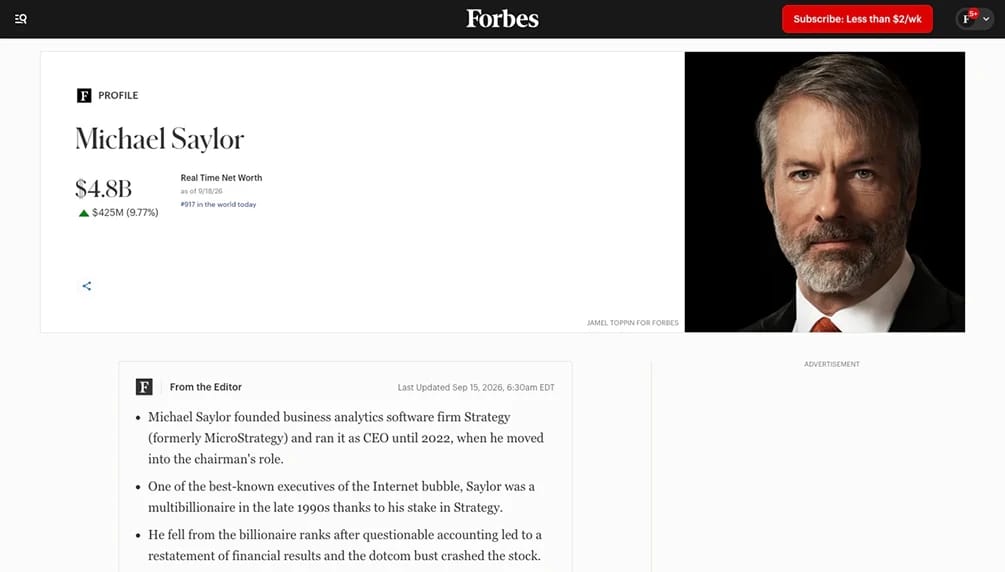
Forbes estimated Saylor’s net worth at $4.8 billion as of September 18, 2026. The breakdown below uses approximate mid-September asset values. We value his Class B shares using the quoted MSTR price and use his disclosed 2020 Bitcoin holding as an assumption.
- Strategy shares: Saylor owns 19,616,680 shares of Class B stock, according to the quarterly report for June 30, 2026. That stake is worth about $2.6 billion with MSTR trading in the low $130s in mid-September.
- Personal Bitcoin: In October 2020, he disclosed 17,732 BTC purchased for roughly $175 million. The holding is worth about $1.43 billion at a Bitcoin price near $81,000 in mid-September.
- Historical share-sale proceeds: CNBC reported in April 2024 that Saylor had generated about $370 million before tax from exercising and selling Strategy shares under a prearranged trading plan. Those historical proceeds do not establish his current cash balance.
- Property and yachts: He lives in a waterfront estate on Indian Creek in Miami Beach and has owned the 154-foot motor yacht Usher since 2013. Neither has a publicly recorded valuation, and both are small relative to his shares and Bitcoin.
The shares and Bitcoin total approximately $4.03 billion using the rounded valuations above, about $770 million below Forbes’ estimate. That difference cannot be reliably assigned to cash, property or other assets without a complete account of his current assets and liabilities.
Repeated Class A stock issuance has also reduced his control of Strategy. Each Class B share carries ten votes, but his voting power fell from 40.1% in the 2025 annual report to 35.8% at the end of June. His economic stake is below 6% of the roughly 346 million common shares counted in the April proxy statement.
How Much Bitcoin Does Michael Saylor Own?
Strategy owns its corporate Bitcoin. Saylor’s financial exposure to those holdings is reflected in the value of his Strategy shares. Adding the company’s Bitcoin separately to his personal wealth would count that exposure twice.
The personal figure comes from an October 28, 2020 disclosure, when Saylor reported holding 17,732 BTC purchased at an average of $9,882 each. His current personal balance has not been independently verified.
On August 3, 2026, Saylor said he had never sold his personal Bitcoin. That statement does not establish whether he has made additional purchases. We use the disclosed 17,732 BTC when estimating the value of his personal holdings.
.webp)
Strategy's Bitcoin Treasury
Strategy held 845,050 BTC on September 7, 2026, acquired for $63.73 billion at an average of $75,412 per coin. The holding represents about 4% of all Bitcoin that will ever exist and puts Strategy ahead of every company on our Bitcoin treasuries tracker. It also overtook BlackRock's IBIT fund in April.
Bitcoin spent much of 2026 below Strategy's cost basis. From a peak above $126,000 in October 2025, it fell to roughly $57,000 on July 1. Since 2025, accounting rules have required Strategy to value its coins at market prices each quarter, sending price declines directly into reported earnings.
Strategy reported a $12.4 billion net loss in the fourth quarter of 2025 and an $8.22 billion net loss in the second quarter of 2026, almost all unrealized. At $81,000 per Bitcoin, the 845,050 BTC treasury would be worth approximately $68.45 billion, about $4.72 billion above its stated acquisition cost of $63.73 billion.
When Strategy Started Selling Bitcoin
For six years, Saylor told audiences never to sell. Until 2026, Strategy's only disposal had been a small December 2022 sale for tax reasons. Dividend obligations and a falling share price ended that record.
- May 26 to 31: Strategy sold 32 BTC for $2.5 million to fund preferred dividends.
- June 29: The board approved a Digital Credit Capital Framework that included a BTC Monetization Program. It allows up to $1.25 billion in Bitcoin sales to replenish a US dollar reserve, plus further sales for dividends, interest and buybacks.
- June 29 to July 5: Strategy sold 3,588 BTC for $216 million at prices near $60,000, well below its average cost.
- July 27 to August 9: Two more weekly sales totaled 1,638 BTC and 1,690 BTC, raising a combined $213 million, partly for preferred share repurchases.
- August 24 to 30: Strategy resumed buying, adding 4,603 BTC and taking its holdings from 840,447 BTC to the current 845,050.
Those sales totaled about 6,950 BTC for roughly $432 million. CEO Phong Le described the change as active capital management, telling analysts that Strategy had bought 174,895 BTC and sold 3,620 in the year to July. Saylor's explanation on the same call was more blunt. "Maybe the best way to buy the most Bitcoin is not to buy the most Bitcoin."
.webp)
Risks to Saylor's Fortune
With so much of Saylor's wealth concentrated in MSTR, threats to the stock affect his personal fortune. Three risks are active now.
- Index exclusion: In January, MSCI dropped a proposal to remove companies with more than 50% of their assets in crypto. A second consultation, opened on August 3, targets non-operating companies. Strategy's response gives a September 30 feedback deadline, an October 16 decision and a December 1 effective date. It also says MSCI-linked funds hold only 3.1% of its shares.
- A lower Bitcoin valuation multiple: By the end of August, Strategy’s common-equity market value was 0.78 times its gross Bitcoin value on a basic share count. Issuing common shares below the gross Bitcoin value per share and using the proceeds to buy Bitcoin would reduce Bitcoin per existing share. Assessing the value available to common shareholders also requires accounting for debt, preferred claims and cash.
- Funding obligations: Dividend commitments and potential debt repayments put pressure on available cash. Strategy’s convertible notes maturing in 2028 allow holders to demand repayment on September 15, 2027. Meeting these obligations may require additional financing or Bitcoin sales, which can affect the value of its common shares.
.webp)
Michael Saylor’s Controversies and Criticism
In June 2024, Saylor and MicroStrategy reached a $40 million settlement with the District of Columbia to close a tax case. It was his second regulatory settlement after the 2000 SEC case. The Attorney General alleged that Saylor had lived in Washington for years while claiming residence elsewhere, and called it the largest income tax recovery in the District's history.
Critics remain focused on the business model's reliance on new capital. Gold supporter Peter Schiff said after the June announcement that Strategy had become a Bitcoin seller. Supporters point to its survival of a 55% Bitcoin decline without forced liquidation and to convertible notes that mature from 2028 onward.
Governance attracts quieter criticism. Saylor’s supervoting shares give him substantial influence over shareholder decisions, with 35.8% of total voting power as of June 30, 2026. He has also personally provided indemnification coverage to the company's directors and officers since June 2021, according to the proxy statement. Both arrangements tie Strategy closely to one person.
Bitcoin Forecasts and Views on Ethereum
At the Bitcoin 2024 conference, Saylor projected a price of $13 million per coin by 2045. He has since raised that figure to $21 million over roughly two decades. These rising targets come from his own models, built on assumed adoption rates, and warrant the caution due to any long-range forecast.
In May 2024, Saylor predicted that the SEC would classify Ether as a security and approve no spot Ethereum ETF. The prediction failed three weeks later when the SEC approved the exchange filings. He then told a podcast that the approval was good for Bitcoin because it legitimized the whole asset class.
Strategy continues to hold only Bitcoin. Other companies have copied the model for different assets, most visibly BitMine under Tom Lee, whose approach we cover in our Ethereum treasury thesis explainer.
Final Thoughts
Forbes estimated Michael Saylor’s net worth at $4.8 billion as of September 18, 2026. His Strategy stake and disclosed personal Bitcoin explain most of that wealth, although his full personal balance sheet is not public.
Bitcoin’s price and MSTR’s valuation remain the main drivers of changes in his estimated wealth. Strategy’s financing costs, Bitcoin sales, and potential index changes can also affect the value of his shares.
.webp)