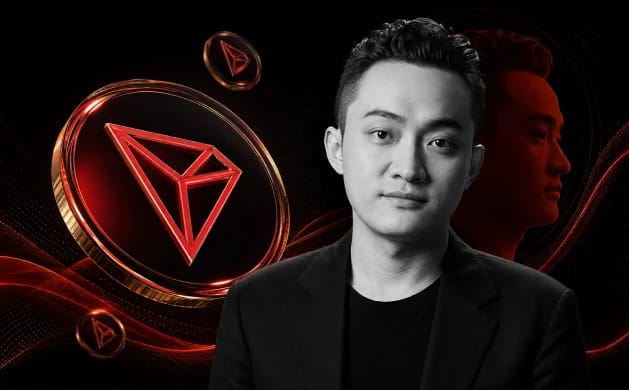



Who is Justin Sun?
Justin Sun is the crypto entrepreneur behind TRON, now the dominant settlement network for Tether's USDT stablecoin. He was born on July 30, 1990, in Xining, Qinghai. Sun holds citizenship in St. Kitts and Nevis and lives in Hong Kong.
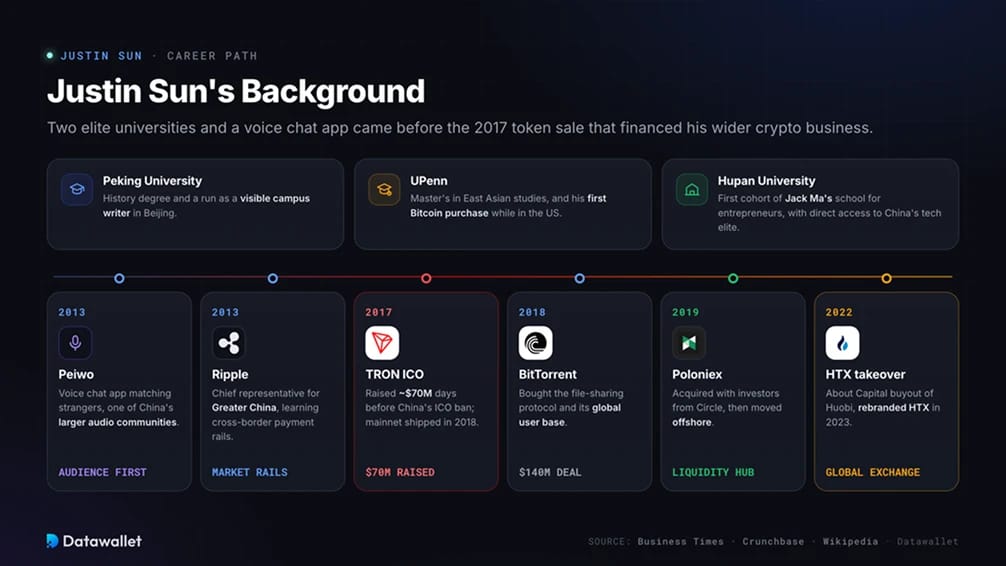
His business interests include the BitTorrent protocol, purchased for $140 million in 2018, and Poloniex, which he acquired in 2019. He also controls HTX, formerly Huobi, after taking over through an About Capital buyout in 2022 despite holding only an adviser title.
Sun mixes infrastructure deals with spectacle. In 2019, he bid $4.57 million for lunch with Warren Buffett. He ate the $6.2 million duct-taped banana from Maurizio Cattelan's Comedian in 2024, then completed a Blue Origin suborbital flight in August 2025 using a $28 million auction ticket won four years earlier.
The attention has commercial value. Sun uses his audience of more than three million X followers, under @justinsuntron, to support listings, liquidity, and retail interest across his venues.

Justin Sun's Background
Sun's career began with two elite universities and a voice chat app before moving through Ripple's China operation to the 2017 token sale that financed his wider crypto business.
Early Life and Education
After spending his early childhood in Qinghai, Sun grew up in Guangdong. He studied history at Peking University and became a visible campus writer before completing a master's in East Asian studies at the University of Pennsylvania. While living in the United States, he bought his first Bitcoin.
On returning to China, Sun joined the first cohort of Hupan University, the entrepreneurship school founded by Alibaba's Jack Ma. The experience gave the young app founder direct access to some of the country's most powerful technology figures.
Peiwo and Ripple
Sun released Peiwo in 2013. The social app matched strangers through short voice clips and grew into one of China's larger audio communities. That same year, he became Ripple Labs' chief representative for Greater China. The position taught him how exchanges and market makers interact with cross-border payment rails.
Both roles reinforced a model Sun has followed ever since: build the audience first, then attach a product to it.
Launching TRON
Sun raised roughly $70 million in TRON's 2017 initial coin offering, days before China banned the practice, and moved the project abroad. Criticism over borrowed whitepaper passages did not stop the network from shipping its own mainnet in 2018.
TRON is a layer 1 blockchain that uses delegated proof of stake, a design that trades some decentralization for speed and near-zero transfer costs. Those cheap transfers made it the preferred network for moving Tether's USDT, especially across Asia, Latin America, and Africa, and the chain now reports over 350 million user accounts.
The token economics reinforce the model. Users burn or stake TRX to pay for bandwidth and energy on the network, so every USDT transfer creates underlying demand for the coin that Sun holds in enormous quantity. TRX ranks eighth by market capitalization in 2026.
HTX (formerly Huobi)
Huobi launched in China in 2013 and grew into one of the world's largest exchanges before regulatory crackdowns pushed it offshore. In late 2022, Sun's About Capital vehicle bought a controlling stake from the founding team, and the platform rebranded as HTX the following year.
HTX gives Sun a global spot and derivatives venue that lists deep markets in TRX, BTT, and other ecosystem tokens, generating fee revenue independent of token prices. The exchange serves users across Asia and emerging markets but is barred from the United States and now faces sanctions in the UK and EU.
Poloniex
Poloniex is the older and smaller of Sun's two exchanges, founded in the United States in 2014 and briefly owned by Circle before an investor group including Sun took it over in 2019. The new owners moved it offshore and withdrew from the American market.
The platform functions mainly as a listing and liquidity hub for TRON ecosystem assets. It absorbed a hack of over $120 million in November 2023, after which Sun pledged to reimburse affected users, and Arkham still values the business at $150 million to $200 million.
Together, the three assets form a closed loop. Sun controls a blockchain, the exchanges listing its tokens, and much of the liquidity between them.
Justin Sun's Net Worth in 2026
Major wealth trackers estimate Justin Sun's 2026 net worth at between $8.5 billion and $9.5 billion. Forbes ranks him 415th among the world's billionaires. On-chain analysts at Arkham estimate $5 billion to $7 billion, citing the difficulty of pricing his private assets.
His fortune consists mainly of the following assets:
- TRX holdings: Bloomberg attributes more than 60 billion TRX to Sun, close to two-thirds of the circulating supply. It applies a 75% liquidity discount because he could not sell the full position at prevailing market prices.
- HTX equity: Sun's controlling interest in HTX is his largest off-chain asset. Estimates of its value differ by several billion dollars, making it the biggest source of disagreement between wealth trackers.
- Poloniex ownership: Arkham values the smaller exchange at roughly $150 million to $200 million, despite the $120 million hack it suffered in November 2023.
- Verified wallets: Arkham has connected Sun to more than 200 addresses holding about $2.6 billion in TRX, staked ETH, Bitcoin, and stablecoins. Few crypto billionaires have such a visible balance sheet.
- Tron Inc stake: Sun invested $18 million in the Nasdaq-listed TRX treasury company through Black Anthem Limited. The transaction closed in January 2026.
- Art and collectibles: His collection includes a Picasso and the disputed $78.4 million Giacometti sculpture Le Nez. Sun's legal team now values these assets in the nine figures.
Why the Estimates Disagree
No public filing confirms Sun's precise TRX balance or his ownership percentage in HTX. Every estimate therefore combines verified wallet holdings with assumptions about privately held equity.
Sun has challenged the calculations. In August 2025, he sued Bloomberg after the outlet prepared a detailed breakdown for its Billionaires Index using information supplied by his own team.
The concentration of his holdings creates another problem. Sun owns most of the TRX float, so analysts cannot apply the token's $31 billion market capitalization directly to his stake. Doing so would ignore the sharp price decline that a sale of that size would likely trigger, which explains the heavy valuation discounts.
.webp)
How Much Crypto Does Justin Sun Own?
Public blockchains reveal an unusually large portion of Sun's wealth. Arkham tracks around $2.6 billion across his tagged addresses. Those wallets contain roughly 1.8 billion TRX, six figures of Lido staked ETH, about 4,000 BTC, and sizeable stablecoin balances.
Other disclosed positions remain partly outside the trackers' view. Sun announced a $100 million purchase of the TRUMP memecoin in 2025 and committed about $75 million to World Liberty Financial's token sales. That investment now sits at the center of his largest legal fight.
The visible wallets represent only part of his holdings. Even after a steep discount, his broader TRX position is worth several times the value of his entire tracked on-chain portfolio.
.webp)
The World Liberty Financial Feud
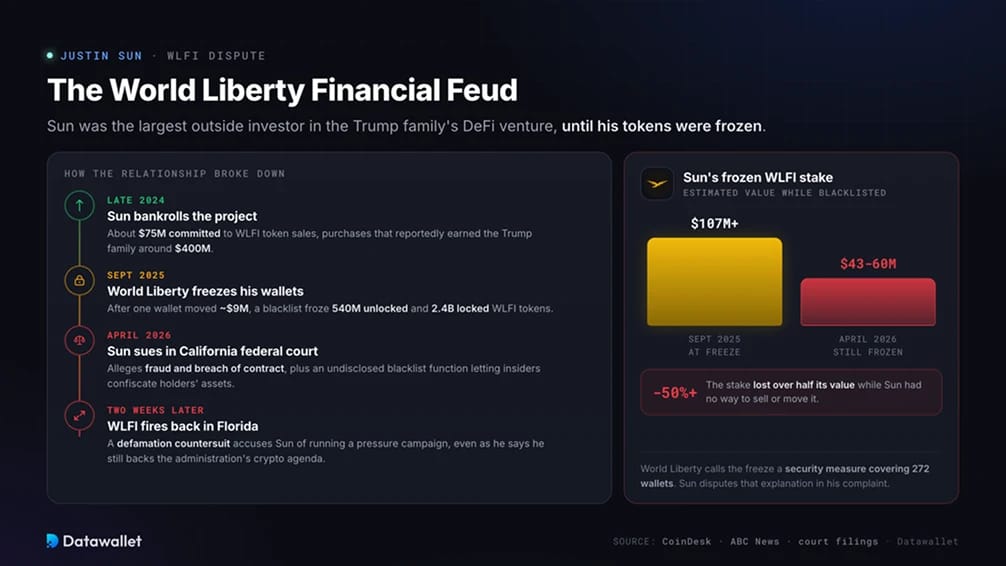
Sun became the largest outside investor in World Liberty Financial, the DeFi venture backed by President Donald Trump's family. His purchases beginning in late 2024 reportedly earned the Trumps around $400 million. The relationship later broke down.
In September 2025, World Liberty blacklisted wallets linked to Sun after one transferred about $9 million in tokens. The action froze roughly 540 million unlocked WLFI and another 2.4 billion locked tokens. While the holdings remained frozen, their estimated value fell by more than half. A stake once worth over $107 million had declined to between $43 million and $60 million by April.
Sun sued World Liberty in California federal court in April 2026. His complaint alleges fraud and breach of contract, along with the existence of an undisclosed blacklist function that allowed insiders to confiscate holders' assets.
World Liberty responded within two weeks by filing a defamation countersuit in Florida. The company accused Sun of conducting a pressure campaign. More than the frozen tokens are at risk. Sun spent 2025 presenting himself as an ally of the administration. He is now suing a company tied to the president's family while maintaining that he still supports its crypto agenda.
TRON's Stablecoin Meets Wall Street
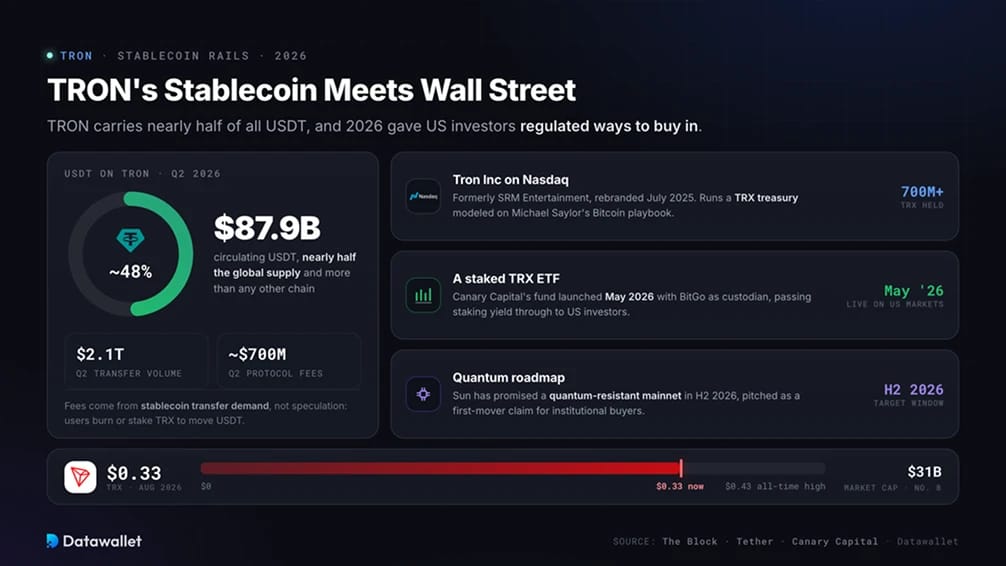
Away from the legal disputes, TRON's core network continues to expand. It ended Q2 2026 with $87.9 billion in circulating USDT, nearly half the global supply and more than any competing blockchain. Transfers reached $2.1 trillion during the quarter.
Several developments have brought TRON closer to US capital markets this year:
- Tron Inc on Nasdaq: Formerly SRM Entertainment, the company rebranded in July 2025. It now holds over 700 million TRX as a treasury asset, following the strategy Michael Saylor developed with Bitcoin and covered in our Michael Saylor net worth profile.
- A staked TRX ETF: Canary Capital launched its staked TRX fund in May 2026 with BitGo as custodian. The fund gives US investors regulated exposure to TRX while passing through staking yield.
- Fee machine economics: TRON earned close to $700 million in protocol fees during Q2. Stablecoin transfer demand, rather than speculation, generated that income.
- Quantum roadmap: Sun has promised to move TRON to a quantum-resistant mainnet during the second half of 2026. He presents the proposal as a first-mover claim aimed at institutional buyers.
TRX has performed better than most large tokens during 2026's uneven market. In August, it traded near $0.33 with a market capitalization of $31 billion, putting it within reach of its $0.43 all-time high. Our Tether (USDT) statistics hub contains further network data.
Justin Sun's Legal and Regulatory Battles
Sun has faced a busy legal calendar in 2026, with the cases producing mixed outcomes:
- SEC case dismissed: The regulator settled its 2023 fraud suit in March 2026. Rainberry Inc. agreed to pay a $10 million penalty, while all claims against Sun, the Tron Foundation, and the BitTorrent Foundation were dismissed with prejudice and without admissions. Some Democratic lawmakers criticized the result, pointing to his Trump-linked investments.
- UK sanctions on HTX: Britain sanctioned Huobi Global in May 2026 over connections to Russia-related networks, followed by the EU. Separately, the FCA's promotion lawsuit against HTX entered settlement talks under a court stay running to late August.
- The Geffen art case: Sun is suing David Geffen to recover Le Nez. He claims a former adviser sold the sculpture without authority, while Geffen's countersuit characterizes the dispute as seller's remorse.
- The TUSD reserve dispute: Sun alleges that $456 million backing the TrueUSD stablecoin was diverted into unauthorized investments. The dispute extends across courts in Hong Kong and Dubai after he injected roughly $500 million to keep the token stable.
A consistent pattern runs through these cases. Sun litigates aggressively, accepts settlements when the price is suitable, and uses court proceedings as part of his public relations strategy.
Final Thoughts
Justin Sun enters late 2026 with an estimated net worth of roughly $8.5 billion to $9.5 billion. The SEC case that had clouded his American ambitions since 2023 is now closed following a $10 million corporate penalty.
Much of that fortune cannot be spent freely. The concentrated TRX position makes Sun a multibillionaire, but it is also the asset he can least afford to sell. A large disposal would undermine the market supporting its value.
His risks now run in several directions. TRON's stablecoin dominance produces substantial fee income, while the Nasdaq vehicle and staked ETF bring in traditional capital. The World Liberty lawsuit will test whether Sun's political bet in Washington has changed from an asset into a liability.