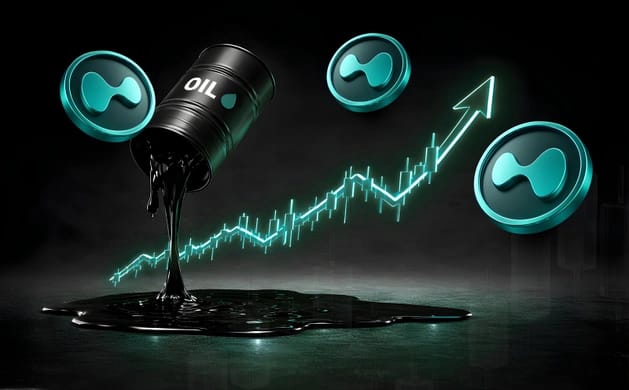




The current energy market is in a state of historic upheaval. With the Strait of Hormuz effectively closed, Brent crude recently spiked to $119 per barrel, marking the largest supply disruption in history.
Traders are now flocking to Hyperliquid to hedge against this unprecedented 2026 volatility using oil perpetual contracts through crypto-collateralized positions.
Use the following guide to understand how to trade energy assets 24/7 completely onchain. 👇
What Are Oil Perpetual Contracts?
Oil perpetual contracts are decentralized derivatives that track crude prices without the traditional burden of expiration dates. On Hyperliquid, traders can use up to 20x leverage to gain exposure to energy markets using $USDC or $USDH as the underlying collateral.
This framework allows participants to speculate on oil price movements without ever handling physical barrels or rolling monthly futures. To ensure the contract price remains tethered to real-world values, a funding mechanism adjusts balances every 1 hour.
The Wall Street Journal notes that these perpetuals are bypassing the "clunky mechanics" of legacy commodity trading. By leveraging the HIP-3 architecture, Hyperliquid provides a streamlined environment where traders manage energy positions with instantaneous execution and lower friction.
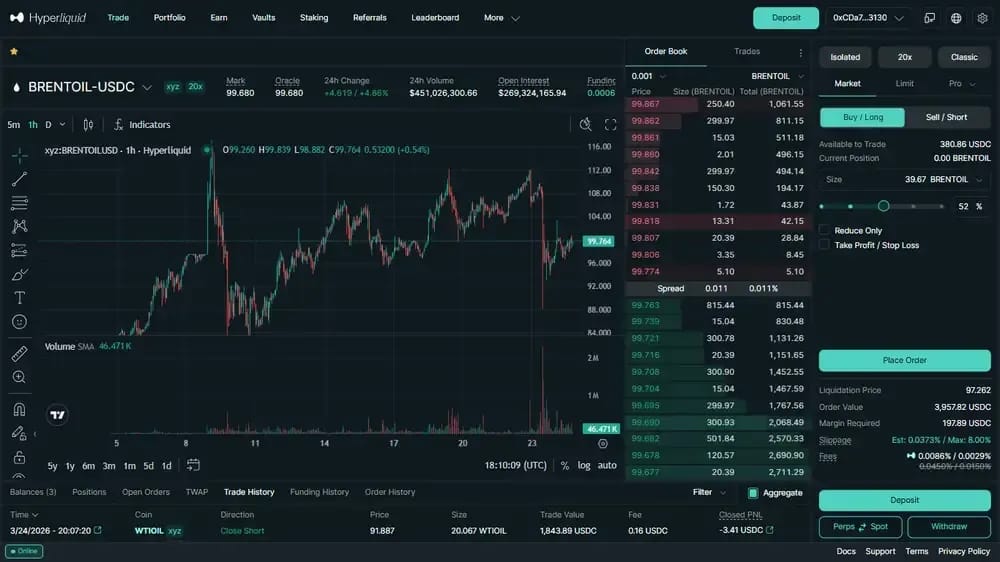
How Do Oil Perpetuals on Hyperliquid Work?
Oil perpetuals on Hyperliquid operate as a decentralized synthetic market, utilizing a unique peer-to-peer architecture to mirror global crude prices without physical settlement.
We will now examine the specific components that enable oil perps:
- Trade[XYZ] Integration: This protocol acts as the primary builder, utilizing the HIP-3 framework to deploy officially licensed WTI and Brent crude oil contracts.
- HyperStone Oracles: Specialized data feeds provide sub-second price updates, ensuring the onchain mark price tracks global energy metrics with institutional-grade precision.
- 500,000 HYPE Stake: Trade[XYZ] must maintain this bond as collateral to ensure market integrity and prevent malicious manipulation of the oil feeds.
- 20x Leverage Limit: Traders can control positions twenty times their collateral, reflecting the standard cap for commodity assets to manage extreme energy volatility.
- Hourly Funding Rate: A peer-to-peer exchange occurs every 1 hour, where longs pay shorts (or vice versa) to keep the contract tethered to spot.
- USDC Settlement: All margin requirements and PnL are denominated in $USDC, removing the need for physical delivery or complex cash settlement in USD.
- Isolated Margin: This mandatory mode for HIP-3 assets confines potential losses to a single trade, protecting the user's broader account balance from liquidation.
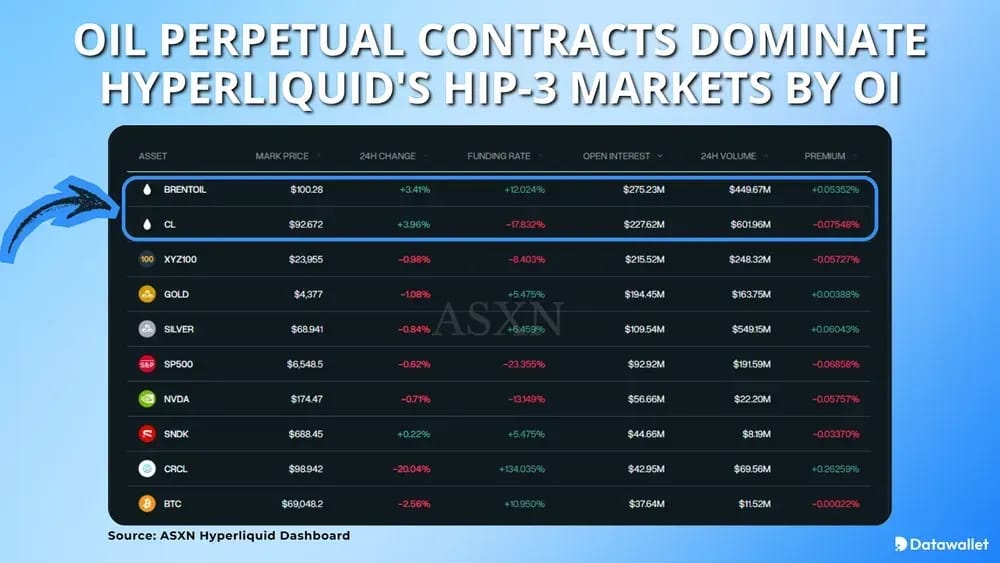
- Open Interest Caps: The protocol enforces strict notional limits, such as the $500 million cap on CL-USDC, to prevent systemic risk within the ecosystem.
- HIP-3 Fee Share: Trading costs are split 50/50 between the Hyperliquid protocol and the deployer, incentivizing Trade[XYZ] to maintain deep, consistent liquidity.
- Onchain Order Book: Every bid and ask is processed by the HyperCore L1, allowing for transparent, sub-second execution even during high-volatility geopolitical events.
How to Trade Oil Perpetual Contracts on Hyperliquid
To trade oil on Hyperliquid, you must connect a Web3 wallet, bridge collateral to the native L1, and execute orders via the decentralized order book.
1. Account Creation
- Connect Wallet: Visit Hyperliquid and link a crypto wallet like MetaMask, Rabby, or Coinbase Wallet to establish your non-custodial trading identity.
- Fee Discount: New users using a referral code during setup to secure a 4% fee discount on your initial $25 million in trading volume.
- Enable Trading: Sign the one-time request to create your onchain trading account, allowing for gasless order execution within the platform.
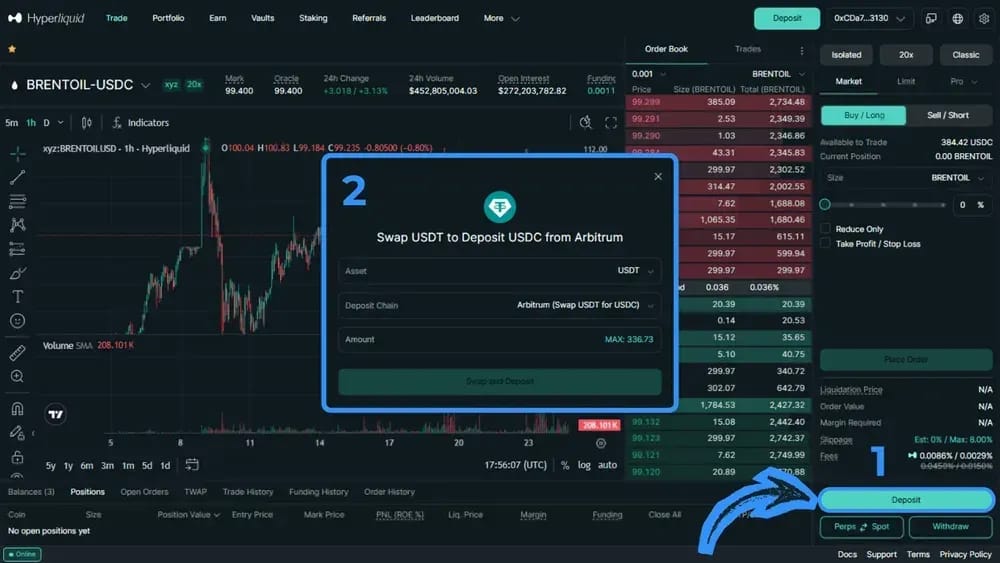
2. Funding Your Account
- Direct Deposit: Transfer $USDC directly from the Arbitrum network into your Hyperliquid address to begin with native collateral.
- Multi-Chain Bridging: Use the "Deposit" tab to bridge assets from Ethereum, Optimism, or Polygon via integrated providers like Across or Squid.
- Cross-Asset Conversion: Convert various stablecoins or tokens into $USDC or $USDH during the bridge process to satisfy the specific collateral requirements.
3. Placing a Trade
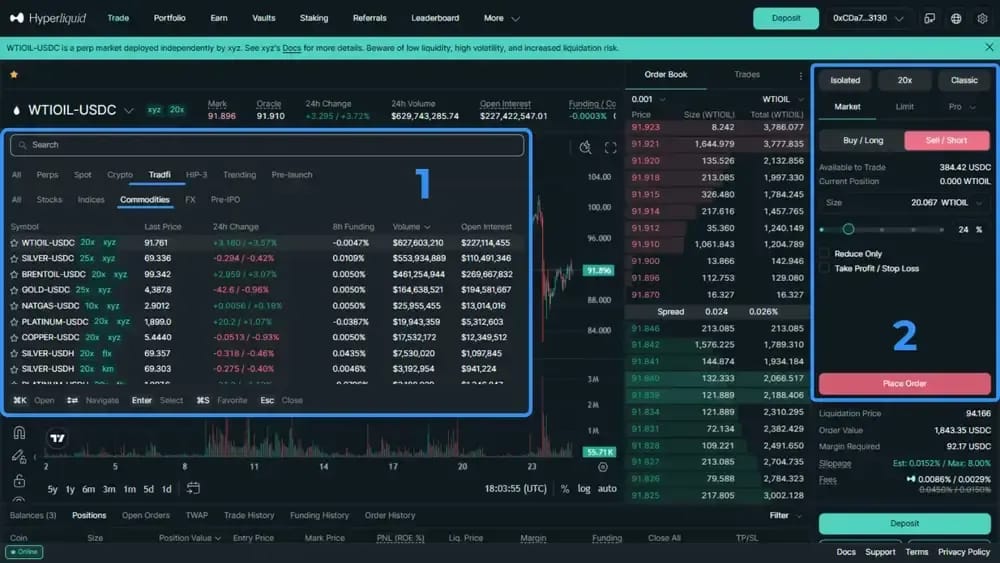
- Select Market: Navigate to the Tradfi or Commodities tab and choose oil contracts like WTIOIL-USDC or BRENTOIL-USDC.
- Set Leverage: Adjust your leverage slider; while oil perps support a maximum of 20x, you can select lower levels to manage risk.
- Order Selection: Choose a Limit Order for specific price entry or a Market Order for instant execution at current liquidity prices.
- Confirm Position: Input your size in barrels or $USDC and click "Buy/Long" or "Sell/Short" to broadcast your trade to the chain.
4. Monitoring Your Trade
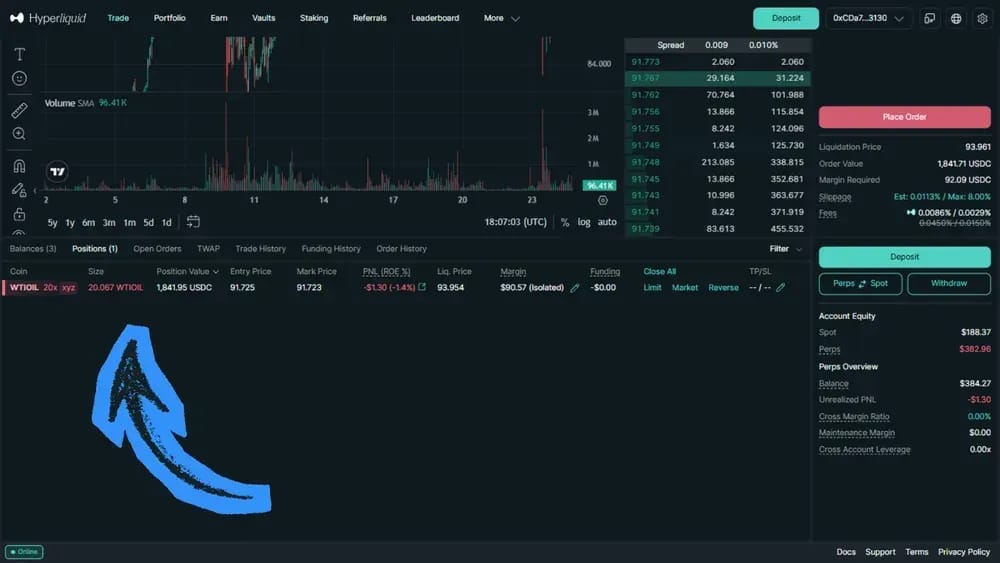
- Dashboard Tracking: View your live Unrealized PnL, entry price, and the current mark price within the "Positions" tab.
- Risk Management: Set Take Profit and Stop Loss triggers to automate your exit strategy and protect against sharp price reversals.
- Funding Cycles: Monitor the 8h Funding rate displayed next to the pair name to understand the cost of holding your position.
- Margin Adjustments: Add or remove collateral from an Isolated Margin position to manually change your liquidation price as market conditions fluctuate.
Hyperliquid Oil Perpetual Contracts Comparison
Hyperliquid hosts several oil perpetuals via the HIP-3 framework, allowing traders to choose between $USDC or $USDH collateral and various leverage caps for crude.
Note: While Trade[XYZ] markets offer the highest liquidity and 24/7 access, the OIL-USDH contract managed by Flix includes specific restrictions that prevent opening new positions during traditional market weekend closures.
Do You Need KYC to Trade Oil Perpetuals on Hyperliquid?
Hyperliquid is a fully decentralized, permissionless exchange, meaning you can trade oil perpetuals directly from your Web3 wallet without ever completing a KYC verification process or submitting personal identification documents.
However, the platform enforces strict geo-blocking via its interface to comply with global regulations. Access is prohibited for users in the United States, Ontario (Canada), the United Kingdom, and sanctioned regions like Iran or North Korea.
Risks of Trading Oil Perpetuals on Hyperliquid
Trading synthetic oil with high leverage introduces unique dangers, particularly concerning the divergence between decentralized 24/7 pricing and traditional commodity exchange hours.
Below are the primary risk factors you must manage when holding oil positions:
- Weekend Price Gaps: Traditional exchanges like CME close on weekends; major news can cause massive price gaps upon reopening, potentially triggering instant, unavoidable liquidations.
- 20x Leverage Volatility: At maximum leverage, a 5% move against your position results in total collateral loss, a common occurrence in volatile energy markets.
- Oracle Re-anchoring: The "cage" mechanism limits weekend volatility; however, if prices hit boundaries, the system re-anchors, suddenly moving your liquidation price significantly.
- Hourly Funding Costs: Funding is paid every 1 hour; in crowded trades, high costs can rapidly erode your capital even if prices remain stagnant.
- Smart Contract Vulnerability: Collateral safety relies entirely on code; any unforeseen smart contract exploit in the clearinghouse or HIP-3 logic could lead to permanent fund loss.
- Liquidity Slippage: Oil perpetuals have thinner order books than Bitcoin; large market orders may execute at much worse prices than the visible mid-market.
- Synthetic Basis Risk: Prices are synthetic representations; they may deviate from true WTI or Brent spot prices during extreme network congestion or imbalances.
- No Negative Balance Protection: As a decentralized exchange, no insurance fund exists for individuals; large gaps can cause immediate liquidation at the next available price.
Final Thoughts
Hyperliquid’s introduction of oil perpetuals marks a pivot in onchain finance by providing high-speed, decentralized access to the $100 trillion global energy market for any user with a crypto wallet.
By leveraging the HIP-3 framework and 20x leverage, traders now bypass the traditional hurdles of legacy commodity brokers. This 24/7 access allows for more reactive positioning during volatile geopolitical shifts and weekend events.
While these tools offer institutional-grade efficiency, the inherent risks of energy volatility and synthetic pricing require disciplined management. Maintaining adequate margin is essential to surviving the unique price gaps found in oil.