


Which Countries Ban USDT Outright?
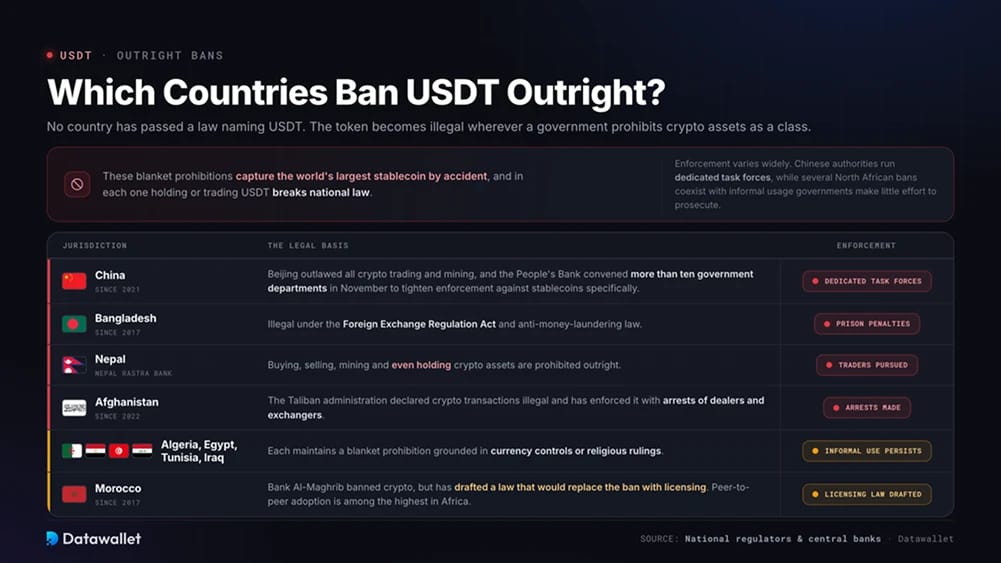
No country has passed a law naming USDT specifically. The token becomes illegal wherever a government prohibits crypto assets as a class, and those blanket bans capture the world's largest stablecoin.
These are the jurisdictions where holding or trading USDT breaks national law:
- China: Beijing outlawed all crypto trading and mining in 2021, and the People's Bank of China convened more than ten government departments in November to tighten enforcement against stablecoins specifically, citing illegal currency exchange and capital flight.
- Bangladesh: All crypto activity has been illegal since 2017 under the Foreign Exchange Regulation Act and anti-money-laundering law, and violations carry criminal penalties including imprisonment.
- Nepal: The Nepal Rastra Bank prohibits buying, selling, mining, and holding crypto assets, and authorities pursue traders who breach the ban.
- Afghanistan: The Taliban administration declared crypto transactions illegal in 2022 and has enforced the prohibition with arrests of dealers and exchangers.
- Algeria, Egypt, Tunisia, Iraq: Each maintains a blanket prohibition grounded in currency controls or religious rulings.
- Morocco: Bank Al-Maghrib banned crypto in 2017, though the central bank has drafted a law that would replace the prohibition with a licensing regime, and adoption through peer-to-peer trading remains among the highest in Africa.
Enforcement varies across this group. Chinese authorities pursue stablecoin networks with dedicated task forces, while several North African bans coexist with informal usage that governments make little effort to prosecute.
Sanctioned Territories Blocked by Tether
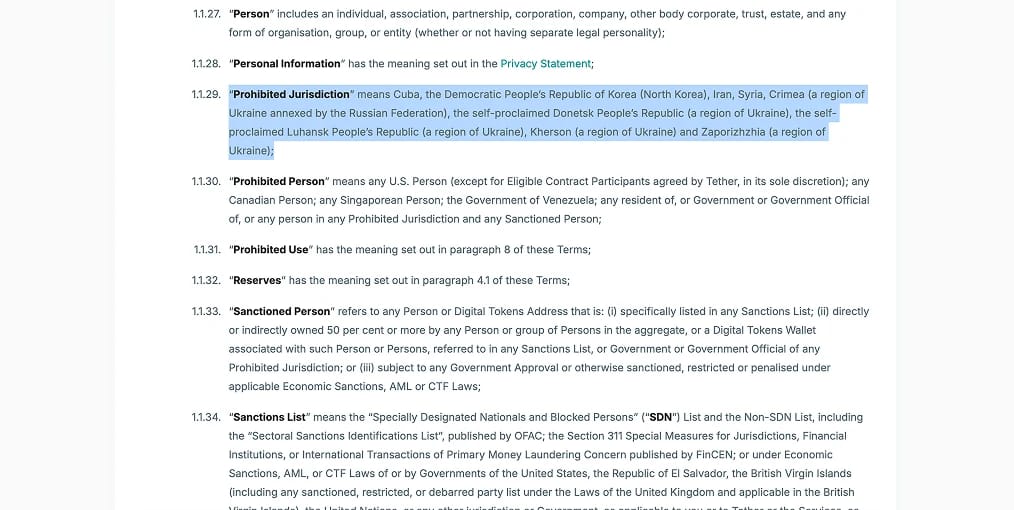
Tether enforces a second layer of restrictions that applies regardless of local law. The company's terms of service prohibit any dealings with sanctioned persons and jurisdictions, and its limited functionality list bars residents of Cuba, Iran, North Korea, Syria, Crimea, and the Government of Venezuela from its platform.
The distinction between the token and the platform matters. Canada and Singapore also appear on the platform restriction list, yet residents of both can legally hold and trade USDT through local exchanges. The restriction covers direct issuance and redemption with Tether itself, a service almost no retail holder uses.
Comprehensive OFAC sanctions drive the territorial blocks. Because Tether can freeze tokens at the contract level, a sanctioned jurisdiction faces a harder barrier with USDT than with bitcoin, where no issuer exists to enforce a blacklist.
Why USDT Left Regulated EU Exchanges Under MiCA
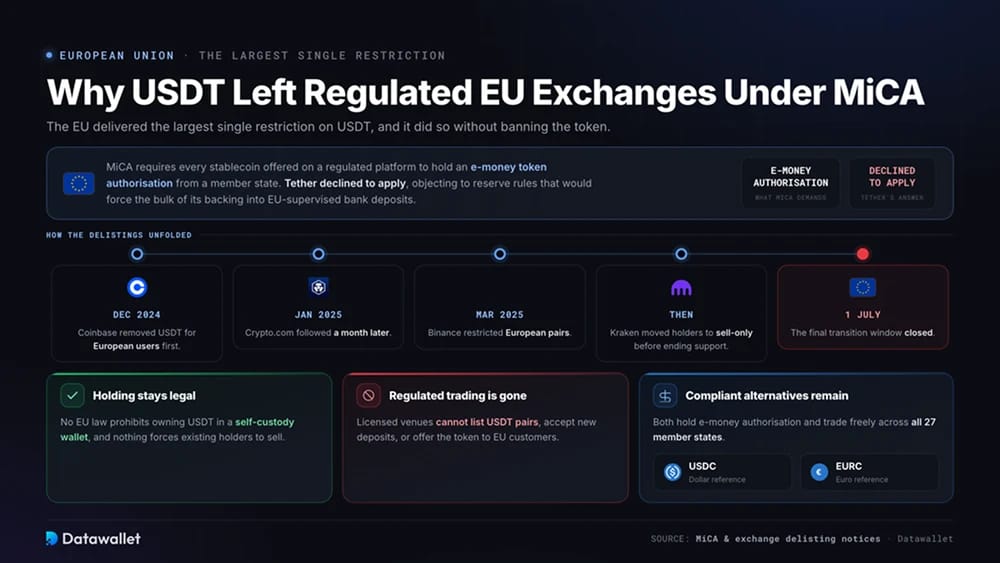
The European Union delivered the largest single restriction on USDT, and it did so without banning the token. MiCA, the EU rulebook for crypto assets, requires every stablecoin offered on a regulated platform to hold an e-money token authorisation from a member state. Tether declined to apply, objecting to reserve rules that would force the bulk of its backing into EU-supervised bank deposits.
Delistings unfolded in stages. Coinbase removed USDT for European users in December 2024, Crypto.com followed a month later, Binance restricted European pairs the following March, and Kraken moved holders to sell-only mode before ending support. The final transition window closed on 1 July, which ended USDT's presence on every MiCA-licensed order book.
What the rules mean for anyone in the EU:
- Holding stays legal: No EU law prohibits owning USDT in a self-custody wallet, and nothing forces existing holders to sell.
- Regulated trading is gone: Licensed venues cannot list USDT pairs, accept new USDT deposits, or offer the token to EU customers.
- Compliant alternatives remain: USDC and EURC hold e-money authorisation and trade freely on MiCA-licensed exchanges across all 27 member states.
Our guide to buying USDT in Europe covers the remaining options, including platforms outside the MiCA perimeter.
Is USDT Legal in the US?
Yes, USDT remains legal to hold and trade across the United States, though a regulatory clock is running. The GENIUS Act, signed in July 2025, created the first federal framework for stablecoins and gave foreign issuers a transition period that expires on 18 July 2028. After that date, US platforms cannot offer stablecoins from issuers that fail the law's reserve and supervision tests.
Tether faces a compliance gap. Roughly a quarter of USDT's reserves sit in bitcoin, precious metals, and secured loans, none of which qualify under rules that demand cash and short-term US Treasuries. The company responded in January by launching USAT, a separate US-regulated stablecoin issued through federally chartered Anchorage Digital Bank, while it pursues a Treasury reciprocity determination that would keep USDT itself eligible.
For now nothing changes for American users, and our guide on how to buy USDT in the USA lists the exchanges that support it.
Countries That Allow USDT Trading but Ban Payments
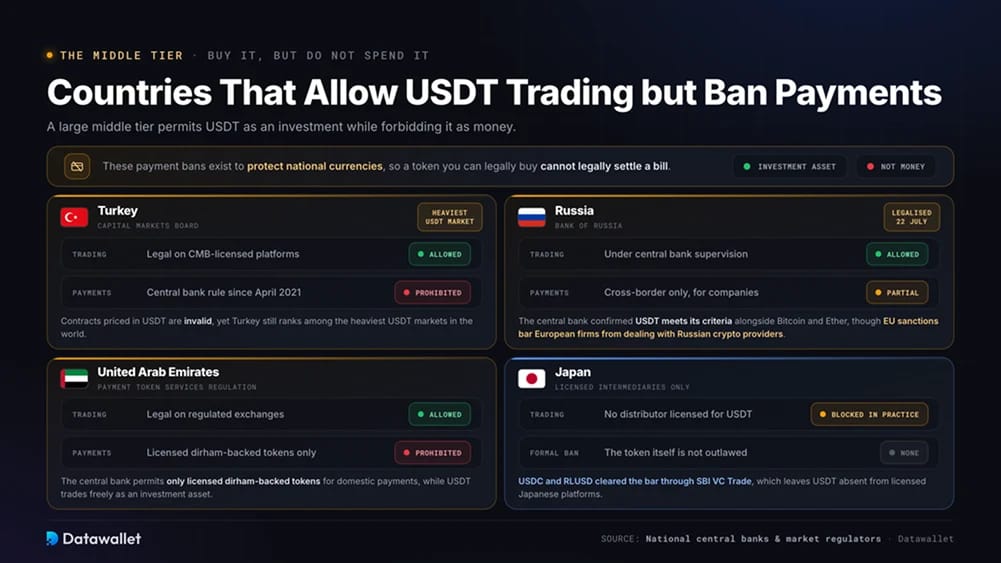
A large middle tier permits USDT as an investment while forbidding it as money. These payment bans exist to protect national currencies, so a token you can legally buy cannot legally settle a bill.
- Turkey: Crypto ownership and trading are legal on platforms licensed by the Capital Markets Board, but a central bank regulation has prohibited crypto payments since April 2021, so contracts priced in USDT are invalid. Turkey still ranks among the heaviest USDT markets, as our guide to buying USDT in Turkey explains.
- Russia: A law passed on 22 July legalises crypto trading under Bank of Russia supervision, and the central bank has confirmed USDT meets its criteria alongside Bitcoin and Ether. Companies may use crypto for cross-border settlement, while domestic payments stay illegal and EU sanctions now prohibit European firms from dealing with any Russian crypto service provider.
- United Arab Emirates: The central bank's Payment Token Services Regulation permits only licensed dirham-backed tokens for domestic payments, yet USDT trades legally on regulated exchanges as an investment asset, a split covered in our guide to buying USDT in the UAE.
- Japan: Foreign stablecoins may only reach residents through licensed intermediaries, and no distributor has been licensed for USDT. USDC and RLUSD have cleared the bar through SBI VC Trade, which leaves USDT absent from licensed Japanese platforms without being formally banned.
Countries Where USDT Is Legal and Regulated
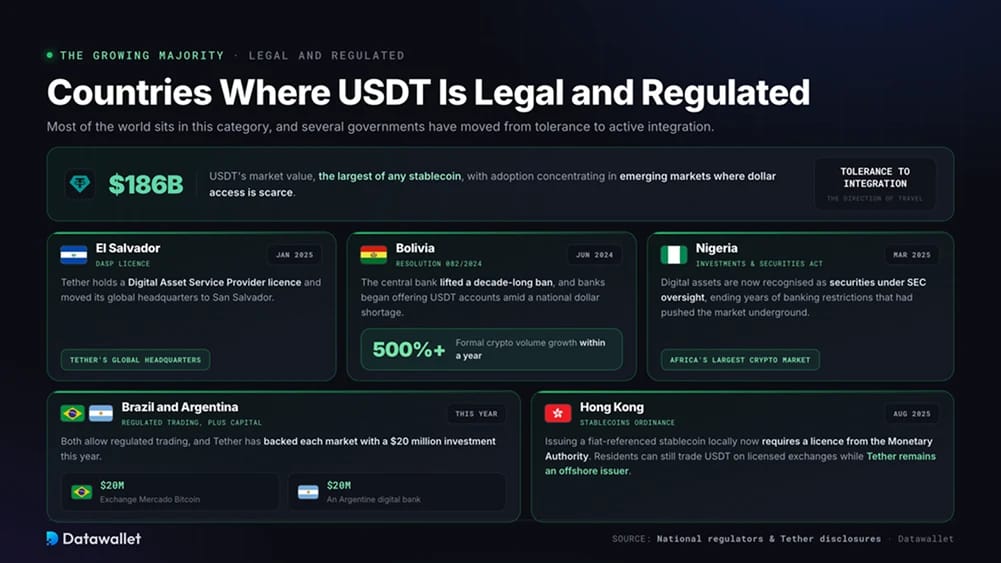
Most of the world sits in this category, and several governments have moved from tolerance to active integration. USDT carries a market value near $186 billion, the largest of any stablecoin, and the usage statistics show adoption concentrating in emerging markets where dollar access is scarce.
The most consequential legal markets:
- El Salvador: Tether holds a Digital Asset Service Provider licence and moved its global headquarters to San Salvador in January 2025.
- Bolivia: The central bank lifted a decade-long crypto ban in June 2024 through Board Resolution 082/2024, and formal crypto volumes grew more than 500% within a year as banks began offering USDT accounts to customers facing a national dollar shortage.
- Nigeria: The Investments and Securities Act, signed in March 2025, recognises digital assets as securities under SEC oversight, ending years of banking restrictions that had pushed Africa's largest crypto market underground.
- Brazil and Argentina: Both allow regulated trading, and Tether has backed each market this year with $20 million investments in exchange Mercado Bitcoin and an Argentine digital bank.
- Hong Kong: The Stablecoins Ordinance took effect in August 2025 and requires a licence from the Monetary Authority to issue fiat-referenced stablecoins locally, though residents can still trade USDT on licensed exchanges while Tether remains an offshore issuer.
Anyone comparing venues can start with our ranking of the best USDT exchanges, which weighs liquidity, fees, and licensing by region.
How Tether Freezes Wallets and Enforces Sanctions
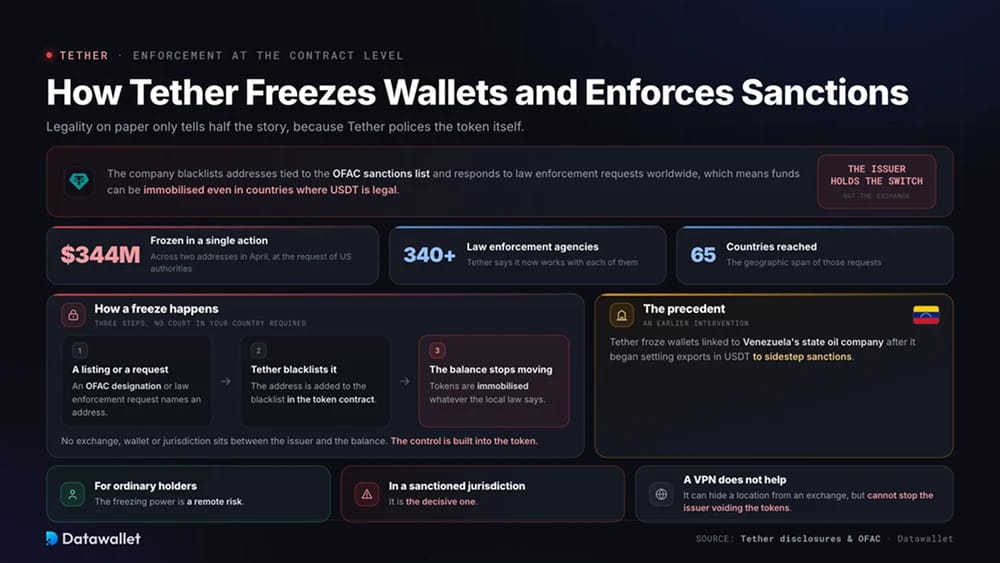
Legality on paper only tells half the story, because Tether polices the token at the contract level. The company blacklists addresses tied to the OFAC sanctions list and responds to law enforcement requests worldwide, which means funds can be immobilised even in countries where USDT is legal.
Freezing volumes have grown sharply. Tether supported a freeze of more than $344 million across two addresses in April at the request of US authorities, and the company says it now works with over 340 law enforcement agencies in 65 countries. Earlier interventions targeted wallets linked to Venezuela's state oil company after it began settling exports in USDT to sidestep sanctions.
For ordinary holders the freezing power is a remote risk. For anyone in a sanctioned jurisdiction it is the decisive one, since a VPN can hide a location from an exchange but cannot stop the issuer from voiding the tokens.
Final Thoughts
The USDT map divides into four zones rather than a simple legal and illegal split. A shrinking group of countries bans the token outright, sanctioned territories are locked out by the issuer itself, a middle tier permits trading while blocking payments, and a growing majority regulates it openly.
Movement has run in both directions this year. The EU closed its regulated market to USDT under MiCA, while Russia and Bolivia travelled the opposite way, and the US deadline in 2028 will decide whether the world's largest stablecoin keeps its place in its deepest capital market.
We expect the list to keep shifting, so anyone relying on USDT in a specific country should verify current rules with the local regulator, since penalties in the banned jurisdictions range from account closures to criminal prosecution.