







Can I Buy Bitcoin with Raiffeisen Bank?
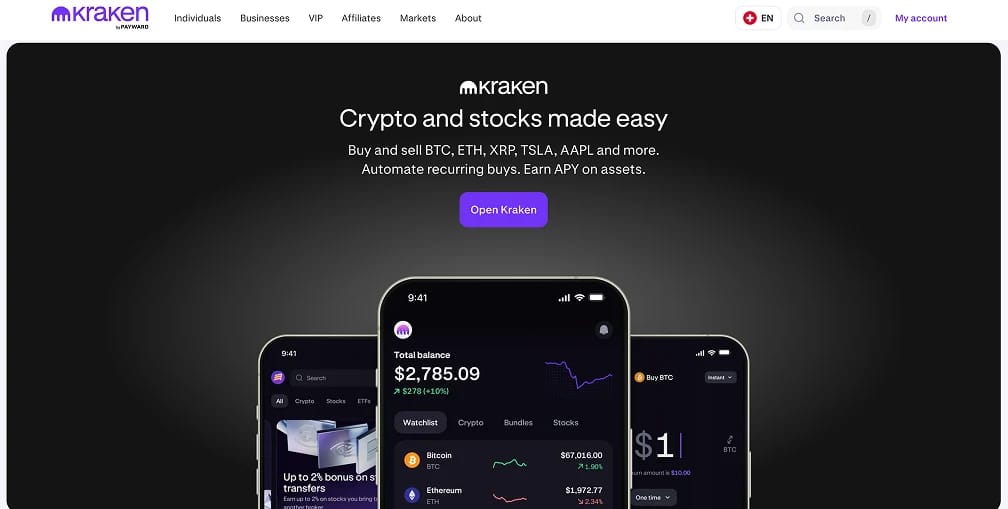
Raiffeisen Bank customers can buy Bitcoin by transferring euros to a regulated Austrian crypto exchange through SEPA. Our Express Überweisung from an Austrian Raiffeisen account reached Kraken within a minute, with no follow-up call. Choose a MiCA-licensed platform authorised to serve customers in your country.
Selected Austrian Raiffeisen banks also offer a Bitpanda integration inside Mein ELBA, first launched in January 2024. Eligible customers can find it under Entdecken, then Sparen & Veranlagen, with purchases starting at 1 € and savings plans at 10 €. Availability depends on your regional bank.
When using the integration, you become a Bitpanda customer. Raiffeisen acts as a paid third-party access provider. Coins cannot be transferred to an external wallet, and deposits from other exchanges are not supported. You must sell through the app to cash out, so use a separate exchange if you want to withdraw Bitcoin to your own wallet.
How to Buy Crypto with Raiffeisen Bank
Send an Express Überweisung from Mein ELBA to Kraken, then buy your crypto on the exchange. Kraken's Irish entity holds a MiCA licence from the Central Bank of Ireland covering Austria and every Raiffeisen market within the EEA. Euro deposits are free, and withdrawing coins costs only the network fee.
Steps to buy crypto with Raiffeisen Bank:
- Create and verify a Kraken account: Register on Kraken and complete identity verification (KYC) with a Reisepass or Personalausweis. Residents of Austria, Czechia, Slovakia, Hungary and Romania contract with Payward Europe Solutions Limited under MiCA. Swiss residents use Kraken's international platform, covered below.
- Copy the deposit details: In Funding, select EUR, then SEPA or SEPA Instant. Copy the IBAN, beneficiary name and reference containing your Public Account ID, which has 16 characters and starts with AA. Deposits missing this reference go to manual review. Swiss customers should select CHF and the Bank Frick SIC account instead.
- Check your Überweisungslimit: Open Profil & Einstellungen in Mein ELBA to review the limit for your pushTAN or cardTAN method. Each Raiffeisenbank sets its own ceiling. One Carinthian Raiffeisenbank allows up to 70,000 €, while banks in the Lower Austrian network permit up to 100,000 €.
- Send the transfer: Add Kraken as a new Empfänger, using the exact beneficiary name shown in Funding. Mein ELBA runs the Empfängerüberprüfung on every SEPA payment. A shortened name triggers a mismatch warning before signing. Tick Express Überweisung and approve with pushTAN.
- Buy your crypto: When the euros arrive, open Kraken Pro and place a limit order on BTC/EUR or your chosen pair. This lets you buy at a price you set. The simple Buy button carries a wider spread, the gap between the buy and sell price, so we use it only for a small first test.
Held payments almost always sit at the bank end. A short call to your Raiffeisenbank confirming that you initiated the transfer releases the money the same day.
Fees and Transfer Limits for Raiffeisen Bank Customers
Raiffeisen adds no charge to the transfer itself. Exchange fees determine the purchase cost, while your bank's limits can affect whether the payment goes through.
Raiffeisen Bank costs and limits (Austria)
- SEPA Überweisung: Included in most Girokonto packages and settles the next business day. Any per-booking charges appear in your local bank's Preisblatt.
- Express Überweisung: Free in Mein ELBA and the Mein ELBA-App, with payments credited in seconds around the clock. You can set and change its Tageslimit or per-transaction limit for each Girokonto at any time.
- Überweisungslimit: Adjustable under Profil & Einstellungen, subject to your Raiffeisenbank's ceiling. This limit causes most failed first deposits.
- Empfängerüberprüfung: Mandatory across SEPA since October 2025 and applied automatically in Mein ELBA. Copy Kraken's beneficiary name rather than typing it.
- Card deposits: Raiffeisen Debitkarte and Kreditkarte payments at Kraken cost 0.25 € plus 3.75%. We use cards only for a first 20 € test.
- Bitpanda via Mein ELBA: Raiffeisen charges nothing for access. Bitpanda applies a trading fee to each trade, shown before confirmation. Coins cannot be withdrawn, making this suitable for savings plans rather than self-held coins.
- Tax: Since 1 March 2022, crypto income has been classified as Einkünfte aus Kapitalvermögen (investment income), taxed at the 27.5% Sondersteuersatz with no holding period for coins acquired from 1 March 2021. Swaps between cryptocurrencies are tax-neutral. Domestic providers such as Bitpanda deduct KESt (Austria's withholding tax on investment income) at source. Kraken's Irish entity does not, so you must declare disposals in your Einkommensteuererklärung.
- Reporting: Since 1 January, the EU's DAC8 directive has required licensed exchanges to report client balances and transactions to national tax authorities. Keep Kraken statements with your Mein ELBA records.
Kraken fees
- SEPA and SEPA Instant deposit: Free, with a 1 € minimum.
- CHF deposit via SIC (Bank Frick): Free from Swiss and Liechtenstein banks, with same-day credit and a 1 CHF minimum. CHF sent from outside those countries goes through SWIFT at 0.75 CHF.
- Spot trading on Kraken Pro: Entry-tier fees are 0.25% maker for limit orders that wait on the order book and 0.40% taker for orders that fill immediately. Rates fall with 30-day volume. See the full schedule in our Kraken fees guide.
- Instant Buy: The quoted price includes a spread. Suitable for a test, but costly on large orders.
- EUR withdrawal: About 1 € by SEPA.
- Crypto withdrawal: Network fee only, under a euro on most low-cost chains.
A 2,000 € purchase funded by Express Überweisung costs nothing at Raiffeisen and 8 € on Kraken Pro. Using Instant Buy or a card costs several times as much.
Raiffeisen Crypto Rules by Country
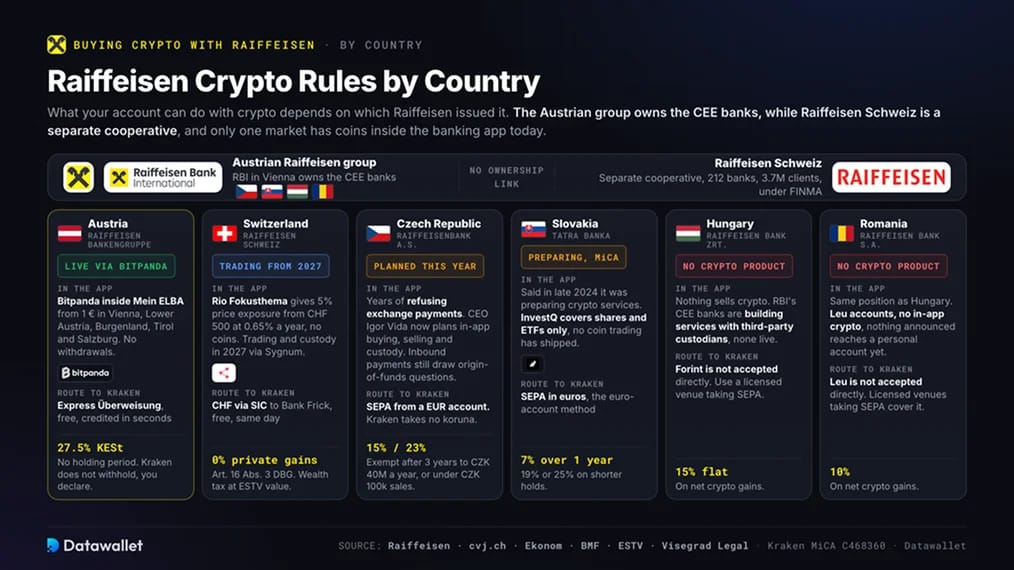
Your crypto options depend on which Raiffeisen issued your account. The Austrian group, led by Raiffeisen Bank International (RBI), owns the banks in Czechia, Slovakia, Hungary and Romania. Raiffeisen Schweiz operates as a separate Swiss cooperative.
Switzerland
Raiffeisen Schweiz, a cooperative of 212 banks serving 3.7 million clients, confirmed in May that it will introduce crypto trading and custody through Sygnum Bank during 2027. Until then, its only crypto product is the Kryptowährungen Fokusthema in the Raiffeisen Rio app. Added on 21 April, it offers a 5% weighting from CHF 500 at a 0.65% annual fee. You get price exposure, with no coins to withdraw.
To buy coins you own, send CHF from Raiffeisen e-banking to Kraken's Bank Frick account. Liechtenstein banks belong to SIC, making the transfer domestic and free, with same-day credit between 07:00 and 15:00 UTC on banking days. Send francs only. Euros are converted at Bank Frick's rate and handled through SWIFT.
Kraken is not FINMA-supervised, a trade-off against the wider spreads at PostFinance and the other banks in our Swiss exchange ranking. Private capital gains remain tax-free under Art. 16 Abs. 3 DBG unless you trade like a business. Holdings must be declared for wealth tax at the ESTV year-end value, and providers have reported under CARF since 1 January.
Czech Republic
For years, Raiffeisenbank a.s. refused crypto-related payments under group policy. It also closed exchange accounts after absorbing Equa bank. CEO Igor Vida told Ekonom in February that the bank now plans to introduce crypto buying, selling and custody in its app this year. Inbound exchange payments still prompt origin-of-funds questions.
Kraken does not accept koruna. Send euros by SEPA from a Raiffeisenbank EUR account rather than having the bank convert a CZK payment. The Czech National Bank has supervised providers since February 2025 and issued its first CASP authorisations this February, as covered in our Czech exchange guide.
Under Act No. 32/2025 Coll., coins held for over three years are exempt up to CZK 40 million a year. An exemption also applies in years with under CZK 100,000 in total sales. Other gains are taxed at 15% or 23%.
Slovakia, Hungary and Romania
None of RBI's other subsidiaries sells crypto yet, so customers also need to use the euro-account method. Slovakia's Tatra banka said in late 2024 that it was preparing crypto services under MiCA. Its new InvestQ app covers shares and ETFs, but coin trading has not launched. Slovak residents pay a 7% rate on coins held over one year, with shorter holds taxed at 19% or 25%.
Raiffeisen Bank Zrt. in Hungary operates forint accounts, while Raiffeisen Bank S.A. in Romania uses leu. Kraken accepts neither currency directly. Hungary taxes net crypto gains at a flat 15%; Romania applies 10%. Our guides to exchanges in Hungary and exchanges in Romania list licensed venues that accept SEPA from those accounts.
Russia and Belarus are among Kraken's prohibited regions, so this guide does not cover RBI's remaining customers there.
Best Exchanges for Raiffeisen Bank Customers
We recommend the same exchanges to Austrian Raiffeisen customers as to Erste Bank and Bank Austria customers. For these purchases, all three banks simply send the euros. Kraken leads on asset breadth and CHF deposits. Bybit EU holds its licence from Austria's own FMA.
Kraken is the only exchange listed that accepts both euros from an Austrian Raiffeisen account and francs from a Swiss account free of charge. Bitpanda is the most convenient option for Mein ELBA users who do not plan to hold coins themselves. Active traders get lower trading costs with Bybit.
Raiffeisen Bank Cryptocurrency Policy
No Austrian Raiffeisenbank or Landesbank holds coins for retail customers or operates its own order book. Crypto available in Mein ELBA comes from Bitpanda. Each of the eight Landesbanken decides whether to enable the service, explaining why an Innsbruck customer sees a crypto tab while a Linz customer does not.
RBI, the group's listed central institution, is proceeding cautiously. None of its announced services is available through a personal Girokonto yet. In a January note, RBI said a subsidiary had begun the CASP licence process, with plans to offer asset-referenced tokens to clients this year. Its CEE subsidiaries were also developing services with third-party crypto custodians. RBI added that it had co-founded the banking consortium preparing a euro stablecoin.
The MiCA transition period ended across the EU on 1 July 2026. Transfers to venues that lost EEA access on that date are therefore the most likely to be refused. Our list of MiCA-licensed crypto exchanges identifies the platforms that qualified.
About Raiffeisen Bank
The Austrian Raiffeisen Bankengruppe has three tiers, starting with more than 300 legally independent cooperative Raiffeisenbanken. Above them sit eight Raiffeisenlandesbanken, with Raiffeisen Bank International in Vienna serving as the central institution.
The Landesbanken own a majority of RBI. In turn, RBI owns the retail banks bearing the Raiffeisen name across Central and Eastern Europe, including the Prague, Bratislava, Budapest and Bucharest subsidiaries covered above. It is supervised by the ECB under the Single Supervisory Mechanism and by Austria's FMA.
Raiffeisen Schweiz shares the Giebelkreuz emblem and Friedrich Wilhelm Raiffeisen's cooperative model. It has no ownership link to the Austrian group and answers to FINMA. Germany's Volksbanken Raiffeisenbanken form a third, separate network under DZ Bank. Their meinKrypto service is covered in our Volksbank guide.
Austrian retail customers use the Girokonto through Mein ELBA and the Mein ELBA-App, signing payments with pushTAN or cardTAN. Austria's statutory scheme protects deposits up to 100,000 € per customer. Crypto held on an exchange falls outside that protection.
.webp)
Final Thoughts
Customers in Vienna, Lower Austria, Burgenland, Tirol and Salzburg can buy Bitcoin from 1 € inside Mein ELBA today. The coins remain at Bitpanda and cannot be withdrawn. Elsewhere in the group, from Linz to St. Gallen to Prague, Raiffeisen only transfers the money until its announced services arrive.
For coins you control, Kraken covers every Raiffeisen market with one account. Euro and franc deposits are free, EEA residents receive MiCA supervision, and Kraken Pro fees start at 0.25%.
Set your Überweisungslimit before sending and copy the beneficiary name to pass the Empfängerüberprüfung. Start with a test transfer. Austrian holders should retain every Kraken statement, as they must declare the 27.5% KESt themselves when using a foreign exchange.
.webp)