







Can I Buy USDT in Europe?
You can legally own, hold, and send USDT anywhere in the EU, but you can no longer buy it from a licensed European exchange. Under Title V of MiCA, in full force since 30 December 2024, licensed exchanges cannot offer a non-authorised e-money token (a stablecoin pegged to one official currency) to the public in the EEA. USDT's issuer Tether never applied for that authorisation, so every regulated venue removed it.
Coinbase pulled USDT for EEA users in December 2024, Crypto.com followed in January 2025, and Binance and Kraken removed USDT spot pairs in March 2025. When the transitional window for exchanges on old national registrations closed on 1 July 2026, the European Securities and Markets Authority (ESMA) confirmed no extension. No MiCA-licensed venue sells USDT to an EEA resident.
You can still hold USDT in a wallet you control, send it on-chain, and swap it on a decentralised exchange, since ESMA has stated that custody and transfer alone do not count as offering it to the public. The compliant on-exchange substitute is USDC, Circle's dollar stablecoin, which is EU-authorised and trades freely on regulated venues.
Our guide to the best MiCA-licensed crypto exchanges covers which platforms cleared the bar.
How to Buy USDT in Europe
On a regulated European exchange you now buy USDC, the compliant dollar stablecoin, because MiCA-licensed venues no longer list USDT. For most buyers we recommend Coinbase, funded over SEPA. USDT itself is available only from offshore venues.
The setup is a verified Coinbase account linked to a euro bank account in your own name. SEPA, the Single Euro Payments Area, is the standard way to move euros between banks, and Coinbase accepts it at no cost.
Steps to buy USDC on Coinbase:
- Create and verify your account: Register at Coinbase and complete identity verification (KYC) with a passport or national ID card plus a selfie. Verification usually clears within the hour.
- Link your bank for SEPA: In payment settings, add your euro account and choose SEPA transfer. SEPA deposits are free on Coinbase and settle on business days.
- Send a small test transfer: Move €10 to €20 first, using the exact reference Coinbase shows. This sets up the payee and clears any first-time fraud hold before you send more. Funding by a pan-European neobank such as Revolut or Trade Republic works the same way.
- Fund the full amount: Once the test lands, send the balance. Euro deposits over SEPA carry no Coinbase fee and typically credit within one to three business days.
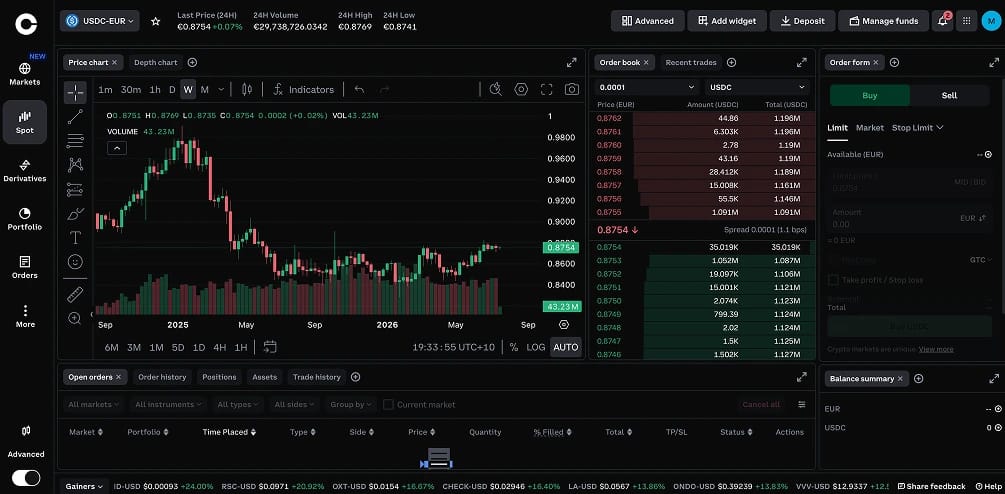
- Buy USDC on Advanced: Open the USDC/EUR market on the Advanced interface, then place a limit or market order. Advanced pricing beats the Simple Buy widget.
The offshore option for USDT itself is BloFin, which operates outside MiCA. It is available to EEA users, lists USDT, and does not require identity verification for withdrawals up to 20,000 USDT per day. Euros enter through a third-party card provider rather than SEPA, and it operates from the Marshall Islands with no EU licence and no local complaints channel. Our BloFin supported and restricted countries guide lists the current availability, and our no-KYC USDT guide covers the wider set of offshore venues. Keep only trading capital on any platform of this type.
Because USDC and USDT both track the US dollar, one of either costs roughly €0.87 at current EUR/USD levels rather than €1, and the euro figure shifts with the exchange rate day to day.
EUR to USDT Fees
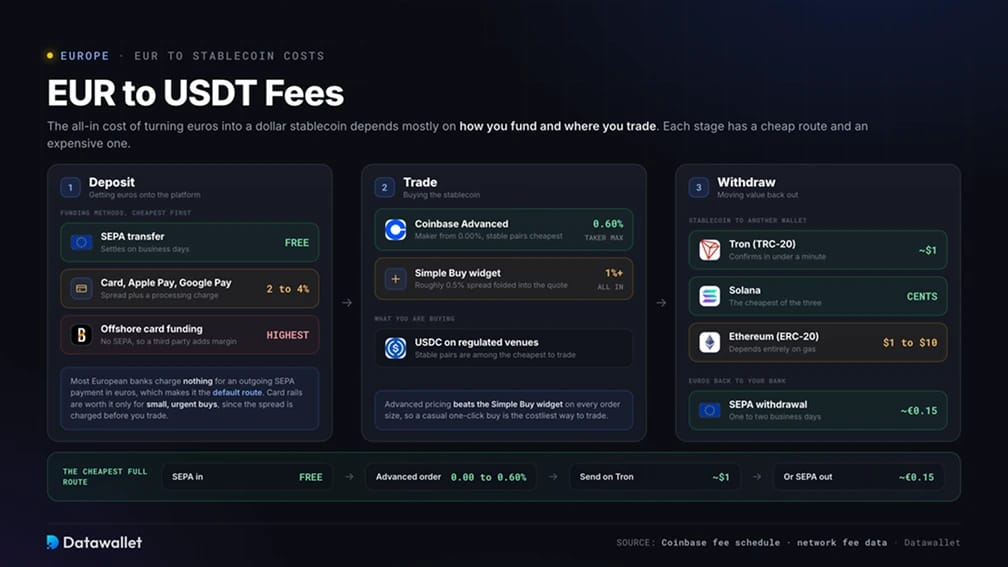
The all-in cost of turning euros into a dollar stablecoin depends mostly on how you fund and where you trade.
Deposits
- SEPA transfer (recommended): Free on Coinbase and the other MiCA-licensed venues, with settlement on business days. Most European banks charge nothing for an outgoing SEPA payment in euros.
- Debit card, Apple Pay, and Google Pay: Convenient but priced through a spread plus a processing charge that usually totals around 2% to 4%. We treat these as an option only for small, urgent buys.
- Offshore card funding on BloFin: With no SEPA support, euros enter through a third-party provider that adds its own margin, so buying USDT this way costs more than a SEPA deposit into a regulated venue.
Trading
- Coinbase Advanced: Maker fees run from 0.00% to 0.40% and taker fees up to 0.60% at the base tier, with stable pairs among the cheapest to trade. The Coinbase fees guide breaks the schedule down in full.
- Simple Buy: The one-click screen folds a spread of roughly 0.5% into the quote on top of the fee, so a casual buy can run well over 1% all in.
Withdrawals
- Stablecoin to another wallet: Tron (TRC-20) costs about a dollar and confirms in under a minute, Solana lands for cents, and Ethereum (ERC-20) runs from one to ten dollars depending on gas. Match the network to your destination.
- Euros back to your bank: Selling to euros and withdrawing over SEPA returns funds to your account for a flat fee of around €0.15 on Coinbase, usually within one to two business days.
Best Exchanges for USDT and USDC in Europe
The table weighs MiCA licensing, euro funding, fees, and stablecoin access for European buyers. The regulated venues list USDC rather than USDT, while BloFin is the one platform that still offers USDT to EEA users, offshore and unlicensed. Our full country comparison lives in the best crypto exchanges in Europe guide, and the best USDT exchanges roundup ranks global venues for Tether itself.
Coinbase leads for the regulated, low-friction path, pairing MiCA authorisation with e-money safeguarding on your euro balance. Kraken suits active traders wanting deeper books and lower Pro fees, OKX rewards volume with tight spot pricing, and Bitstamp gives a long-standing EU-native alternative. BloFin sits apart as the only venue offering USDT, at the cost of any EU licence.
Regulatory Status of USDT in Europe
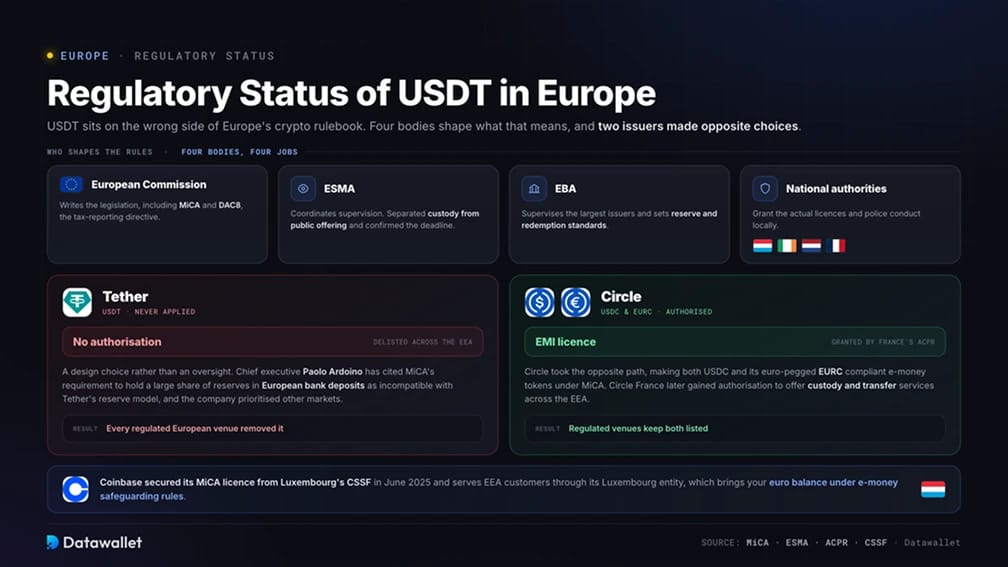
USDT sits on the wrong side of Europe's crypto rulebook. Four bodies shape what that means for you as a holder.
- European Commission: Writes the legislation, including MiCA (Regulation (EU) 2023/1114) and DAC8, the tax-reporting directive that took effect in 2026.
- ESMA: Coordinates supervision across member states, issued the guidance that separated custody from public offering, and confirmed the 1 July 2026 transitional deadline with no extension.
- European Banking Authority (EBA): Supervises the largest stablecoin issuers and sets the reserve and redemption standards that e-money tokens must meet.
- National competent authorities: Grant the actual licences and police conduct locally, including the CSSF in Luxembourg, the Central Bank of Ireland, De Nederlandsche Bank, and France's ACPR.
Tether's absence from the licensed market is a design choice rather than an oversight. Chief executive Paolo Ardoino has cited MiCA's requirement to hold a large share of e-money reserves in European bank deposits as incompatible with Tether's reserve model, and the company has prioritised other markets instead.
Circle took the opposite path. It secured an Electronic Money Institution licence from France's ACPR, which made both USDC and its euro-pegged EURC compliant e-money tokens under MiCA, and Circle France later gained authorisation to offer custody and transfer services across the EEA. That is why regulated European venues keep USDC and EURC listed while removing USDT. Coinbase, for its part, secured its MiCA licence from Luxembourg's CSSF in June 2025 and serves EEA customers through its Luxembourg entity, which brings your euro balance under e-money safeguarding rules.
Tax Implications of USDT in Europe
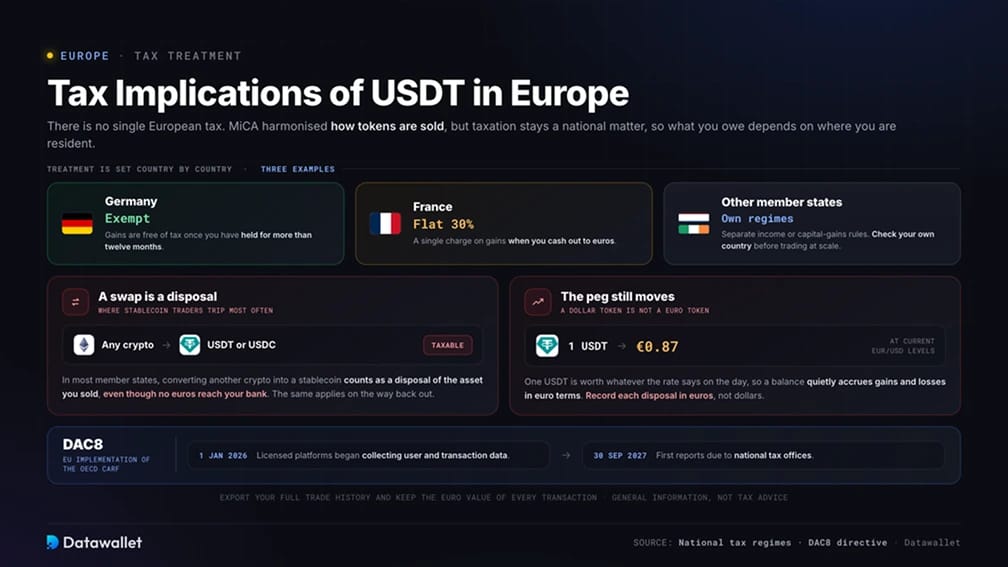
There is no single European tax on crypto. MiCA harmonised the rules on how tokens are sold, but taxation stays a national matter, so what you owe on USDT or USDC depends on where you are resident.
- Treatment is set country by country: Germany exempts gains once you have held an asset for more than twelve months, France applies a flat 30% charge on gains when you cash out to euros, and other member states run their own income or capital-gains regimes. Check the position for your specific country before you trade at scale.
- A swap is usually a taxable event: In most member states, converting another crypto into USDT or USDC, or back out again, counts as a disposal of the asset you sold, even though no euros reach your bank. Stablecoin traders trip on this most often.
- A pegged token still moves against the euro: One USDT is worth whatever the EUR/USD rate says on the day, around €0.87 at present, so a balance quietly accrues small gains and losses in euro terms. Record each disposal in euros.
- Exchanges now report to tax authorities: Under DAC8, the EU implementation of the OECD Crypto-Asset Reporting Framework, licensed platforms began collecting user and transaction data from 1 January 2026, with the first reports due to national tax offices by 30 September 2027.
💡 For active users: Export your full trade history from every venue and keep the euro value of each transaction. Because the tax treatment differs so widely across the bloc, anyone trading at volume should put the question to an adviser in their own country before the reporting cycle catches up. This is general information rather than tax advice.
USDT vs USDC in Europe
For a European buyer, the two tokens do the same job but sit on opposite sides of MiCA. USDC is the compliant choice on regulated exchanges, while USDT is reachable only through offshore venues, self-custody, or decentralised exchanges.
- Regulation and recourse: USDC is issued by Circle under an EU e-money licence, with reserves held at EU banks and one-for-one redemption, so a European holder has legal protection. USDT carries no MiCA authorisation and thinner reserve disclosure, so any recourse sits outside the EU.
- Where each is accepted: USDC is listed on MiCA-licensed venues with direct euro funding, while USDT dominates global and offshore platforms, self-custody wallets, and decentralised exchanges. Match the token to the platform you use.
- Liquidity and reach: USDT is the larger stablecoin and still settles most of the market outside the EU, so traders on international venues hold it as working capital. USDC is smaller but the default inside the regulated European system.
- Which to hold: Choose USDC for regulated custody, euro conversions, and EU protection. USDT makes sense only if you need deeper global liquidity or a specific offshore or on-chain venue that quotes in it.
Final Thoughts
For most European buyers, the answer is Coinbase funded over SEPA, holding USDC as your dollar stablecoin. Coinbase holds a MiCA licence across all 27 EU states and brings your euro balance under e-money safeguarding, while USDC gives the same dollar exposure as USDT with EU authorisation behind it. Free SEPA deposits and low Advanced fees make it the simplest way from euros to a regulated stablecoin.
Verify an account, run a small SEPA test transfer, then fund and buy USDC on the Advanced interface. Move long-term holdings into a wallet you control, and keep dated euro records of every trade, since swaps into and out of stablecoins count as disposals in most member states and exchanges now report under DAC8.
USDT itself remains available to Europeans only through offshore, unlicensed venues such as BloFin, which trade EU consumer protection for direct Tether access. That is a reasonable choice for a specific need, provided you understand what you are giving up.
%20(1).webp)