






CoinEx Closure Timeline and Deadlines
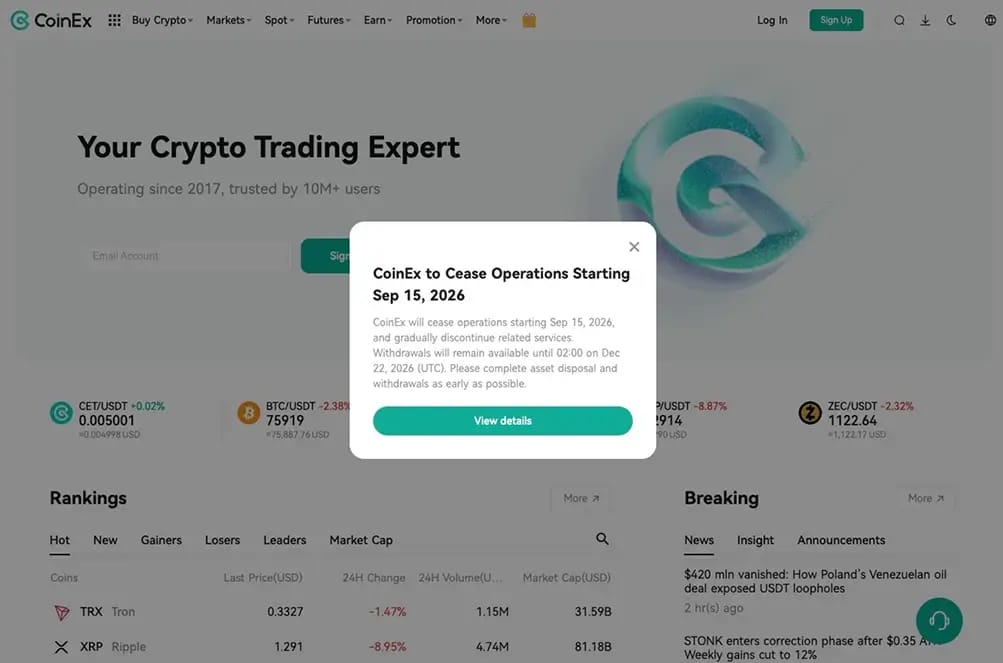
The official cessation notice sets four shutdown dates, with the two September cutoffs carrying more weight than December because they determine whether users receive their coins or a USDT balance.
The deadline to withdraw assets in their original form is 29 September, not 22 December. From the announcement, anyone wanting to keep their Bitcoin, Ether or altcoins has under two weeks to move them.
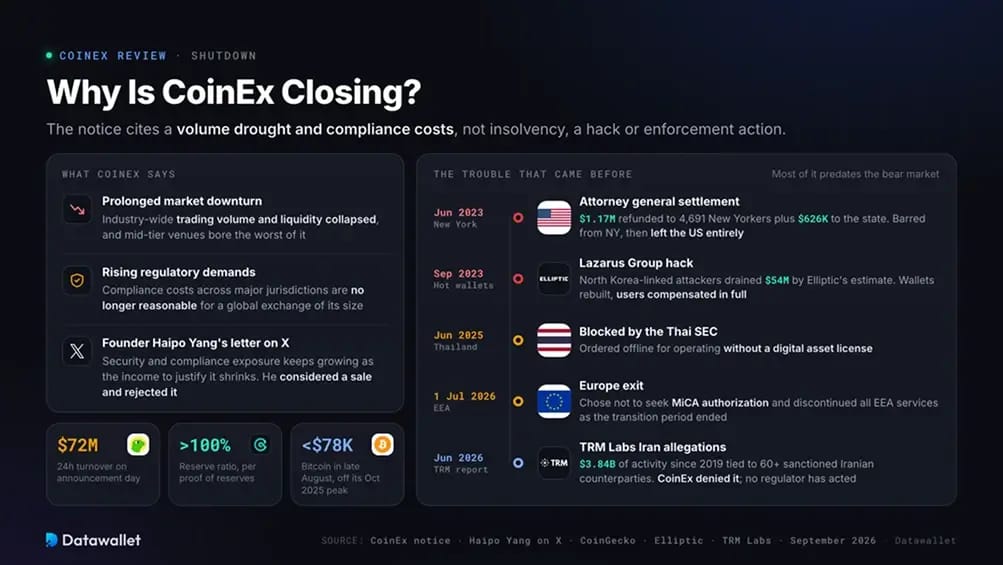
Why Is CoinEx Closing?
CoinEx attributes the closure to a prolonged market downturn and a collapse in industry-wide trading volume and liquidity. It also cites rising regulatory demands across major jurisdictions, with compliance costs the company considers no longer reasonable. The notice names no insolvency, hack, or enforcement action. CoinEx says its reserve ratio remains above 100% and points to its proof of reserves page as evidence.
Founder Haipo Yang was more direct in a letter posted on X. He wrote that the security and compliance exposure of running an exchange keeps growing as the income needed to justify it shrinks. CoinEx had also never become the top-tier exchange he intended to build. Yang considered a sale but rejected it because customers had trusted the platform and, in some cases, him personally.
CoinGecko put CoinEx's 24-hour turnover at about $72 million on announcement day, too little to fund the staff, licenses, and security spending a global exchange requires. Mid-tier venues have borne the worst of the volume drought. Bitcoin had slipped below $78,000 in late August after retreating from its October 2025 peak.
Most of CoinEx's past security and regulatory problems predate the bear market.
- 2023 New York: The state attorney general sued CoinEx over unregistered securities and commodities brokerage. The June 2023 settlement refunded $1.17 million to 4,691 New Yorkers and paid $626,000 to the state. It also barred CoinEx from New York, after which the exchange left the US entirely.
- The 2023 Lazarus hack: In September 2023, attackers linked to North Korea drained hot wallets in a breach that Elliptic estimated at $54 million. CoinEx rebuilt its wallet system and compensated users in full.
- 2025 Thailand: The Thai SEC ordered the platform to be blocked from June 2025 for operating without a digital asset license.
- The 2026 Europe exit: CoinEx chose not to seek authorization under MiCA, the EU's crypto licensing regime. It discontinued all EEA services as the transition period ended on 1 July 2026.
- The 2026 Iran allegations: TRM Labs published research attributing $3.84 billion of CoinEx activity since 2019 to more than 60 sanctioned Iranian counterparties. The report came weeks after OFAC designated Nobitex and three other Iranian exchanges. CoinEx denied doing any business with Iranian platforms or government bodies and pledged stricter geofencing and monitoring.
Neither the notice nor Yang's letter mentions the TRM report. No regulator has announced action against CoinEx over it. Yang's remark about compliance exposure he could no longer contain came 12 weeks after the report and remains the most direct explanation on record.
What Happens to Each CoinEx Product
Each product closes under its own terms, and several will trigger automatic action on your account if you do nothing.
- Futures: Markets went reduce-only on 15 September, allowing users to close positions but not open or increase them. Funding payments continue. Any positions left on 22 September are force-settled at the index price, so leveraged traders should close on their own terms before then.
- Margin and crypto loans: New borrowing and renewals stopped on 15 September. Loans still unpaid on 22 September will be liquidated under the existing rules. Proceeds cover the debt, with any surplus returned to the account.
- Earn, savings and staking: Fresh subscriptions are closed, and CoinEx will redeem products still held on 22 September. Fixed-term yields are paid pro rata for the actual lock-up period; dual investment settles under its product rules.
- Grid bots and Auto-Invest: Users can no longer create strategies. On 22 September, running strategies end, and pending orders are canceled. Any futures grid positions close under the futures rules above.
- P2P and fiat: The service ends on 22 September, following the halt to new advertisements and orders on 15 September. Disputed orders continue through the appeal process. CoinEx will return merchant security deposits once disputes involving them are resolved.
- On-chain trading: Exchange-interface access to DEX-listed tokens ends on 22 September. CoinEx will sell and settle any assets users have not disposed of by then.
- Deposits: On-chain deposits stop on 22 September except for CET. CET deposits stay open until 29 September, so on-chain holders can sell into the buyback. CoinEx advises against depositing anything now unless needed to close a position.
- CoinEx Smart Chain and OneSwap: Both close on 29 September, when the CSC cross-chain bridge also stops redeeming. Assets bridged onto CSC must be brought back before that deadline.
- Referral income and campaigns: Commissions stopped on 15 September. Unpaid rewards from ongoing promotions will not be distributed.
CoinEx Wallet, the self-custody app, and CoinEx Vault remain outside the closure and continue under their own terms. The mining pool ViaBTC, which shares a founder with CoinEx, confirmed in a separate statement that it is a distinct legal entity with its own infrastructure.
Miners receiving automatic payouts into CoinEx accounts must change the destination address before that service ends on 22 September.
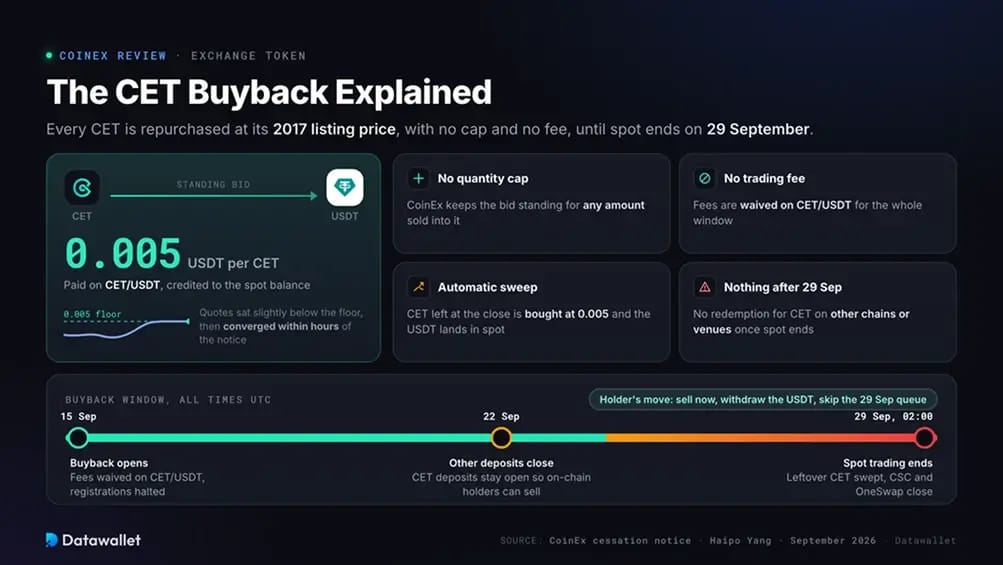
The CET Buyback Explained
The buyback gives CoinEx's exchange token, CET, a defined ending instead of the slow collapse that usually follows an exchange closure. CoinEx maintains standing buy orders at 0.005 USDT per token in the CET/USDT market from 15 to 29 September. There is no quantity cap or trading fee on sales. Any CET left when spot trading ends is bought automatically at that price, with the USDT credited to the spot balance.
Yang described 0.005 USDT as CET's original 2017 listing price. Public quotes had traded slightly below that level in the days before the announcement, then converged on it within hours. The market therefore expects the floor to hold. CoinEx's fee-and-burn program had already destroyed much of the initial 10 billion supply, and CET traded far below its peak.
Timing is the practical decision for holders, rather than price. Selling into the buyback now and withdrawing the USDT avoids the 29 September conversion queue. Those holding CET on other chains or venues should note that no redemption of any kind is available after that date.
What Happens to Assets Left Behind
The notice's most consequential rule changes what users recover from non-USDT balances held past 02:00 UTC on 29 September. During the withdrawal period, CoinEx will sell coins with external liquidity in batches and credit the net proceeds in USDT. It will not announce each sale.
Thinly traded altcoins may fetch well below their last quoted price. CoinEx delists coins with no external liquidity, abandons their wallets, and disclaims further custody or redemption duties. A small-cap token not withdrawn on-chain before 29 September may simply be gone.
At 02:00 UTC on 22 December, remaining USDT moves to independent custody under Clause 5.3 of the terms of service, which gives users 90 days to withdraw after an account relationship ends. The monthly custody fee is 5% of the balance recorded at the deadline. Claims must be emailed to support@coinex.com by 22 August 2028, with identity re-verification likely.
The claims deadline is 20 months after withdrawals close, and 20 monthly charges of 5% equal the entire balance. On a linear reading, a claim six months late recovers about 70%. After a year, roughly 40% remains, while anyone waiting until the final deadline recovers nothing. The custody arrangement amounts to a penalty schedule.
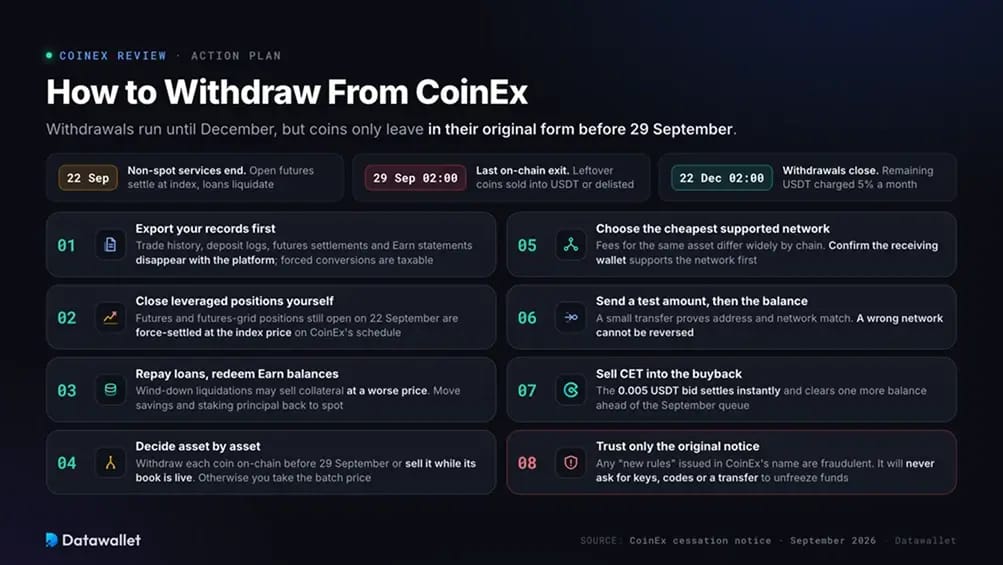
How to Withdraw From CoinEx
Withdrawals remain open, and CoinEx says the staged closure of other services does not affect them. Yang has acknowledged that some tokens may take longer while balances move from cold to hot wallets, and congestion builds ahead of shared deadlines. Aim to finish well before 29 September.
- Export your records first: While you can log in, download trade history, deposit and withdrawal logs, futures settlements, and Earn statements. Forced September conversions are taxable events in most jurisdictions. The records disappear with the platform.
- Close leveraged positions yourself: Closing manually lets you choose the moment. Futures and futures grid positions left open on 22 September will settle at the index price on CoinEx's schedule.
- Repay loans and redeem Earn balances: Wind-down liquidations may sell collateral at a worse price than a manual repayment. Redeem savings and staking balances to move the principal into the spot account.
- Decide asset by asset: Withdraw each coin on-chain before 29 September or sell it into USDT while its order book is live. Otherwise, you accept CoinEx's batch sale price or risk losing an illiquid token.
- Choose the cheapest supported network: The same asset can carry widely different withdrawal fees across chains. For small residual balances, that choice determines whether a meaningful amount arrives. First confirm that the receiving wallet supports the network.
- Send a test amount, then the balance: A small transfer confirms that the address and network work together. Choosing the wrong network cannot be reversed.
- Sell CET into the buyback: A sale at the 0.005 USDT bid settles instantly. It also clears another balance ahead of the September queue.
- Trust only the original notice: CoinEx says it will publish no further announcements, and any "new rules" or "supplementary policy" issued in its name are fraudulent. Reminders come only through email, in-app messages, and verified social accounts. The exchange will never request keys, passwords, codes, or a transfer to "unfreeze" funds.
Choose a destination you control for assets leaving CoinEx. Our roundup of the best crypto wallets compares self-custody choices.
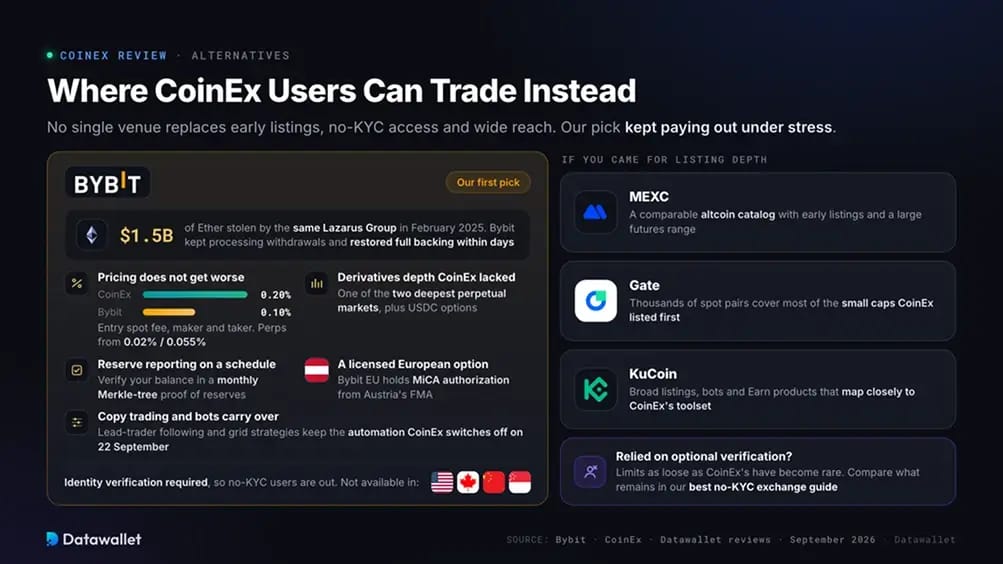
Where CoinEx Users Can Trade Instead
Most CoinEx users came for early altcoin listings, verification-free trading within withdrawal caps, or access in countries the large exchanges skip. No single replacement covers all three needs. The closure reinforces that the platform holding your balance matters more than its fee schedule.
We recommend Bybit first because it kept processing withdrawals when it lost about $1.5 billion in Ether in February 2025. The attack came from the same Lazarus Group that hit CoinEx in 2023. Bybit restored full backing within days. An exchange that kept paying out under that stress is the closest thing the industry has to a tested counterparty.
- Pricing does not get worse: Entry-tier spot fees are 0.10% for both makers and takers, half CoinEx's 0.20% headline rate. Perpetuals start at 0.02% maker and 0.055% taker.
- Derivatives depth CoinEx never had: Bybit operates one of the industry's two deepest perpetual markets and offers USDC options. The contract range is covered in our Bybit futures review.
- Reserve reporting on a schedule: Users can check that their balance is included in Bybit's monthly Merkle-tree proof of reserves. This goes beyond CoinEx's published ratio.
- A licensed European option: Bybit EU holds MiCA authorization from Austria's Financial Market Authority. EEA residents who lost CoinEx access in July therefore have a supervised alternative.
- Copy trading and bots carry over: Both lead-trader following and grid strategies are available, preserving the automation CoinEx users lose on 22 September.
Bybit requires identity verification, ruling it out for CoinEx's no-KYC users. Access is also unavailable in the US, Canada, mainland China and Singapore, as covered in our Bybit review and Bybit restricted countries page.
For traders who used CoinEx mainly for listing depth, MEXC, Gate and KuCoin offer comparable catalogs. Users who relied on optional verification should compare the platforms in our best no-KYC crypto exchange guide. Limits as loose as CoinEx's have become rare.
Final Thoughts
CoinEx ends its nine-year run with a published reserve ratio and a fixed token buyback, while withdrawals remain open until 22 December. Compared with BitMart's closure, this is a more responsible exit. Yang's letter is also unusually candid about why running a mid-sized exchange stops being worth the risk.
Our advice holds regardless of how the closure proceeds. Withdraw every asset you want in its original form before 02:00 UTC on 29 September. Sell CET into the buyback ahead of the automatic sweep, and clear all USDT before December to avoid a custody arrangement that erodes 5% a month. Anything left to CoinEx's batch process sells at a price you did not choose.
The wider lesson from 2026 is that an exchange balance is a company's promise, and companies close. CoinEx has at least published a clear schedule for keeping that promise, and we will update this page if withdrawals depart from the plan.
.webp)