
What is Arc?
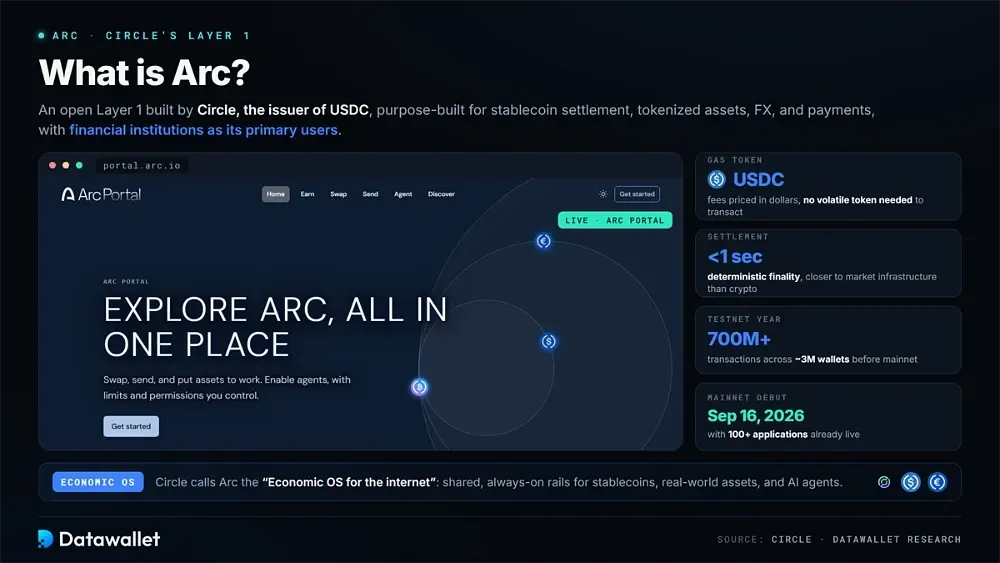
Arc is an open Layer 1 blockchain developed by Circle, the company behind USDC. Its design is not aimed at competing as another general-purpose chain. Instead, Arc was built specifically around stablecoin settlement, tokenized assets, foreign exchange, and payments, with financial institutions and enterprises operating onchain as its primary users.
Its gas model is one of the network's defining features. Transaction fees are paid in USDC and priced in dollars, removing the need for businesses to hold a volatile token simply to transact. Arc also provides deterministic finality in under a second, making its settlement model resemble modern market infrastructure more closely than a speculative crypto network.
Circle first unveiled Arc in August 2025, followed by the public testnet that October. Adoption accelerated quickly. Within a year, the testnet had processed more than 700 million transactions across nearly three million wallets. At the same time, over 100 institutional and ecosystem builders were developing applications on a parallel private mainnet.
That development phase led to the public mainnet launch on September 16, 2026, with more than 100 applications already live. Circle describes Arc as the "Economic OS for the internet," positioning the network as shared infrastructure for stablecoins, real-world assets, and even AI agents operating on unified, always-on rails.
Arc Mainnet Launch
Arc's mainnet debut brought together an unusually broad group of institutional participants for a blockchain launch. Circle confirmed the September 16 date in early August when it announced the founding validator cohort, then marked the launch with a New York event streamed through the official @arc X account.
Jeremy Allaire called Arc the most significant release in Circle's history since USDC itself. The launch came one day after the Senate failed to advance the CLARITY Act. On September 15, 2026, a cloture motion on the motion to proceed was rejected 49-50, falling short of the 60 votes required and leaving broader US digital-asset market-structure legislation unresolved as Arc went live.
Several launch-day milestones defined the mainnet debut:
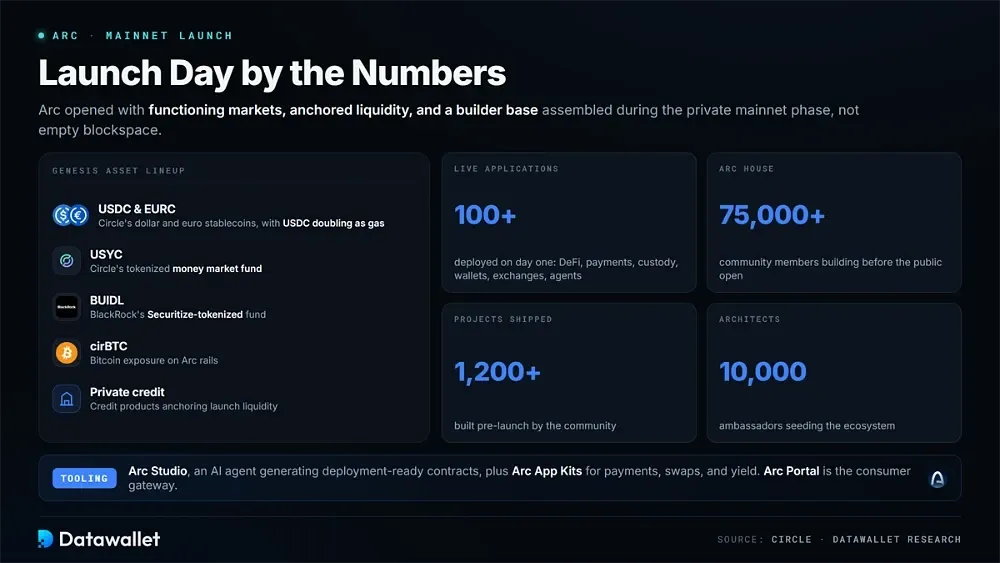
- Validator Cohort: Eleven institutions, including BlackRock, DTCC, ICE, Mastercard, Visa, Standard Chartered, MoneyGram, SBI Group, Galaxy, Sumitomo, and Worldpay, secure the chain alongside Circle.
- Live Applications: More than 100 applications deployed on day one, covering DeFi protocols, payment processors, custody providers, wallets, exchanges, and agent-focused infrastructure platforms.
- Asset Lineup: USDC, EURC, Circle's USYC money market fund, BlackRock's Securitize-tokenized BUIDL fund, cirBTC, and private credit products anchor launch liquidity.
- Builder Community: More than 75,000 Arc House members and 10,000 Architect ambassadors shipped over 1,200 projects before the network opened publicly.
- Developer Tooling: Circle launched Arc Studio, an AI coding agent that generates deployment-ready contracts, as well as Arc App Kits, an SDK for payments, swaps, and yield.
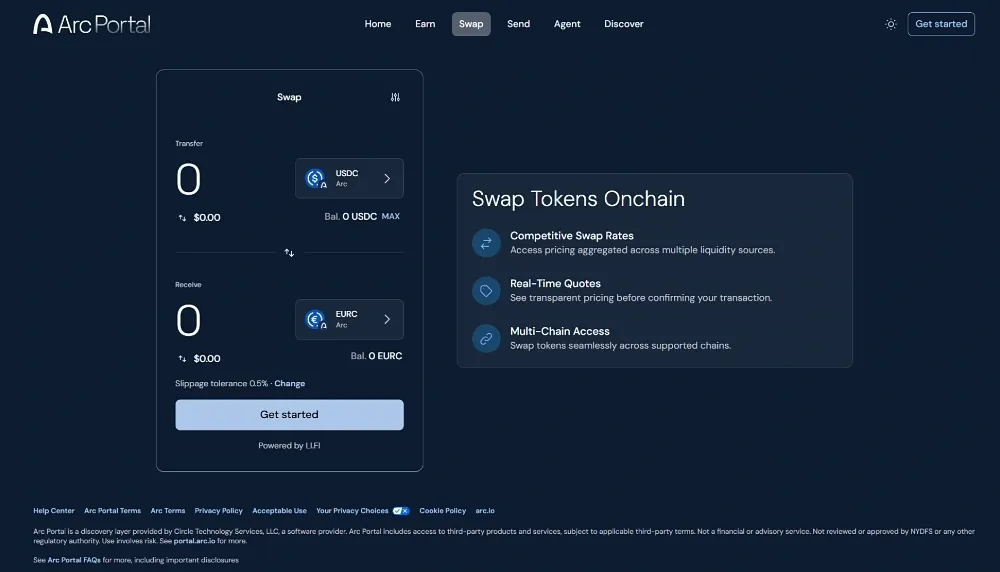
- Access Points: Arc Portal debuted as the consumer-facing gateway for funding wallets, delegating tasks to agents, and exploring the expanding ecosystem.
How Does Arc Work?
Arc keeps consensus and execution separate, allowing the two layers to be optimized independently. A Byzantine Fault Tolerant engine orders and finalizes blocks, while a Rust-based Ethereum client handles execution. The result remains fully compatible with existing EVM chains tooling.
The official documentation explains how the components fit together. Five architectural pillars define how Arc approaches institutional-grade settlement.
1. Malachite Consensus
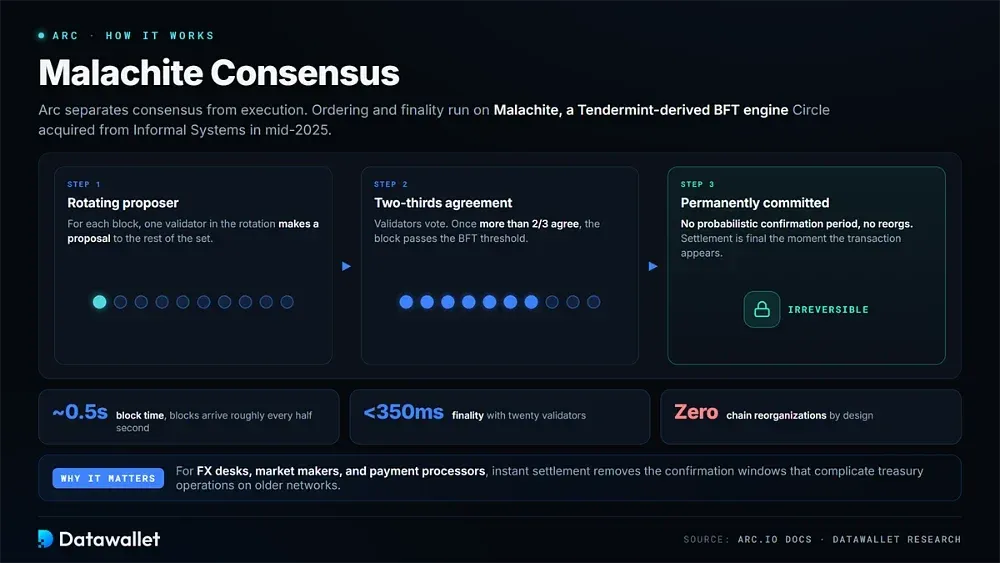
Arc's consensus layer uses Malachite, a Tendermint-derived BFT engine that Circle acquired from Informal Systems in mid-2025. For each block, a rotating proposer makes a proposal. Once more than two-thirds of validators agree, that block is permanently committed. The model has no probabilistic confirmation period and does not allow chain reorganizations.
Speed is a central benefit. Blocks arrive roughly every half second, while finality takes under 350 milliseconds with twenty validators. For FX desks, market makers, and payment processors, settlement occurs as soon as a transaction appears. That removes the confirmation windows that can complicate treasury operations on older networks.
2. Reth Execution Layer
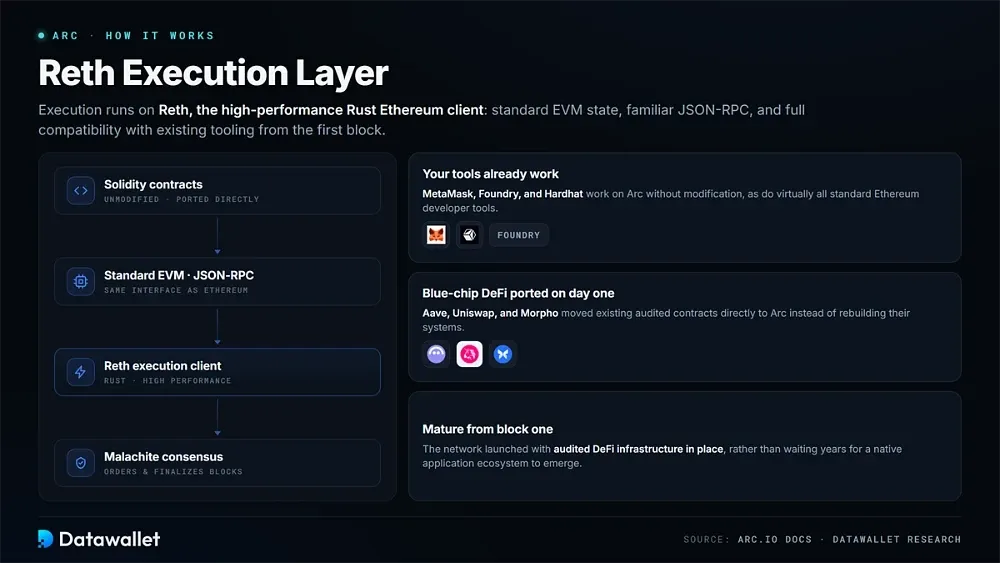
Reth, the high-performance Rust Ethereum client, handles execution. It maintains state, runs the standard EVM, and exposes the familiar JSON-RPC interface. Solidity contracts and tools such as Foundry, Hardhat, and MetaMask therefore work on Arc without modification from the first block, as do virtually all standard Ethereum developer tools.
That compatibility had an immediate practical effect. Established protocols including Aave, Uniswap, and Morpho could port their existing contracts directly to Arc instead of rebuilding their systems. As a result, the network launched with mature, audited DeFi infrastructure rather than waiting years for a native application ecosystem to emerge.
3. USDC Gas and Stable Fees
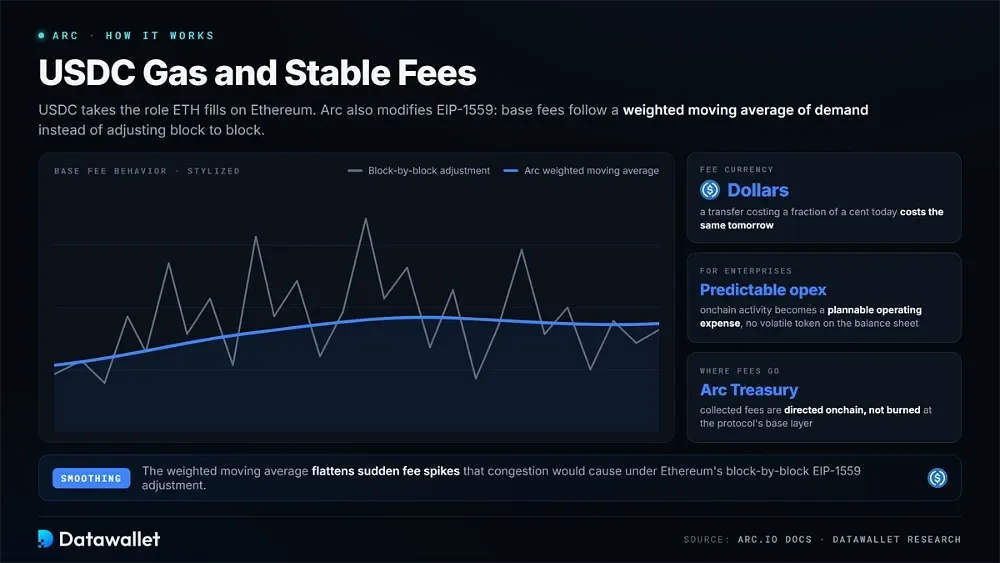
On Arc, USDC takes the role that ETH fills on Ethereum by serving as the native gas token. Fees are denominated in dollars. A transfer costing a fraction of a cent today can therefore cost the same tomorrow, allowing enterprises to treat onchain activity like a predictable operating expense.
Arc also modifies Ethereum's EIP-1559 fee model. Base fees do not adjust independently from one block to the next. Instead, the protocol applies a weighted moving average of network demand to smooth sudden fee spikes. Fees collected by the network are directed to an onchain Arc Treasury rather than burned at the protocol's base layer.
4. Permissioned Validator Set
Arc begins as a proof-of-authority network, meaning block production is limited to approved institutions. Open validator participation is exchanged for identifiable accountability. Every validator is a known, regulated entity carrying legal and reputational exposure, an assurance designed around the requirements of banks and asset managers moving balance-sheet activity onchain.
Full nodes remain permissionless. Anyone can operate one and independently verify every transaction and block against validator signatures. Circle's roadmap explores a move toward permissioned proof of stake in 2027, with staked ARC tokens coordinating a larger validator set. No firm timeline for wider decentralization has been committed.
5. StableFX and Native Interoperability
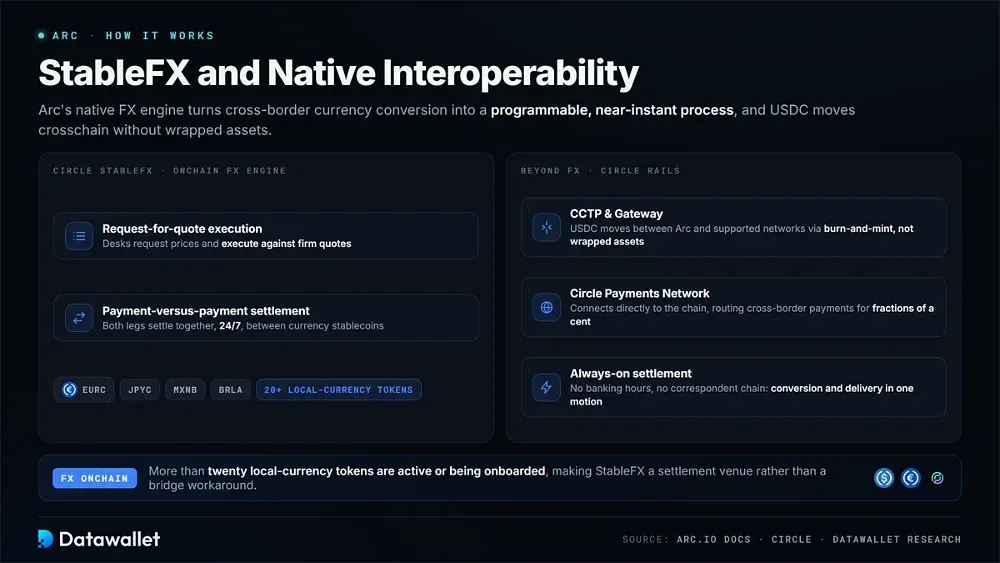
Circle StableFX is Arc's native foreign exchange engine. It combines request-for-quote execution with 24/7 payment-versus-payment settlement between currency stablecoins. More than twenty local-currency tokens are either active or being onboarded, including EURC, JPYC, MXNB, and BRLA. This turns cross-border currency conversion into a programmable, near-instant process.
Arc's interoperability extends beyond foreign exchange. Native integration with Circle's CCTP and Gateway lets USDC move between Arc and other supported networks through burn-and-mint transfers instead of wrapped assets. Circle Payments Network also connects directly to the chain, routing cross-border payments for fractions of a cent.
How To Use Arc
Using Arc does not require new wallet software or a volatile token for gas. Because the chain is fully EVM-compatible, setup closely resembles the process for any Ethereum sidechain.
Follow these six steps to make your first transaction on Arc mainnet:
- Wallet Selection: Choose an Arc-supported wallet such as MetaMask, Phantom, Ledger, Rainbow, or Trust Wallet. Our best crypto wallets guide compares leading options.
- Network Configuration: Add Arc mainnet with the official RPC parameters published at arc.io. Check every value against Circle's documentation, as fake RPC endpoints commonly appear after major launches.
- USDC Funding: Move USDC to Arc through CCTP-integrated bridges or withdraw directly from supported exchanges such as Coinbase, Kraken, Binance, or OKX. USDC covers both gas and everything else on the network.
- Test Transfer: Start with a small transfer to verify that your configuration is correct. Average fees are well under a cent, making the check inexpensive while helping prevent costly errors.
- Portal Exploration: Visit Arc Portal to browse live applications, fund agent wallets with spending limits, and monitor activity across the network's ecosystem from a single interface.
- Application Access: Use day-one protocols such as Aave for lending, Uniswap for swaps, or edgeX for FX perpetuals in the same way you would interact with them on Ethereum.
Arc Ecosystem and Day-One Applications
Arc launched with an unusually deep application lineup. During the private mainnet phase, Circle brought in builders from across the financial ecosystem so that functioning markets were available from the start, rather than leaving empty blockspace for speculative deployments to fill later.
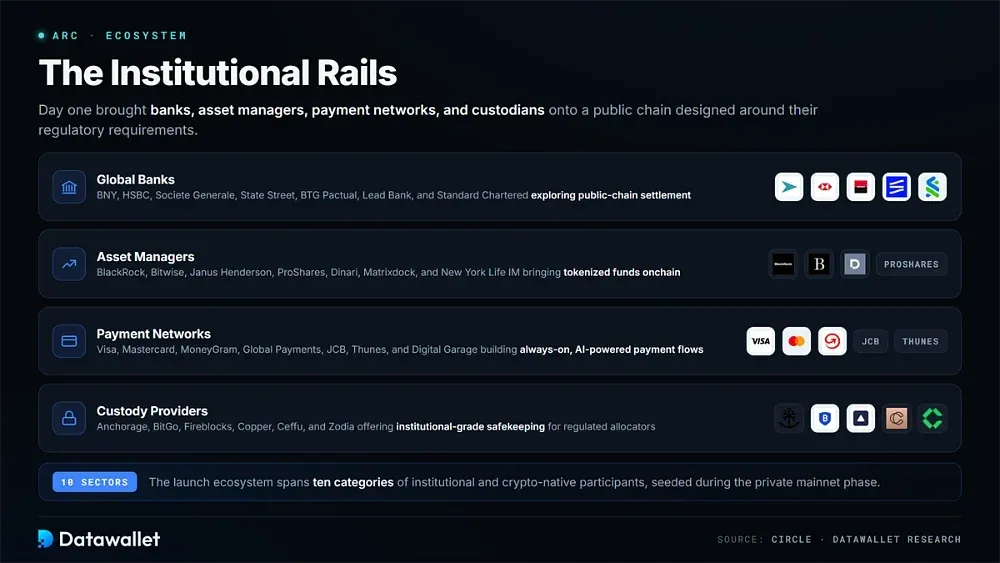
The launch ecosystem covers ten categories of institutional and crypto-native participants:
- Global Banks: BNY, HSBC, Societe Generale, State Street, BTG Pactual, Lead Bank, and Standard Chartered are exploring a public chain designed around bank regulatory requirements.
- Asset Managers: BlackRock, Bitwise, Janus Henderson, ProShares, Dinari, Matrixdock, and New York Life Investment Management are bringing tokenized funds and securities products onchain.
- Payment Networks: Visa, Mastercard, MoneyGram, Global Payments, JCB, Thunes, and Digital Garage are developing always-on settlement and AI-powered global payment flows on Arc.
- Exchanges: Coinbase, Binance, Kraken, OKX, Bybit, Upbit, KuCoin, Gate, Bitso, and Bitvavo provide direct deposit and withdrawal access to the network.
- DeFi Trading: Uniswap, Aero, fomo, 1inch, edgeX, Robinhood, Pump.fun, and Hibachi support spot markets, perpetuals, structured products, and crosschain execution venues.
- Credit Markets: Aave and Morpho lead onchain lending. Gauntlet, Steakhouse Financial, Keyrock, and Cumberland support the market through vault curation, risk oversight, and liquidity provision.
- Custody Providers: Anchorage, BitGo, Fireblocks, Copper, Ceffu, and Zodia Custody provide institutional-grade safekeeping for regulated allocators deploying capital.
- Wallet Support: MetaMask, Phantom, Ledger, Rainbow, Trust Wallet, and major exchange wallets make Arc accessible to hundreds of millions of existing users.
- Infrastructure Layer: Alchemy, QuickNode, Chainlink, Figment, Blockdaemon, Goldsky, and Kaleido provide builders with RPC access, oracles, indexing, and node operations.
- Agentic Platforms: Kite AI, Virtuals, BlockRun, Architect, and Orthogonal are building identity, execution, and marketplace layers for autonomous AI economic activity.
ARC Tokenomics
Although USDC pays transaction fees on Arc, the network also has a separate native coordination asset. The ARC whitepaper, published May 11, 2026, sets out the proposed structure.
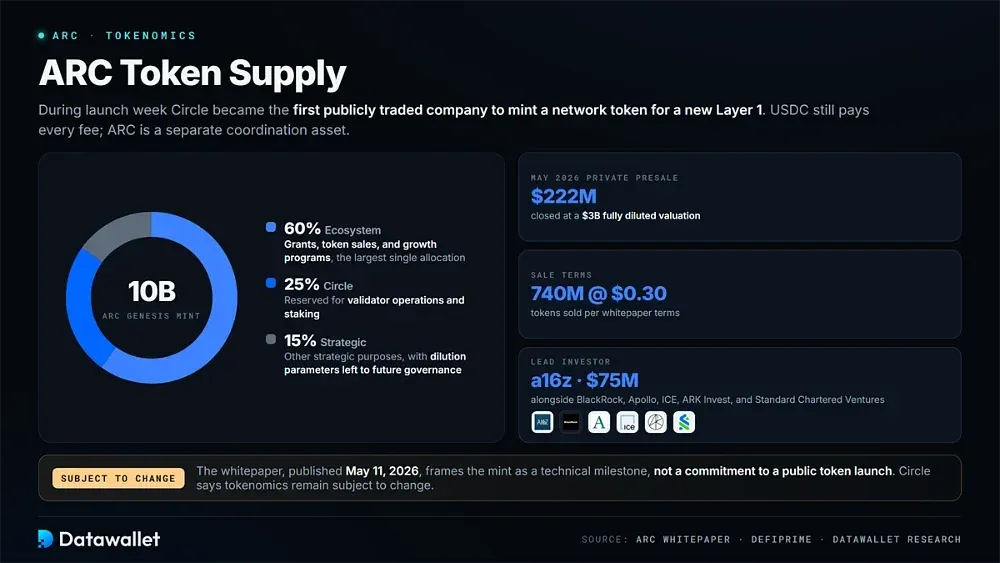
During launch week, Circle completed the genesis mint of all 10 billion ARC tokens, making it the first publicly traded company to mint a network token for a new Layer 1. The mint represents a technical milestone, however, rather than a commitment to a public token launch.
Token Utility and Purpose
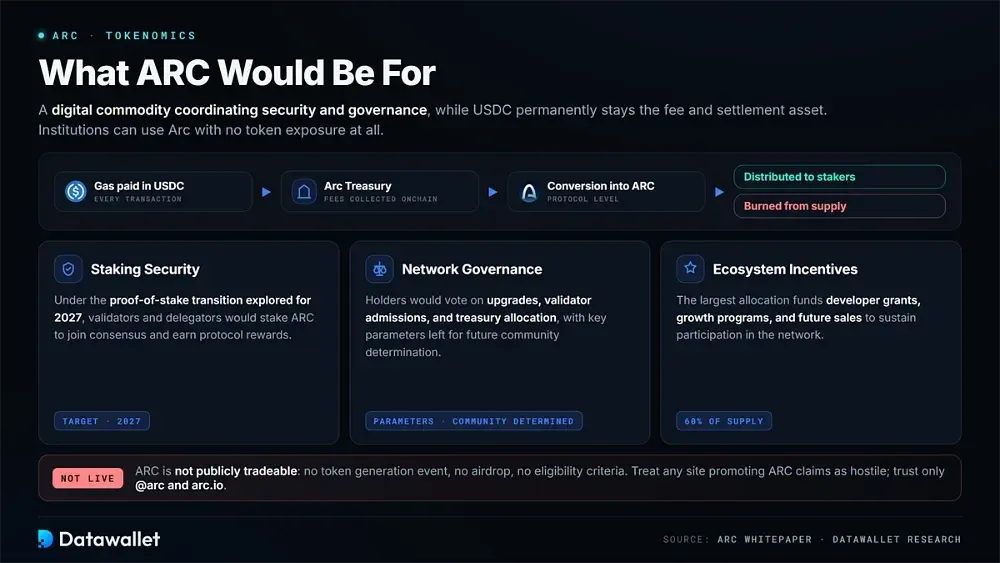
ARC is presented as a digital commodity intended to coordinate long-term network security and governance. USDC, by contrast, permanently remains the asset used for fees and settlement. This structure allows institutions to use the network without direct token exposure while preserving a separate incentive asset for Arc itself.
Proposed ARC functions include:
- Staking Security: Under the proof-of-stake transition being explored for 2027, validators and delegators would stake ARC to participate in consensus and receive protocol rewards.
- Network Governance: Holders would vote on protocol upgrades, validator admissions, treasury allocation, and parameters that the whitepaper intentionally leaves for future community determination.
- Fee Mechanics: Gas remains payable in USDC, while a protocol-level conversion directs value into ARC. Portions would be distributed to stakers, with other portions burned from supply.
- Ecosystem Incentives: The largest allocation is reserved for developer grants, growth programs, and future token sales intended to support sustained participation in the network.
Supply Allocation and Presale
The proposed distribution splits the 10 billion initial supply among three groups. Sixty percent is allocated to the ecosystem for grants, sales, and growth programs. Circle receives 25 percent for validator operations and staking, while the remaining 15 percent is reserved for other strategic purposes. Several dilution parameters are deferred to future governance.
Circle also reached a fundraising milestone in May 2026, when it closed a $222 million private presale at a $3 billion fully diluted valuation. The sale covered 740 million tokens at $0.30 each. A16z crypto led the round with $75 million, alongside BlackRock, Apollo, ICE, ARK Invest, and Standard Chartered Ventures.
Airdrop Status and Caution
ARC is not publicly tradeable. No token generation event has been scheduled, and Circle has not announced an airdrop. Although the size of the ecosystem allocation has prompted community speculation about eventual distributions, no eligibility criteria currently exist. Circle has repeatedly stated that the tokenomics remain subject to change.
Treat any website promoting ARC claims as hostile. Scammers routinely impersonate major crypto airdrops around mainnet launches, and Arc's institutional profile gives them an especially attractive target. For token announcements, rely only on the official @arc account and arc.io domains.
Arc Network Statistics and Trends
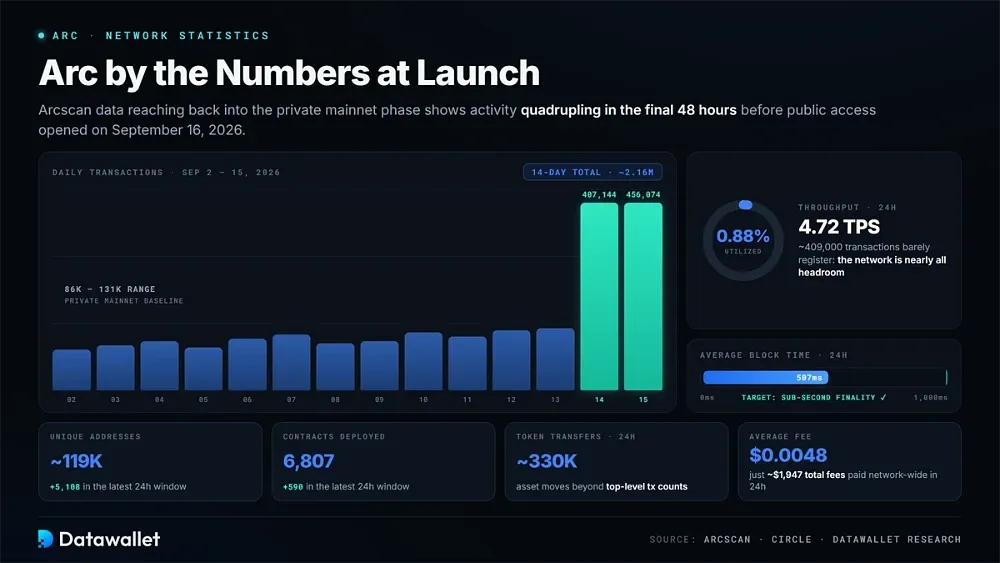
Arc entered public mainnet with activity already building from its private deployment phase. The latest figures come from Arcscan and Circle, with Arcscan's historical data extending back into the private mainnet period before public access opened on September 16, 2026.
Key metrics as of mid-September 2026:
- Transaction activity: Arc processed 407,144 transactions on September 14 and 456,074 on September 15, lifting the fourteen-day total to roughly 2.16 million transactions.
- Address growth: Arcscan indexed about 119,000 unique addresses by September 15, with 5,108 new addresses appearing during its latest complete 24-hour reporting window.
- Contract deployment: Around 6,807 contracts had been deployed since Arcscan’s index began, including 590 new contracts during the explorer’s latest complete 24-hour period.
- Token transfers: Arc recorded roughly 330,000 token transfers over the latest 24-hour window, offering another measure of asset movement beyond top-level transaction counts.
- Transaction costs: Arc’s average transaction fee was about $0.0048 over the latest 24-hour window, while users paid approximately $1,947 in total network fees.
- Network utilization: Arcscan measured utilization at only 0.88 percent despite roughly 409,000 transactions, with average throughput reaching 4.72 transactions per second during the window.
- Block performance: Arc averaged roughly 507 milliseconds between blocks over the latest 24-hour period, consistent with Circle’s design target of deterministic sub-second transaction finality.
- Pre-launch acceleration: Daily transactions ranged from about 86,000 to 131,000 between September 2 and 13, then exceeded 400,000 on both September 14 and 15.
Arc vs Other Stablecoin Chains
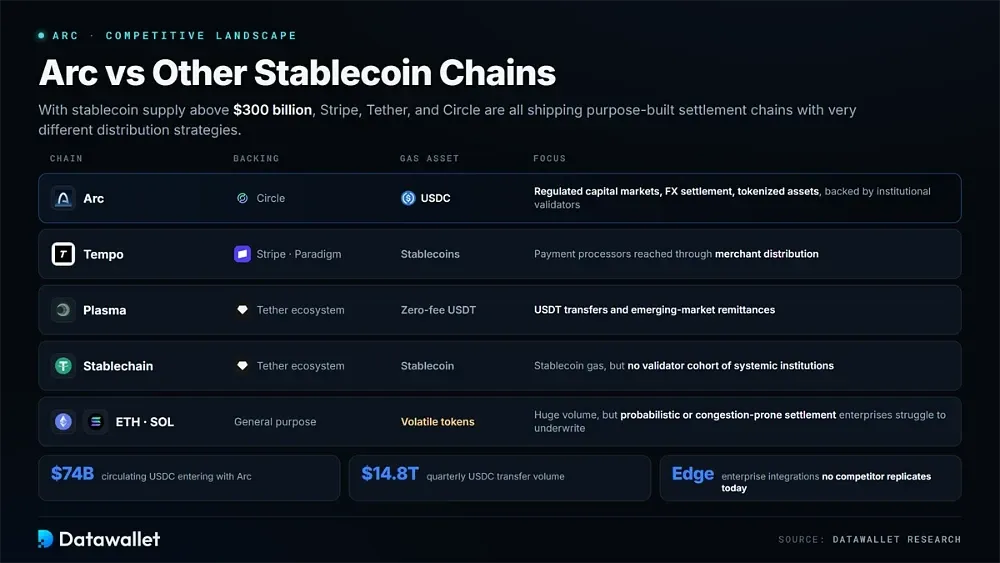
Arc is entering an increasingly crowded competition for stablecoin settlement infrastructure. With stablecoin supply above $300 billion, Stripe, Tether, and Circle are each developing purpose-built chains built around very different distribution strategies.
Regulation still frames the contest, although the broader US policy backdrop is less settled. The GENIUS Act established federal stablecoin rules in 2025, while the CLARITY Act stalled in the Senate.
Arc's positioning differs from its closest purpose-built competitors in several ways:
- Tempo Comparison: Tempo, backed by Stripe and Paradigm, is aimed at payment processors through merchant distribution. Arc instead draws on Circle's existing USDC float and its relationships with institutional validators.
- Plasma Comparison: Plasma focuses on zero-fee USDT transfers and emerging-market remittances. Arc puts greater emphasis on regulated capital markets, FX settlement, and tokenized institutional assets.
- Stablechain Comparison: Stablechain also uses a stablecoin for gas but is centered on Tether's ecosystem. It does not have Arc's validator cohort of systemically important financial institutions.
- General-Purpose Chains: Ethereum and Solana carry enormous stablecoin volume, but both require volatile gas tokens and use probabilistic or congestion-prone settlement that enterprises struggle to underwrite.
- Distribution Edge: Circle enters with $74 billion of circulating USDC, $14.8 trillion in quarterly transfer volume, and existing enterprise integrations that no competitor can currently replicate.
Arc and the Agentic Economy
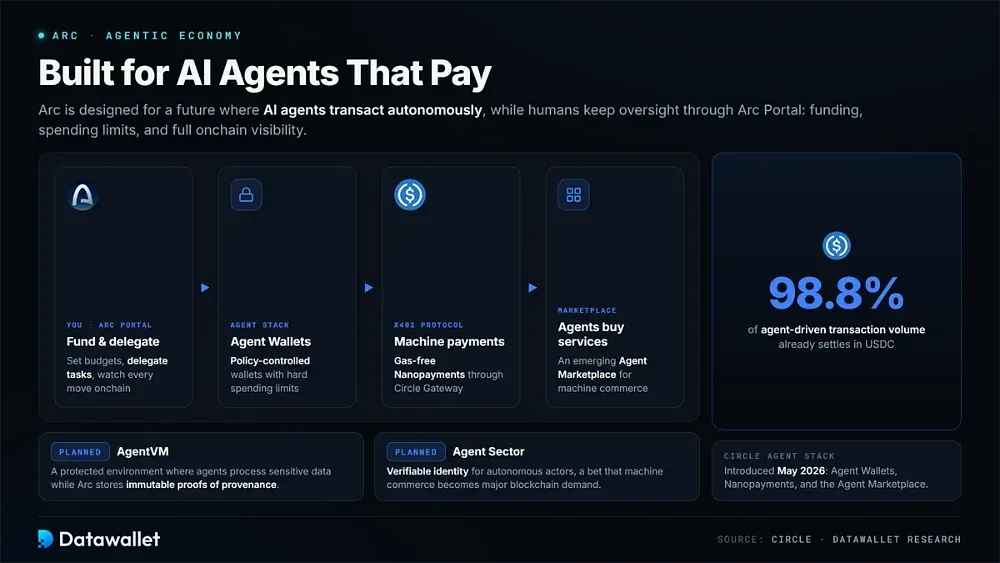
Arc was designed around a future in which AI agents can transact autonomously. Circle's launch materials state that USDC already settles 98.8 percent of agent-driven transaction volume, much of it through the x402 protocol standard for machine-to-machine payments.
The Circle Agent Stack, introduced in May 2026, provides the underlying components. These include policy-controlled Agent Wallets and gas-free Nanopayments through Circle Gateway, along with an emerging Agent Marketplace. Through Arc Portal, human users can maintain oversight by funding agents, setting spending limits, and delegating tasks while retaining full onchain visibility.
Circle's longer-term plans include AgentVM, a protected environment intended to let agents process sensitive data while Arc stores immutable proofs of provenance. Combined with a planned Agent Sector for verifiable identity, the design reflects a bet that autonomous commerce will become a major source of blockchain demand.
Risks and Considerations
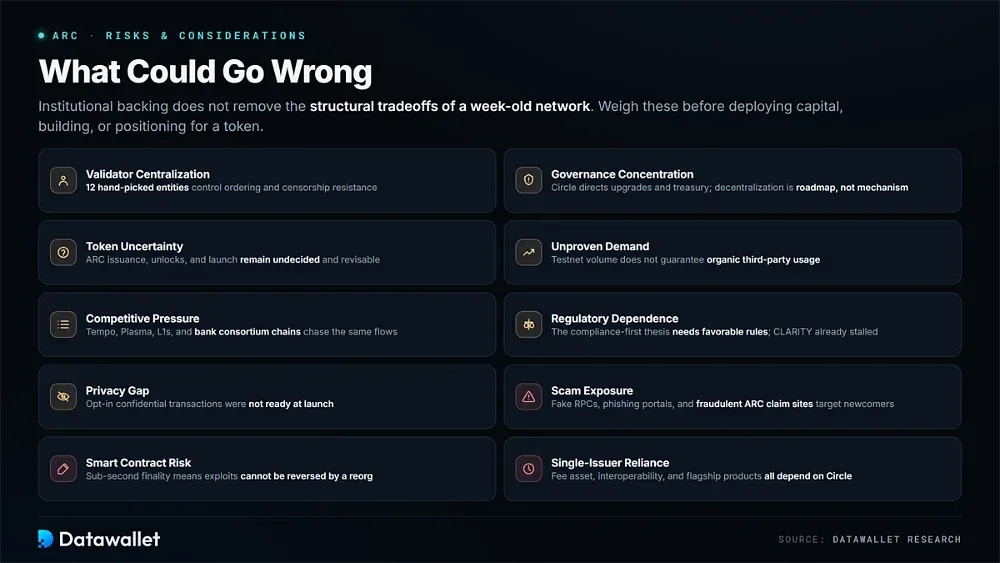
Arc's institutional backing does not remove the structural tradeoffs or unresolved questions surrounding a week-old network. Anyone considering deploying capital, building applications, or positioning for a token should account for those factors.
Keep the following considerations in mind before committing time or funds to Arc:
- Validator Centralization: Eleven hand-picked institutions plus Circle control block production through proof of authority, so transaction ordering and censorship resistance depend on their conduct.
- Governance Concentration: Circle currently directs protocol development, validator admissions, and treasury policy. Decentralization therefore depends on future roadmap execution rather than mechanisms already in place.
- Token Uncertainty: ARC's issuance, unlock schedule, and public launch remain undecided. Presale valuations and airdrop expectations consequently depend on assumptions Circle may revise.
- Unproven Demand: High testnet volume and launch partnerships do not ensure organic usage. Arc still has to demonstrate meaningful third-party activity beyond Circle's treasury operations and ecosystem migration.
- Competitive Pressure: Tempo, Plasma, established Layer 1 networks, and bank consortium chains are all pursuing stablecoin settlement. Enterprise adoption cycles could ultimately favor a competing system.
- Regulatory Dependence: Arc's compliance-first thesis depends on favorable rules. Delayed legislation, adverse rulemaking, or divergence among foreign regulators could materially reduce its addressable market.
- Privacy Gap: Opt-in confidential transactions were still under development rather than available at launch, leaving institutions with confidentiality requirements dependent on future network upgrades.
- Scam Exposure: Mainnet launch attention creates opportunities for fake RPC endpoints, phishing portals, and fraudulent ARC claim sites designed specifically to drain newcomers' wallets.
- Smart Contract Risk: Both newly deployed contracts and ported protocols can contain vulnerabilities. Because Arc provides sub-second finality, exploited transactions cannot be reversed or removed through a chain reorganization.
- Single-Issuer Reliance: Circle underpins the network's fee asset, interoperability infrastructure, and flagship products, concentrating operational and counterparty risk in a single company.
Final Thoughts
Arc launches with advantages no prior Layer 1 has held: a $74 billion stablecoin base, validators drawn from the institutions that operate global finance, and a compliance-first design aligned with existing US stablecoin rules even as broader digital-asset market-structure legislation remains unresolved. If tokenized real-world assets scale as projected, Arc is built to capture that settlement.
Its unresolved questions are just as visible. The proof-of-authority structure still needs to progress toward the promised staking transition, ARC's undefined tokenomics require resolution, and demand beyond Circle's own orbit has yet to materialize organically. For additional context on the broader market shaping Arc's opportunity, see our tokenization statistics report.