




What is Stablechain?
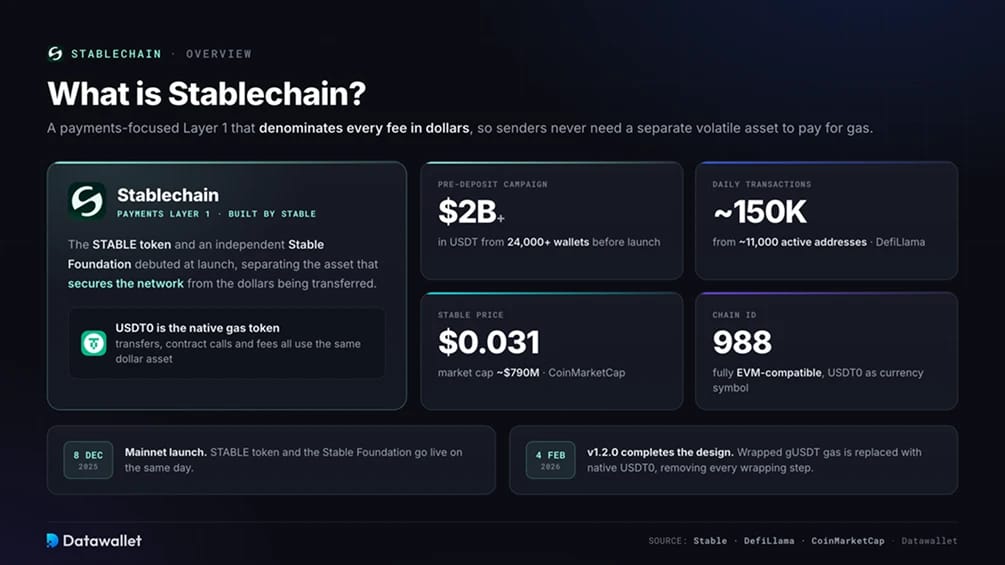
Stablechain is a payments-focused Layer 1 blockchain that denominates every fee in dollars. Built by the Stable team, the network uses USDT0 as its native gas token. Senders do not need a separate volatile asset to pay transaction costs.
Mainnet launched on December 8, 2025, after a pre-deposit campaign attracted more than $2 billion in USDT from over 24,000 wallets. The STABLE token and an independent Stable Foundation debuted on the same day, separating the asset used for network security from the dollars being transferred.
A protocol upgrade completed the design on February 4, 2026. The v1.2.0 release replaced the wrapped gUSDT gas asset with native USDT0. Transfers, smart contract calls, and fees can now use the same asset without any wrapping steps.
Network activity has increased since launch. DefiLlama records roughly 150,000 daily transactions from around 11,000 active addresses. According to CoinMarketCap, STABLE trades near $0.031 with a market capitalization of about $790 million.
How Does Stablechain Work?
Stablechain combines a custom consensus engine with an Ethereum-style execution layer. It also includes features designed specifically for payment companies and institutions. The whitepaper identifies five core building blocks.
1. StableBFT Consensus
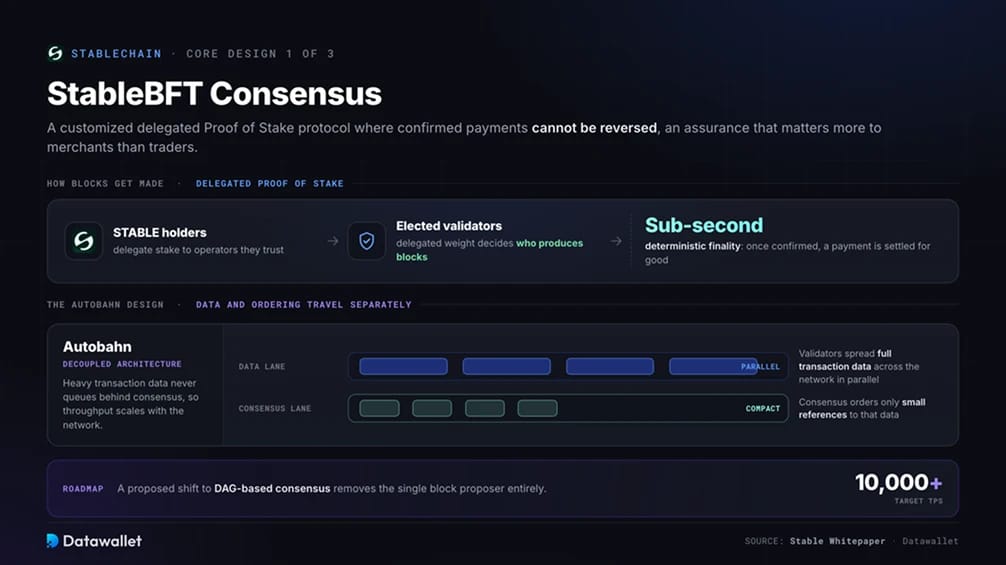
StableBFT is a customized delegated Proof of Stake protocol in which STABLE holders elect the validators responsible for producing blocks. The system provides sub-second, deterministic finality, meaning confirmed payments cannot be reversed. That assurance matters more to a merchant settling invoices than it does to a trader.
A design called Autobahn separates data handling from block ordering. Validators distribute transaction data across the network in parallel, while consensus orders only compact references. The roadmap proposes an eventual transition to DAG-based consensus, removing the single block proposer and targeting throughput above 10,000 transactions per second.
2. USDT0 as Native Gas
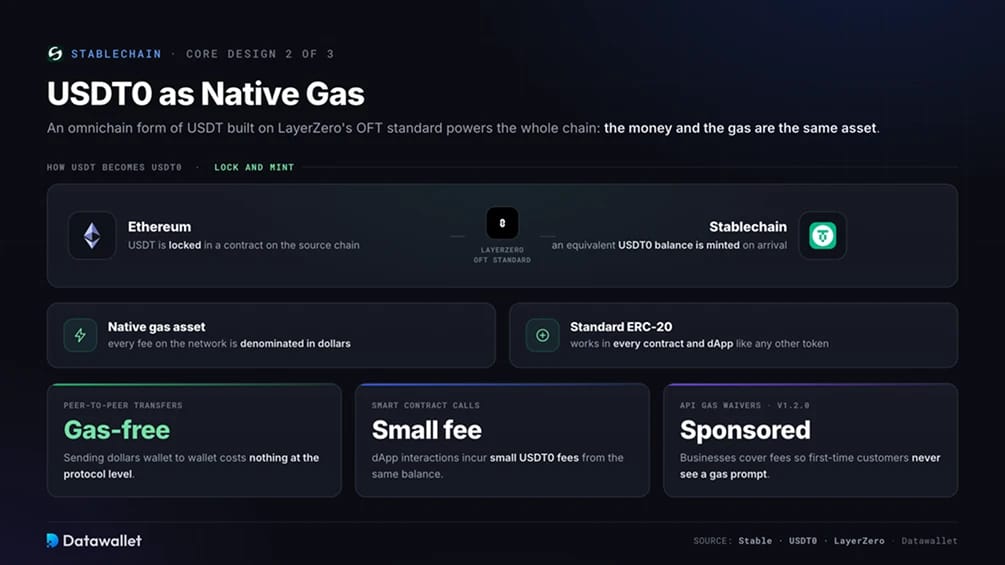
USDT0 is an omnichain form of USDT built on LayerZero's OFT standard. This token format locks USDT on Ethereum and mints an equivalent balance on the destination network. On Stablechain, USDT0 functions as both the native gas asset and a standard ERC-20 token. We examine this dual role in our USDT vs USDT0 comparison.
Peer-to-peer USDT0 transfers are gas-free at the protocol level, allowing users to send dollars to another wallet at no cost. Smart contract interactions incur small USDT0 fees. The v1.2.0 upgrade also introduced API-managed gas waivers, which businesses can use to sponsor fees and prevent first-time customers from encountering a gas prompt.
3. EVM Execution and StableDB
Stablechain is fully compatible with the Ethereum Virtual Machine, the software environment that executes Ethereum smart contracts. Solidity applications can be deployed without code changes, as they can on other EVM chains. MetaMask, Foundry, Hardhat, and other familiar tools work out of the box.
Beneath the execution layer, a purpose-built storage engine called StableDB holds frequently accessed balances in memory to reduce read latency. Parallel transaction execution provides more throughput than a sequential engine. Together, these choices optimize the network for millions of small dollar transfers rather than complex DeFi computation.
4. Enterprise Settlement Features
Guaranteed Blockspace allows institutions to reserve dedicated validator capacity and use isolated transaction queues. A payroll run or exchange settlement can therefore execute on schedule, even during congestion on the public network.
Stablechain's USDT Transfer Aggregator places thousands of separate transfers into one on-chain transaction. Exchanges and payment processors can settle mass payouts as a single batch, reducing costs and the amount of data recorded on the ledger.
5. Confidential Transfers
Salaries and supplier rates are rarely information that businesses want published on a public ledger. Stablechain addresses this problem through confidential transfers, which use zero-knowledge cryptography to conceal transaction amounts while proving the underlying statement is valid.
The sender and receiver addresses remain visible. This structure keeps transfers auditable and compatible with anti-money laundering requirements.
How to Use Stablechain
You only need USDT and an Ethereum-compatible wallet to begin using Stablechain.
Follow these steps to transact on the network:
- Add the network: Connect Stablechain to a wallet such as MetaMask using Chain ID 988 and USDT0 as the currency symbol. Our add Stablechain to MetaMask guide provides the full configuration.
- Acquire USDT: Purchase Tether through a centralized platform listed in our guide to the best USDT exchanges, then withdraw it to a self-custody wallet.
- Bridge to the chain: Transfer your USDT to Stablechain as USDT0 using a supported crypto bridge, such as Stargate or Jumper.
- Send dollars: Move USDT0 to another address without paying gas. You can also interact with dApps and cover the small dollar-denominated fees from the same balance.
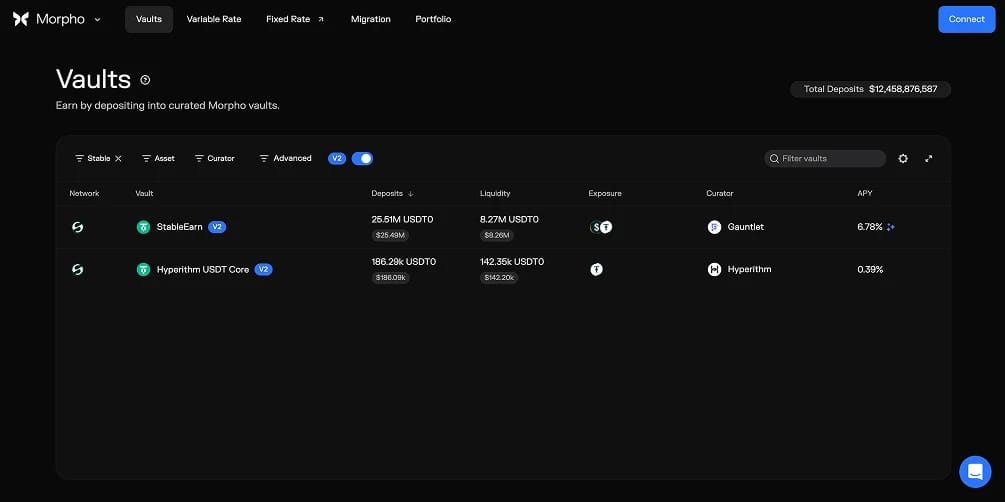
- Explore the ecosystem: Use curated Morpho lending vaults, swap tokens through Stable Swap, or try newer applications being launched on the chain.
- Stake and vote: STABLE holders can delegate tokens to validators and participate in protocol governance through the Stable Foundation.
Is Stablechain Backed by Tether (USDT)?
Tether does not own, issue, or operate Stablechain. The network is nevertheless more closely connected to the Tether ecosystem than almost any other chain. This relationship contributes to the project's credibility, but it also creates concentration risk.
Bitfinex incubated the project and co-led its seed round. The exchange shares its iFinex parent company with Tether. Tether CEO Paolo Ardoino is an advisor and personal investor, while USDT0 is also a named backer. That Tether-affiliated business extends USDT to networks that would otherwise lack native support.
The connection extends beyond funding and personnel. Stablechain's USDT0 integrates with the Legacy Mesh, joining balances across Ethereum, Tron, and TON into a shared pool of transferable Tether liquidity. Its fee model also rests on USDT maintaining its position as the leading dollar stablecoin. Our Tether statistics page tracks this dominance, which remained above 60% of the stablecoin market in mid August.
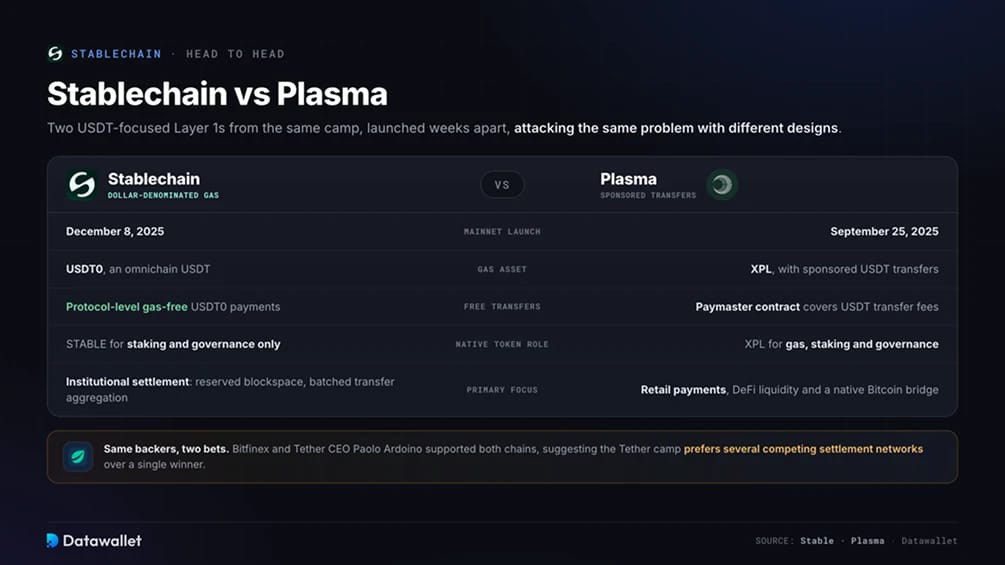
These backers have not committed exclusively to Stablechain. Bitfinex and Ardoino also supported Plasma, a competing chain focused on USDT. Their involvement suggests the Tether camp prefers several settlement networks competing to support its coin rather than relying on a single winner.
STABLE Tokenomics & Supply
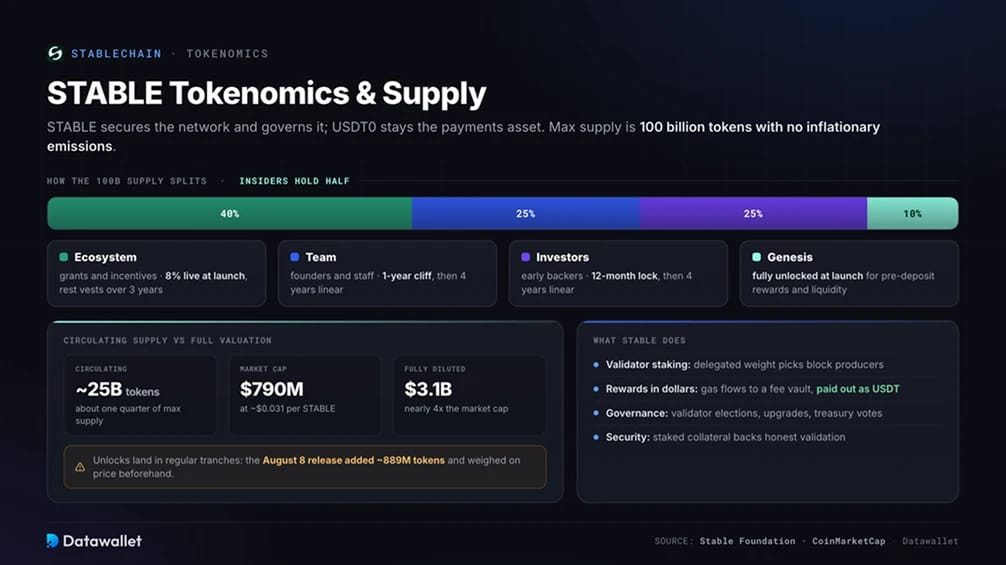
The STABLE token secures the network and supports governance. USDT0 remains the asset used for customer-facing payments. STABLE has a maximum supply of 100 billion tokens, with no inflationary emissions planned.
Supply and Allocation
Insiders hold half of the total supply, a larger concentration than community-first launches such as Hyperliquid. Vesting schedules, however, keep most of those tokens locked for several years.
The 100 billion supply breaks down as follows:
- Genesis distribution: 10% was fully unlocked at mainnet launch to reward pre-deposit campaign participants and establish market liquidity.
- Ecosystem and community: 40% is allocated to grants, incentives, and partnerships. Of this amount, 8% was available at launch, with the rest vesting linearly over three years.
- Team: 25% is reserved for founders and employees. These tokens have a one-year cliff followed by four years of linear vesting.
- Investors and advisors: 25% belongs to early backers. The allocation remains locked for twelve months before entering the same four-year linear vesting schedule.
Approximately 25 billion tokens are circulating, equivalent to about one-quarter of the maximum supply. At current prices, this produces a fully diluted valuation near $3.1 billion, compared with a market capitalization of around $790 million. Unlocks occur in regular tranches. One release on August 8 added roughly 889 million tokens and weighed on the price in the preceding days.
Utility
STABLE holders receive rewards generated by network activity rather than newly issued tokens. The structure connects the token's value directly to the volume of USDT transferred across Stablechain.
The token's main functions include:
- Validator staking: STABLE holders delegate tokens to validators. Delegated weight determines which operators produce blocks and collect fees.
- USDT-denominated rewards: Gas fees enter a protocol-managed vault, from which validators can distribute a portion of those dollars to delegators.
- Governance: Tokenholders vote on validator elections and protocol upgrades. They also participate in treasury decisions coordinated through the Stable Foundation.
- Network security: Staked tokens provide the economic collateral supporting honest validation under the delegated Proof of Stake system.
Stablechain Adoption and Ecosystem
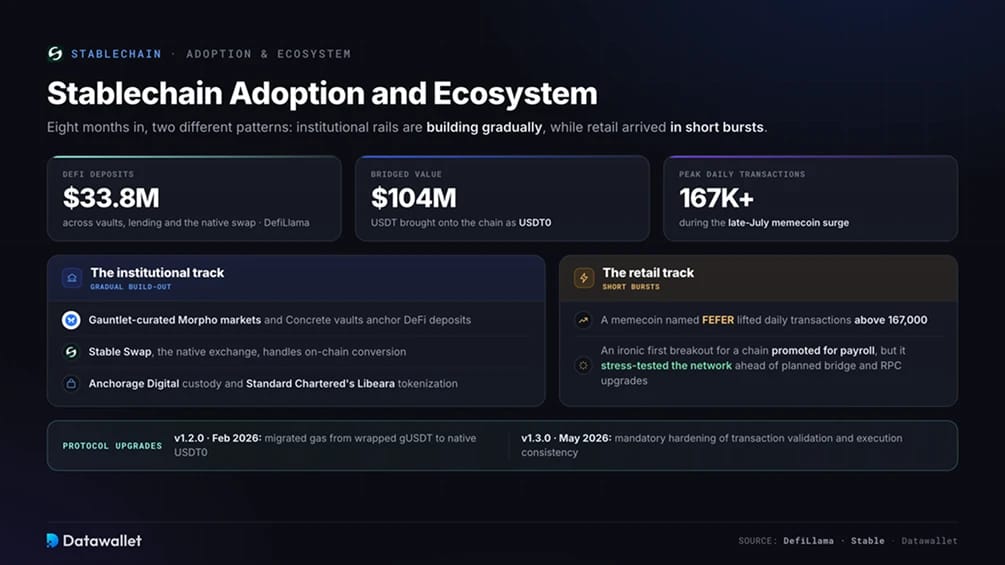
Eight months after launch, Stablechain presents two different patterns of adoption. Institutional infrastructure is developing gradually, while retail activity has appeared in short bursts.
DefiLlama reports around $33.8 million in DeFi deposits. Concrete vaults, Gauntlet-curated Morpho lending markets, and the native Stable Swap exchange account for much of that total. Bridged value stands near $104 million. Institutional partnerships include Anchorage Digital for custody and Standard Chartered's Libeara tokenization platform.
Retail users found a different reason to join the chain. A memecoin named FEFER triggered a late July surge that lifted daily transactions above 167,000. It was an ironic first breakout for a network promoted for payroll and remittances, but the episode stress-tested Stablechain before its planned bridge and RPC improvements.
Protocol development has continued alongside this activity. In addition to the v1.2.0 gas migration, a mandatory v1.3.0 upgrade in mid May strengthened transaction validation and improved execution consistency across the validator set.
Stablechain vs Plasma
Stablechain's closest competitor is Plasma, another USDT-focused Layer 1 supported by the Bitfinex and Tether camp. Both networks launched within weeks of one another and approach the same problem through different technical designs.
Plasma uses XPL, its conventional native token, for gas and staking. Free USDT transfers are sponsored through a paymaster contract, which pays transaction fees on behalf of the user. The network's early expansion relied on DeFi integrations and a native Bitcoin bridge, with retail payments in emerging markets forming another area of focus.
Stablechain removes the volatile gas token from the user experience entirely. Its main differentiators, including reserved blockspace and batched transfer aggregation, target institutions. The stronger model may ultimately depend on whether stablecoin settlement grows through consumer applications or payment companies integrating directly with blockchains.
Stablechain Funding
Stable completed a $28 million seed round on July 31, 2025. Bitfinex and Hack VC co-led the financing. Participants ranged from traditional asset managers to exchange venture arms, including Franklin Templeton, Castle Island Ventures, Susquehanna's SIG DT Investments, KuCoin Ventures, Gate Ventures, Mirana Ventures, and Nascent.
PayPal Ventures made a separate strategic investment in September 2025. Its participation was notable because PayPal issues a competing stablecoin. Angel investors included Ardoino and Anchorage Digital CEO Nathan McCauley, who both advise Stable.
Demand during the pre-deposit campaign exceeded the venture capital raised. Caps filled within minutes during several phases, and deposits ultimately surpassed $2 billion. Stablechain consequently had a substantial pool of committed USDT before producing its first block.
Is Stablechain Safe?
Several elements of Stablechain's design prioritize reliability, including deterministic finality and compliance-aware privacy. Its mandatory hardening upgrade also demonstrates active security maintenance. The mainnet launch itself was less reliable.
During the first hours of operation, some depositors reported that they were unable to withdraw funds or claim STABLE tokens. The team resolved the issue, but the disruption weakened its payments-grade reliability pitch.
Key risks to weigh include:
- USDT concentration: Stablechain's gas model, settlement asset, and wider value proposition all depend on Tether. A reserve, legal, or regulatory shock affecting USDT would therefore have a greater impact on Stablechain than on a general-purpose network.
- Insider-heavy supply: The team and investors control half of the STABLE supply. Regular unlocks create recurring selling pressure while the market capitalization remains far below the fully diluted value.
- Validator centralization: A curated delegated Proof of Stake validator set concentrates block production. Censorship and coordinated failures remain concerns until the network broadens this base.
- Compliance controls: USDT's blocklisting function sits at the center of Stablechain, allowing the issuer to freeze funds. Regulators may view this as a benefit, while holders face it as a risk.
- Bridge dependence: USDT0 enters through LayerZero's lock-and-mint system. A failure in the messaging layer or its contracts could strand bridged dollars or place them at risk.
- Thin DeFi depth: Stablechain applications hold about $33.8 million in deposits. Compared with established networks, this limited on-chain liquidity can make it harder to exit large positions.
- Regulatory shifts: Stablecoin regulation remains unsettled. Changes range from pending GENIUS Act implementation in the US to European MiCA rules that have already removed USDT from EU-regulated exchanges.
Stablechain Founders
Joshua Harding founded Stable and brought the project out of stealth in June 2025, initially serving as CEO. The company is now led by Brian Mehler. Before becoming chief executive, Mehler co-managed a $1 billion blockchain fund at Block.one, the company behind EOS.
CTO Sam Kazemian leads the technical side. He founded the Frax stablecoin protocol and has direct experience building dollar-pegged systems. That background is reflected in Stablechain's fee-vault structure and USDT-focused economics.
Stable employed around 27 people when it announced the seed round. The company also receives high-profile advisory support from Ardoino and McCauley. Access to Tether's leadership is arguably its strongest competitive advantage.
Final Thoughts
Stablechain is built around a focused thesis: dedicated infrastructure can take stablecoin settlement away from general-purpose chains, much as specialized card networks separated payments from broader banking. Removing a volatile token from the gas experience is a meaningful usability improvement. The fee-funded staking system also connects STABLE's value to network activity more clearly than many other Layer 1 tokens.
Competition remains intense and well funded. Plasma is pursuing the same USDT users, while Tron continues to hold the largest pool of Tether balances. Corporate networks such as Tempo and Circle's Arc are targeting many of the same institutions.
Our view is that Stablechain belongs on any stablecoin watchlist, but its token warrants more caution than the underlying chain. The payments design does not eliminate the risks created by insider ownership, scheduled unlocks, and complete dependence on Tether's standing. Any STABLE position should be sized accordingly.