Best Crypto VCs (Venture Capital Funds)
Summary: Crypto venture capital funds support early blockchain teams by providing capital, strategic resources, governance expertise, and long-term ecosystem alignment.
The current noteworthy firms include research-driven funds, exchange-affiliated platforms, and globally distributed multi-strategy firms. Below are the top eight crypto VCs to look at in 2025:
- Coinbase Ventures - Broad Global Portfolio With Strategic Integration
- Paradigm - High Conviction Research Partner For Technical Protocols
- a16z Crypto - Large Multibillion Platform Supporting Complex Projects
- Polychain Capital - Thesis Driven Investor Backing Early Network Experiments
- YZi Labs - Exchange Heritage Providing Strong Incubation Capabilities
- DGC - Broad Infrastructure Network With Integrated Subsidiaries
- Dragonfly Capital - Asia US Bridge Connecting Liquidity And Ecosystems
- Pantera Capital - Institutional Investor With Extensive Multi Cycle Expertise

Best Crypto VC: Coinbase Ventures 🏆
Coinbase Ventures remains our top VC pick due to steady deployment discipline, deep ecosystem integrations, and reliable support across high-impact global crypto categories.
Focus
Multi-sector exposure across infra, DeFi & consumers
Value Add
Built-in distribution through Coinbase products
Founder Support
Direct guidance on listings and compliance
Top 8 Crypto Venture Capital Firms in 2025
We evaluated leading crypto venture firms using onchain metrics, portfolio databases, and detailed round-level tracking. This approach highlighted the breadth of involvement, sector concentration, and consistent engagement with high-performing ecosystem segments.
Our review emphasized funds that deployed through downcycles, maintained valuation discipline, and supported founders with substantial operational guidance. We also assessed alignment risk, token practices, and structural conflicts involving exchanges, custody units, or trading operations.
See the detailed comparison table below:
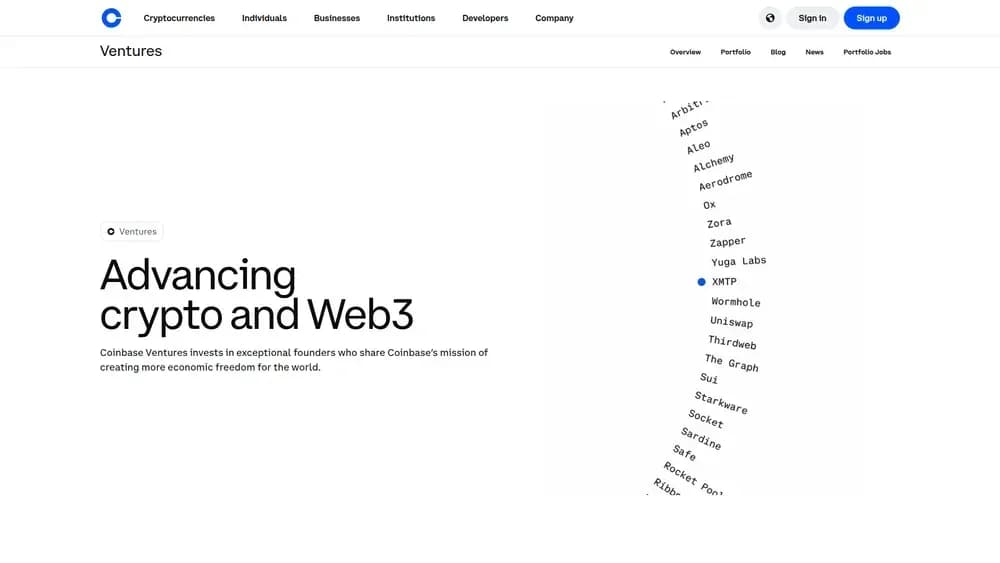
1. Coinbase Ventures
Coinbase Ventures is one of the most active global crypto investors with consistent involvement across key categories. The firm supports teams working on infrastructure, compliance tools, consumer applications, and foundational developer systems across major markets.
It invests early and helps founders build essential integrations that improve product readiness and institutional compatibility. The team provides structured guidance that strengthens regulatory preparation while supporting secure on-ramp, custody, and wallet connections.
In late 2025, Coinbase acquired Cobie's Echo for $375 million, adding a full onchain fundraising and deal execution platform. This acquisition lets Coinbase Ventures source earlier pipeline visibility and coordinate qualified allocations through Echo’s standardized processes for private crypto financings.
Coinbase Ventures Highlights:
- Fund type: Strategic venture arm within the Coinbase corporate platform.
- Stage focus: Seed and early growth participation across global markets.
- Sector focus: Infrastructure, compliance tooling, DeFi platforms, consumer applications.
- Projects: 452 total projects across infrastructure, compliance, DeFi, and consumer sectors.
- Notable investments: FTX Trading ($900M), Yuga Labs ($450M), Sui ($300M), Paxos ($300M).
2. Paradigm
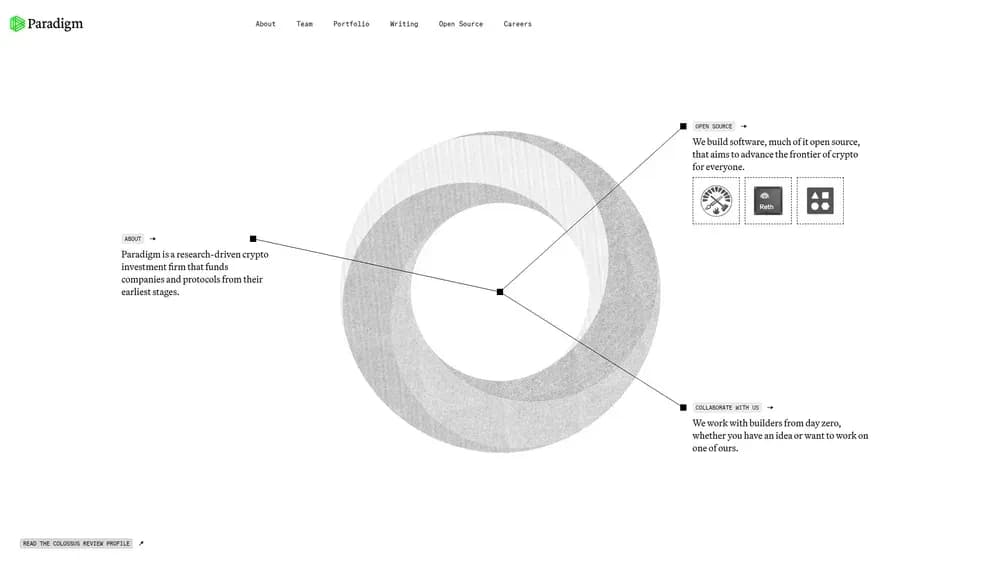
Paradigm is a research-driven crypto investor supporting foundational networks and advanced financial infrastructure across global markets. The firm engages deeply with protocol design to help founders build efficient mechanisms and transparent economic structures.
It invests with concentrated conviction and assists teams through direct involvement in engineering alignment and market architecture decisions. Founders receive collaborative support that optimizes governance planning and strengthens long-term protocol sustainability across ecosystem phases.
Paradigm operates an internal research group producing more than 40 technical papers annually that guide protocol design choices. Its engineering teams benchmark systems against historical MEV data and throughput records to validate performance requirements before mainnet deployment.
Paradigm Highlights:
- Fund type: Focused crypto investment firm with concentrated deployment.
- Stage focus: Early to growth round participation with selective large commitments.
- Sector focus: DeFi systems, scaling layers, middleware, and MEV-related infrastructure.
- Projects: 131 total projects across DeFi, infrastructure, middleware, and scaling sectors.
- Investments: Citadel Securities ($1150M), FTX ($900M), MoonPay ($555M), OpenSea ($300M).
3. Andreessen Horowitz (a16z crypto)
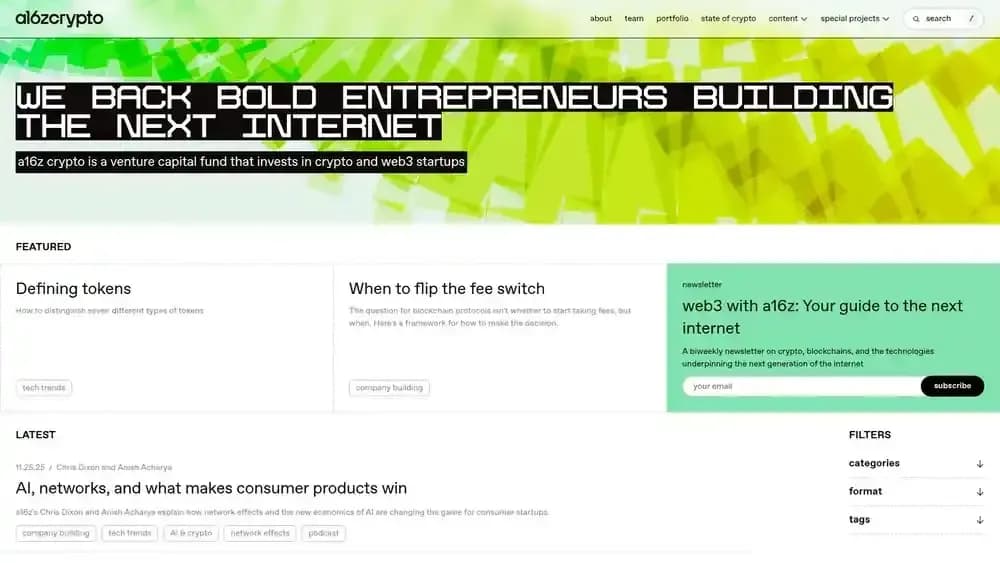
A16z crypto is one of the most influential investors backing advanced blockchain systems and important infrastructure. The firm supports teams pursuing technical breakthroughs that reshape onchain markets and long-horizon digital service models.
A16z Crypto runs structured support programs that assist more than 150 founders yearly with governance modeling and incentive simulations. Its policy group tracks over 20 global jurisdictions, giving teams detailed regulatory forecasts during early architectural planning.
The investment approach targets projects capable of shaping ecosystem standards while demonstrating strong engineering leverage. This model provides founders with credible partnerships that improve strategic reach and reinforce lasting platform durability.
a16z crypto Highlights:
- Fund type: Multi-fund investment platform with dedicated crypto vehicles.
- Stage focus: Seed participation through selective late-stage growth rounds.
- Sector focus: Infrastructure, DeFi, web3 applications, AI, and crypto crossover systems.
- Projects: 278 total projects across infrastructure, financial primitives, and scaling tech.
- Notable investments: Robinhood ($2400M), Kalshi ($1000M), Flow ($725M), Forte ($725M).
4. Polychain Capital
Polychain maintains a research operation analyzing 70+ blockchain networks for security assumptions, validator economics, and incentive structures. Its analysts review protocol telemetry using multi-year datasets that highlight stress points during network upgrades and liquidity expansions.
It invests early across core infrastructure while maintaining flexibility through combined venture and liquid strategy exposure. Founders receive support grounded in rigorous technical evaluation that strengthens incentive mechanisms and network reliability.
Polychain favors projects requiring deep engineering alignment and extended development cycles supported by patient capital. This approach helps teams refine protocol assumptions, test economic models, and prepare for multi-phase ecosystem growth.
Polychain Capital Highlights:
- Fund type: Hybrid crypto fund combining venture positions with liquid token strategies.
- Stage focus: Early network financing with selective ecosystem followons.
- Sector focus: Infrastructure, privacy systems, DeFi primitives, cryptoeconomic experimentation.
- Projects: 248 total projects across infrastructure, privacy, DeFi, and early network sectors.
- Notable investments: Solana ($314M), Coinbase ($300M), Avalanche ($230M), DeSo ($200M).

5. YZi Labs (formerly Binance Labs)
YZi Labs is an independent investment platform with origins inside the Binance ecosystem, currently overseen by CZ. The firm supports early crypto teams building cross-domain applications strengthened by extensive historical exposure to global exchange dynamics.
The VC evaluates deployments using load data from over 30 prior exchange-integrated launches across varied regulatory environments. Its incubation cohorts typically support 20-25 projects per cycle, giving founders structured benchmarks on liquidity access and operational readiness.
YZi Labs maintains strong historical expertise from its exchange-aligned origins while expanding into broader technological domains. This positioning helps founders pursue advanced projects that blend blockchain functionality with data, identity, and compute-intensive platforms.
YZi Labs Highlights:
- Fund type: Independent investment platform with incubation heritage.
- Stage focus: Early-stage financing combined with accelerator participation.
- Sector focus: Web3 ecosystems, infrastructure, gaming environments, identity, and compute systems.
- Projects: 212 total projects across infrastructure, gaming, identity, and multi-chain sectors.
- Notable investments: Sui ($300M), Mythical Games ($150M), Ronin ($150M), Forbes ($200M).

6. Digital Currency Group (DCG)
Dragonfly Capital is a global crypto investor supporting infrastructure, DeFi systems, NFT applications, and scaling environments. The firm helps founders access cross-regional liquidity channels that improve early traction and expand international user reach.
Dragonfly reviews cross-region liquidity behavior using data from over 80 exchanges and L2 environments to guide launch planning. Its governance contributors monitor 200+ protocol proposals annually, giving founders practical insight into ecosystem-level decision dynamics.
Dragonfly focuses on teams capable of achieving multi-region adoption while preserving operational resilience across dynamic conditions. This strategy benefits founders seeking partners who increase visibility and accelerate liquidity pathways.
Dragonfly Capital Highlights:
- Fund type: Global crypto investment fund with active research involvement.
- Stage focus: Seed to mid-stage financing across major ecosystems.
- Sector focus: L1 networks, L2 systems, DeFi platforms, NFT applications, and infrastructure.
- Projects: 211 total projects across infrastructure, DeFi, NFT, and scaling sectors.
- Notable investments: Polygon ($450M), Secret ($400M), NEAR ($350M), Avalanche ($250M).
7. Dragonfly Capital
Dragonfly Capital is a global crypto investor supporting infrastructure, DeFi systems, NFT applications, and scaling environments. The firm helps founders access cross regional liquidity channels that improve early traction and expand international user reach.
Dragonfly reviews cross-region liquidity behavior using data from over 80 exchanges and L2 environments to guide launch planning. Its governance contributors monitor 200+ protocol proposals annually, giving founders practical insight into ecosystem-level decision dynamics.
Dragonfly focuses on teams capable of achieving multi region adoption while preserving operational resilience across dynamic conditions. This strategy benefits founders seeking partners who increase visibility, accelerate liquidity pathways, and reinforce protocol lasting power.
Dragonfly Capital Highlights:
- Fund type: Global crypto investment fund with active research involvement.
- Stage focus: Seed to mid stage financing across major ecosystems.
- Sector focus: L1 networks, L2 systems, DeFi platforms, NFT applications, and infrastructure.
- Projects: 211 total projects across infrastructure, DeFi, NFT, and scaling sectors.
- Notable investments: Polygon ($450M), Secret ($400M), NEAR ($350M), Avalanche ($250M).

8. Pantera Capital
Pantera Capital analyzes multi-cycle market conditions with datasets covering 12 years of crypto liquidity, volatility, and funding activity. Its internal research models map token circulation and demand curves using inputs from hundreds of historical market events.
It manages multiple fund strategies that provide flexible exposure across early venture positions and liquid token markets. Founders gain access to insights that improve capital planning, institutional engagement, and project readiness for broader asset distribution.
Pantera prioritizes teams building core infrastructure with durable utility across market cycles and fluctuating adoption conditions. This focus supports founders seeking experienced partners who reinforce operational discipline.
Pantera Capital Highlights:
- Fund type: Institutional crypto investment manager with multi-fund structure.
- Stage focus: Early stage venture participation with selective later stage involvement.
- Sector focus: DAT platforms, payments networks, DeFi systems, exchanges, and gaming.
- Projects: 235 total projects across payments, infrastructure, DeFi, and exchange sectors.
- Investments: Ripple Labs ($500M), Mill City Ventures ($450M), Bakkt ($300M), Alchemy ($250M).

What Are Crypto Venture Capital Firms?
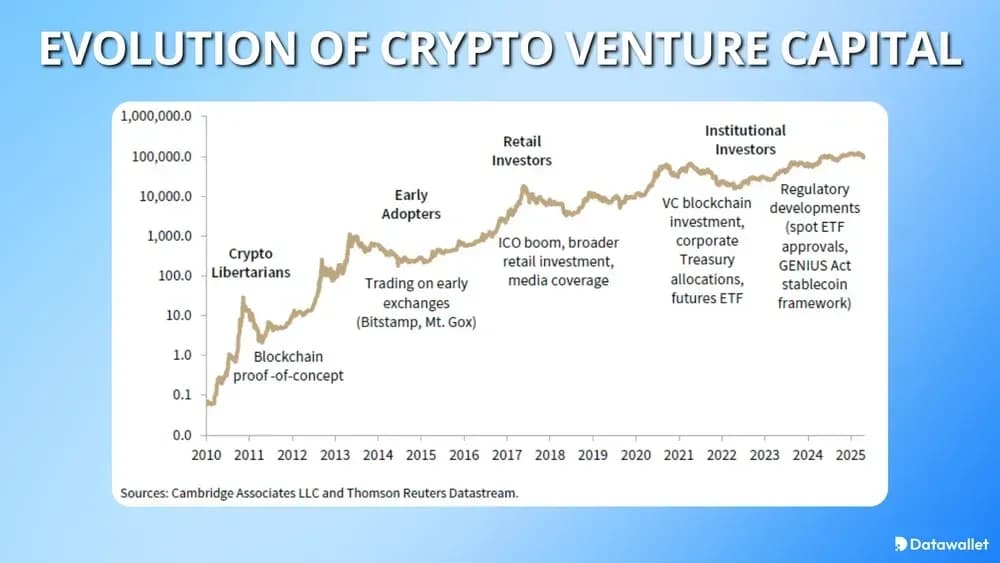
Crypto venture capital firms are specialized investors that fund early companies building blockchain networks, crypto products, and decentralized applications. They raise money from external LPs and deploy it into teams, creating foundational tools for digital asset ecosystems.
These firms assess technical design, token structure, regulatory exposure, and market potential before investing meaningful capital. Their role supports founders by providing resources, strategic guidance, and essential industry connections needed to reach product maturity.
Crypto VCs blend traditional startup evaluation with analysis tailored to liquid tokens, distributed governance, and global participation models. Their portfolios commonly include infrastructure providers, consumer platforms, financial protocols, and developer systems critical to overall ecosystem progress.
How Do Crypto VCs Make Money?
Crypto venture capital firms generate revenue through structured fund economics that combine management fees, performance incentives, and token-driven income streams.
The points below outline their primary income sources:
- Management fees: Firms charge annual fees around 2% of committed capital, covering salaries, research, operations, and multi-year fund administration.
- Performance fees: They earn carried interest near 20% of realized profits, creating incentive alignment between fund managers and long-term LP outcomes.
- Equity exits: They generate profit when portfolio firms achieve liquidity through acquisitions, public listings, or structured secondary-market transactions.
- Token allocations: They receive token grants at early valuations that appreciate as networks grow adoption, liquidity, and measurable onchain activity.
- Staking rewards: They earn yield from protocol participation by staking tokens or delegating positions into validator systems, producing recurring incentives.
- Airdrop gains: They benefit from protocol airdrops awarded to early backers, adding supplemental upside beyond standard token or equity returns.
- Market-making partnerships: Some firms operate affiliated trading units that monetize order flow, liquidity provisioning, and token inventory management within supported networks.
Crypto Venture Capital Market Conditions in 2025
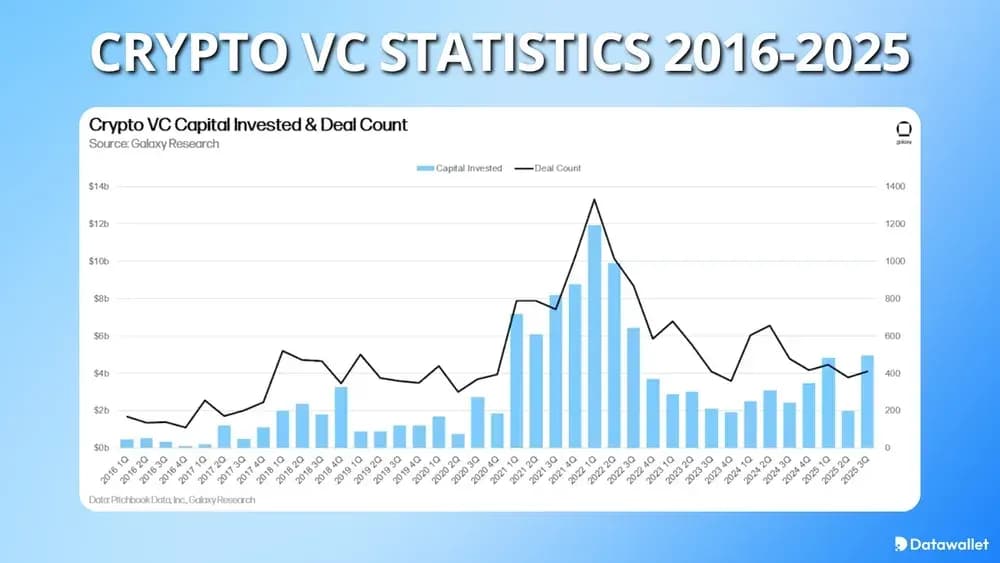
According to a recent research by Galaxy, venture activity in crypto increased during Q3 2025 but remained well below earlier cycle peaks. Most quarterly momentum came from a small group of later stage transactions that strongly influenced overall investment totals.
Capital deployed reached $4.59 billion across 414 deals, reflecting cautious allocator sentiment and ongoing fundraising challenges across recent quarters. United States based companies maintained clear leadership, capturing the largest share of capital deployment and market transactions.
Later stage rounds accounted for 56% of invested funds, led by $1 billion for Revolut and $500 million for Kraken. Early stage participation remained durable, supported by steady pre-seed formation across infrastructure, financial tooling, and emerging application categories.
Institutional preference continued shifting toward ETFs and digital asset treasury companies, reducing demand for earlier venture positions. Despite these pressures, trading platforms, infrastructure providers, stablecoin networks, and AI-linked systems continued attracting major investor attention.
Risks of Taking Crypto Venture Capital Funding
Taking crypto venture funding introduces structural constraints that influence governance, token distribution, economic design, and operational decision-making for founders.
Below are the primary risks associated with crypto-focused venture participation:
- Governance concentration: Large allocations can consolidate protocol voting power within a few funds, limiting community influence and slowing critical network changes.
- Token unlock pressure: Large vesting cliffs can release major token supply (as seen with $ARB, $APT, $OP), creating liquidity stress and decreasing market price.
- Exit misalignment: Funds facing redemption cycles may prioritize faster liquidity events over healthier strategies supporting sustainable project development.
- Regulatory spillover: Investigations involving a venture firm or affiliates can trigger scrutiny, operational delays, or banking disruptions for associated portfolio teams.
- Signaling impact: A VC declining follow-on participation can discourage new investors, weaken user confidence, and reduce broader ecosystem engagement.
- Control complexity: Multiple funds holding equity, token rights, and board seats can slow decisions, complicating execution and hindering product development speed.
Final Thoughts
The next cycle will likely concentrate crypto venture around fewer, highly specialized technical funds as generalist capital migrates toward tokenized public-market products.
Founders may increasingly skip traditional VC structures by raising hybrid on-chain rounds that merge community liquidity with institutional participation at earlier stages.
If current policy trends persist, the United States could become the dominant center for regulated crypto finance, forcing major venture firms to reorient operations.
Frequently asked questions


.webp)