







Compare Top Crypto Exchanges in Kuwait
1. Rain
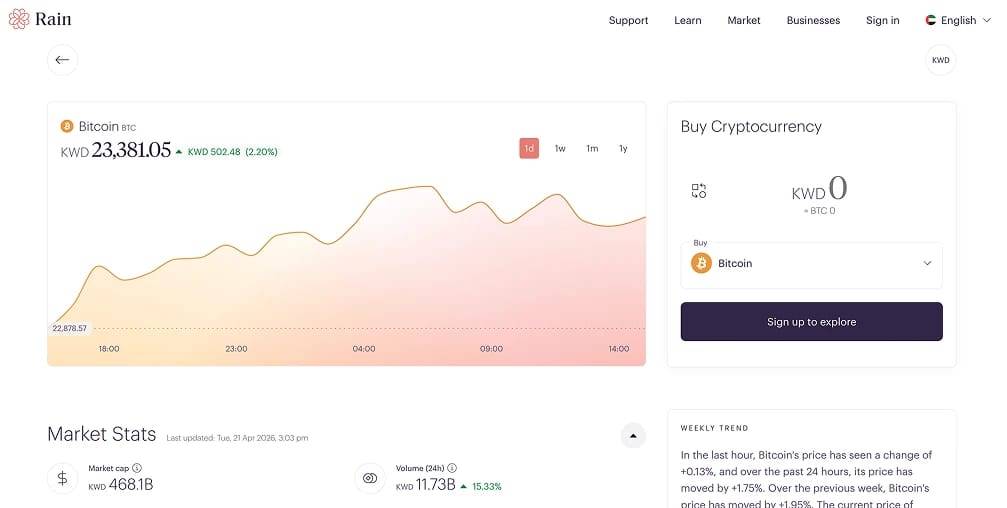
Rain sets the bar for what a regulated regional exchange should look like for Kuwaiti users. It holds a Category 3 Crypto-Asset Services Provider license from the Central Bank of Bahrain, serves Kuwaiti residents directly, and combines KWD SWIFT deposits, KNET card payments, and Shari'a compliance certified by the Shariyah Review Bureau.
That combination matters more in Kuwait than anywhere else in the region. With local banks blocked from crypto under the CBK directive, regional regulation becomes the strongest trust signal available. Rain is the only exchange on this list that pairs a CBB licence with Kuwait-native rails, including KNET support from a Kuwaiti bank card, which no global platform offers.
The product is built to keep first-time buyers moving. You can buy, sell, and swap 85+ cryptocurrencies through a clean interface, KYC typically clears in under 24 hours, and support is 24/7 bilingual in Arabic and English with human agents. Rain Pro adds charting, limit and stop orders, and maker/taker pricing of 0.1% / 0.25%. Larger tickets can go through the Rain OTC Desk for private facilitated execution.
Pros
- CBB-licensed Category 3 CASP, the only regulated regional exchange on this list that serves Kuwait directly, covering Bahrain, Kuwait, Saudi Arabia, Oman, and the UAE.
- Only exchange that accepts KNET card payments from Kuwaiti bank cards, which keeps funding on Kuwait-native rails rather than relying on international card processing or P2P escrow.
- Shari'a compliant via Shariyah Review Bureau certification across the full product suite, plus 24/7 Arabic human support and cold storage holding the vast majority of client assets offline.
Cons
- The coin menu is deliberately conservative at around 85 assets, so if you're chasing smaller altcoin listings you'll need a second account on a deeper catalog like Gate or Bybit.
- Taker fees of 0.25% run higher than what you'll pay on Bybit or Binance spot, though still competitive against card-based on-ramps.
- Regulated in Bahrain, not Kuwait, so the CBB is the regulator of record if anything goes wrong. No Kuwaiti regulator will intervene on your behalf because none engages with crypto firms.
2. Bybit
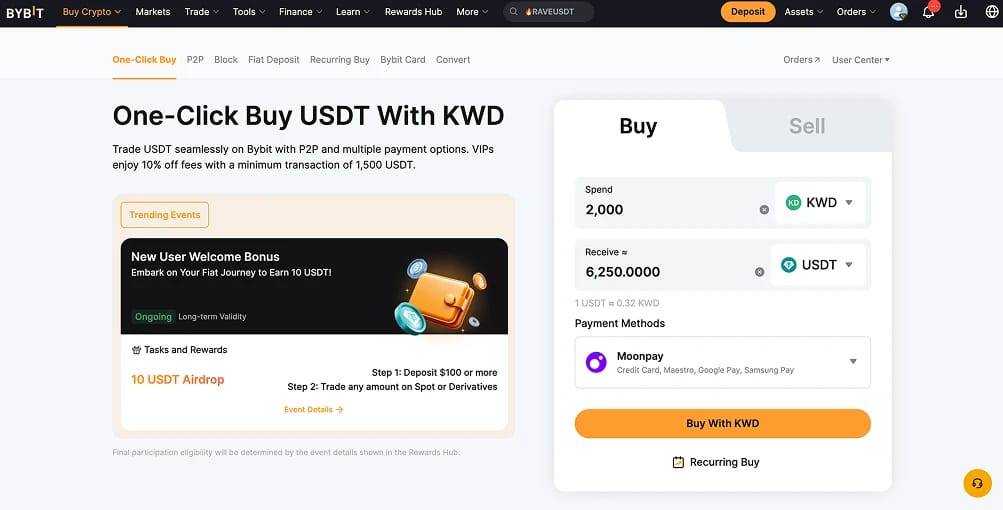
Bybit is where Kuwaiti users go when they want product depth on a global exchange without giving up Arabic support or a Shari'a compliant account option. It's the world's second-largest exchange by volume, and its product maps closely to what MENA users care about: Arabic UI, an Islamic Account, and a KWD P2P market deep enough to fill the gap when your Kuwaiti bank won't touch an exchange wire.
The Islamic Account launched in September 2024 with dual Shari'a certification from ZICO Shariah Advisory Services and CryptoHalal. It covers spot trading across roughly 75 approved tokens plus DCA and Spot Grid bots, which is one of the few scaled options globally for traders who want to stay inside Islamic finance principles and avoid interest-bearing or gharar-heavy instruments.
For everyone else, the mainline Bybit experience covers what you'd expect from a top-two venue: 1,800+ tokens, 0.1% spot fees, perpetual futures with leverage up to 125x, an active copy trading leaderboard, and Bybit Earn for staking and structured yield. On the regulatory side, Bybit holds a full SCA Virtual Asset Platform Operator licence in the UAE (October 2025), a MiCA licence from Austria's FMA (FN 636180i), a provisional VARA approval in Dubai, and a CMB registration in Türkiye.
Pros
- Dual Shari'a certified Islamic Account launched in September 2024, offering spot access to approximately 75 approved tokens plus DCA and grid bots for rules-based investing.
- Arabic interface, 24/7 Arabic customer support, and one of the deepest KWD P2P markets in the MENA region.
- Strong regulatory posture for Kuwaiti users: full UAE SCA licence (first exchange to secure it), MiCA in Austria, provisional VARA in Dubai, plus 1:1 proof-of-reserves and cold storage for most assets.
Cons
- No local Kuwait licence exists and none can be issued, so any dispute goes through offshore support without a regional regulator to escalate to.
- The product surface is wide. Beginners can stumble into leverage, options, or bots they didn't plan to use.
- Direct KWD bank transfers aren't reliable. Most users rely on P2P or foreign-card deposits, both of which carry their own costs.
3. Binance
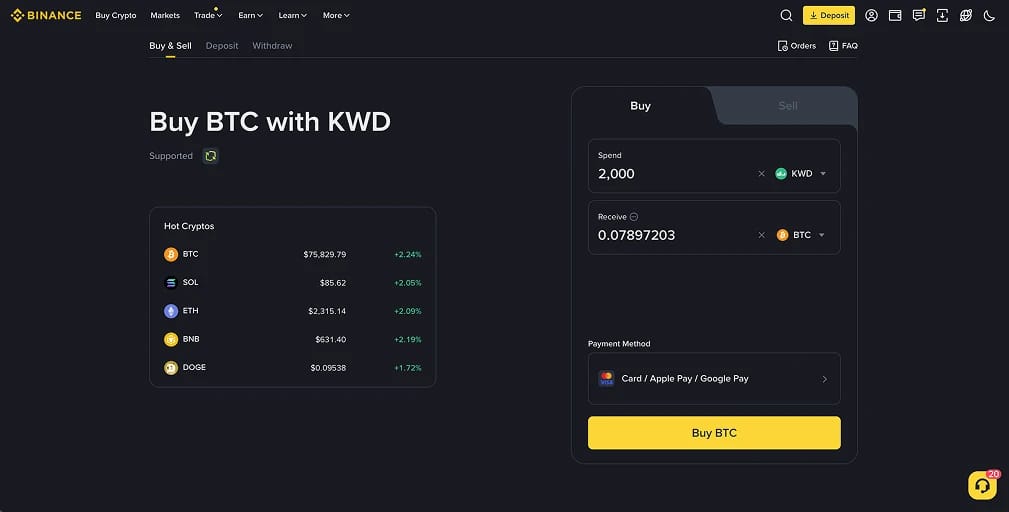
Binance is the scale play for Kuwaiti users. With over 309 million users globally and liquidity depth that smaller venues can't match, it's the platform most copy traders and active spot users default to once they outgrow a regional broker.
The copy trading product is built for heavy activity. You can filter lead traders by win rate, PnL, drawdown, and follower count, set allocation rules, and mirror positions while keeping your own stop rules. The tradeoff: most of the leaders on the board trade futures, so copy trading here is often a leverage product rather than a passive spot strategy.
For trust signals, Binance publishes Proof of Reserves, runs a SAFU emergency insurance fund, and holds regional licences including an ADGM FSP in Abu Dhabi and VARA approval in Dubai. The interface is fully available in Arabic for Kuwaiti users, and the KWD P2P market runs deep, which is how most Kuwaiti buyers fund without touching a local bank wire.
Pros
- Deepest overall liquidity in global crypto, which translates to tight spreads on majors and a copy trading pool with real volume behind it.
- Arabic interface, 24/7 Arabic support, and an active KWD P2P market with verified merchants accepting local bank transfer and cash deposit.
- Regional regulatory footprint: ADGM-registered in Abu Dhabi, VARA approval in Dubai, and CBB Category 4 licence in Bahrain, all strong compliance signals even though Kuwait itself licenses no crypto firms.
Cons
- The default UI surfaces futures, margin, and quick-buy screens aggressively. New users can end up leveraged without meaning to.
- Quick-buy spreads run substantially worse than the spot order book. Using Spot > BTC/USDT is the only way to avoid overpaying on entry.
- No reliable direct KWD bank rail. Kuwaiti users fund through P2P or international cards, both of which add friction and cost.
4. Gate
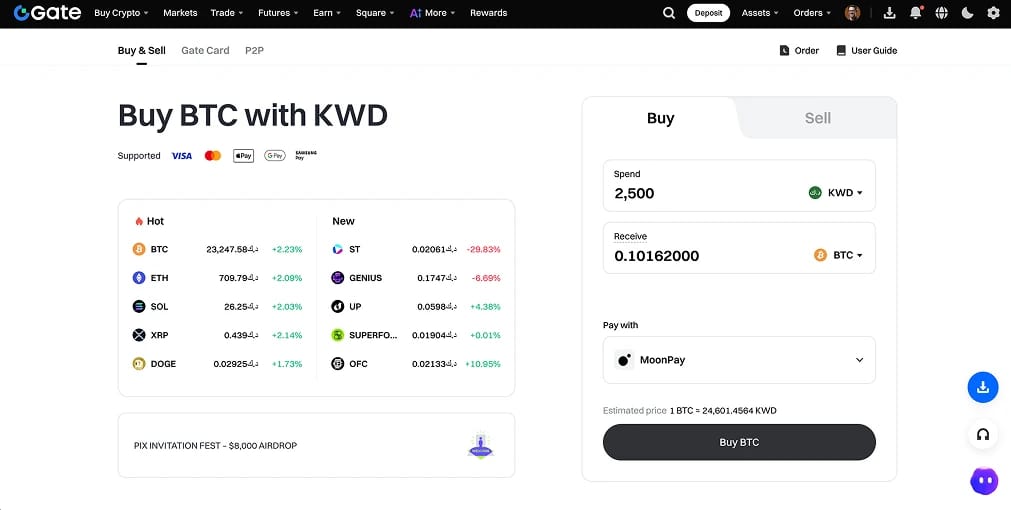
If your goal is access to the long tail of crypto rather than just majors, Gate outpaces every other exchange on this list. It supports 4,400+ cryptocurrencies across spot, margin, futures, and options, and typically lists new tokens within hours of launch.
Gate backs that breadth with meaningful trust signals. The platform publishes a total reserve ratio of 125%, which is the kind of transparency metric we actually check before keeping any balance on an offshore venue. Additional products include Copy Trading, Trading Bots, Gate Card (a Visa crypto debit card), and Simple Earn with APRs up to 9.75% on select assets.
For Kuwaiti users, Gate offers an Arabic interface and Arabic-speaking support, with KWD funding through Visa/Mastercard and an active P2P market. The tradeoff with any deep-catalog exchange is the same: more coin access means more exposure to illiquid pairs, and on tokens outside the majors, spreads and slippage can eat into returns fast.
Pros
- 4,400+ cryptocurrencies, the largest selection on this list, covering almost every new token launch Kuwaiti traders might want exposure to.
- 125% published reserve ratio, Arabic interface with Arabic support, and a full stack spanning spot, futures, bots, Gate Card, and Simple Earn.
- One of the fastest platforms globally for listing new tokens at launch, which matters if you track pre-launch narratives or early-stage listings actively.
Cons
- KWD deposits are limited mainly to credit and debit cards (with FX markups) plus P2P. No direct KWD bank transfer rail exists.
- Not regulated by the CBB, CMA, or any GCC authority. You're relying on offshore support if anything breaks.
- Quick-buy flows on a catalog this large can hide spread cost on lower-volume tokens, so order-book discipline matters more here than on a simpler platform.
5. Bitget
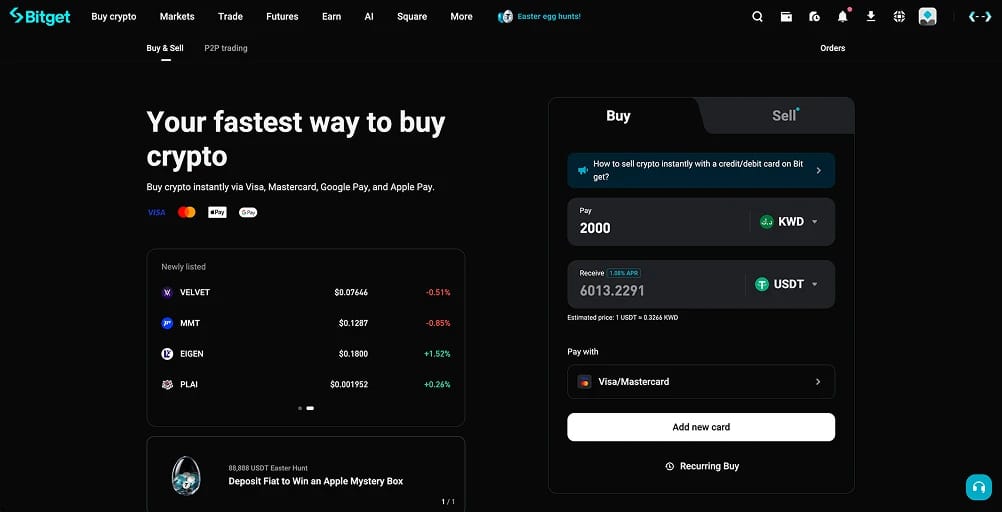
Bitget works for Kuwaiti users who are mostly interested in futures and copy trading. The platform has been building out a Universal Exchange (UEX) concept where crypto, stocks, and commodities all trade against USDT in the same account, which is useful if you rotate risk across asset classes.
Futures copy trading is where Bitget has built most of its reputation. Bitget publishes detailed guides covering copy modes, balance allocation, and why specific copy actions fail, which is unusual for a derivatives venue and generally correlates with a product that's used at scale rather than just marketed.
On safety, three signals are worth checking before parking funds here: a stated $441 million Protection Fund, Proof of Reserves with 1:1 backing language, and most assets held in offline multi-signature cold storage. The interface is available in both English and Arabic, and KWD funding goes through card deposits or the P2P market.
Pros
- Futures-first platform with deep tooling for systematic traders: copy trading with transparent ROI leaderboards, grid bots, and DCA bots.
- UEX feature lets you trade stocks and commodities against USDT in the same account, useful for traders who rotate between asset classes.
- Arabic interface, $441M Protection Fund, Proof of Reserves, and active contract and margin tier management, which signals a venue that pays attention to risk.
Cons
- Futures adds complexity and liquidation risk quickly. Not the first platform we'd suggest for a beginner who just wants to hold BTC.
- No CBB licence and no local rail to Kuwait. Funding is card with FX markup or P2P.
- The product surface is broad enough to distract from a simple plan. Bots, leverage products, and UEX markets are easy to wander into.
6. BloFin
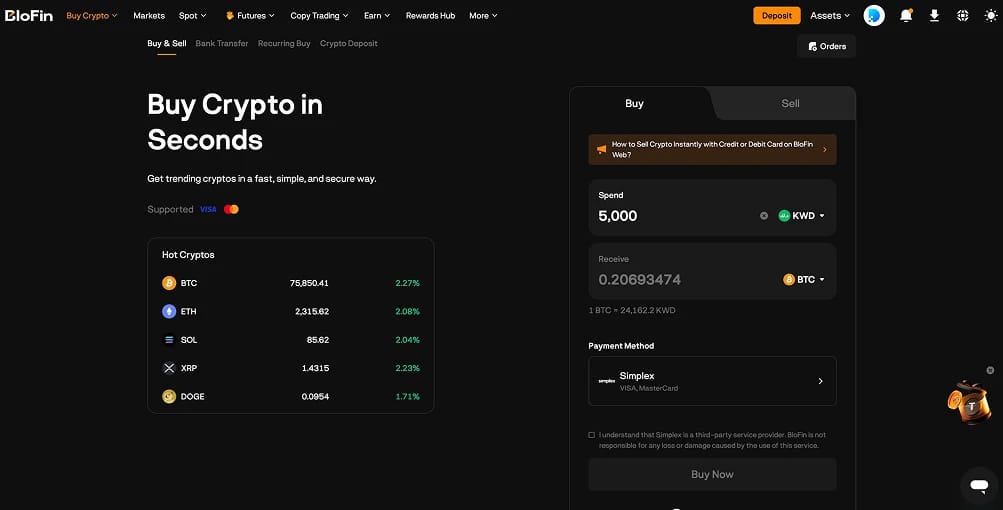
BloFin fits a specific brief for Kuwaiti users: move fast, limit personal info exposure, and use the exchange as a trading tool rather than long-term custody. BloFin publishes a no-KYC 24-hour withdrawal limit of 20,000 USDT, which is unusually specific and useful because most platforms bury withdrawal ceilings behind vague "risk review" language.
Funding happens via crypto deposits only (no direct KWD fiat rail), so Kuwaiti users typically buy stablecoins elsewhere first and bridge them over. That extra step looks like friction on paper, but for traders who want clean execution without layering their Kuwaiti identity onto another exchange profile, the workflow fits.
The product stack is broader than most newer derivatives venues: spot, futures, copy trading with visible ROI leaderboards, AI-powered bots, a Unified Trading Account that handles cross-margin automatically, and a BloFin Earn menu. BloFin also runs active contract management, announcing tick size updates, leverage tier changes, and delistings regularly, which signals a venue being actively maintained.
Pros
- No-KYC 24-hour withdrawal limit of 20,000 USDT is clearly stated, letting Kuwaiti users trade meaningful size without full identity verification if that matches their threat model.
- Futures-focused with a Unified Trading Account, frequent contract specification updates, visible copy trading leaderboards, and AI-driven bots.
- Competitive fees: 0.02% maker and 0.06% taker on futures compete with the top derivatives venues globally.
Cons
- No direct KWD rail. Every Kuwaiti user funds BloFin by bridging stablecoins from another exchange, which adds a step and an on-ramp dependency.
- Offshore setup with no local protection. It's a trading tool, not a bank replacement, and long-term balances shouldn't sit here.
- The UI isn't currently localised into Arabic, which is a gap relative to Bybit, Binance, and Gate for users who prefer native-language interfaces.
Crypto & Bitcoin Regulation in Kuwait
Kuwait has one of the strictest regulatory positions on crypto globally. On 17 July 2023, four Kuwaiti regulators issued coordinated circulars establishing an absolute prohibition on virtual asset activities:
- Central Bank of Kuwait (CBK): circular directed at all local banks, financing companies, and exchange companies, banning facilitation of crypto transactions.
- Capital Markets Authority (CMA): Circular No. (10) of 2023, prohibiting virtual asset services to clients and forbidding the issuance of any new licenses.
- Insurance Regulatory Unit: Circular No. (6) of 2023, extending the prohibition to insurance-sector entities.
- Ministry of Commerce and Industry: Ministerial Circular No. (1) of 2023, issued jointly with the Minister of State for Youth Affairs.
Under this framework, the prohibition covers four specific areas: using virtual assets for payments, using them as investment vehicles, issuing licenses to virtual asset service providers, and mining virtual assets. Kuwait's CMA has stated that no licenses have ever been issued for virtual asset services, and the regulator has been explicit that none will be.
The legal backbone is Kuwait's AML/CFT Law No. 106 of 2013, as amended. Article 15 of that law defines the penalties that apply to anyone violating the crypto circular, and the framework is specifically designed to align with Recommendation 15 of the Financial Action Task Force (FATF) standards on virtual assets.
Enforcement in Practice
Enforcement escalated through 2025 and into 2026. In April 2025, the Ministry of Interior began a broad crackdown on illegal crypto mining, coordinated with the Ministry of Electricity, Water, and Renewable Energy. Reuters reported that over 1,000 illegal mining sites were identified, with operators facing charges under both the Penal Code and the Industry Law of 1996.
One important carve-out: the CMA's language acknowledges that Kuwaiti clients may access exchanges "executed outside the State of Kuwait with the knowledge of clients." This means the ban applies to Kuwait-incorporated VASPs and local bank facilitation, not to individual residents using offshore platforms. That's the legal reading that lets roughly 273,000 Kuwaitis continue to hold crypto in 2026, even though no local exchange can exist.
How Is Crypto Taxed in Kuwait?
Kuwait is one of the friendliest crypto jurisdictions globally on the tax side, largely because it's one of the friendliest jurisdictions on tax full stop.
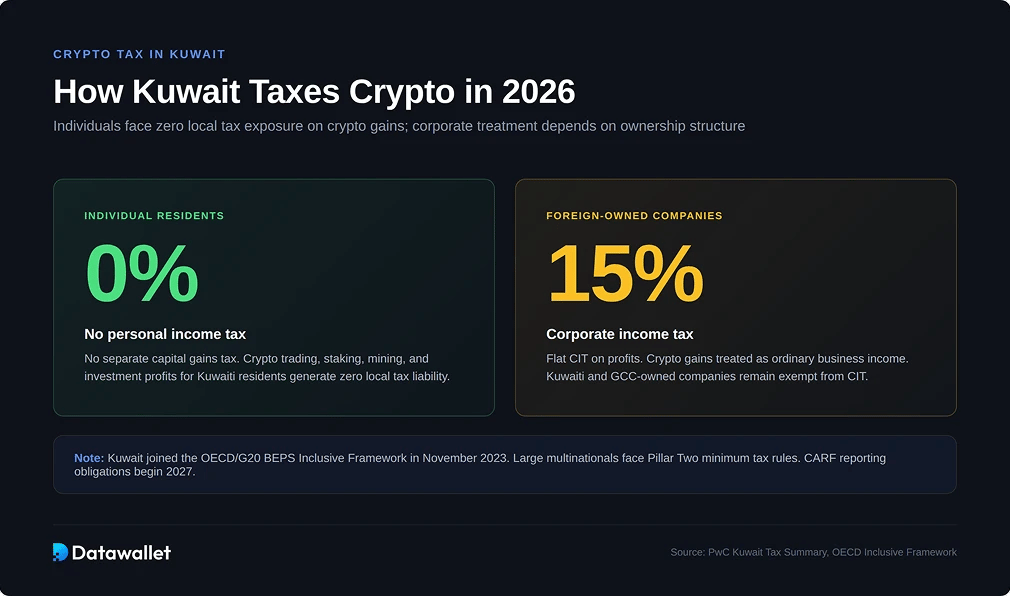
- Individuals: Kuwait imposes no personal income tax on residents, which means there is no income tax and no separate capital gains tax on crypto trading, staking, mining, or investment profits for individual Kuwaiti residents. Profits from offshore exchanges, even if realised, create no Kuwaiti tax liability for individuals.
- Foreign-owned corporate entities: Kuwait applies a flat 15% corporate income tax rate to foreign-owned companies operating in the country. There is no separate capital gains tax regime; gains on assets are treated as ordinary business income and taxed at the same 15% rate.
- Kuwaiti-owned companies: wholly Kuwaiti or GCC-owned companies are generally exempt from corporate income tax, though they remain subject to Zakat (1% of net profit), Kuwait Foundation for the Advancement of Sciences (KFAS) contribution (1%), and National Labour Support Tax where applicable.
Kuwait joined the OECD/G20 Inclusive Framework on Base Erosion and Profit Shifting in November 2023, which means large multinational groups operating in Kuwait will need to pay attention to Pillar Two minimum tax rules as they're implemented, but this does not affect individual crypto holders.
For most Kuwaiti individuals holding crypto offshore, the practical reality is zero Kuwaiti tax exposure on trading gains. The caveat is that if you hold a foreign nationality (for example, US citizenship), your home country's tax rules still apply, and OECD's Crypto-Asset Reporting Framework (CARF) exchanges starting in 2027 will increase cross-border visibility.
Cryptocurrency Adoption in Kuwait
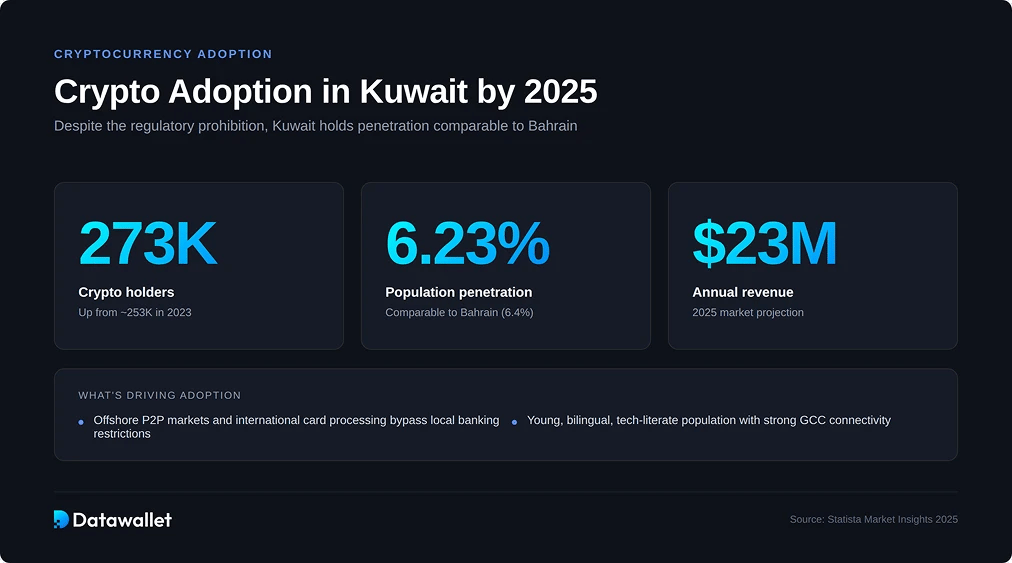
Despite the regulatory prohibition, crypto adoption in Kuwait continued through 2025 and into 2026, with Kuwaitis accessing global exchanges via offshore rails. According to Statista, the key figures are:
- Crypto holders: approximately 273,620 users in Kuwait by the end of 2025.
- Penetration rate: ~6.23% of the population (down marginally from 6.26% in 2024).
- Total crypto revenue: ~US$23.2 million in 2025 (down from US$24.1 million in 2024), reflecting a small contraction tied to the tightening enforcement environment.
The penetration rate is notable because it's comparable to Bahrain (6.4%) despite Kuwait lacking any local regulated platform, any local banking rail, or any official regulator engagement with crypto firms. Adoption here runs almost entirely through offshore P2P markets and international card processing.
Underlying demand is driven by two factors specific to Kuwait. First, KWD is one of the highest-value currencies globally, which makes stablecoin-denominated trading attractive as a hedge against perceived dinar strength and regional FX volatility. Second, a young, tech-literate, and largely bilingual population with strong GCC travel connectivity makes offshore account management practically straightforward, even when local banking won't cooperate.
How to Buy Bitcoin in Kuwait
Buying Bitcoin from Kuwait is a funding problem first and a trading problem second. Our tested process:
- Pick a platform with working KWD rails. We'd start with Rain (CBB-regulated + KNET card support) for first-time buyers who value oversight, or Bybit (Islamic Account + deep P2P market) for users who want broader product access. Binance works well for users comfortable with P2P flows.
- Complete KYC with your Kuwaiti Civil ID. Take the ID photo in good lighting with no glare on the hologram, make sure your exchange profile name matches the Arabic/English transliteration on your Civil ID exactly, and complete the selfie/liveness check in one session.
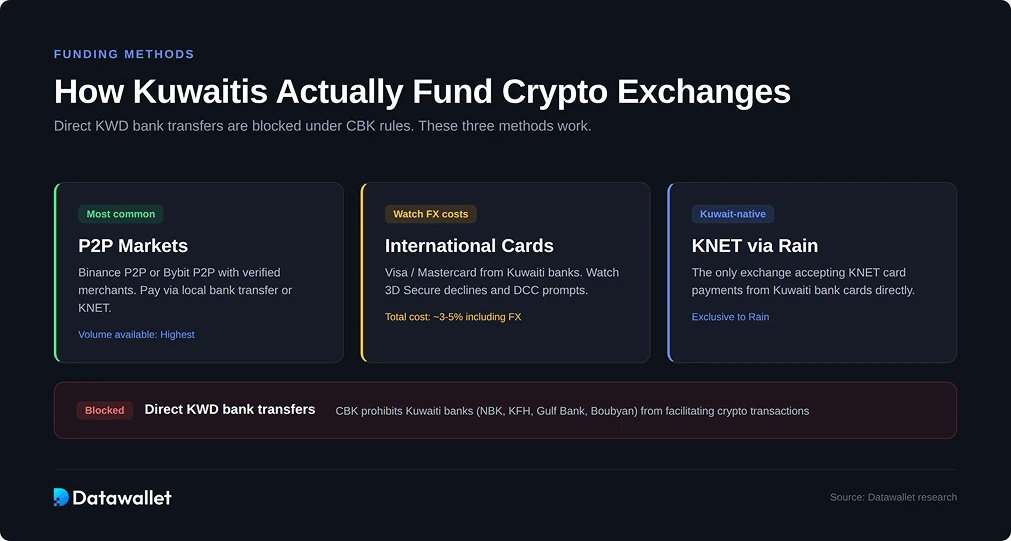
- Fund via the method that matches your risk tolerance. P2P is cheapest and most scalable but requires you to trust an escrow system. International cards are fastest but cost 3-5% in FX and processing. KNET via Rain is the only "Kuwait-native" option and works for smaller tickets.
- Buy BTC through the spot order book, not the quick-buy screen. Once funded, navigate to Spot > BTC/USDT (or BTC/USDC) and use a limit order if price matters, or a market order if speed matters. The quick-buy "convert" flow on most platforms bakes 1-3% into the spread.
- Withdraw to self-custody if you're not actively trading. We move BTC to a hardware wallet we control if the position is meant to be held. Double-check the network and address on the first transaction, because almost every expensive mistake in crypto happens at withdrawal.
For Kuwaiti users specifically, we'd also recommend doing a small test deposit and a small test withdrawal before scaling up any meaningful position. If something breaks, you want to know at $50, not at $50,000.
Final Thoughts
Buying crypto from Kuwait is a payments problem first and a trading decision second. Confirm your platform accepts your Civil ID, finish KYC before funding, and pick the payment method your bank won't flag as crypto-adjacent.
Rain is the highest-trust pick for most Kuwaiti users, combining CBB regulation, KNET, KWD SWIFT, and Shari'a compliance. Bybit works better if you want broader product depth, an Islamic Account, and a deeper P2P market. Binance wins on liquidity and copy trading depth.
If you go offshore for altcoin access or futures (Gate, Bitget, BloFin), keep balances light, stick to the order book, and test a small withdrawal first. With no local regulator to escalate to, exit testing matters more here than almost anywhere.
Our Methodology
We evaluated over 12 crypto exchanges available to Kuwaiti users by creating accounts with a Civil ID, funding via P2P, international cards, and KNET, executing spot trades, and testing withdrawals back to Kuwaiti bank accounts. Each platform was scored across six criteria:
- Trust Score: Our proprietary rating (out of 5) weights regional regulatory standing, security history, proof-of-reserves, platform longevity, and audit coverage. With no local licences issued in Kuwait, exchanges holding a CBB Category 3 CASP, UAE SCA licence, or VARA approval scored highest.
- KWD Funding: Tested P2P, international card, and KNET rails across Kuwaiti bank cards from NBK, KFH, Gulf Bank, Boubyan, Burgan, and Kuwait International Bank for settlement speed, bank friction, and DCC exposure.
- Regulatory Context: Verified platform accessibility under Kuwait's July 2023 prohibition framework (CBK, CMA Circular No. 10, IRU, MoCI) and prioritised exchanges with credible regional oversight via Bahrain, the UAE, or Türkiye.
- Security: Reviewed breach history, custody setup, proof-of-reserves cadence, client asset segregation, 2FA, withdrawal whitelists, and anti-phishing codes.
- Assets and Liquidity: Tested execution on BTC/USDT, ETH/USDT, and a mid-cap USDT pair. Direct KWD order books were excluded because no exchange maintains meaningful KWD liquidity.
- Fees: Compared maker/taker fees, card markups, P2P spreads, and the all-in cost of a full KWD-to-crypto-to-KWD round trip.
We excluded platforms with no realistic access from Kuwait, those facing active enforcement from tier-one regulators (SEC, CFTC, FCA, MAS, VARA, SCA, CBB), and any provider without credible regional standing. Testing ran February to April 2026.
%2520(1).webp)