




What is the x402 Protocol?
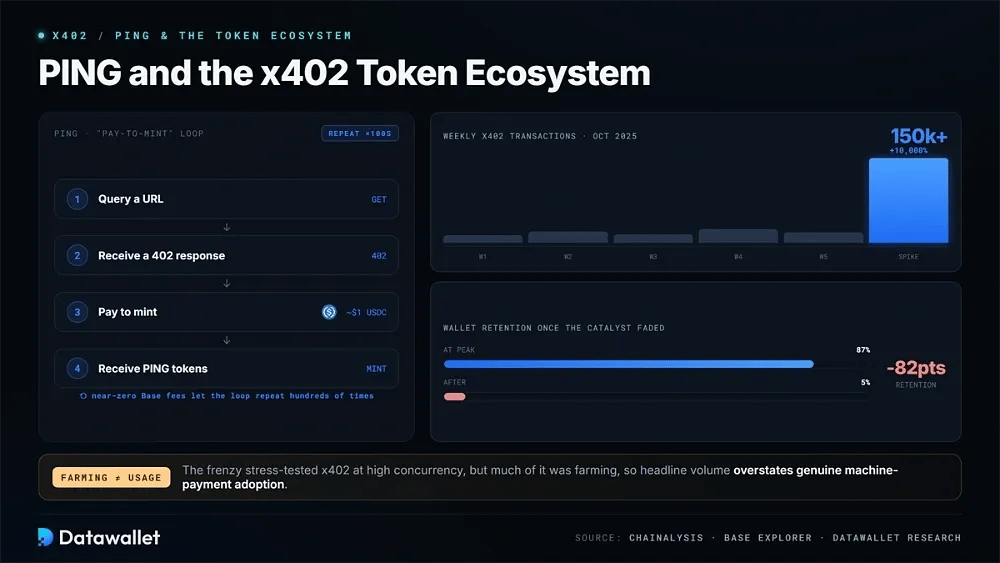
x402 is an open standard that embeds payments directly into HTTP by reactivating the "402 Payment Required" status code, reserved but never implemented since 1997. It lets a server charge for any endpoint and lets a client, human or machine, pay in stablecoins and receive the resource in one exchange.
Coinbase authored and open-sourced the protocol in May 2025, drawing on earlier crypto micropayment work but made practical by cheap Layer 2 blockchains and gasless stablecoin transfers. The core idea is simple: money should move through the web as freely as data already does, with no checkout redirect or account setup.
What makes it timely is the arrival of autonomous AI agents. These programs cannot fill in card forms, verify emails, or store credentials, so legacy rails fail them completely. x402 gives agents a native way to pay a fraction of a cent for an API call, settling onchain in roughly two seconds with cryptographic finality.
The protocol is deliberately chain-agnostic and permissionless. Any server can return a 402 response, any client can satisfy it, and settlement happens through stablecoins rather than a card network. USDC on Base was the launch pairing, but the design accommodates other tokens, chains, and even traditional payment rails over time.
How Does x402 Work?
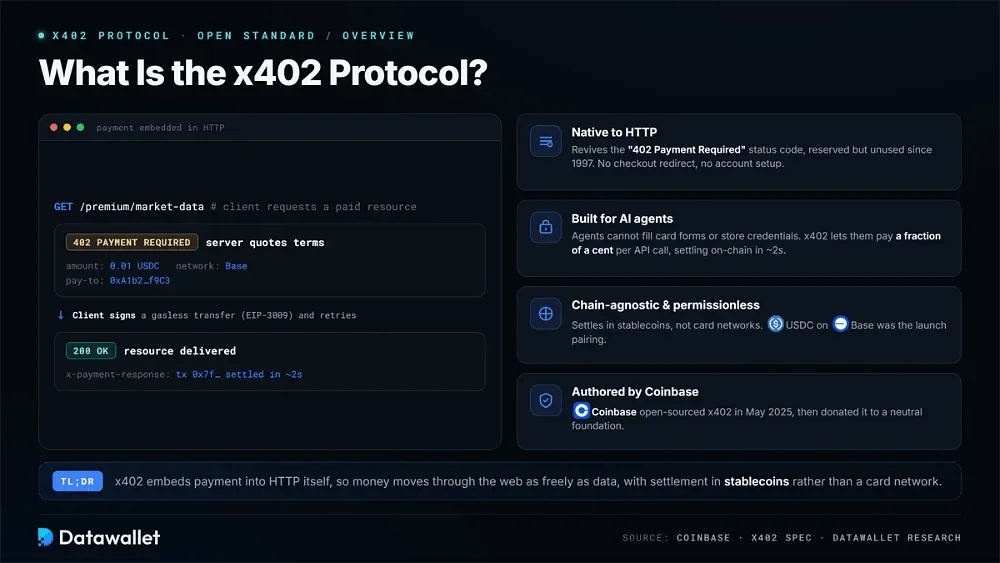
Every x402 payment follows the same request-response cycle, adding a payment step to an ordinary HTTP exchange without breaking existing web infrastructure:
- Request: A client, often an AI agent, sends a standard HTTP request to a resource server such as an API endpoint, dataset, or gated article, exactly as any browser or script would.
- 402 response: The server replies with a 402 Payment Required status and payment terms, specifying the amount, accepted token, recipient address, and network the developer has chosen.
- Signature: The client signs a token-transfer authorisation with its wallet, typically via Circle's EIP-3009 "Transfer With Authorization" standard, which enables gasless, signature-based USDC transfers.
- Retry: The client resends the request with the signed payload attached in a payment header, proving it has authorised the exact amount the server quoted for that resource.
- Verification: A facilitator checks the payload, confirms the nonce and amount, screens for compliance where applicable, and submits the transaction onchain for settlement.
- Delivery: Once settlement confirms, the server returns a 200 OK with the requested content plus a response header carrying the transaction details for the client's records.
The facilitator is the piece that abstracts blockchain complexity away from both sides. It handles gas, network selection, and transaction submission while remaining non-custodial, meaning it cannot move funds outside the client's signed intent. Sellers therefore avoid running their own chain infrastructure entirely.
Protocol fees are zero, so users pay only nominal network gas, often under a hundredth of a cent on Base or Solana. This economic profile is what makes single-cent and sub-cent metering viable, something card networks structurally cannot match given their fixed per-transaction minimums.
The Role of Facilitators
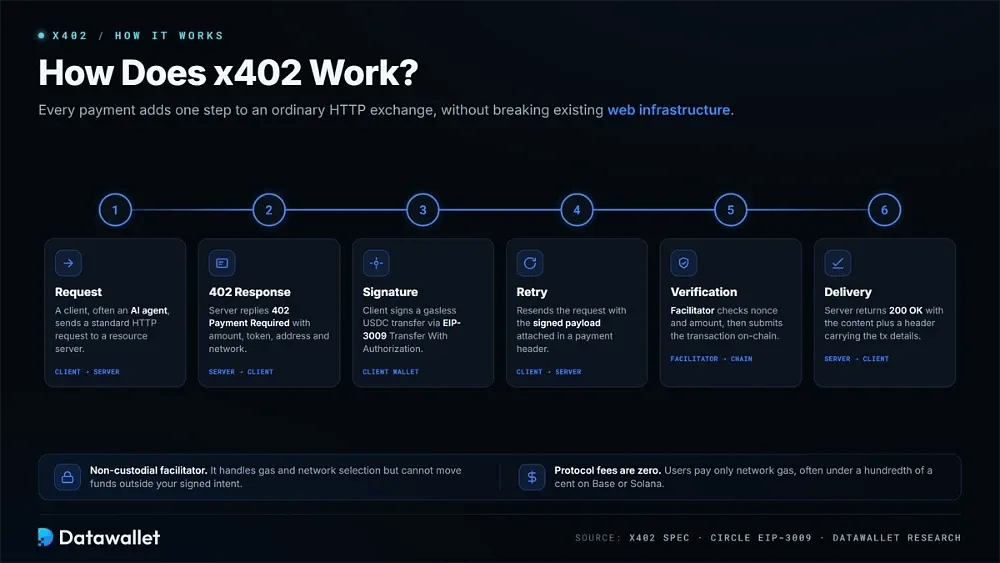
Facilitators are optional intermediaries that verify and settle payments so resource servers stay lightweight. Coinbase Developer Platform runs the dominant one, processing ERC-20 payments on Base, Polygon, Arbitrum, World, and Solana with a free tier of 1,000 transactions monthly.
The design lets sellers skip blockchain plumbing, but it introduces concentration risk. Because most production endpoints route through Coinbase's facilitator, an outage or policy change there could darken large parts of the ecosystem at once, a tension the protocol's trust-minimising goals aim to resolve as independent facilitators appear.
PING and the x402 Token Ecosystem
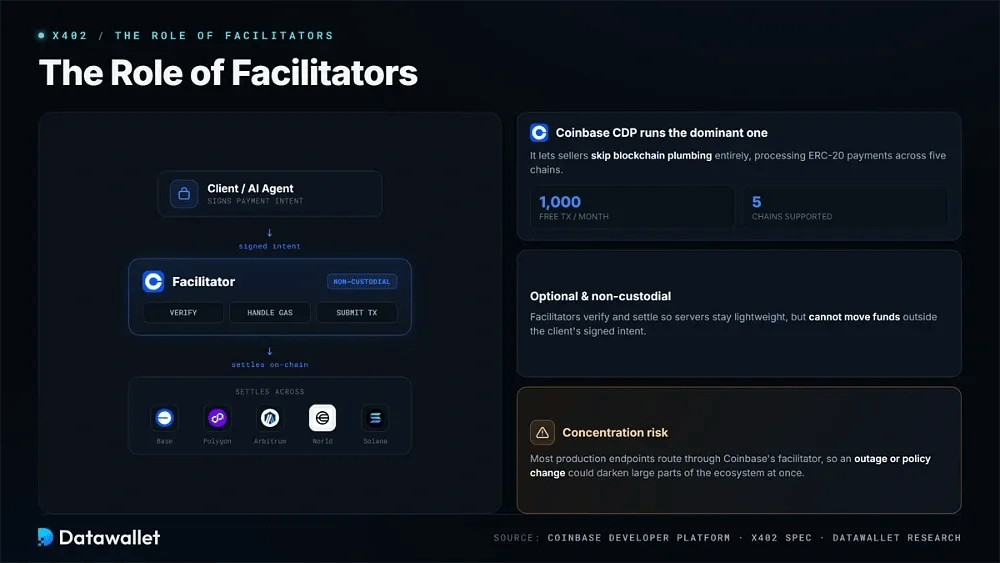
x402 has no official token, and the protocol never required one to function. Speculation instead clustered around assets built on top of it, most visibly PING, a "pay-to-mint" experiment where users queried a URL, received a 402 response, and paid roughly $1 in USDC to mint tokens.
That mechanic turned the protocol into a speculative game in October 2025. According to Chainalysis, PING processed over 150,000 transactions in its first month, and weekly x402 transaction counts spiked more than 10,000% as Base's near-zero fees let users repeat the payment loop hundreds of times.
The frenzy inflated an "x402 ecosystem" category tracked by data platforms, whose combined market cap swung wildly through late 2025 and into 2026. Much of that activity was farming rather than durable usage, and wallet retention cratered from around 87% to 5% once the speculative catalyst faded.
The episode cut both ways. It stress-tested the protocol at high concurrency and proved x402 could handle the transaction density that autonomous agent commerce would eventually demand. But it also blurred the line between genuine machine-payment adoption and memecoin churn, a distinction worth keeping in mind when reading headline volume figures.
x402 Adoption and Transaction Data
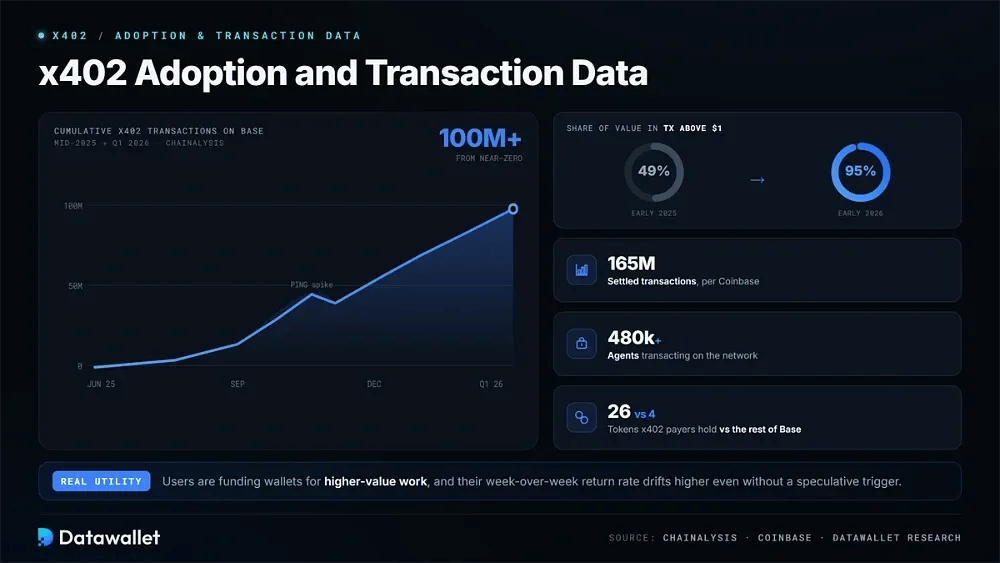
Beneath the speculation, the underlying usage curve tells a steadier story. Chainalysis reported that wallets interacting with x402 generated more than 100 million cumulative transactions on Base through the first quarter of 2026, up from near-zero in mid-2025.
The composition also shifted in a telling way. Transactions above $1 grew from 49% of value moved in early 2025 to roughly 95% by early 2026, suggesting users are funding wallets for higher-value work rather than only running sub-cent experiments. Coinbase later cited figures around 165 million settled transactions across 480,000-plus agents.
Wallet behaviour points to real utility rather than pure hype. Chainalysis found x402 payers hold an average of 26 different tokens versus four for the rest of Base, and their week-over-week return rate drifted higher even without a speculative trigger, a pattern that implies users keep coming back for value.
Enterprise Integrations Driving Growth
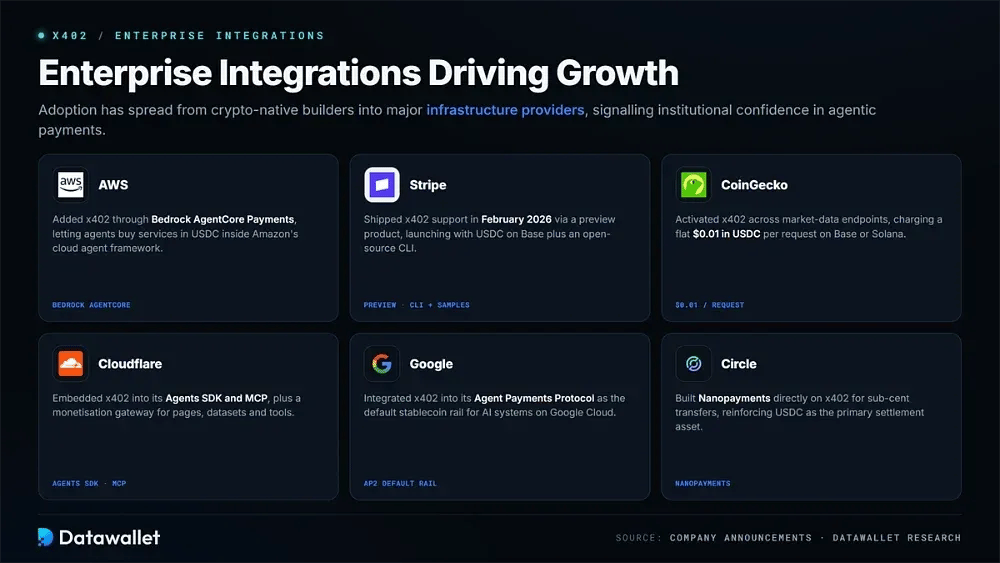
Adoption has spread well beyond crypto-native builders into major infrastructure providers, a shift that signals institutional confidence in agentic payments:
- AWS: Amazon added x402 support through Bedrock AgentCore Payments, letting AI agents purchase services in USDC directly inside Amazon's cloud agent framework rather than through separate billing systems.
- Stripe: The payments giant shipped x402 support in February 2026 via a preview product, launching with USDC on Base alongside an open-source CLI and sample code for both clients and servers.
- CoinGecko: The data provider activated x402 across high-value market-data endpoints, charging a flat $0.01 in USDC per request with payment accepted on Base or Solana.
- Cloudflare: The network embedded x402 into its Agents SDK and MCP infrastructure, and opened a monetisation gateway letting sites charge for pages, datasets, and tools that settle in stablecoins.
- Google: The company integrated x402 into its Agent Payments Protocol as the default stablecoin rail, letting AI systems on Google Cloud pay one another for API calls and compute.
- Circle: The USDC issuer built Nanopayments directly on x402 for sub-cent transfers, reinforcing the stablecoin's role as the protocol's primary settlement asset.
Coinbase, Base, and Agentic Wallets
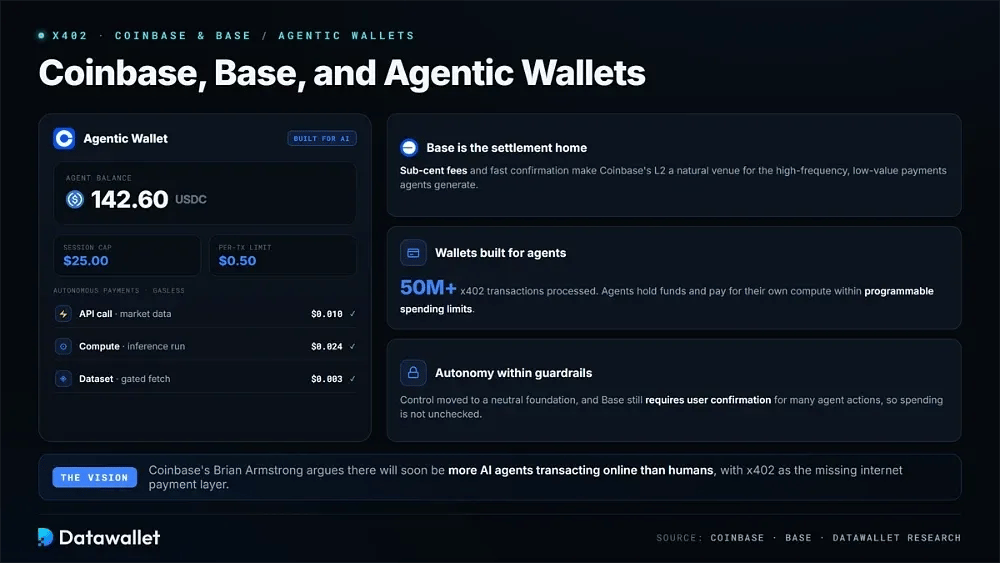
x402 fits into a wider Coinbase strategy to make Base, its Ethereum Layer 2, the settlement home for autonomous agents. The chain's sub-cent fees and fast confirmation make it a natural venue for the high-frequency, low-value payments that agent workflows generate.
Coinbase pairs the protocol with Agentic Wallets, wallet infrastructure purpose-built for AI, which the company says has processed over 50 million x402 transactions. These wallets let agents hold funds, pay for their own compute and API access, and trade gaslessly within programmable session caps and per-transaction spending limits.
The vision extends toward a machine economy where agents transact continuously without human approval at every step. Coinbase CEO Brian Armstrong has argued there will soon be more AI agents transacting online than humans, framing x402 as the internet payment layer that has been missing for three decades.
That said, control has moved away from Coinbase itself. The protocol was donated to a neutral foundation, and Base still requires user confirmation for many agent actions through a separate approval window, so autonomy operates within guardrails rather than as unchecked machine spending.
The x402 Foundation and Governance
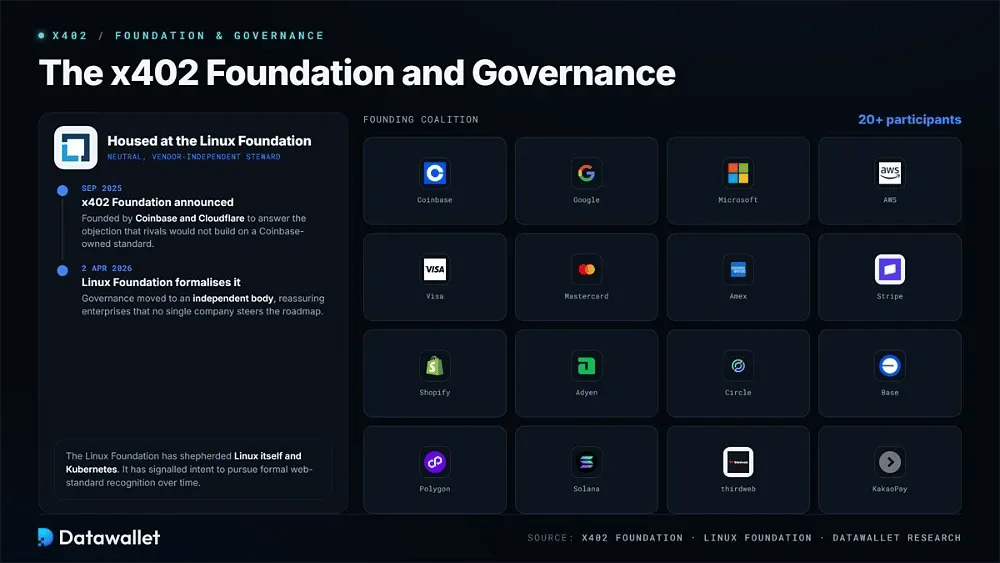
To avoid the obvious objection that competitors would not build on a Coinbase-owned standard, governance shifted to an independent body. Coinbase and Cloudflare announced the x402 Foundation in September 2025, and the Linux Foundation formalised it on 2 April 2026.
The launch coalition was strikingly broad, spanning payments, cloud, and crypto with more than 20 founding participants. The roster included Google, Microsoft, AWS, Visa, Mastercard, American Express, Stripe, Shopify, Adyen, Circle, Base, Polygon Labs, the Solana Foundation, thirdweb, and KakaoPay, with Coinbase remaining a contributor.
Neutral stewardship matters for legitimacy. The Linux Foundation has shepherded infrastructure like Linux itself and Kubernetes, and housing x402 there is meant to reassure enterprises that no single company steers the roadmap. The foundation has also signalled intent to pursue formal web-standard recognition alongside emerging agent identity standards over time.
x402 vs Competing Payment Standards
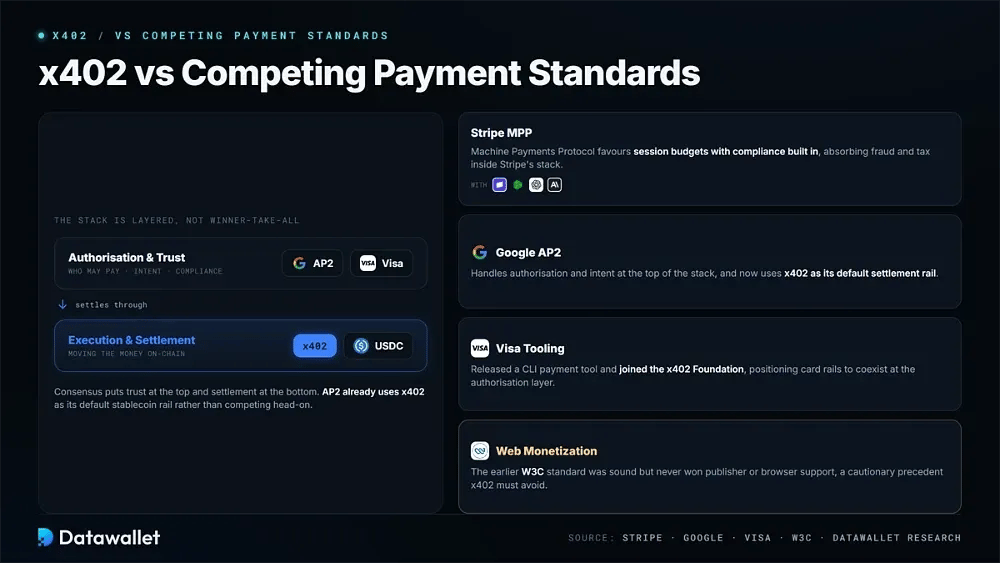
x402 is not the only contender for the agent-payment layer, and the landscape is converging on a layered rather than winner-take-all structure. Understanding where each standard sits helps clarify how they compete and coexist:
- Machine Payments Protocol: Stripe's MPP, co-created with Paradigm and backed by OpenAI and Anthropic, favours session-based budgets with compliance built in, absorbing fraud and tax handling inside Stripe's stack rather than leaving it to operators.
- Google AP2: The Agent Payments Protocol handles authorisation and intent at the top of the stack, and now uses x402 as its default stablecoin settlement rail rather than competing head-on for execution.
- Visa tooling: Visa released a command-line payment tool for agent commerce and joined the x402 Foundation, positioning its card rails to coexist with onchain settlement at the authorisation layer.
- Web Monetization: The earlier W3C standard was technically sound but never won enough publisher or browser support, a cautionary precedent x402 must avoid by securing a durable killer use case.
The emerging consensus places trust and authorisation at the top, with AP2 and Visa, and execution and settlement at the bottom, with x402 and onchain stablecoins. Stripe hedges by participating in both consortia, so the standards may layer together more than they replace one another.
Risks and Limitations of x402
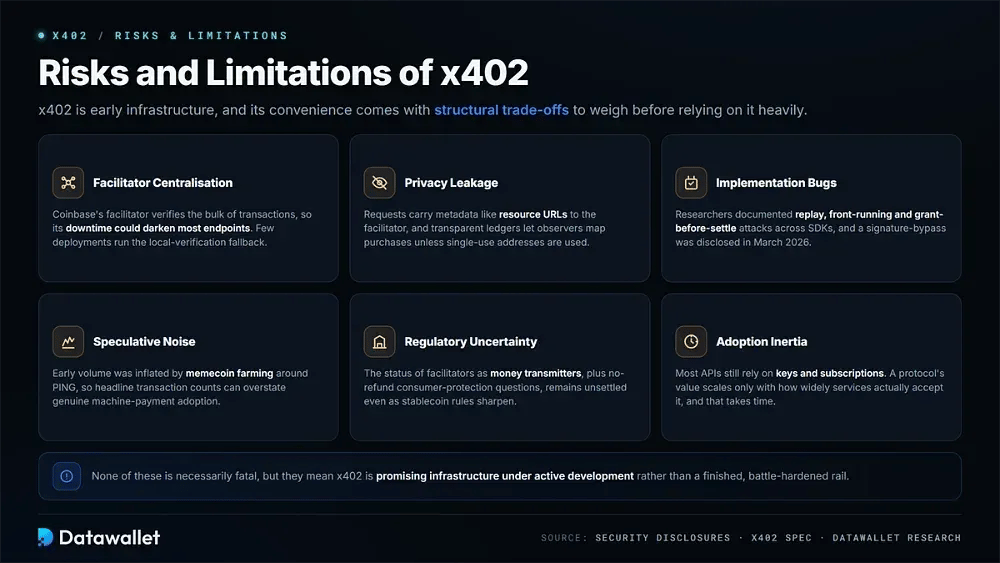
x402 is early infrastructure, and its convenience comes with structural trade-offs that builders and users should weigh before relying on it heavily. The main concerns are:
- Facilitator centralisation: Coinbase's facilitator verifies the bulk of transactions, so its downtime could darken most x402 endpoints, and few deployments yet implement the local-verification fallback the spec allows.
- Privacy leakage: Payment requests carry metadata such as resource URLs and reason strings to the facilitator before settlement, and transparent onchain ledgers let observers map a user's purchases unless single-use addresses are employed.
- Implementation bugs: Security researchers have documented replay, front-running, and grant-before-settle attacks across x402 SDKs, and a signature-verification bypass was disclosed in March 2026, underscoring the need for audited code.
- Speculative noise: Early volume was inflated by memecoin farming around PING, so headline transaction counts can overstate genuine machine-payment adoption and mislead anyone sizing the opportunity.
- Regulatory uncertainty: The legal status of facilitators as potential money transmitters, plus consumer-protection questions around no-refund payments, remains unsettled even as stablecoin regulation sharpens and Coinbase runs compliance screening voluntarily.
- Adoption inertia: Most APIs still rely on keys and subscriptions, and reaching the network effects x402 needs will take time, since a protocol's value scales only with how widely services actually accept it.
None of these is necessarily fatal, and several are typical of any young standard. But they mean x402 should be treated as promising infrastructure under active development rather than a finished, battle-hardened rail, particularly for anyone deploying it in production or speculating on related tokens.
Final Thoughts
x402 has done something rare in crypto: taken a dormant piece of the web's own foundation and turned it into working payment infrastructure that some of the largest technology and finance companies now back. By collapsing payment into a single HTTP round trip, it makes machine commerce feel native to the internet.
The current chapter is about proving durability. Speculative volume has cooled, governance has moved to a neutral foundation, and a modular v2 has arrived, but the facilitator layer remains concentrated and a well-funded Stripe standard is competing for the same future. Whether x402 becomes the SSL of agent payments or one option among several is still open.
For builders and observers, the signal to watch is sustained, non-speculative usage rather than headline transaction counts. If AI agents keep funding wallets and paying for real services, x402's foundational bet pays off. For anyone exploring the stablecoins that settle these payments, understanding the rails underneath is the sensible starting point.