






Who is Mike Novogratz?
Mike Novogratz is an American investor who has spent four decades cycling through Wall Street's most volatile seats. He traded macro at Goldman Sachs, ran a multi-billion-dollar hedge fund at Fortress Investment Group, then bet his third act on digital assets when most peers treated Bitcoin as a punchline.
He founded Galaxy Digital in 2018 as a full-service investment bank for crypto, spanning trading, lending, asset management, staking, and venture investing. He has described its culture as three-quarters Goldman Sachs and one quarter Drexel Burnham, a nod to building markets for an asset class the establishment refused to touch.
Few billionaires wear their wins and losses this publicly. He has a Bitcoin tattoo on one arm and a Luna tattoo on the other, the second inked months before that token collapsed and wiped billions from his firm. In our reading of his filings and interviews, the willingness to absorb public punishment and keep allocating defines his career.
.webp)
Mike Novogratz's Background
Novogratz's story runs from a military household in Virginia through Princeton's wrestling room, an Army helicopter cockpit, two decades at the top of traditional finance, and the crypto firm that carries his name into the AI era.
Early Life and Education
Michael Edward Novogratz was born on November 26, 1964, and grew up in Alexandria, Virginia, the third of seven children. His father, Robert Novogratz Sr., was a decorated West Point football lineman, and discipline ran through the family. His sister Jacqueline later founded the impact investing pioneer Acumen Fund.
He wrestled his way to a Virginia state runner-up finish in high school, then captained the Princeton University wrestling team, earning first team All-Ivy honors in 1986 and 1987 and qualifying twice for the NCAA championships. He graduated with an A.B. in economics in 1987, then served as a helicopter pilot in the U.S. Army through the ROTC program.
Goldman Sachs and Fortress
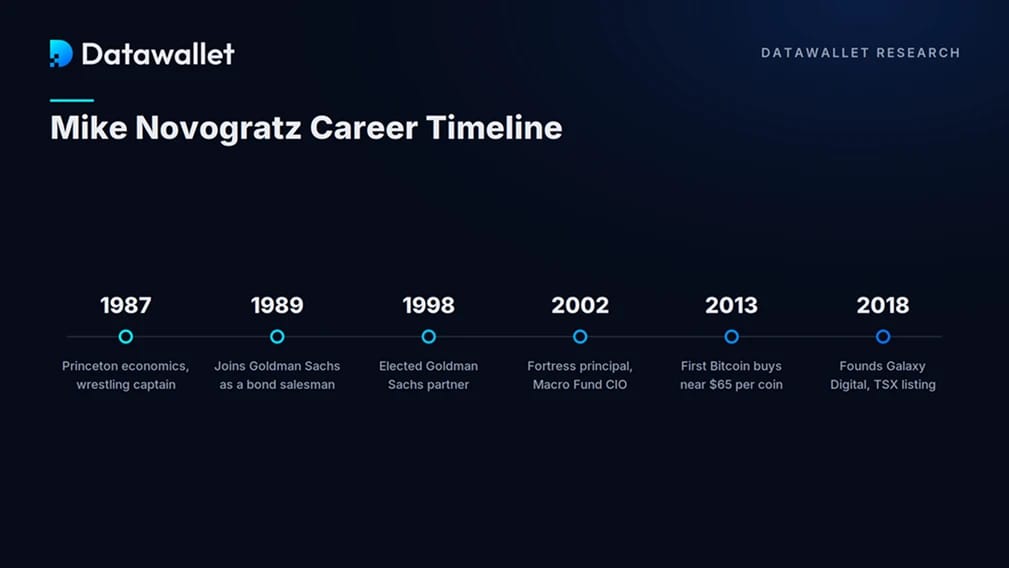
Novogratz joined Goldman Sachs in 1989 as a short-term bond salesman and rose over eleven years, running fixed-income businesses in Asia and Latin America before being elected partner in 1998, while the firm was still privately held. That partnership stake became the first layer of his fortune.
He moved to Fortress Investment Group in 2002 as a principal, serving as chief investment officer of the Fortress Macro Fund. Fortress went public in 2007, and that September, Forbes ranked him at No. 317 on the Forbes 400 with a net worth of $1.5 billion. He also served on the New York Federal Reserve's Investment Advisory Committee on Financial Markets from 2012 to 2015.
The macro fund's later years were rough. A string of wrong-way bets on Swiss francs and Brazilian rates forced its closure, and Novogratz retired from Fortress in 2015. By then, he had already found his next obsession, having bought roughly $7 million of Bitcoin at prices near $65 in 2013.
Founding Galaxy Digital
He planned a crypto hedge fund for late 2017, shelved it when the market turned frothy, and launched Galaxy Digital in 2018 as a diversified merchant bank for digital assets. The firm listed in Toronto that year was one of the few crypto companies publishing audited financial results through the sector's early boom-and-bust cycles.
Galaxy's defining upgrade came in May 2025, when it redomiciled from the Cayman Islands to Delaware and listed on Nasdaq under the ticker GLXY. The company completed its delisting from the Toronto Stock Exchange in early 2026, consolidating its listing on Nasdaq just as its data center business began generating revenue.
Mike Novogratz's Net Worth in 2026
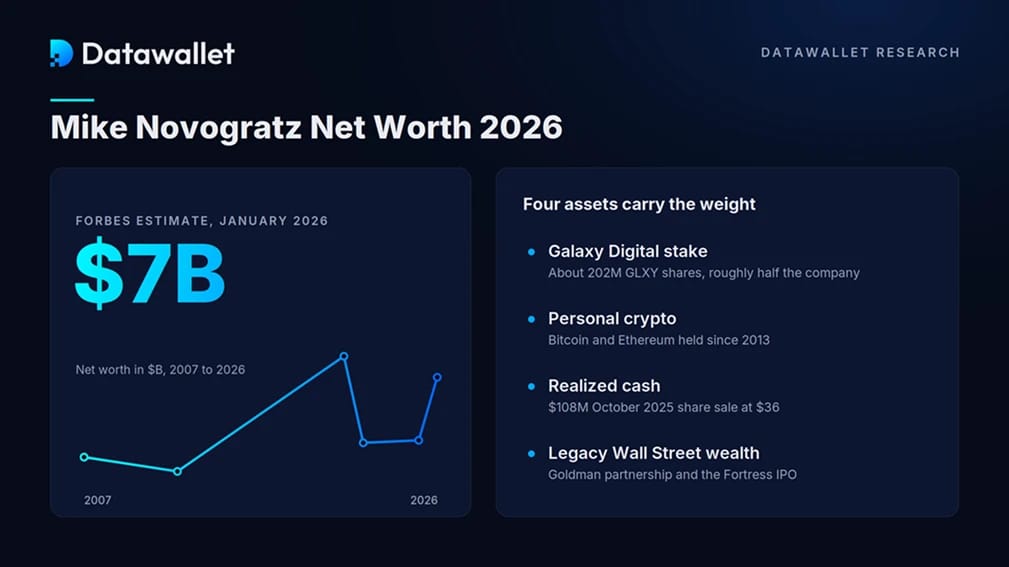
Mike Novogratz's net worth reached about $6 billion in July 2026, according to Forbes' estimate, ranking him among crypto's wealthiest. The figure is a moving target, since the bulk of it is one concentrated stock position layered on personal crypto holdings.
Four assets carry most of the weight:
- Galaxy Digital stock: His holding vehicle, Galaxy Group Investments LLC, holds roughly 202 million shares on a fully exchanged basis, around half the company, making GLXY's share price the dominant input into any estimate.
- Personal crypto: He has held Bitcoin and Ethereum since 2013, said in 2021 that crypto made up 85% of his wealth, and more recently put the figure near two thirds.
- Realized cash: He has taken meaningful chips off the table, selling 3 million GLXY shares for about $108 million in October 2025 and joining a $460 million Capital Group placement priced at $36 per share that same month.
- Legacy Wall Street wealth: His Goldman Sachs partnership stake and the Fortress IPO made him a billionaire before crypto existed, and that base funded his early Bitcoin buys and his philanthropy.
Any headline number deserves skepticism. GLXY has traded well below the $36 October placement price during the 2026 crypto drawdown; his exact wallet holdings are undisclosed, and Forbes revalues him only periodically. A defensible range matters more than a false precision figure.
Historical Fluctuation
His net worth chart looks like one of his macro trades. After peaking at $1.5 billion in 2007, it shrank to around $500 million by 2012 as Fortress stock slid. Crypto rebuilt it, pushing his fortune to an estimated $8.5 billion in November 2021 before the Luna collapse and the 2022 bear market cut it to roughly $2.5 billion within months.
Forbes still had him at $2.7 billion on its 2025 list. The Nasdaq listing and the market's repricing of Helios then more than doubled that inside a year. The early 2026 crypto correction has compressed the total again, but the data center lease gives his wealth a contracted revenue floor it never had in prior cycles.
What is Galaxy Digital?
Galaxy Digital is a Nasdaq-listed company, trading under the ticker GLXY, that pairs an institutional crypto platform with an AI infrastructure business. The crypto side spans trading, derivatives, lending, asset management, staking, and venture investing, while the data center side develops and operates the Helios campus in West Texas.
The corporate history maps onto crypto's own maturation. Founded in 2018 and listed in Toronto through the industry's outsider years, Galaxy redomiciled from the Cayman Islands to Delaware and moved to Nasdaq in May 2025, then completed its Toronto delisting in early 2026. Novogratz controls roughly half the company, so its market value and his personal balance sheet are effectively the same trade.
The scale is now institutional by any measure. Galaxy's asset management arm oversaw about $5 billion at the end of Q1 2026, with a further $3.2 billion staked to its validators, and the company held $2.8 billion in total equity with $2.6 billion in cash and stablecoins. A record $505 million net profit in Q3 2025 gave way to a loss during the 2026 correction, a swing that reflects crypto exposure still at its core.
The Helios Bet That Rebuilt His Fortune
The most consequential trade of Novogratz's crypto era started as damage control. In December 2022, weeks after FTX imploded and dragged Sam Bankman-Fried's fortune to zero, Galaxy paid about $65 million for a 160-acre Bitcoin mining site in Dickens County, Texas, from the debt-stricken miner Argo Blockchain. He has since called it likely his best investment by a wide margin.
The asset underneath the mining rigs was power. Helios sits on land where Galaxy controls over 1,500 contiguous acres, and in January 2026, grid operator ERCOT approved an additional 830 megawatts, doubling total approved capacity to more than 1.6 gigawatts, with filings citing over 3.4 gigawatts of potential capacity.
Galaxy converted the campus from Bitcoin mining to AI infrastructure and signed CoreWeave as the sole tenant. Across three lease phases signed between April 2025 and January 2026, CoreWeave has contracted 526 megawatts of critical IT load over 15-year terms, which Galaxy expects to generate average annual revenue above $1 billion. A $1.4 billion project financing facility, closed in August 2025, funds the buildout.
The first data hall was delivered to CoreWeave in April 2026, moving Helios from construction into revenue. Sell-side analysts now argue that the campus could be worth more than Galaxy’s entire crypto platform, with one Forbes estimate valuing Helios at more than $20 billion if fully built out. That is why his net worth no longer trades purely as a crypto proxy.
Mike Novogratz's Investment Portfolio
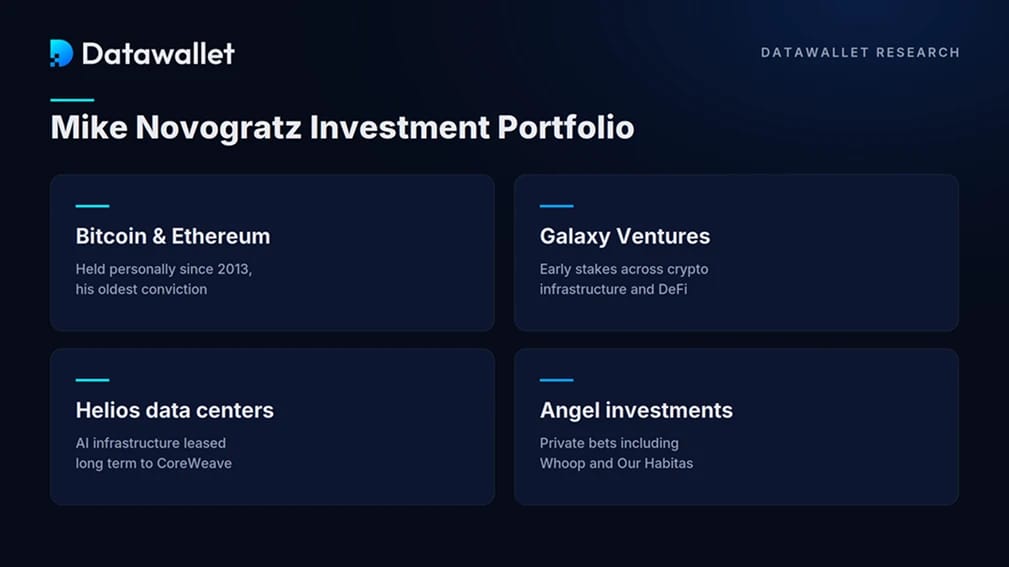
Outside his Galaxy stake, Novogratz's investing runs mostly through the firm itself. Galaxy's asset management arm oversaw about $5 billion at the end of Q1 2026, with a further $3.2 billion staked to Galaxy validators, and its venture arm has backed dozens of crypto companies and protocols.
The positions that shape his exposure include:
- Bitcoin and Ethereum: His oldest and most public conviction, held personally since 2013 and expressed through Galaxy's trading, mining, and treasury operations.
- Galaxy Ventures portfolio: Early stakes across crypto infrastructure and DeFi, including protocols like Ethena and the high-performance chain Monad, for venture-style upside on the next cycle.
- Helios and data centers: The AI infrastructure segment is now the single largest driver of how public markets value his Galaxy stake.
- Personal angel checks: Smaller private bets outside crypto, including the wearables company Whoop and the hospitality group Our Habitas, a minor slice next to the Galaxy position.
Concentration is deliberate. Where peers like Brian Armstrong diversified into biotech and hardware, Novogratz has kept compounding inside the firm he controls, which is why his fortune whipsaws harder than most crypto founders.
The Luna Collapse and the $200 Million Settlement
No account of Novogratz's wealth is honest without Luna. Galaxy bought 18.5 million LUNA tokens at a discounted $0.22 in October 2020, and Novogratz became the project's most visible champion, inking a Luna tattoo in early 2022 after the token crossed $100.
The collapse of Terra's ecosystem in May 2022 erased tens of billions of dollars in market value and helped trigger the chain of failures that took down Celsius, Three Arrows Capital, and FTX. Galaxy reported a $554 million loss for that quarter, and his personal fortune fell by billions alongside it.
The regulatory bill arrived later. In March 2025, Galaxy agreed to pay $200 million to settle claims by the New York Attorney General that it publicly promoted LUNA while quietly selling the bulk of its position at a large profit, conduct the state said violated the Martin Act. Galaxy neither admitted nor denied the allegations, and the penalty is payable in installments through 2028.
Novogratz has said Do Kwon and Terraform deceived Galaxy along with other institutional investors, and Kwon pleaded guilty to U.S. fraud charges in 2025. Still, the settlement stands as the most expensive lesson of Novogratz's crypto career and a counterweight to the Helios success story.
Mike Novogratz's Philanthropy
Novogratz gives at a scale and specificity unusual for crypto wealth. He and his wife, Sukey Cáceres Novogratz, a fellow Princeton graduate and author of the meditation guide Just Sit, run their giving through Galaxy Gives, a family foundation focused on criminal justice reform, youth development, and leadership.
Criminal justice is the anchor. He chairs The Bail Project, which pays bail for low-income Americans held in pretrial detention, and is a founding partner of the REFORM Alliance, the probation and parole reform group launched alongside Jay-Z and Meek Mill.
The wrestling thread carries through as well. He founded and chairs Beat the Streets, which builds wrestling programs in New York City public schools, and USA Wrestling named him its Man of the Year in 2011. He also chaired Hudson River Park Friends for nine years and, with Sukey, endowed Princeton's Bridge Year program, which now bears the family name and sends incoming students abroad for a service year.
Final Thoughts
Mike Novogratz's net worth is best understood as a leveraged position on his own conviction. Roughly half of Galaxy Digital, a personal crypto book he has never fully disclosed, and a Texas power site the market once ignored now add up to a fortune Forbes put near $6 billion by mid-2026, trimmed since by the spring drawdown and capable of swinging billions within a quarter.
The Helios lease changes the character of that wealth more than its size. For the first time since he left Fortress, a large share of his fortune is tied to contracted, recurring revenue rather than token prices, even as Galaxy's Q1 2026 loss of $216 million showed how hard crypto weakness still hits the core business.
The rest of 2026 turns on execution if Galaxy delivers the remaining Helios phases on schedule and the ERCOT-approved expansion finds tenants; his wealth compounds on infrastructure economics. If crypto stays soft and the buildout slips, the old volatility reasserts itself, as it has at every prior turn.
.webp)