



What Is Tempo Blockchain?
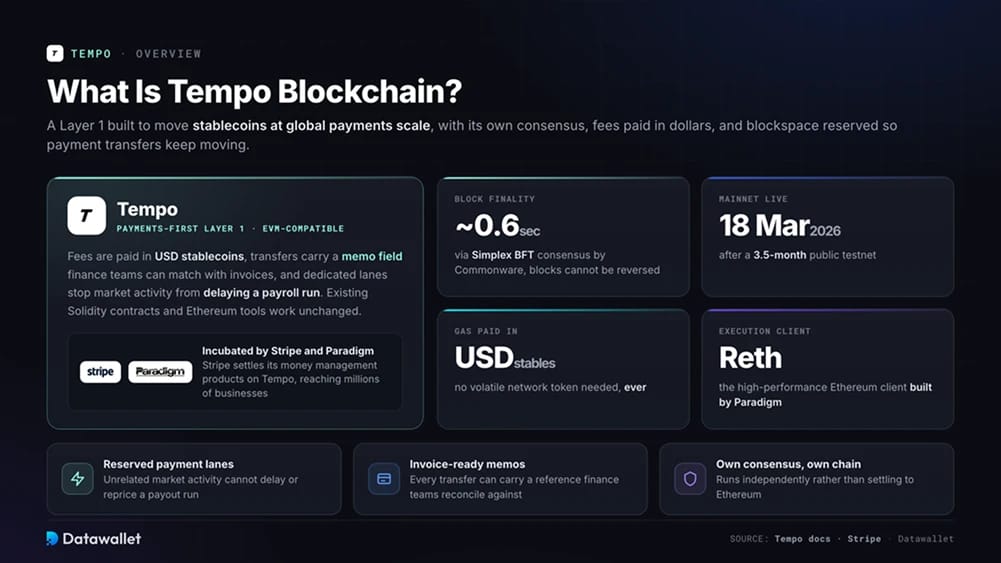
Tempo is a Layer 1 blockchain designed specifically to move stablecoins at the scale of a global payments company. It operates its own consensus rather than settling to Ethereum. Mainnet went live on 18 March 2026 after a three-and-a-half-month public testnet.
Users pay transaction fees in USD stablecoins. The network reserves blockspace for payment transfers, preventing unrelated market activity from delaying a payroll run. Transfers also include a memo field that finance teams can match with invoices.
Tempo is EVM-compatible, so existing Solidity contracts and Ethereum tools work on the network. It is built on Reth, the high-performance Ethereum client maintained by Paradigm.
Consensus is handled by Simplex BFT, a Byzantine fault tolerant design supplied by Commonware. According to the Tempo documentation, blocks become final in about 0.6 seconds and cannot be reversed.
Stripe uses Tempo as the settlement layer beneath its money management products. This gives the blockchain a direct distribution channel to millions of businesses, even when those businesses never know that a blockchain is involved.
How Does Tempo Work?
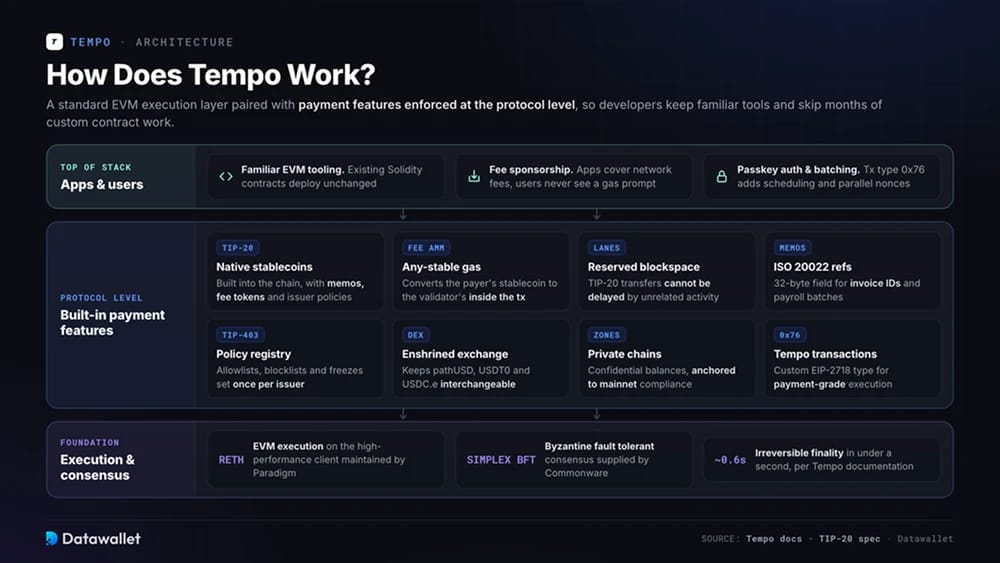
Tempo pairs a standard EVM execution layer with payment features enforced at the protocol level. Developers can continue using familiar tools while gaining capabilities that might otherwise require months of custom smart-contract development.
The core components that make Tempo payment-ready:
- TIP-20 token standard: Tempo’s native stablecoin format is built into the chain rather than deployed as an ERC-20 contract. It supports transfer memos, fee tokens, issuer-controlled compliance policies, and metadata readable by the network’s exchange.
- Stablecoin-native fees: Gas can be paid in any supported USD stablecoin. Regulated firms do not need to buy, hold, or account for a volatile network token, removing a treasury and compliance burden.
- Fee AMM: A built-in automated market maker converts the payer’s chosen stablecoin into the stablecoin preferred by the validator. This exchange occurs within the transaction, so neither party needs to manage the conversion.
- Dedicated payment lanes: Tempo reserves blockspace for TIP-20 transfers at the protocol level. Unrelated smart-contract activity cannot delay a payout run or increase its fee.
- Tempo transactions: A custom EIP-2718 transaction type (0x76) provides call batching, fee sponsorship, scheduled execution, passkey authentication, and parallel nonces. Parallel nonces allow one account to submit multiple transfers simultaneously.
- Fee sponsorship: Applications can cover network fees for their users, creating a gasless experience closer to a fintech app than a crypto wallet.
- Transfer memos: Every TIP-20 transfer can carry a 32-byte memo compatible with ISO 20022 messaging. Accounting systems can use it to record invoice IDs, payroll batches, or cost centres.
- TIP-403 policy registry: Issuers create allowlists, blocklists, and freeze rules once, then apply them across every token they control. The T9 network upgrade in August required each new TIP-20 token to be linked to a policy at creation.
- Enshrined stablecoin DEX: Tempo includes a native decentralised exchange optimised for low-impact stablecoin swaps. This keeps pathUSD, USDT0, USDC.e, and non-USD tokens interchangeable.
- Zones: These are private, permissioned chains anchored to Tempo mainnet. Balances and transfers remain confidential, while the Zones retain interoperability with the base chain and inherit its TIP-403 compliance rules.
Tempo Machine Payments Protocol Explained
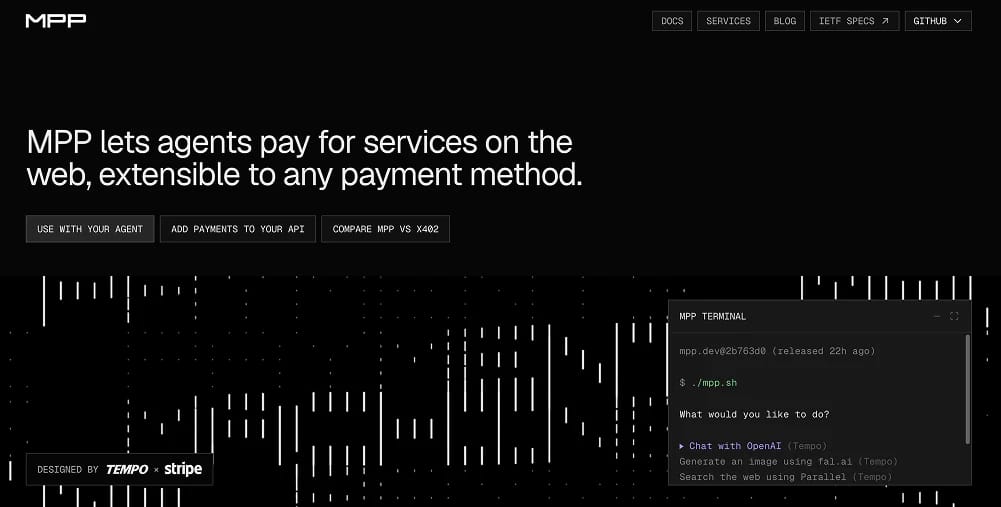
The Machine Payments Protocol (MPP) is an open standard co-authored by Stripe and Tempo. It allows software to pay other software over HTTP without requiring a person to approve every charge. The protocol revives the HTTP 402 “Payment Required” status code, which had remained unused for decades.
When an agent requests a resource, the service returns a payment challenge. The agent’s wallet authorises the charge, payment settles, and the service delivers the resource. Developers do not need to handle the underlying cryptography because the MPP SDK packages this process into a drop-in replacement for the standard fetch call.
Sessions are the central building block. Tempo describes them as “OAuth for money.” An agent allocates funds once and can then stream small payments to a service within agreed limits. Thousands of micro-charges are consolidated into one on-chain settlement. This makes pay-per-call pricing practical when a single task may use a hundred APIs.
MPP is not limited to Tempo or stablecoins. Visa extended the standard to card payments, Lightspark added Bitcoin Lightning, and Stripe supports it through cards and wallets. At launch, the payments directory listed more than 100 compatible services, including Alchemy, Dune Analytics, Anthropic, and OpenAI.
Tempo introduced MPP Credits in June. Developers can use a card to fund an agent’s wallet instead of buying stablecoins first. RedotPay had integrated MPP for its 7.5 million users the previous month. Our x402 protocol explainer examines how MPP differs from Coinbase’s competing standard.
Tempo Zones and Enterprise Payment Features
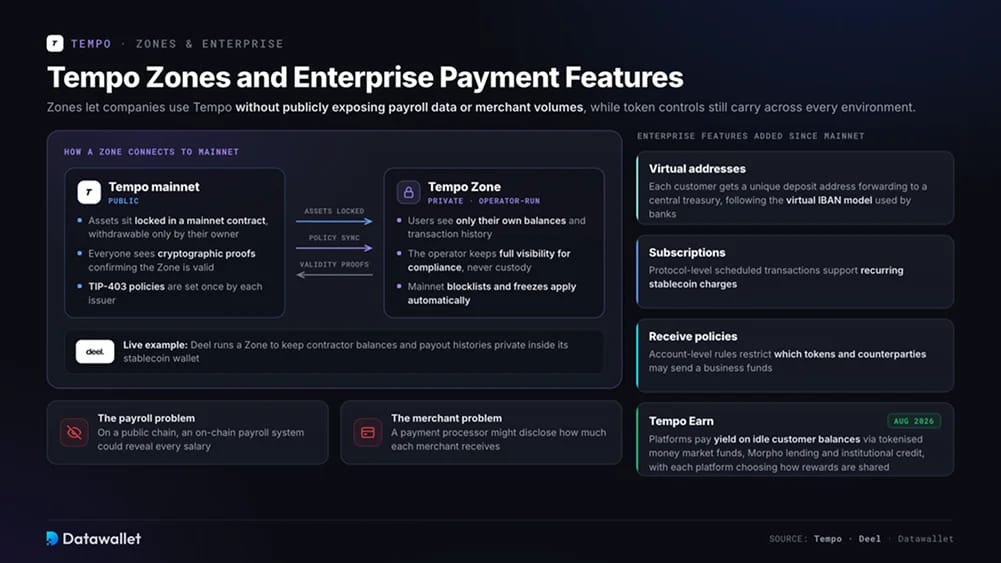
Zones allow companies to use Tempo without publicly exposing payroll data or merchant volumes. On a public blockchain, an on-chain payroll system could reveal every salary, while a payment processor might disclose how much each merchant receives.
A Tempo Zone is a parallel blockchain linked to mainnet and run by a trusted institution. Users inside the Zone can see only their own balances and transaction history. The operator has full visibility for compliance, while the public sees cryptographic proofs confirming that the Zone is valid.
Assets are locked in a mainnet contract and can be withdrawn only by their owner. As a result, the Zone operator never takes custody.
Token controls also carry across environments. If an issuer updates a blocklist or freezes a token on mainnet, every Zone applies the change automatically. Deel uses a Zone to keep contractor balances and payout histories private within its stablecoin wallet.
Other enterprise features added since mainnet:
- Virtual addresses: Each customer receives a unique deposit address that forwards stablecoins to a central treasury account, following the virtual IBAN model used by banks.
- Subscriptions: Protocol-level scheduled transactions support recurring stablecoin charges.
- Receive policies: Businesses can set account-level restrictions covering which tokens and counterparties may send them funds.
- Tempo Earn: Launched in August, Tempo Earn allows platforms to pay yield on idle customer balances. It uses tokenised money market funds, Morpho’s on-chain lending markets, and institutional credit. Each platform determines how rewards are distributed.
What Can You Use Tempo For?
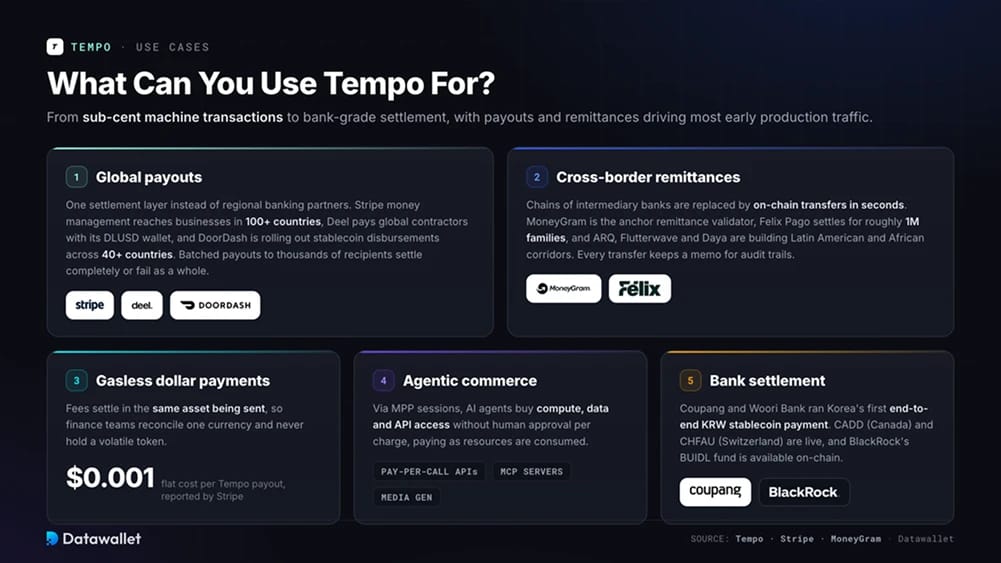
Tempo supports payment activity ranging from sub-cent machine transactions to bank-grade settlement. Payouts and remittances account for most of its early production traffic.
1. Stablecoin Fees and Gasless Payments
Businesses pay network costs in the same asset being transferred:
- Predictable accounting: Payments and fees settle in dollars, allowing finance teams to reconcile one asset rather than two.
- No volatile exposure: Banks and fintech companies do not need to hold a speculative token to keep payments operating. This simplifies capital and compliance treatment.
- Sponsored fees: Platforms can pay charges from their own treasury, so users never encounter a gas prompt.
- Fixed cost per transfer: Stripe reports a flat cost of $0.001 for each Tempo payout. Fees do not increase when other parts of the chain become busy.
2. Agentic Commerce
Through MPP sessions, AI agents can purchase compute, data, and API access without seeking human approval for each transaction. Tempo’s agentic payments documentation covers pay-per-call APIs, monetised MCP servers, and media generation charged by request.
Providers list their services in the payments directory, where agents can discover them. Agents pay as resources are consumed instead of relying on monthly subscriptions negotiated by people.
3. Global Payouts
Platforms that pay sellers, creators, and contractors across multiple countries can use one settlement layer instead of coordinating numerous regional banking partners:
- Stripe money management: Businesses in more than 100 countries can hold, send, and receive stablecoins through their Stripe account. Tempo settles the transfers in under a second.
- Deel: The payroll platform launched a stablecoin wallet for global contractors exclusively on Tempo. Its DLUSD token is issued with Bridge.
- DoorDash: The marketplace is introducing stablecoin-powered payments across more than 40 countries, with Tempo handling driver and merchant disbursements.
- Batch execution: Tempo transactions can combine many transfers into one operation. A payout to thousands of recipients therefore settles completely or fails as a whole.
4. Cross-Border Remittances
Remittance providers use Tempo to replace chains of intermediary banks, where settlement may take days, with transfers completed on-chain in seconds. MoneyGram joined in May as Tempo’s anchor remittance validator. Stripe also plans to use the network for settlement with MoneyGram.
Felix Pago is settling remittances for roughly one million families through the chain. ARQ is developing Latin American payment corridors, while Flutterwave and Daya are adding stablecoin settlement for African businesses.
Each transaction retains a memo for audit trails. This is particularly useful for firms operating under money transmitter licences.
5. Tokenised Deposits and Bank Settlement
Banks are testing Tempo for continuously available settlement involving deposit tokens and local-currency stablecoins:
- Korea: Coupang and Woori Bank completed the country’s first end-to-end KRW stablecoin payment. The test followed a Coupang Eats order through to real-time merchant settlement, with the bank converting funds to and from won.
- Canada: CADD, the first CAD-backed stablecoin issued by a Canadian financial institution, launched on Tempo in May.
- Switzerland: AllUnity’s Swiss franc stablecoin CHFAU went live in June. It became the second non-USD currency added to the on-chain FX pool.
- Regulated yield: BlackRock’s BUIDL fund is available on Tempo. The final prospectus for BRSRV, BlackRock’s new GENIUS-compliant money market fund, also lists Tempo as a supported blockchain for its on-chain share class.
Tempo Adoption Statistics
Tempo’s network data points to payments activity rather than speculation. Fees remain minimal despite high transaction counts relative to value locked. Stablecoin supply is also divided among several issuers instead of depending on one.
Key Tempo network statistics:
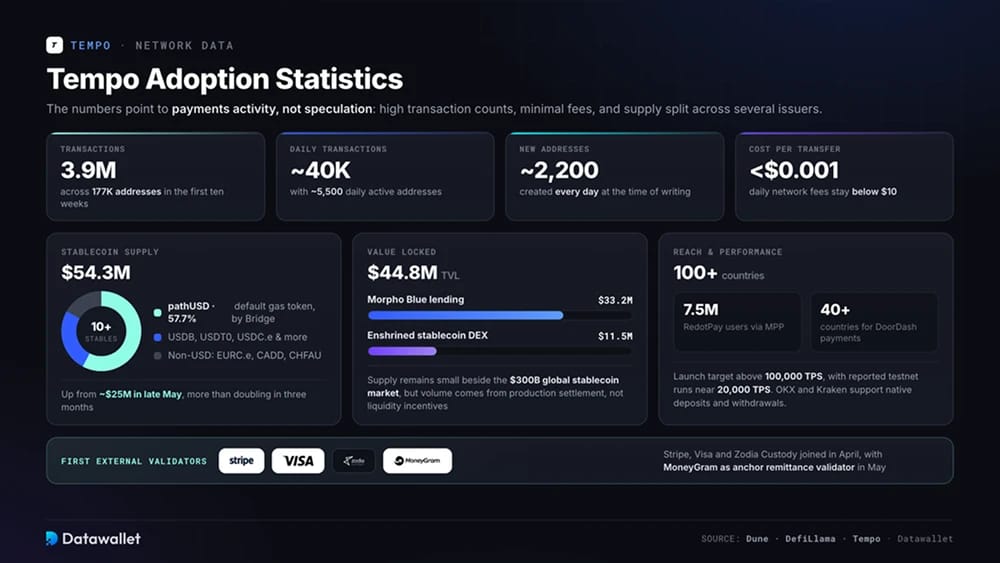
- Transactions: According to Dune Analytics data, Tempo processed 3.9 million transactions across 177,000 addresses during its first ten weeks on mainnet.
- Daily activity: At the time of writing, DefiLlama records approximately 40,000 daily transactions and 5,500 active addresses. Around 2,200 new addresses are created each day.
- Stablecoin supply: Tempo holds $54.3 million in stablecoins, compared with about $25 million in late May. The Bridge-issued pathUSD, which serves as the default gas token, represents 57.7 percent of the total.
- Value locked: Total value locked stands at $44.8 million. Morpho Blue accounts for $33.2 million, while the enshrined stablecoin DEX holds $11.5 million.
- Fees: Daily network fees remain below $10 despite tens of thousands of transactions. That reflects transfer costs of less than $0.001 each.
- Validators: Stripe, Visa, and Zodia Custody by Standard Chartered became Tempo’s first external validators in April. MoneyGram joined as the anchor remittance validator in May.
- Distribution: Stripe’s Tempo-based money management service is available to businesses in more than 100 countries. RedotPay’s MPP integration reaches 7.5 million users, while DoorDash is introducing stablecoin payments across more than 40 countries.
- Stablecoins live on Tempo: The network supports pathUSD, USDB, USDT0, USDC.e, EURC.e, DLUSD, CADD, CHFAU, Open USD, and Ondo’s USDY. It also supports cbBTC through Chainlink CCIP and BlackRock’s BUIDL fund.
- Exchange support: OKX became Tempo’s first international exchange partner in April. Kraken followed in June by adding native USDT0 deposits and withdrawals on the network.
- Performance: Tempo posts nightly benchmark results at perf.tempo.xyz. Its launch target was more than 100,000 transactions per second, while reported testnet runs reached close to 20,000 TPS.
Tempo’s supply remains small beside the $300 billion global stablecoin market. Its daily activity is also well below Tron or Solana.
The source of that volume is more distinctive. Stripe, Deel, and MoneyGram are using the network for production settlement, unlike chains whose initial activity was driven by liquidity incentives.
Who Is Building on Tempo?
Many of Tempo's partners are companies that already process substantial online payment volumes. Design partners named in the September 2025 launch announcement included Anthropic, Deutsche Bank, DoorDash, Nubank, OpenAI, Revolut, Shopify, Standard Chartered, and Visa. Mastercard, UBS, Kalshi, and Cross River Bank joined when the public testnet launched in December.
Since mainnet, Stripe, MoneyGram, Flutterwave, OnePay, and Coastal Bank have used Tempo for live settlement. Bridge, Ondo Finance, AllUnity, and BlackRock have brought assets or funds onto the network. Infrastructure integrations include Morpho, Chainlink, LayerZero, Stargate, RedStone, and Dune.
Tempo has also made several senior hires. Former Ethereum Foundation researcher Dankrad Feist and former Optimism CEO Liam Horne joined in late 2025. Farcaster co-founders Dan Romero and Varun Srinivasan joined in February after Neynar acquired the Farcaster protocol. The company separately acquired Ithaca, the team behind the Porto wallet SDK.
Does Tempo Have a Token?
No. Tempo does not have a native token and has announced no plans to launch one. Network fees and validator rewards are both paid in stablecoins through the Fee AMM. Tokens using the “Tempo” name on Solana or other networks have no affiliation with the project.
Tempo intends to make validation permissionless over time. Such a transition could eventually require a staked asset to secure the network, but the project has made no public commitment to a token.
Matt Huang has described the current structure as intentionally neutral. Under this model, neither a single stablecoin issuer nor a group of token holders controls the chain.
Tempo Funding and Founders
Stripe and Paradigm announced Tempo on 4 September 2025. They incubated and invested in the project, which operates as an independent company.
In October 2025, Tempo raised a $500 million Series A at a $5 billion valuation. Thrive Capital and Greenoaks led the round, with participation from Sequoia, Ribbit Capital, and SV Angel.
Tempo’s CEO is Matt Huang, the co-founder and managing partner of Paradigm and a Stripe board member. He continues to hold his position at Paradigm. Georgios Konstantopoulos, Paradigm’s CTO and the engineering lead behind Reth and Foundry, oversees the technical side. Simon Taylor, who writes the Fintech Brainfood newsletter, leads go-to-market.
The project’s commercial importance comes from Stripe’s broader crypto strategy. Stripe acquired Bridge for $1.1 billion, bought wallet provider Privy, and processed $1.4 trillion in payment volume during 2024. Tempo provides the settlement layer connecting those parts of the business.
Tempo vs Arc vs Plasma
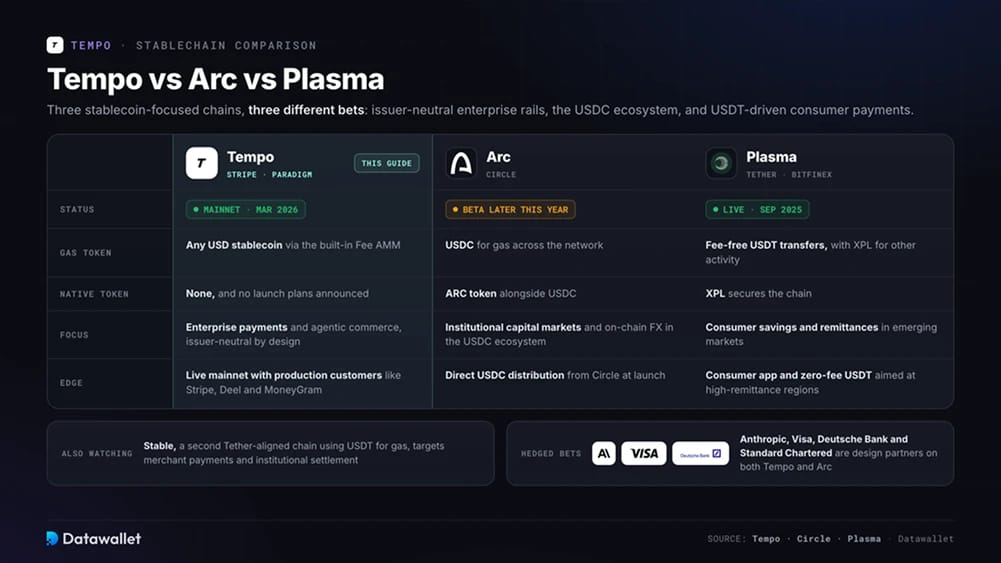
Several blockchains focused on stablecoins have launched over the past year. Their designs differ in ways that matter to developers and asset holders. These networks are sometimes described as stablechains. We cover the USDT-aligned entrant separately in our Stablechain explainer.
How the main stablechains compare:
- Tempo: Incubated by Stripe and Paradigm, Tempo has operated on mainnet since March. It has no native token, accepts fees in any USD stablecoin, and is designed to remain issuer-neutral. Its main focus is enterprise payments and agentic commerce.
- Arc: Circle, the issuer of USDC, is building Arc. The network uses USDC for gas alongside a separate ARC token and targets a mainnet beta later in the year. It focuses on institutional capital markets and on-chain foreign exchange within the USDC ecosystem.
- Plasma: Supported by Tether and Bitfinex, Plasma has been live since September 2025 and uses the XPL token. It provides fee-free USDT transfers and a consumer app aimed at savings and remittances in emerging markets.
- Stable: Stable is another Tether-aligned blockchain. It uses USDT for gas and targets merchant payments and institutional settlement.
Anthropic, Visa, Deutsche Bank, and Standard Chartered are design partners for both Tempo and Arc. Their involvement with each network suggests that large firms are maintaining several potential settlement options.
Tempo’s advantage is its live mainnet and existing production customers. Its neutral design also avoids favouring one issuer’s stablecoin. Arc will benefit from direct access to USDC distribution when it launches.
Risks of Tempo Blockchain
Tempo’s enterprise-oriented design introduces several trade-offs for developers and asset holders to consider.
Key risks and trade-offs to watch:
- Validator concentration: Tempo currently uses permissioned validation and has a small validator group that includes Stripe, Visa, Zodia Custody, and MoneyGram. Two are payment companies with commercial interests in the network. No date has been published for the planned move to permissionless validation.
- Network age: Mainnet has operated for only five months. Its response to adversarial conditions, major outages, or contentious upgrades has not been tested publicly.
- Zone operator trust: Zone operators can view every internal transaction and determine ordering. Although they cannot access customer funds, critics argue that this arrangement recreates the intermediary model public blockchains were intended to replace.
- Fee liquidity dependency: Stablecoin gas payments depend on the Fee AMM having enough liquidity to complete conversions. Transactions using a smaller token could stall if its pool becomes too thin.
- Issuer control: TIP-403 allows issuers to freeze assets and enforce blocklists at the protocol level. Regulated firms may require these controls, but they conflict with expectations of censorship-resistant settlement.
- Stablecoin regulation: Tempo’s enterprise model relies on regulated stablecoins. Changes to GENIUS Act implementing rules, reserve standards, or the treatment of foreign issuers could alter which assets can operate on the network.
- Smart contract risk: Bugs in the precompiles, Fee AMM, or protocol contracts could result in losses, as on any programmable blockchain. Tempo publishes its specifications and client under open-source licences, supporting external review.
- Competitive pressure: Tempo is competing for stablecoin settlement volume with Circle’s Arc, Tether-backed Plasma and Stable, Tron, and general-purpose Layer 2s.
- Agentic demand uncertainty: Autonomous agent commerce remains an early market. If agent spending develops more slowly than expected, a significant part of Tempo’s positioning will depend on demand that has yet to materialise.
- Stripe dependency: Stripe products generate much of Tempo’s present volume. That connection supports adoption but also creates risk if Stripe changes its priorities or regulators examine the relationship between the payment processor and its settlement network.
Final Thoughts
Tempo is one of the few blockchains whose customer list matters more than its token chart. Stripe, MoneyGram, Deel, Visa, and Coupang are using it for live payments. Its network data also resembles a payment system more closely than a trading venue.
Decentralisation remains the central question. Permissioned validators and operator-managed Zones have helped Tempo earn enterprise trust. The next phase will depend on whether the network can reduce that control without sacrificing the reliability its customers expect.