



About KuCoin
KuCoin launched in 2017 and grew into one of the largest altcoin venues in crypto, operated by Seychelles-registered Peken Global Limited. It reports a user base of over 40 million across 200+ countries and ranks among the top ten exchanges for spot volume on CoinMarketCap, while its derivatives business often ranks higher.
Leadership has changed completely. Co-founders Chun Gan and Ke Tang left management under the plea agreement with US prosecutors, and BC Wong, previously chief legal officer, became CEO in January 2025. His first major act was the Trust Project, a $2 billion multi-year program announced at TOKEN2049 Dubai to fund security, reserve transparency, and licensing.
That context frames the rest of this review. KuCoin built its reputation by listing small tokens before anyone else, and it is now trying to keep that identity while becoming a licensed, KYC-mandatory platform.
KuCoin Features
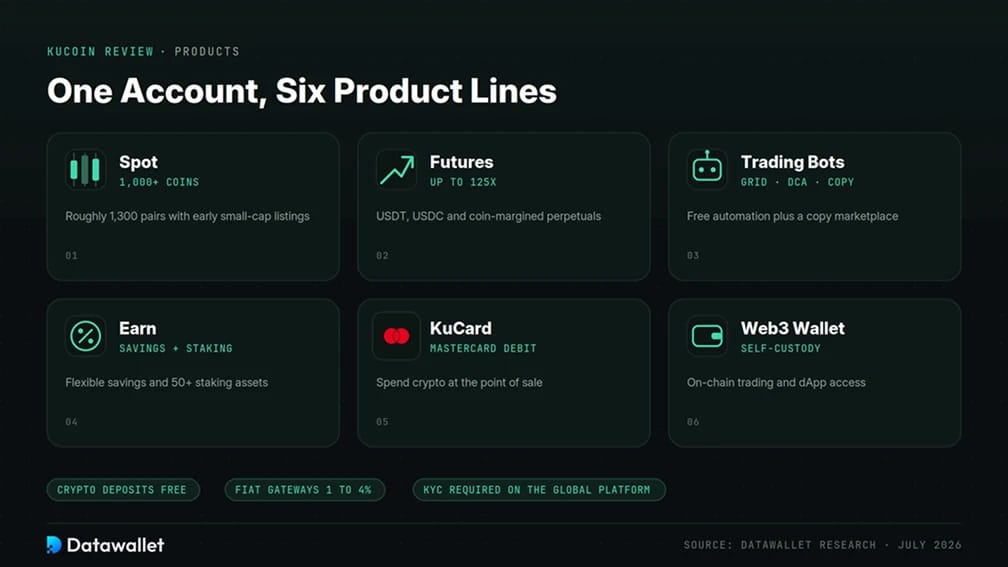
The product range is among the widest of any exchange, with everything housed in a single account and app.
- Spot trading: More than 1,000 cryptocurrencies across roughly 1,300 pairs, including small-cap listings that larger venues skip. Depth is strong on majors and thins quickly on the smallest coins.
- Futures trading: USDT-margined, USDC-margined, and coin-margined perpetuals with leverage up to 125x on the most liquid contracts.
- Margin trading: Cross and isolated modes offer up to 10x leverage on spot pairs, and hourly interest applies to borrowed funds.
- Trading bots: Free built-in bots cover spot grid, futures grid, DCA, and rebalancing strategies, and a copy trading marketplace lets newer users mirror established accounts.
- Earn products: Flexible savings, staking on 50+ assets, dual investment, and structured products such as Shark Fin. Rates change frequently, so always confirm the live figure in-app.
- Launch programs: Spotlight token sales, GemPool staking rewards, and pre-market trading give early access to new tokens, long a KuCoin strength.
- KuCard and payments: A Mastercard debit card converts crypto at the point of sale in supported regions, and our best crypto debit cards breakdown tests it against similar cards. KuCoin Pay handles merchant and peer-to-peer payments.
- Web3 wallet: A self-custodial wallet connects the exchange account to on-chain trading and dApps.
KuCoin’s Stock Index Perpetual Contracts
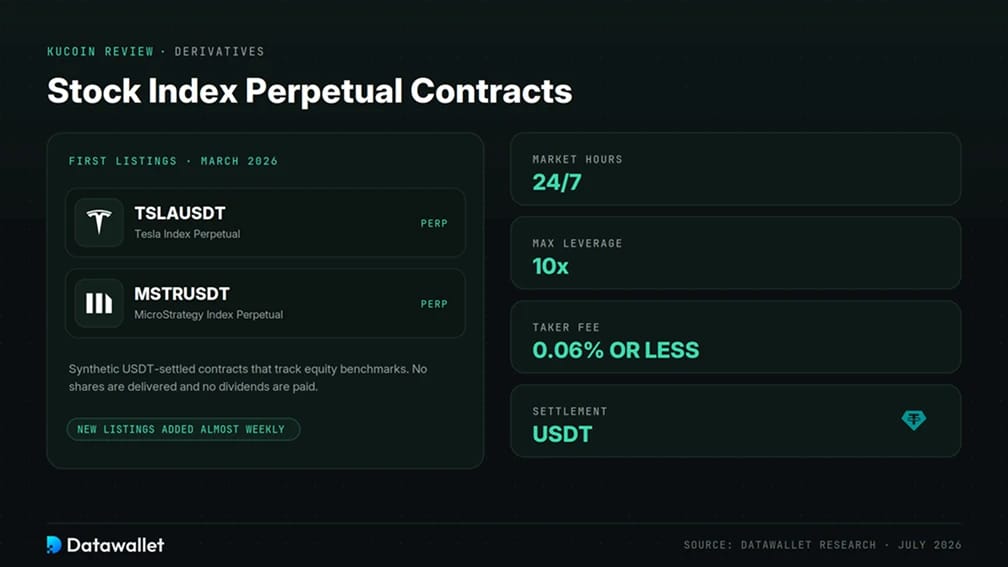
The clearest new direction is equity exposure. KuCoin launched Stock Index Perpetual Contracts in March 2026, starting with Tesla (TSLAUSDT) and MicroStrategy (MSTRUSDT) and adding listings almost weekly since.
The design differs from tokenized stocks. These synthetic, USDT-settled derivatives track equity benchmarks, so no shares back a position and no dividends are paid. In return, contracts trade 24/7 with up to 10x leverage and taker fees at or below 0.06%, letting traders hedge or speculate on equities without leaving the exchange.
Access is restricted in several jurisdictions, and thin liquidity on newer contracts can widen spreads outside US market hours. Anyone wanting actual on-chain share ownership can compare alternatives in our best tokenized stock trading exchanges breakdown.
KuCoin Fees Explained
KuCoin runs separate VIP ladders for spot and futures, and the base rates are competitive without leading the market.
- Spot trading: Major pairs cost 0.1% maker and 0.1% taker at the base tier, and less liquid listing classes cost more. VIP tiers 0 to 12 cut rates as 30-day volume or KCS holdings rise, reaching 0% maker at the top.
- KCS discount: Enabling the pay fees with KCS setting applies a 20% discount to spot fees, bringing the effective base rate to 0.08%. The discount does not apply to futures.
- Futures trading: Base rates are 0.02% maker and 0.06% taker, in line with Binance and OKX at the entry level. VIP tiers reduce both rates, and a settlement charge applies when positions close.
- Deposits and withdrawals: Sending crypto costs nothing, while each asset and network carries a fixed withdrawal charge. Review the current schedule before a large transfer, because a few networks price above typical levels.
- Fiat channels: Card purchases and third-party gateways add roughly 1% to 4%, so the cheapest funding path is usually a crypto transfer from a platform you already use.
If the terminology is new, our maker vs taker fees explainer covers the pricing gap between limit and market orders.
Is KuCoin Regulated?
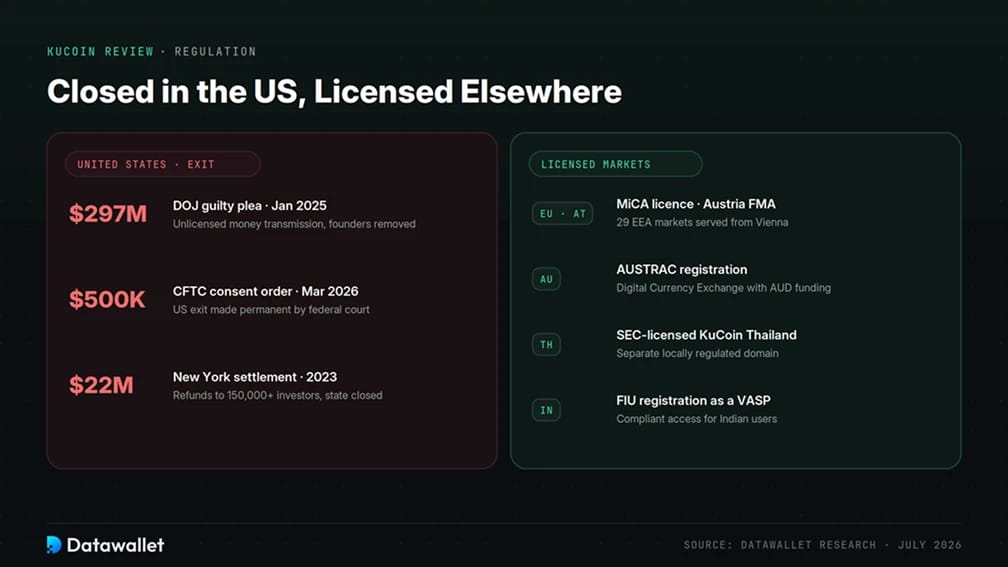
The honest answer has two halves, and both matter. The first half is the US record. In January 2025, operator Peken Global pleaded guilty to running an unlicensed money transmitting business, paid more than $297 million in penalties, removed both founders from management, and agreed to leave the US market for at least two years.
A March 2026 CFTC consent order made the exit permanent unless KuCoin registers as a foreign board of trade and added a $500,000 civil penalty. A 2023 settlement with the New York Attorney General cost $22 million and closed the state entirely.
The second half is the licensing push that followed:
- Europe: KuCoin EU Exchange GmbH received a MiCA authorization from Austria's Financial Market Authority in November 2025 and opened its Vienna-run platform to 29 EEA markets in January 2026. EEA users are migrating off the global site.
- Australia: A local subsidiary registered with AUSTRAC as a Digital Currency Exchange in November 2025, added AUD funding, and partnered with AFSL holder Echuca Trading to bring futures under a regulated structure.
- Thailand: KuCoin acquired a local operator and relaunched it as KuCoin Thailand, an SEC-licensed exchange running on its own domain, separate from the global platform.
- India: KuCoin holds a virtual asset service provider registration from the Financial Intelligence Unit of India, restoring compliant access for Indian users.
Each approval covers a single legal entity in a single jurisdiction, so your counterparty and your protections depend on where you live. The US, Canada, and several other markets remain blocked, and our KuCoin restricted countries page tracks availability in detail.
Is KuCoin Safe?
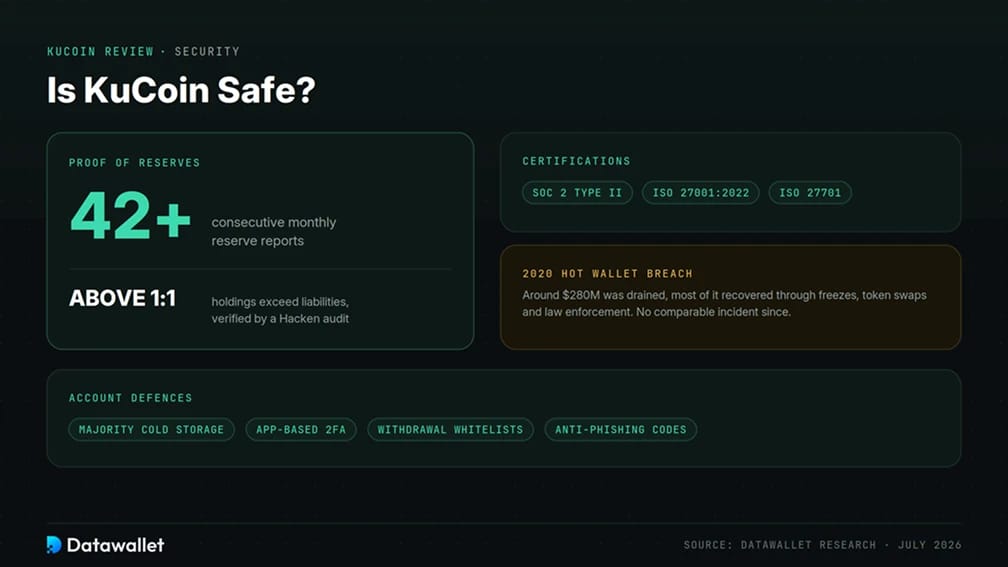
Yes, KuCoin is considered a safe exchange. Its transparency reporting now ranks among the most consistent in the industry. Monthly proof of reserves has run for over 42 consecutive months, and an independent Hacken audit verified that holdings exceed user liabilities at a ratio above 1:1.
The platform holds SOC 2 Type II, ISO/IEC 27001:2022, and ISO/IEC 27701 certifications, keeps most assets in cold storage, and supports app-based two-factor authentication, whitelisted withdrawal addresses, and anti-phishing codes.
The record includes one serious breach. In September 2020, attackers drained roughly $280 million after hot wallet keys were compromised. KuCoin recovered most of it through freezes, token swaps by affected projects, and law enforcement work, then covered the remaining user losses. Its rebuilt security architecture dates from that incident, and no comparable breach has occurred since.
KCS and the KuCoin Ecosystem
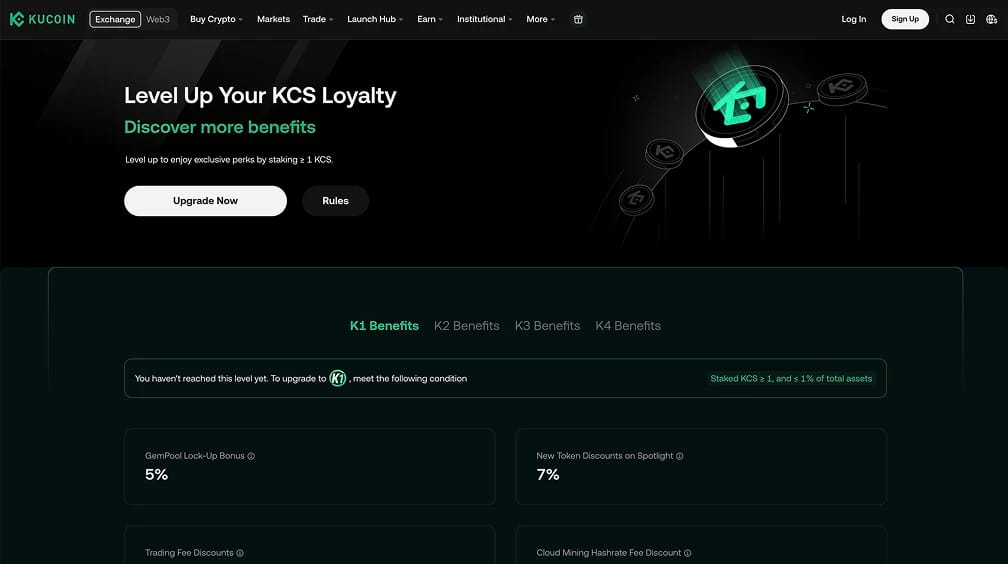
KCS is the exchange token at the center of the wider ecosystem. Enabling the fee setting with any balance cuts spot trading costs by 20%, and holding at least 6 KCS qualifies for a daily bonus paid from a share of platform trading revenue.
Supply is capped at 200 million tokens, and a recurring buyback-and-burn program shrinks the circulating amount. KCS also pays gas on KCC, the EVM-compatible chain run by KuCoin's community, and unlocks Spotlight launches and loyalty tiers. Like every exchange token, its value tracks the platform itself, so treat it as concentrated exposure rather than a diversifier.
KuCoin User Reviews
Public sentiment splits sharply by venue, and the split itself is informative. The mobile apps score well across hundreds of thousands of ratings, while consumer complaint sites paint one of the harshest pictures in the sector.
The divide follows a familiar logic. App ratings capture everyday trading, while complaint platforms collect accounts written at the worst possible moment, after a freeze, a stalled withdrawal, or a P2P dispute that support failed to resolve.
Here is how the feedback breaks down by platform:
- Trustpilot: The score is currently suspended behind a public breach-of-guidelines notice, issued after Trustpilot removed a batch of fake positive reviews. Of the roughly 1,650 that remain, 75% award one star, citing risk-control account freezes, dormancy fees on inactive accounts, and templated support replies that resolve nothing.
- Google Play: The Android app carries 4.5/5 across roughly 287,000 reviews and more than 10 million downloads. Written feedback praises charting, coin selection, and bot performance and names P2P dispute handling as the most common frustration.
- Apple App Store: Scores differ across regional storefronts and average close to 4.7/5. Reviewers highlight smooth navigation and asset breadth, alongside occasional complaints about verification delays and heavy on-device storage use.
Both signals can be true at once. Routine trading works for most people, while support quality shows at the hard moments, when a compliance review, a delisting deadline, or a frozen withdrawal is on the line. The suspended Trustpilot score carries particular weight, since it suggests attempted reputation management rather than isolated bad luck.
Final Thoughts
KuCoin is a different company from the one indicted in 2024. The guilty plea was expensive, and the US door is closed, but the response has been substantive. New leadership, a $2 billion trust program, a MiCA license, AUSTRAC registration, licensed arms in Thailand and India, and 42 straight months of reserve reporting amount to a genuine compliance reset.
The core appeal is intact. Few venues list small tokens early, futures pricing stays competitive, and the bot and earn stack gives casual users plenty to work with. The weaknesses persist too, since fiat support remains patchy, support quality lags the majors, and account freezes draw the loudest complaints.
Before opening an account, check the KuCoin referral code guide for current welcome rewards, and weigh the platform against its closest rivals in our Binance vs KuCoin and Bybit vs KuCoin comparisons.