



USDT vs USDT0: Overview
USDT is the largest stablecoin in crypto, with a market capitalization above $183 billion as of September 2026. Tether has issued the token since 2014. Today, it anchors trading pairs on nearly every major exchange and settles tens of billions of dollars in daily volume across global markets and emerging economies.
USDT0 is Tether's omnichain dollar extension, developed by Everdawn Labs under license from Tether and launched in January 2025. It uses LayerZero's OFT standard to move a unified USDT supply across 29 connected networks without wrapped assets or third-party bridges.
The table below highlights the main differences between the two assets:
How is USDT0 Different From USDT?
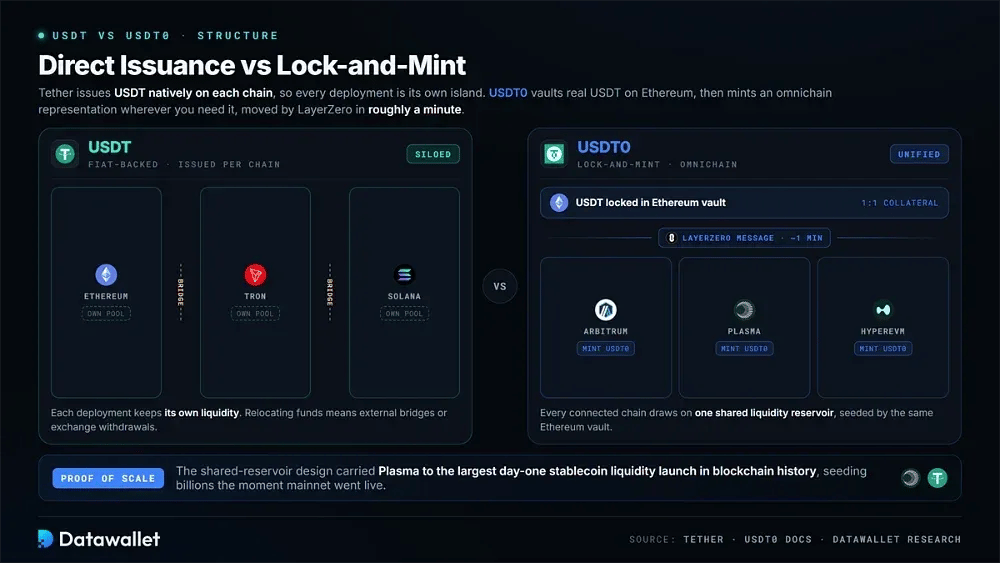
The fundamental difference is structural. Tether issues USDT directly onto individual blockchains as a fiat-backed token. USDT0 instead uses a lock-and-mint design in which real USDT is vaulted on Ethereum before an equivalent omnichain representation is minted on the selected destination network.
That structure changes how each token moves between chains. Standard USDT remains siloed on its native network, so relocating funds requires crypto bridges or exchange withdrawals. USDT0 uses LayerZero messaging to complete native cross-chain transfers in roughly a minute.
Their liquidity models also differ. Each USDT deployment has its own separate pools, whereas USDT0 connects every supported chain to one shared reservoir. This model helped Plasma achieve the largest day-one stablecoin liquidity launch in blockchain history, with billions seeded immediately at mainnet debut.
USDT vs USDT0: Available Networks
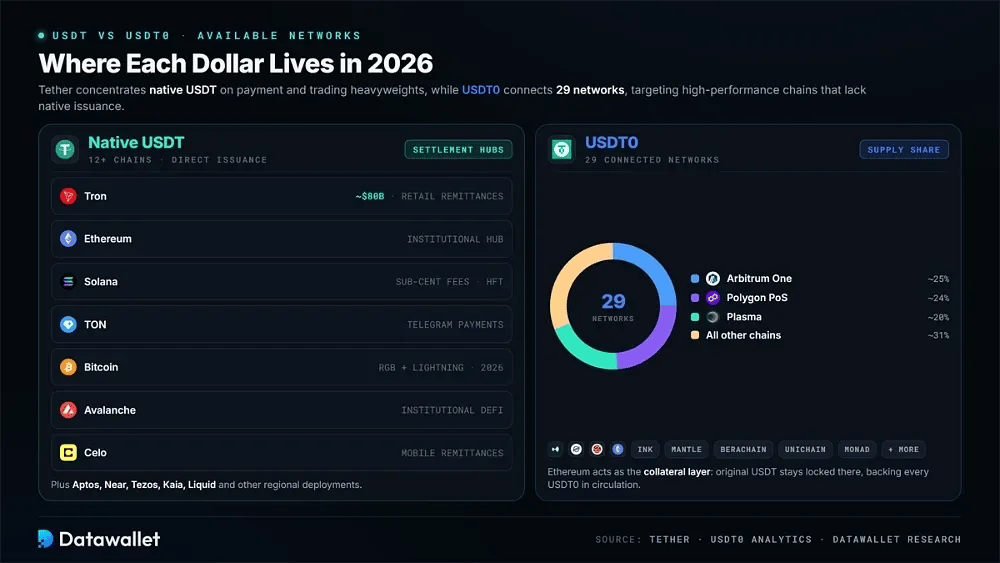
Tether issues native USDT on more than a dozen blockchains, and bridged versions extend its reach considerably further. USDT0, by comparison, connects 29 networks according to official analytics. The two deployment strategies are aimed at different user segments.
Supported Networks for Tether (USDT)
Tether focuses native issuance on chains with the strongest payment demand and trading depth. Settlement reliability takes priority over total network count, especially after the company retired several low-usage legacy deployments during 2025.
The most important networks for native USDT in 2026 include:
- Ethereum (Mainnet): Still the institutional hub for large transfers and blue-chip DeFi, though gas costs remain higher here than on any competing network.
- Tron Network: Hosts roughly $80 billion in USDT, the largest single-chain share, and dominates retail remittances thanks to cheap, near-instant transfer settlement.
- Solana: Sub-cent fees and rapid finality make this the preferred venue for high-frequency traders and users active across the chain's DEX ecosystem.
- TON Network: Telegram's blockchain brings USDT to hundreds of millions of messaging users, powering in-app payments and peer-to-peer dollar transfers at scale.
- Bitcoin (RGB & Lightning): Tether's 2026 rollout of native USDT on Bitcoin rails enables private, scalable dollar transfers over the oldest blockchain network.
- Avalanche (C-Chain): Fast finality and mature DeFi infrastructure support institutional settlement alongside a broad range of consumer-facing financial applications on this chain.
- Celo: A mobile-first network where USDT powers low-cost payments and remittance corridors, particularly across emerging markets in Africa and Latin America.
- Other Networks: Aptos, Near, Tezos, Kaia, Liquid, and additional environments where Tether maintains direct issuance for regional or specialized use cases.
Supported Networks for USDT0
USDT0 focuses on newer, high-performance ecosystems that do not have native USDT issuance. This gives those networks access to Tether-grade dollar liquidity as soon as their mainnets become available to users.
The most significant chains in the USDT0 network today are:
- Ethereum (Collateral Layer): The foundation of the system, where original USDT stays locked in the vault contract backing every USDT0 in circulation.
- Arbitrum One: Migrated its bridged USDT to USDT0 in 2025 and still holds around a quarter of total supply, the largest share.
- Plasma: A stablecoin-native Layer 1 using USDT0 as its canonical dollar, offering zero-fee transfers and hosting roughly a fifth of supply.
- Polygon PoS: Holds close to a quarter of circulating USDT0, giving the low-cost sidechain's dApp ecosystem direct access to unified dollar liquidity.
- HyperEVM: Hyperliquid's EVM environment adopted USDT0 as a primary dollar rail, connecting one of crypto's busiest trading ecosystems to omnichain liquidity.
- Ink: Kraken's Layer 2 hosted USDT0's original January 2025 deployment and remains a core venue within the growing omnichain liquidity web.
- Stellar: The September 2026 deployment linked this payments-focused network into unified USDT liquidity, supporting cross-border settlement without wrappers or bridges.
- Other Networks: Mantle, Berachain, Unichain, Flare, X Layer, Monad, BNB Chain, Sei, and further chains joining the expanding LayerZero mesh.
USDT vs USDT0: Security
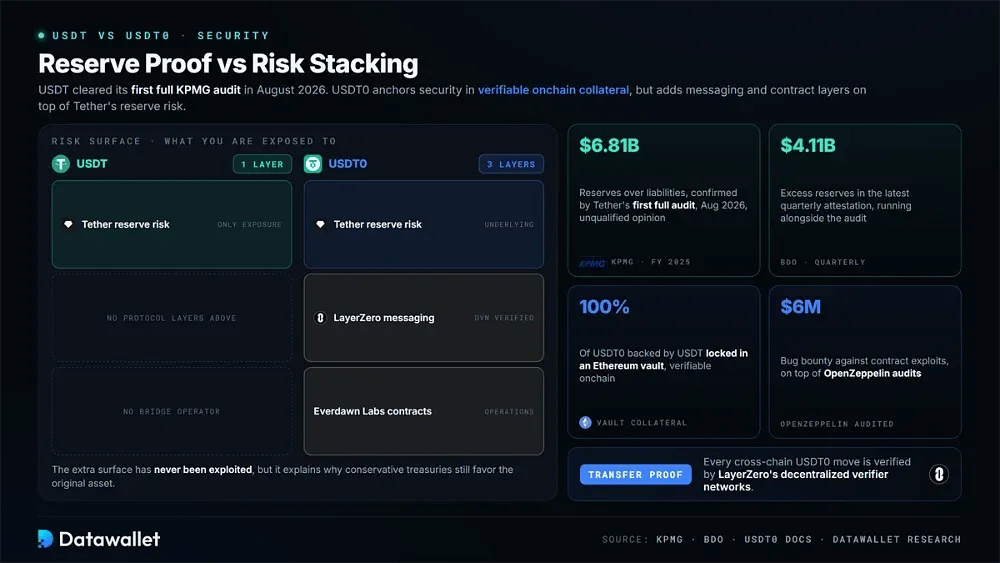
Tether passed its biggest transparency milestone in August 2026. KPMG completed the company's first full financial audit and issued an unqualified opinion, confirming that reserves exceeded liabilities by $6.81 billion at the end of 2025. Quarterly BDO attestations have continued alongside the audit, most recently reporting $4.11 billion in excess reserves.
USDT0 takes a different security approach, relying on verifiable collateral rather than a corporate balance sheet. Every token is backed by USDT held in an Ethereum vault. LayerZero's decentralized verifier networks validate transfers, while the protocol maintains OpenZeppelin audits and a $6 million bug bounty covering contract exploits.
From a practical risk perspective, native USDT exposes holders only to Tether's reserve risk. USDT0 adds LayerZero's messaging infrastructure and Everdawn Labs' contract operations. That additional surface has never been exploited, but it is one reason conservative treasuries continue to favor the original asset.
USDT vs USDT0: Regulations
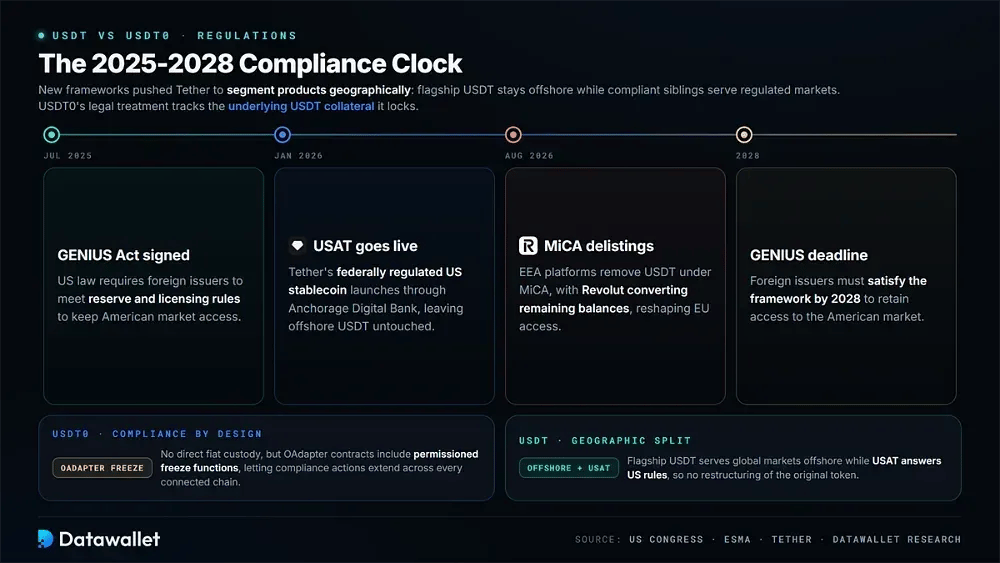
Stablecoin regulation changed substantially between 2025 and 2026, leaving the two assets on different legal footing. Tether responded to new frameworks by separating products geographically. Its flagship USDT remains offshore, while compliant sibling products serve regulated markets.
The key regulatory developments affecting both tokens are:
- GENIUS Act: Signed into US law in July 2025, the framework requires foreign issuers to satisfy reserve and licensing rules by 2028 to retain American market access.
- USAT Launch: Tether's federally regulated US stablecoin went live in January 2026 through Anchorage Digital Bank, serving American users without restructuring the offshore USDT.
- MiCA Delistings: European platforms removed USDT for EEA customers under MiCA rules, with Revolut converting remaining balances by August 2026, reshaping EU stablecoin access.
Because USDT0 does not directly custody fiat, its legal treatment generally follows the underlying USDT collateral it locks. Its OAdapter contracts still contain permissioned freeze functions, allowing compliance actions to carry across chains. That capability is becoming more important as cross-border transfer rules tighten under MiCA and forthcoming GENIUS Act regulations.
USDT vs USDT0: Fees
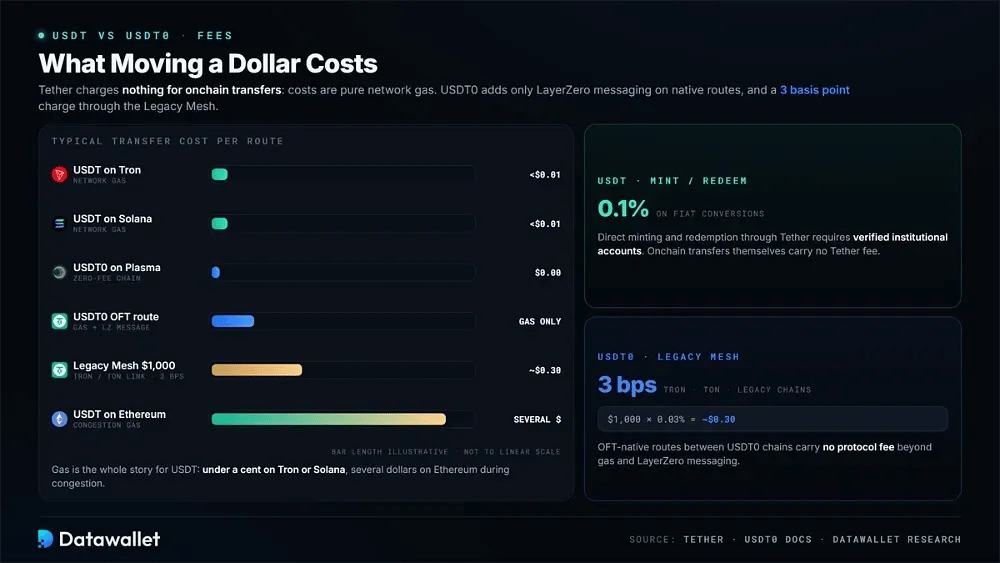
Tether does not charge for onchain transfers. Users pay only network gas, which can range from under a cent on Tron or Solana to several dollars on Ethereum during congestion. Direct minting and redemption through Tether is limited to verified institutional accounts and carries a 0.1% fee on fiat conversions.
Cross-chain USDT0 transfers between OFT-native networks have no protocol fee beyond gas and LayerZero messaging costs. Transfers through the Legacy Mesh, which connects native USDT on Tron, TON, and other established networks, carry a 3 basis point charge. At that rate, bridging $1,000 costs roughly $0.30.
USDT and USDT0: Ecosystem Trends in 2026
Tether's 2026 strategy extends beyond issuing tokens on third-party blockchains. The company now backs networks built specifically for dollar settlement, while USDT0 provides the interoperability layer connecting these newer ecosystems with existing liquidity.
Stablecoin-Native Chains
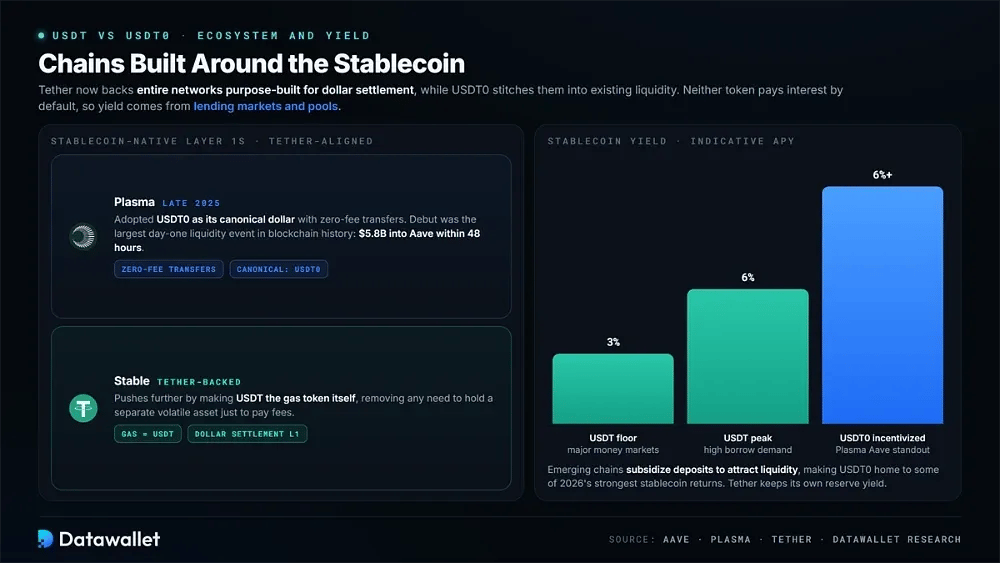
Plasma, a Tether-aligned Layer 1 launched in late 2025, uses USDT0 as its canonical dollar and offers zero-fee transfers. Its debut became the largest day-one liquidity event in blockchain history. Within 48 hours of mainnet, Aave deposits on the network reached $5.8 billion.
Stable, another Tether-backed chain, goes further by using USDT itself as the gas token. Users therefore do not need to hold a separate volatile asset to pay fees. Together, these networks signal a move away from stablecoins simply operating on general-purpose blockchains toward blockchains built around the stablecoin itself.
Key USDT0 Growth Milestones
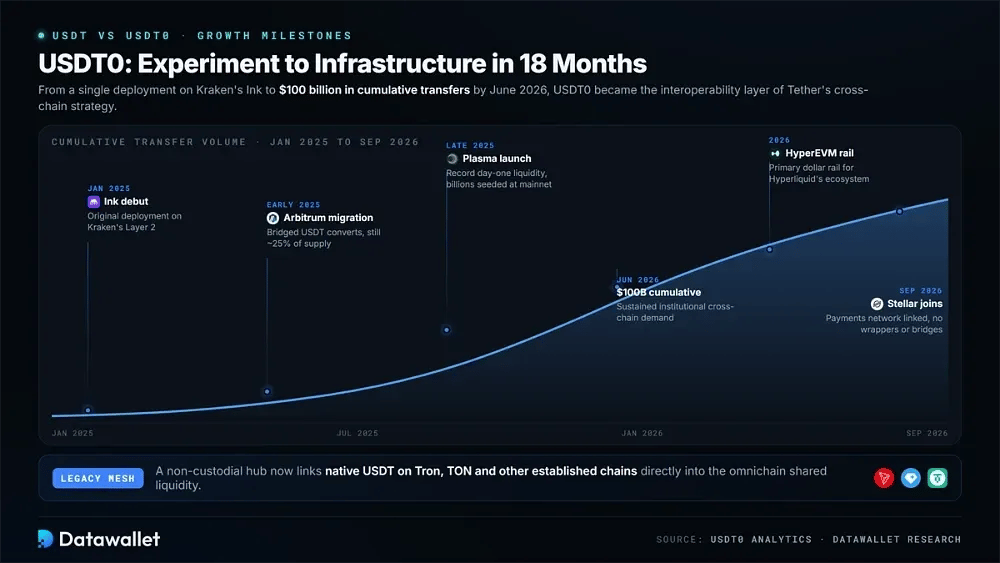
Since debuting on Ink, Kraken's Layer 2, in January 2025, USDT0 has grown from an experimental deployment into core infrastructure for Tether's cross-chain strategy within eighteen months.
Its most significant milestones through 2026 include the following:
- Arbitrum Migration: The network's bridged USDT converted to USDT0 during early 2025, and Arbitrum still holds roughly a quarter of total supply today.
- Plasma Launch: USDT0 powered Plasma's record-setting debut, seeding the new chain with billions in stablecoin liquidity from the first day of mainnet.
- Volume Record: Cumulative transfer volume crossed $100 billion in June 2026, confirming sustained institutional demand for native cross-chain dollar movement at real scale.
- Hyperliquid Adoption: HyperEVM embraced USDT0 as a primary dollar rail, channeling omnichain stablecoin liquidity directly into one of crypto's most active trading venues.
- Stellar Expansion: The September 2026 Stellar deployment connected a payments-focused network into unified USDT liquidity without wrapped assets or third-party bridge dependencies.
- Legacy Mesh: This non-custodial hub now links native USDT on Tron, TON, and other established chains directly into the omnichain shared liquidity.
USDT vs USDT0: Yield Opportunities
Neither token pays interest to holders by default because Tether retains the yield earned on its reserve portfolio. Earning a return requires deploying USDT or USDT0 into lending markets or liquidity pools. On major money markets, USDT yields typically range from 3% to 6%, depending on borrowing demand.
Some of 2026's strongest stablecoin returns have appeared around USDT0 because emerging chains subsidize deposits to attract liquidity. Plasma's incentivized Aave market is the standout example. Our guides to staking stablecoins and the best stablecoin interest rates cover current platforms and risks.
Where Can I Get USDT and USDT0 From?
Centralized platforms are the easiest way to buy USDT, led by Bybit, OKX, Bitget, and MEXC. These USDT exchanges offer direct fiat pairings alongside the deepest order books, which keeps slippage low even for large purchases in 2026's market.
USDT0 is acquired mainly onchain through decentralized exchanges such as Hyperliquid and Uniswap on supported networks. Another option is the native USDT0.to app, which converts Ethereum USDT directly into its omnichain version and routes it to the connected chain you choose.
After purchase, both assets can be stored in self-custody wallets such as MetaMask, Rabby, or a Ledger hardware device. Our guide to the best USDT wallets compares security features and network support for users who want to retain full control of their private keys.
USDT vs USDT0: Adoption
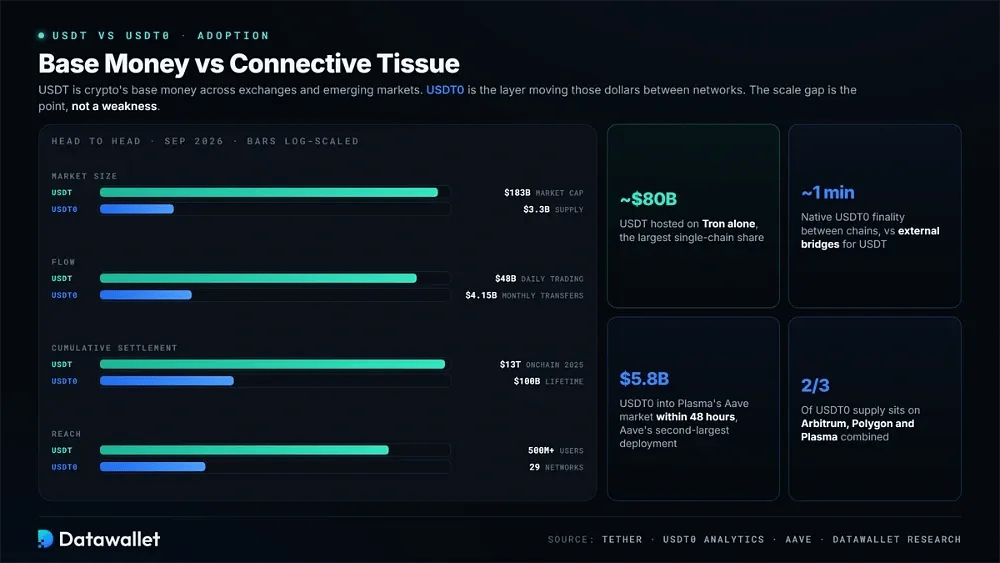
Adoption figures reflect the different roles of the two assets. USDT acts as crypto's base money across exchanges and emerging markets. USDT0 functions as the connective layer that moves those dollars between networks.
The two assets compare as follows across major adoption metrics:
- Market Size: USDT's capitalization stands near $183 billion in September 2026, while USDT0's circulating supply across all connected chains totals roughly $3.3 billion.
- Trading Volume: USDT clears upwards of $48 billion in daily trading volume globally, whereas USDT0 processed about $4.15 billion in transfers last month.
- User Base: Tether reports over 500 million users worldwide, concentrated in emerging markets, while USDT0 serves a smaller cohort of active DeFi participants.
- Network Reach: Native and bridged USDT spans dozens of blockchains overall, while USDT0 directly connects 29 networks through LayerZero's omnichain token standard.
- Chain Distribution: Arbitrum, Polygon, and Plasma together hold roughly two-thirds of USDT0 supply, while Tron alone hosts around $80 billion in USDT.
- Cumulative Flow: Tether settled over $13 trillion in onchain volume during 2025, while USDT0 passed $100 billion in lifetime transfers by mid-2026.
- Settlement Speed: Native USDT0 transfers finalize in about a minute between chains, while moving standard USDT across networks still requires external bridge services.
- Institutional Pull: Plasma's Aave market attracted $5.8 billion in USDT0 deposits within 48 hours, becoming the lending protocol's second-largest global deployment.
Is USDT Better than USDT0?
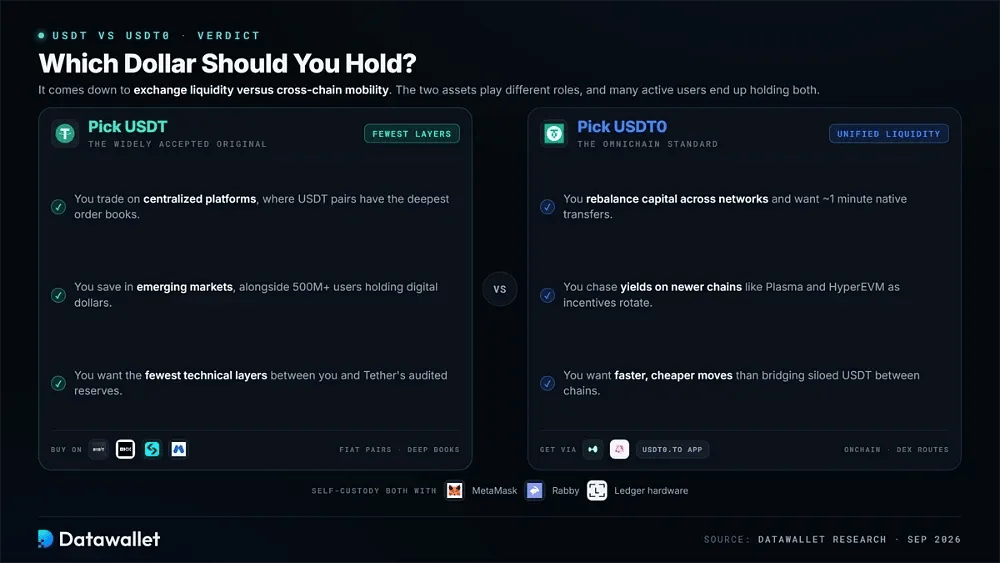
The better option depends on whether exchange liquidity or cross-chain mobility matters more. For traders using centralized platforms, savers in emerging markets, and users who want the most widely accepted digital dollar with the fewest technical layers between themselves and Tether's reserves, USDT remains the clear choice.
USDT0 is better suited to active onchain users who frequently rebalance capital across networks or pursue yields on newer chains such as Plasma and HyperEVM. Its shared liquidity model allows faster and cheaper transfers than bridging siloed USDT. Supply is also increasing as more ecosystems adopt the omnichain standard.
Final Thoughts
USDT is the better fit when maximum acceptance, deep exchange liquidity, and the simplest exposure to Tether's newly audited reserve base are the priority.
For users who regularly move dollars between blockchains, USDT0 is more efficient. Transfers settle natively in about a minute without relying on third-party bridges.
The two assets ultimately complement each other rather than compete. USDT supplies the world's dollar liquidity, while USDT0 makes that liquidity portable across the multichain economy.