
%201.svg)
What is World?
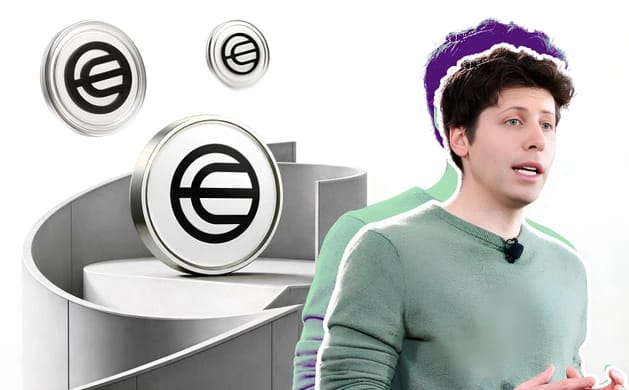
World is a digital network built to help people prove they are real humans online, use decentralized financial tools, and interact with applications designed for people rather than bots. Officially, it describes itself as “the real human network” for proof of human, finance, and connection.
At its core, World is trying to solve a growing internet problem: AI systems and automated accounts are becoming harder to distinguish from real people. Its answer is a privacy-focused proof-of-human (PoH) system that lets users show they are unique humans without publicly revealing personal identity details.
The ecosystem is built around several connected products, including World ID, the Orb, World App, World Chain, and the WLD token. Together, these pieces are meant to create a human-centered network where authentication, participation, and digital transactions can happen at global internet scale.
In practical terms, World aims to become trust infrastructure for the AI era. It is designed so users can anonymously prove humanness, access wallet features and Mini Apps, and participate in a broader onchain ecosystem that prioritizes real humans over scripts, fake accounts, and large-scale abuse.
How Does World Work?
World works through a set of connected products that handle identity verification, private proof of human, wallet access, and app-level utility. Together, they help users prove humanness, interact privately, and access services built for real people online.
World ID
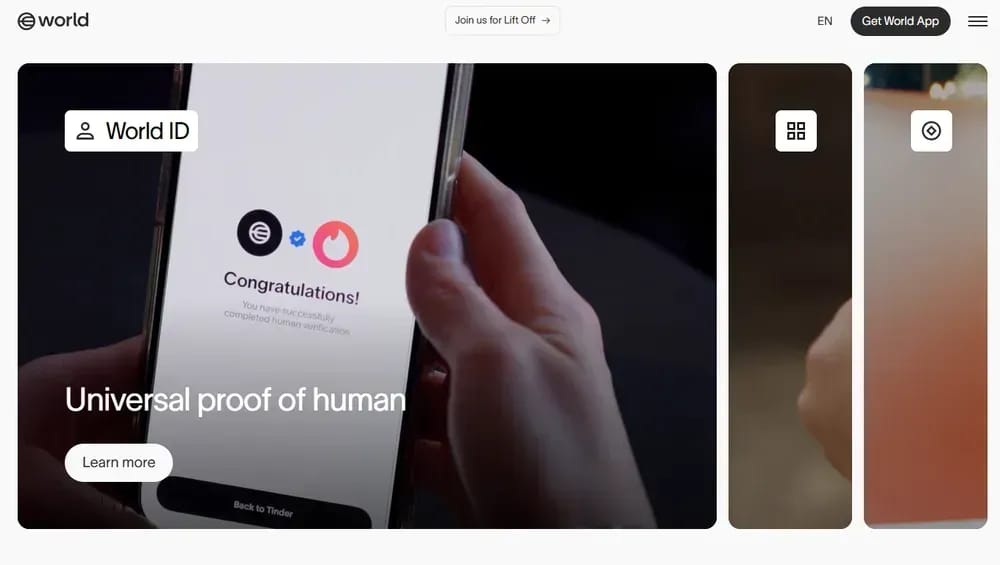
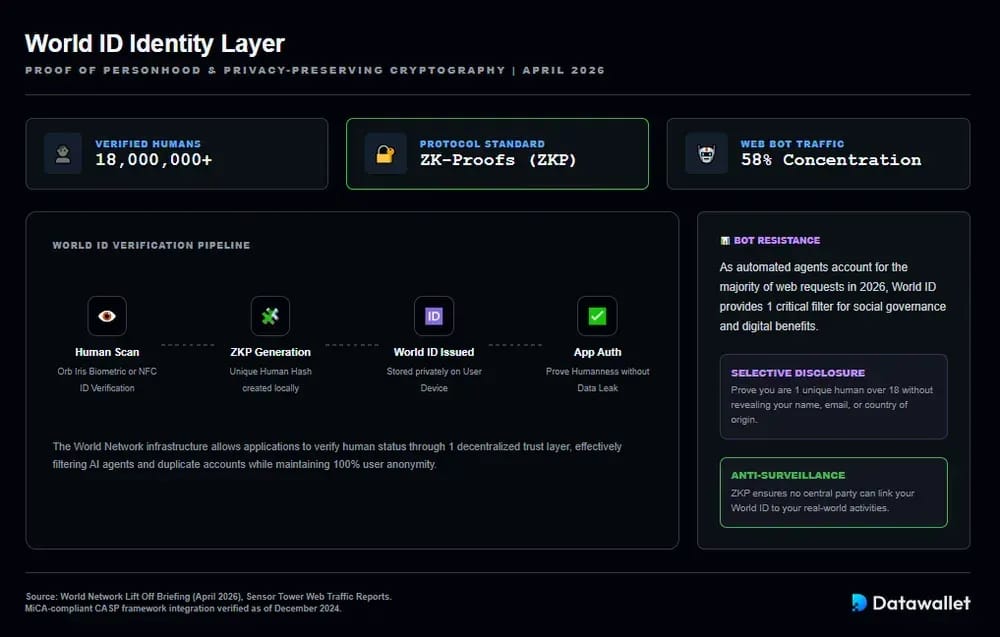
World ID is the identity layer of the network. It gives users a way to prove they are real and unique humans online without revealing personal details like their name, email address, phone number, or government identity to the app requesting verification.
Instead of sharing raw identity data, World ID relies on privacy-preserving cryptography such as zero-knowledge proofs. That allows websites, apps, and services to verify humanness while reducing bots, duplicate accounts, and large-scale abuse without turning authentication into a surveillance-heavy process.
The Orb
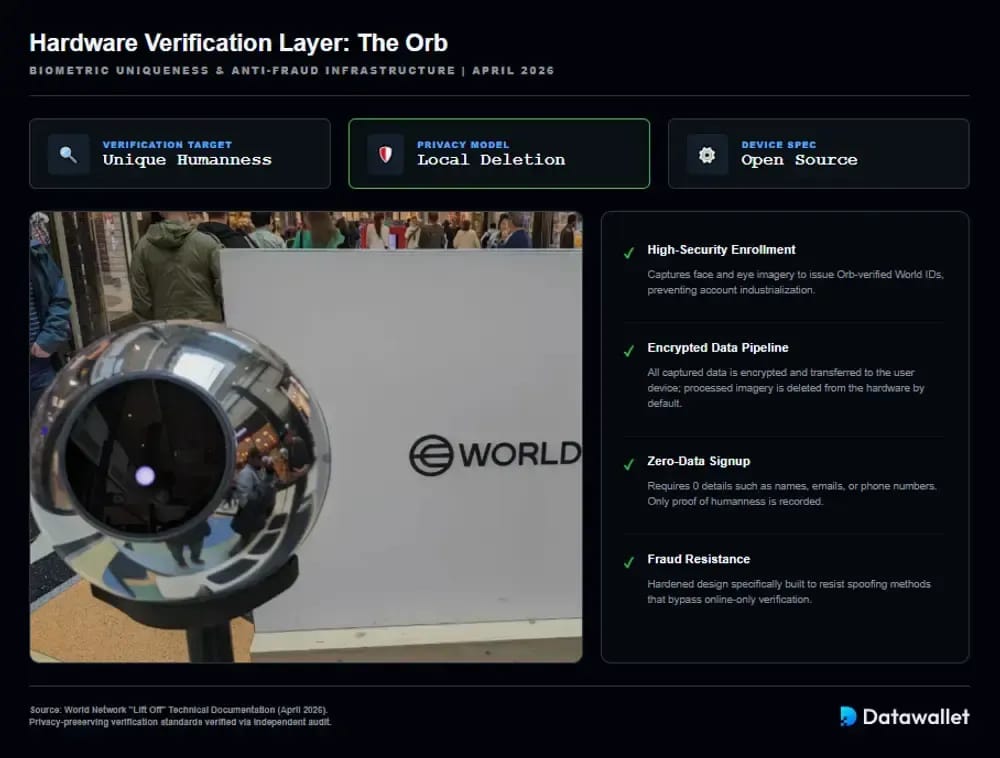
The Orb is the hardware device used during verification. It is designed to confirm that a person is both human and unique, making it a core part of how Orb-verified World IDs are issued within the World network.
Key things to know about the Orb:
- Purpose: It verifies humanness and uniqueness so one person cannot repeatedly create multiple verified identities at scale, which is central to World’s proof-of-human design.
- How it scans: The device captures images of the face and eyes during enrollment as part of the verification flow used to issue an Orb-verified World ID.
- Privacy model: World says the captured data is encrypted, sent to the user’s device, and deleted from the Orb itself by default after processing.
- No traditional signup data: The process does not require users to provide details like their name, email, phone number, or social profile for verification.
- Security focus: The Orb is presented as a high-security, open-source device built specifically for fraud resistance, authenticity, and privacy-preserving verification at scale.
- Why it matters: Its role is to make proof of human more difficult to spoof, duplicate, or industrialize compared with weaker online-only verification methods.
World App
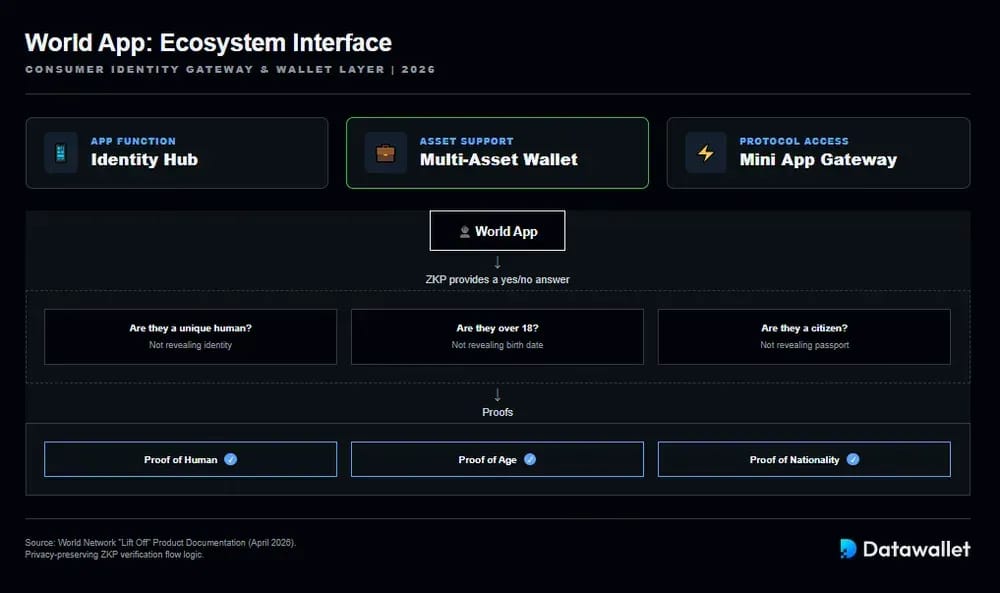
World App is the main consumer gateway into the ecosystem. It is a mobile wallet that stores World ID, supports digital assets, and gives users access to Mini Apps and other services built on top of the broader World network.
It also acts as the place where users approve proof requests when a website or application asks them to verify humanness. In other words, World App is both the identity interface and the wallet layer that makes the system practical in daily use.
What is World Chain?
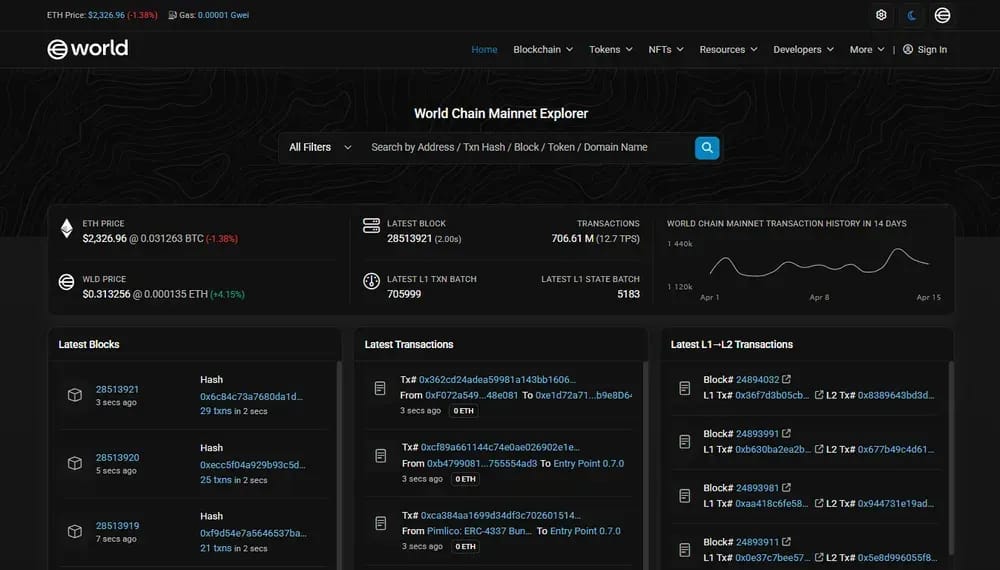
World Chain is World’s human-focused Layer 2 blockchain, built to support applications that can recognize and prioritize verified humans onchain. Official documentation describes it as a blockchain for humans, with features like free gas allowances and native distribution through World App Mini Apps.
Technically, World Chain is built on the OP Stack and is part of the Superchain, which gives it Ethereum compatibility while allowing custom features tailored to World’s ecosystem. Its purpose is to make onchain activity more scalable, usable, and resistant to bot-driven congestion and abuse.
World Chain Use Cases
World Chain is designed to support applications and transactions that benefit from verified-human participation, simplified crypto UX, and distribution through World App. Some of its most important use cases include:
Use cases include:
- Human-prioritized transactions: Verified humans can receive priority inclusion through World’s proof-of-human model, helping protect blockspace from spammy or bot-dominated activity.
- Free or subsidized user activity: World Chain documentation says verified users receive a gas stipend or free gas allowance for transactions on the network.
- Mini App ecosystems: Builders can launch applications that reach World App users directly, giving them access to native mobile distribution from inside the World environment.
- Sybil-resistant apps: Developers can use World ID to build products where one-human-one-account or one-human-one-action design matters, such as claims, voting, or gated participation.
- Simpler crypto experiences: World positions the chain as infrastructure for easier transactions and consumer-facing use cases rather than purely technical DeFi experimentation.
- Ethereum-compatible deployment: Because it is EVM-equivalent through the OP Stack, developers can deploy Ethereum-style smart contracts without major code changes.
The WLD Token
WLD is the native token of the World network and is positioned as both an operative cryptocurrency and a governance mechanism within the ecosystem. Its design is closely tied to World’s goal of broad participation, user ownership, and network growth over time.
1. WLD Tokenomics
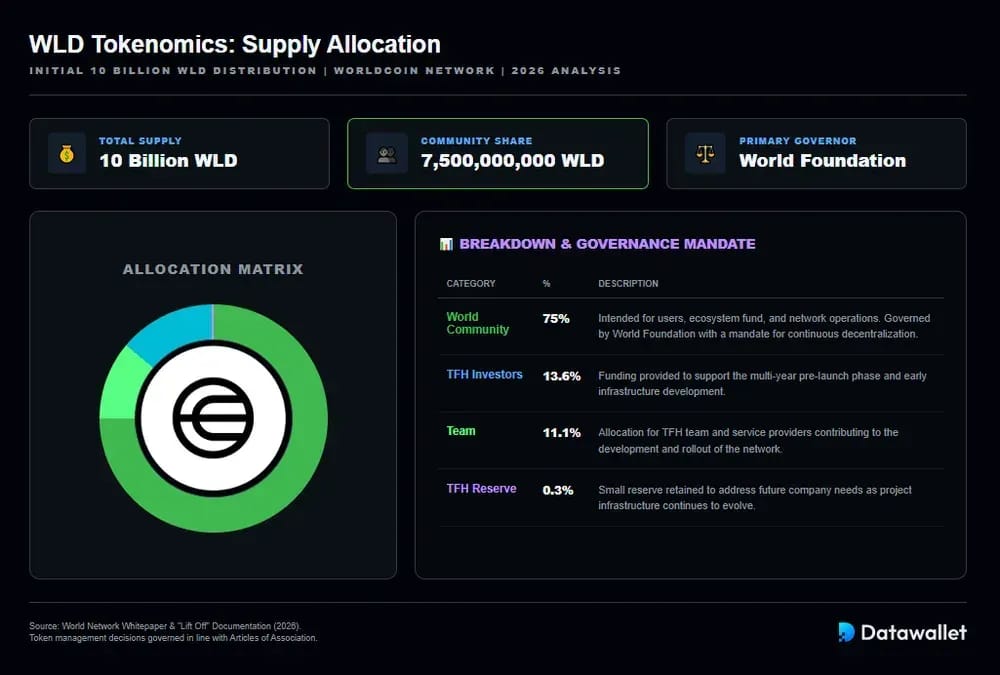
World’s token model splits the 10 billion initial WLD supply across four main stakeholder groups, with the majority reserved for the broader community and long-term network growth.
Current allocation breakdown:
- World Community (75%): World Foundation governs the allocation of these tokens under its Articles of Association while continuing to decentralize token-management decisions over time. Most of this share is intended for users, with some reserved for the ecosystem fund and network operations.
- Team (11.1%): These tokens are allocated to the TFH team and other service providers that helped build and develop World during its early formation and rollout.
- TFH Investors (13.6%): This portion goes to Tools for Humanity investors whose capital helped fund the project’s multi-year pre-launch development phase and early infrastructure buildout.
- TFH Reserve (0.3%): Tools for Humanity retains this small reserve of WLD to address future company needs as the project and supporting infrastructure continue to evolve.
2. How WLD is Distributed
A major part of World’s token design is that distribution is meant to happen gradually and, in theory, broadly. That means WLD is not just a market asset, but part of the network’s participation and ownership model.
How distribution works:
- Verified-human claims: World says eligible verified humans can claim WLD simply for engaging in the network and verifying unique humanness, subject to availability and regional eligibility.
- Equality principle: Official tokenomics materials state that verified individuals in applicable countries should be able to claim the same amount at a given point in time.
- Time-based incentives: Claimable user token amounts decrease over time, which World says is meant to encourage earlier participation and repeated engagement.
- Monthly claim structure: A 2025 World explainer says Orb-verified users could claim around 40 WLD distributed monthly over one year, with additional amounts for passport credentials at that time.
- Not universal in every jurisdiction: Availability depends on where World App and token claims are offered, so access to WLD is not identical across all regions.
- Foundation stewardship: Until the protocol becomes self-sufficient, the World Foundation acts as steward of community tokens and directs them across users, network operations, and ecosystem funding.
3. Why WLD Matters in The Ecosystem
WLD is not presented by World as a standalone token detached from product utility. Instead, it sits beside World ID, World App, and World Chain as part of a broader system aimed at ownership, coordination, and economic participation.
Important context around the token:
- Native ecosystem token: World describes WLD as the native token powering the real human network.
- Governance role: Official materials frame it as part of the governance structure intended to support decentralization of the network over time.
- Ownership narrative: The token is tied to the idea that users should help own the network they are building rather than simply use it as customers.
- Economic coordination: In the whitepaper, WLD is described as the long-term economic unit of account for actors in the network.
- Ecosystem expansion: As Mini Apps, wallets, and human-verified services grow, WLD is intended to be part of the broader incentive structure supporting that expansion.
- Token supply dynamics: Recent official updates show the unlock schedule is still evolving, including a planned 43% decrease in the unlock rate beginning July 24, 2026.
World Orb Scanner Locations
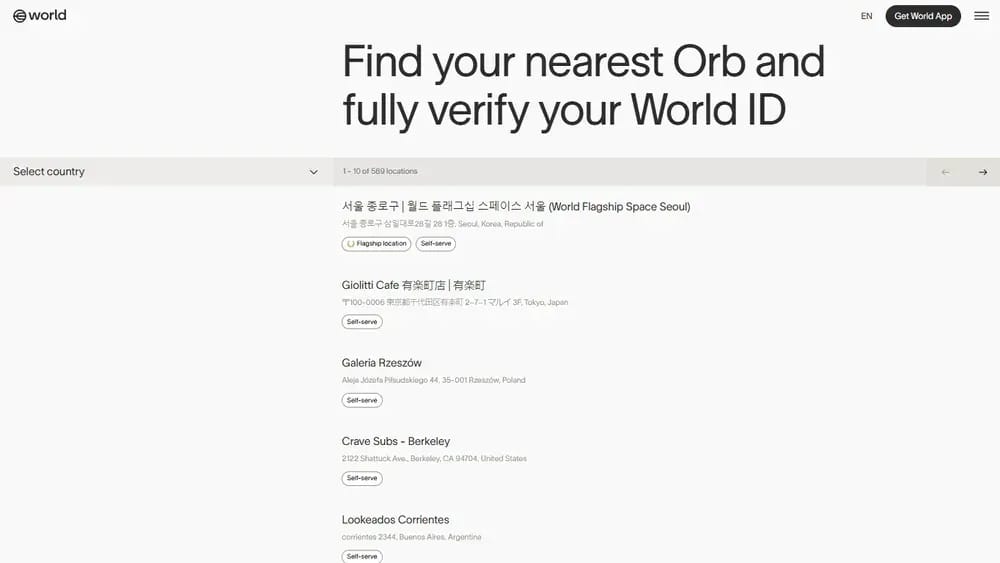
World currently lists 589 Orb scanner locations across 14 countries on its official finder page. Those countries are Argentina, Austria, Brazil, Germany, Italy, Japan, South Korea, Mexico, Poland, Portugal, Singapore, Taiwan, the United Kingdom, and the United States.
To find the nearest Orb, users can visit World’s official Orb locator, choose a country from the dropdown menu, and open a selected site directly in Google Maps.
World Restricted Countries
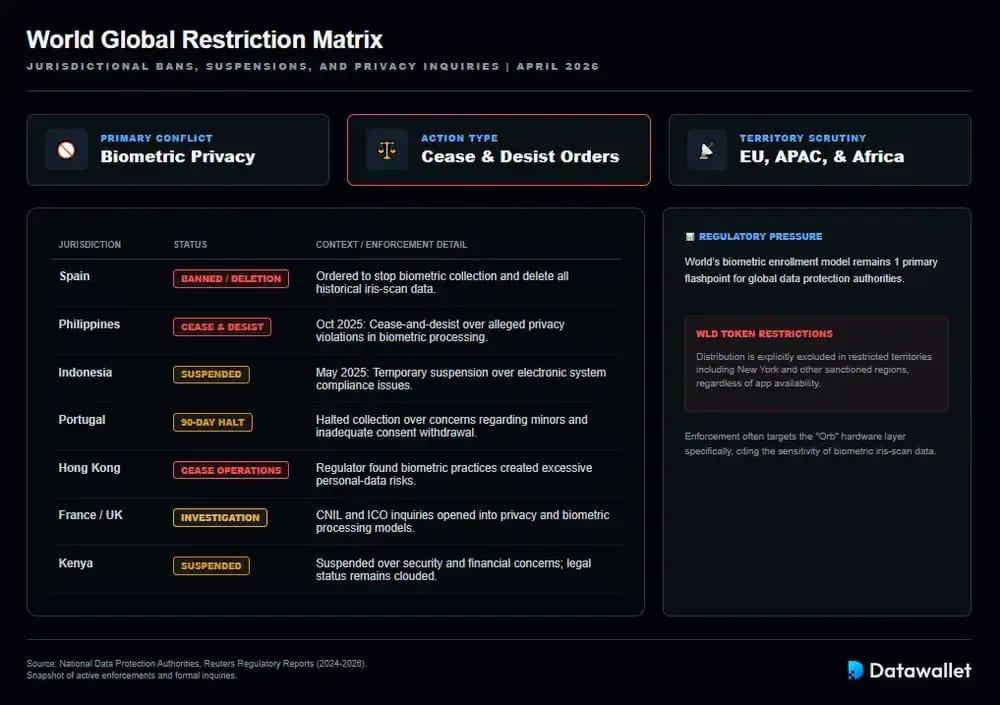
World’s legal and regulatory footprint has faced repeated pressure from privacy watchdogs and national authorities. Several jurisdictions have suspended, banned, investigated, or restricted parts of the project, especially around biometric data collection.
Major restrictions and legal trouble include:
- Spain: Spain’s data protection authority ordered Worldcoin to stop collecting biometric data in March 2024, and Reuters later reported an order to delete all iris-scan data collected since the project began.
- Portugal: Portugal’s CNPD ordered Worldcoin to halt biometric data collection for 90 days in March 2024 over concerns including minors, consent withdrawal, and inadequate user information.
- Indonesia: Indonesian authorities temporarily suspended World and World ID operations in May 2025 after complaints and possible issues with electronic system compliance.
- Philippines: In October 2025, the Philippine privacy regulator issued a cease-and-desist order against Tools for Humanity over alleged privacy-law violations tied to biometric data processing.
- Hong Kong: Hong Kong’s privacy regulator ordered Worldcoin to cease operations in May 2024, saying the project’s biometric data practices created privacy and personal-data risks.
- France: France’s CNIL opened an investigation into Worldcoin’s privacy practices in 2023, adding to early European scrutiny of the project’s biometric enrollment model.
- United Kingdom: Britain’s Information Commissioner’s Office also opened inquiries in 2023, reflecting concerns about how biometric information was being collected and processed.
- Kenya: Kenya suspended operations in 2023 over security, privacy, and financial concerns; Reuters later reported the police investigation was dropped, but later court and privacy actions continued to cloud the project’s status.
- South Korea: South Korean regulators opened investigations into privacy practices as scrutiny widened beyond Europe and Africa.
- WLD-specific restrictions: Even where World App is available, WLD distribution remains restricted by geography, age, and other legal limits; World’s own terms explicitly exclude New York and other restricted territories.
Who Founded Worldcoin?
Worldcoin, now known simply as World, was conceived in 2019 and formally launched out of beta on July 24, 2023. The project was originally introduced under the Worldcoin name before shifting branding toward the broader World identity in late 2024.
The project was co-founded by Sam Altman, Alex Blania, and Max Novendstern, while Tools for Humanity served as the main company developing the early infrastructure, hardware, and software behind the network. Altman became chairman of TFH, while Blania took the CEO role.
In October 2024, Reuters reported that Worldcoin rebranded to World Network, or simply World, as the project tried to expand beyond its original crypto-only image into a wider identity, proof-of-human, and internet infrastructure platform.
Funding
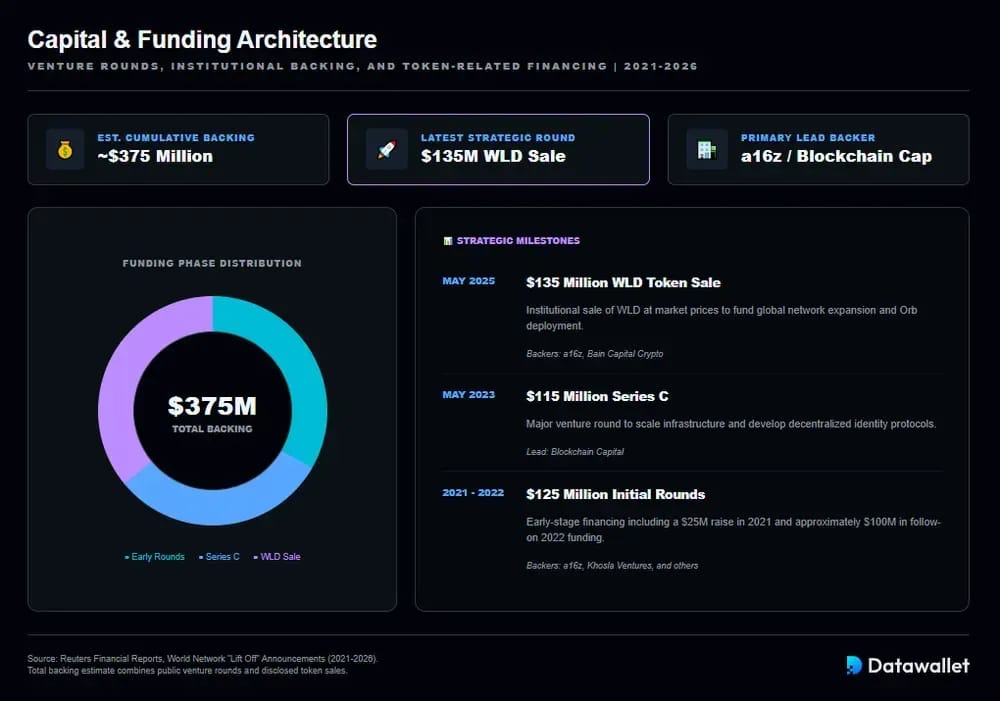
World and Tools for Humanity have raised substantial backing across both venture rounds and token-related financing. Reuters reported a $115 million Series C in May 2023 led by Blockchain Capital, while official World materials later announced a $135 million WLD sale in May 2025 to Andreessen Horowitz and Bain Capital Crypto.
Earlier reporting also pointed to prior funding rounds, including an initial $25 million raise in 2021 and roughly $100 million in 2022, with backers including Andreessen Horowitz, Khosla Ventures, and others. Taken together, public reporting places total backing around the $240 million range before the later 2025 token sale.
Is World Safe?
World promotes a privacy-first architecture built around personal custody, zero-knowledge proofs, encrypted processing, and limited identity disclosure. Official materials say Orb verification data is encrypted, sent to the user’s device, and deleted from the Orb by default, while World ID use does not reveal underlying biometric information to third parties.
That said, “safe” depends on what kind of risk you mean. Even World’s own risk disclosures warn that regulation is unsettled, crypto assets are highly risky, and third-party apps on permissionless infrastructure can expose users to additional dangers beyond the core protocol itself.
Main Risks to Understand
Before using World, users should be aware of several practical and legal risks beyond the project’s marketing claims. The biggest concerns raised by regulators and outside reporting include:
Key risks include:
- Regulatory uncertainty: World’s own risk page says the legal treatment of biometric verification, tokens, and blockchain infrastructure remains unsettled across many jurisdictions.
- Biometric privacy concerns: Regulators in Spain, Portugal, and Hong Kong have all taken action tied to concerns over consent, data handling, and biometric collection practices.
- Crypto volatility: WLD is a high-risk crypto asset whose value, utility, and market behavior can change sharply, including the possibility of losing significant value.
- Third-party app exposure: World’s terms warn that World Chain is permissionless, meaning outside developers may launch applications that World itself does not control or approve.
- Security incidents: TechCrunch reported in 2023 that several operator devices were compromised by credential-stealing malware, though World said no personal user data was exposed through that incident.
- Availability limits: Even if World App is available in a region, WLD access can still be restricted by geography, local law, age, or compliance rules.
Final Thoughts
World is one of the most ambitious crypto-adjacent identity projects on the market, combining proof of human, a wallet, and a Layer 2 network into a single ecosystem. Its appeal comes from trying to solve a real AI-era problem.
At the same time, the project remains controversial because it asks users to trust a biometric verification system in a regulatory environment that is still evolving fast. That tension sits at the center of nearly every debate around World.
For investors, users, and observers, World is worth watching not because it is settled, but because it is still being tested in real time by markets, regulators, and public opinion.