




Who is Sam Altman?
Sam Altman is an American entrepreneur and investor who has run OpenAI since 2019 and built it into the most closely watched company in technology. Before that, he spent five years leading Y Combinator, the accelerator that seeded a generation of startups he later backed himself.
His position is unusual. He runs a business last valued at $730 billion, yet cannot sell a single share, because he was never granted any. That choice, which he has defended under oath, is the central fact of his finances and the reason any estimate of his wealth must look everywhere except at OpenAI.
The mismatch between his influence and his ledger is striking. Altman shapes how hundreds of billions in AI capital is deployed, yet his fortune is built on early bets on companies that supply or surround the AI industry rather than sit at its centre. His power and his money point in different directions.
.webp)
Sam Altman's Background
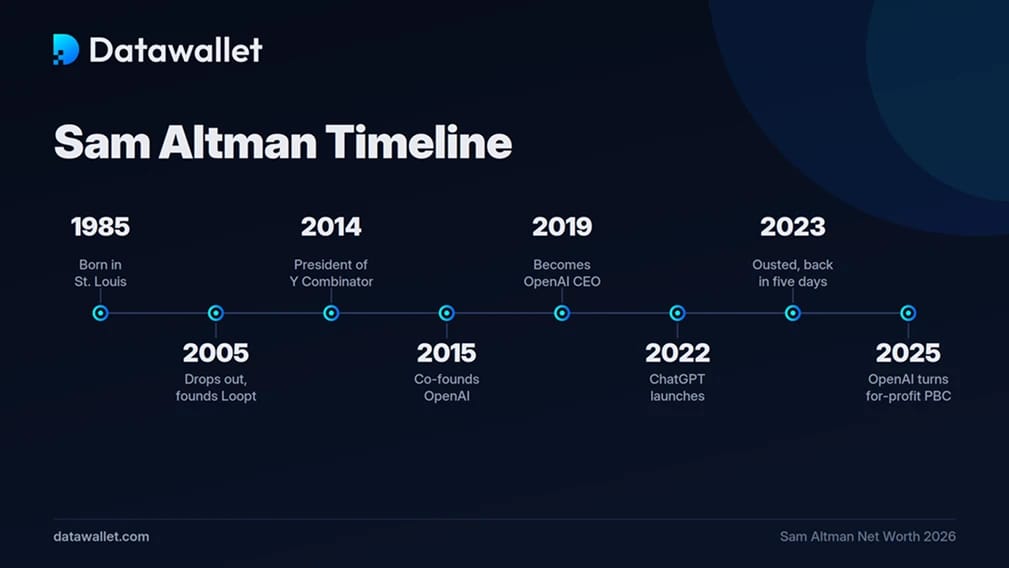
Altman's path runs from a coding-obsessed Midwest childhood through a Stanford exit, a mobile startup that never took off, the presidency of Silicon Valley's most influential accelerator, and the company that put him at the front of the AI era.
Early Life and Education
Sam Altman was born on April 22, 1985, in Chicago and raised in St. Louis, Missouri, the eldest of four children. He got his first computer at around age eight, learned to program early, and attended the John Burroughs School before heading west for college.
He enrolled at Stanford University to study computer science but left after two years in 2005 to start a company. That first venture mattered less for its outcome than for the network and capital it eventually handed him.
Loopt and Y Combinator
His first company was Loopt, a location-sharing app he co-founded in 2005 and ran for seven years. It raised more than $30 million but never found traction, and Green Dot bought it for about $43.4 million in 2012, a modest result that roughly returned investors' money rather than a windfall.
The proceeds funded his next move. In 2012, he and his brother Jack launched Hydrazine Capital, seeded partly by his Loopt payout and largely by Peter Thiel, his main backer.
Altman steered most of it into Y Combinator companies, having joined the accelerator as a part-time partner in 2011. Paul Graham named him president of Y Combinator in 2014, a role he held until 2019, giving him a front-row read on which young companies would compound.
Founding and Leading OpenAI
Altman co-founded OpenAI in 2015 as a nonprofit alongside Elon Musk, Greg Brockman, Ilya Sutskever, and others, with a mission of building artificial general intelligence to benefit humanity.
He became CEO in 2019, the year the lab added a capped-profit subsidiary to raise the capital frontier research demanded. The November 2022 launch of ChatGPT turned a research outfit into a global phenomenon and Altman into its public face.
His grip nearly slipped in November 2023, when the nonprofit board abruptly removed him, saying he had not been consistently candid with directors. Staff and investors revolted, most employees threatened to quit, and he was reinstated within five days under a new board. The episode showed how much of OpenAI's value tracked Altman personally.
The Restructuring and the Road to IPO
The governance fight the firing previewed was settled in October 2025, when OpenAI completed its recapitalization. The for-profit became OpenAI Group PBC, a public benefit corporation controlled by the renamed nonprofit, the OpenAI Foundation, which holds a 26% stake worth roughly $130 billion. Microsoft holds about 27% and employees and investors around 47%.
By the accounts of the deal, Altman took no equity in the new entity, even as the valuation kept climbing: $730 billion in a February 2026 round and, per Bloomberg's April reporting, closer to $852 billion.
In June 2026 the company filed a confidential draft registration with the SEC, its first formal step toward a listing bankers have discussed in the $850 billion to $1 trillion range. Whether the board ever grants its CEO a conventional stake is the biggest open question over his net worth.
Sam Altman's Net Worth in 2026
Sam Altman's net worth in 2026 has been placed by Forbes between roughly $3.5 billion and $4 billion, with the figure shifting as Forbes revalues his private holdings. None of it comes from the company he is best known for.
The estimates have climbed without OpenAI entering the math. Bloomberg pegged his fund holdings near $1.2 billion in 2024, the Wall Street Journal has described a venture book of more than 400 companies, and the headline number rose with the AI cycle as his private positions were marked up.
The main components of his wealth are:
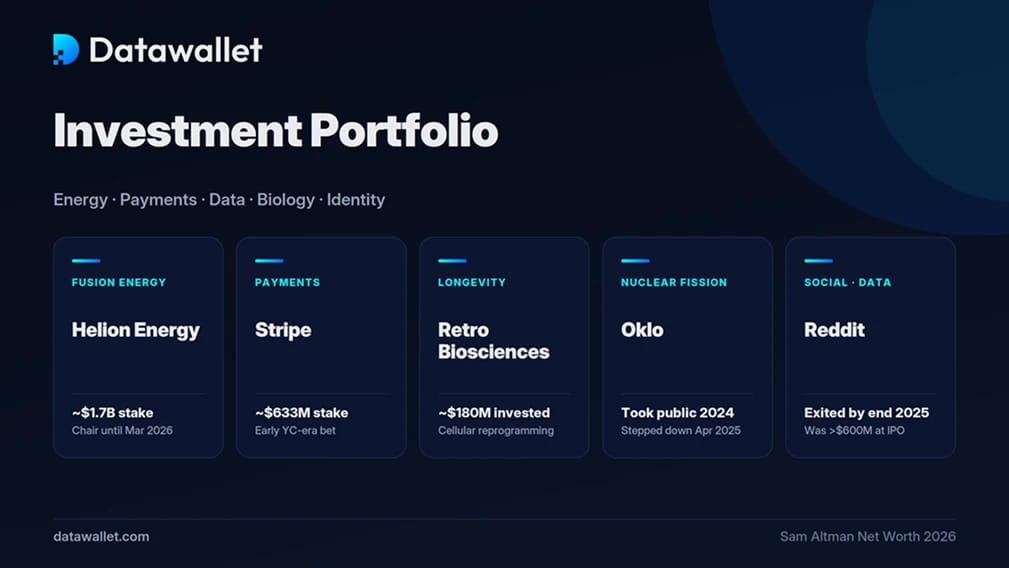
- Helion Energy: His largest position by far. A court filing in Musk's lawsuit valued his stake in the fusion startup at about $1.7 billion as of December 2025. He chaired Helion from 2015 and put a reported $375 million into its 2021 raise, then left its board in March 2026 as OpenAI weighed a larger supply deal.
- Stripe: Valued near $633 million in the same filing, from an early bet on the payments company that now handles transactions for much of the internet, including OpenAI.
- Retro Biosciences: Roughly $258 million in the longevity lab he has funded heavily, a mark that slipped when its May 2026 round priced at a $1.8 billion valuation, down from the $5 billion once floated.
- The rest of the book: Smaller stakes across hundreds of companies, including Cerebras, Lattice, Formation Bio, and the failed AI-device maker Humane, plus his funds Hydrazine Capital, Apollo Projects, and Altman Capital.
The imprecision is built in. Almost every position is private and illiquid, valued off the last funding round rather than a live price, so a single down-round like Retro's can swing the total by hundreds of millions. His fortune is a venture portfolio, and it behaves like one.
.webp)
Sam Altman's Investment Portfolio
Altman has been an active angel since 2010, and his portfolio reads like a map of the inputs AI consumes at scale: energy, payments, data, biology, and identity. He deploys through several vehicles, including Hydrazine Capital, Apollo Projects (started with his brothers Max and Jack), and Altman Capital, which Jack runs and in which Sam is a limited partner.
The positions that define the book today:
- Helion Energy: His clearest conviction bet. Beyond the roughly $1.7 billion stake, it sits where his two careers meet: Microsoft has agreed to buy Helion's power by 2028, and AI data centers need exactly the clean electricity fusion promises.
- Stripe: An early position that has compounded for over a decade as the payments firm scaled, now worth around $633 million.
- Retro Biosciences: A longevity bet he has personally championed, with a reported $180 million invested toward extending healthy lifespan through cellular reprogramming.
- Oklo: The nuclear fission company he took public in 2024 through his AltC SPAC. He chaired it until April 2025, when he stepped down to clear the way for possible OpenAI-Oklo deals.
- Reddit: Once one of his most valuable holdings, worth over $600 million at the 2024 IPO when he was among the largest shareholders. The same court filing shows he had exited by the end of 2025.
The proximity that makes the portfolio coherent has also drawn scrutiny. Several of these companies deal with OpenAI, and in the Musk litigation, lawyers pressed on whether his stakes in those counterparties created conflicts.
Altman testified that he recuses himself when such matters reach the board and that final terms are approved without him. The pattern holds across the book: a few concentrated, long-horizon bets on foundational technology, held through the years they take to mature.
What is World?
Altman's crypto footprint runs through one ambitious project. In 2019 he co-founded Worldcoin, now called World, with Alex Blania and Max Novendstern, built by the company Tools for Humanity. Altman chairs that company, Blania is CEO, and the venture has raised hundreds of millions from backers including Andreessen Horowitz and Bain Capital Crypto.
The premise follows from his day job. If AI makes it impossible to tell humans from machines online, World offers a way to prove personhood: users scan their iris on a device called the Orb, receive a privacy-preserving credential called World ID, and, where law allows, claim the WLD token.
The project rebranded from Worldcoin in October 2024 and runs on World Chain, an Ethereum layer-2 launched the same month. By late 2025 it reported about 33 million app users, roughly 15 million verified, with integrations across Visa, Tinder owner Match Group, Zoom, and DocuSign.
WLD has had a punishing ride. It peaked at $11.74 in March 2024, then spent two years far below that, bottoming under $0.30 in early 2026 amid biometric-privacy pushback from regulators in several countries. The 2026 turn came from an unexpected source: corporate treasuries.
Eightco Holdings disclosed more than 283 million WLD, about 8.4% of the circulating supply and the largest public stake, and traders began treating the token as a liquid proxy for the wave of AI mega-listings tied to Altman, Anthropic, and SpaceX.
Sam Altman Controversies
For a figure of his stature, Altman draws an unusual number of disputes about his conduct, several of which circle the same question his 2023 firing raised: whether his account of events holds up. The cases that bear most on his reputation, and by extension his businesses, are these:
- Conflicts of interest: Several of his largest holdings sell to or partner with OpenAI. A court filing in Musk's lawsuit detailed his stakes in nine OpenAI-linked companies, among them Helion, Stripe, and Cerebras, and ten state attorneys general asked the SEC to scrutinize OpenAI's disclosures ahead of any listing.
- The Musk lawsuit: Elon Musk sued Altman and Greg Brockman over OpenAI's for-profit conversion, alleging they abandoned the nonprofit mission to enrich themselves. On May 18, 2026, a jury found the claims barred by the statute of limitations and the judge dismissed the suit, though Musk has said he will appeal, so the merits were never decided.
- The fight over OpenAI's mission: The 2025 conversion to a for-profit benefit corporation drew criticism that Altman was steering a charity's assets toward private gain. Former employees, AI researchers, and Nobel laureates signed letters opposing it, and the deal closed only after the Delaware and California attorneys general secured control and safety concessions.
- World's privacy backlash: Regulators in several countries have suspended, banned, or fined his identity project over its iris-scanning, with actions across Kenya, Spain, Germany, Hong Kong, Brazil, Indonesia, and South Korea. A Kenyan court ordered locally collected biometric data deleted in 2025, and Brazil banned the project for paying citizens to be scanned.
- A family lawsuit: In January 2025, his sister Annie Altman filed a civil suit in Missouri alleging childhood sexual abuse. Altman has categorically denied the allegations, issued a joint denial with his mother and brothers, and is countersuing for defamation. The claims remain unproven, and the case is heading toward a 2027 trial after she refiled under Missouri's childhood sexual abuse statute.
None of these has dented his position so far. The Musk verdict went his way, the restructuring closed, and World keeps expanding even as bans pile up.
What ties them together is a recurring question about candor and self-dealing, the same one that briefly cost him his job in 2023, and it is the kind of reputational risk that tends to matter most when a company is heading for public markets and a CEO's credibility is part of the pitch.
Final Thoughts
Sam Altman's net worth resists a clean figure for a reason rare even among the founders we cover: he walked away from the equity that would have made him one of the richest people alive. A standard founding-CEO stake in a $730 billion company would run to tens of billions. He has a few billion instead, from bets placed before OpenAI mattered and around the industry it now leads.
The 2026 picture is a fortune growing on its own terms. Helion anchors it, Stripe and the wider venture book add ballast, and World gives him a crypto foothold that has finally found buyers after a brutal stretch. The Retro down-round and the Reddit exit are reminders that this is a private, illiquid portfolio that can reprice without warning.
.webp)